






Passive Components Blog
No Result
View All Result
  • Home
  • NewsFilter
    • All
    • Aerospace & Defence
    • Antenna
    • Applications
    • Automotive
    • Capacitors
    • Circuit Protection Devices
    • electro-mechanical news
    • Filters
    • Fuses
    • Inductors
    • Industrial
    • Integrated Passives
    • inter-connect news
    • Market & Supply Chain
    • Market Insights
    • Medical
    • Modelling and Simulation
    • New Materials & Supply
    • New Technologies
    • Non-linear Passives
    • Oscillators
    • Passive Sensors News
    • Resistors
    • RF & Microwave
    • Telecommunication
    • Weekly Digest

    Exxelia Publishes Micropen White Papers for Printed Electronics

    Stackpole Releases AlN High‑Power Thick Film Chip Resistors

    Samsung Q4 2025 Results: MLCC focus for AI, Server and Automotive

    Würth Elektronik Developed a Custom Transformer for Active Hand Orthosis

    Wk 4 Electronics Supply Chain Digest

    Capacitor Technology Dossier

    Panasonic High Precision Chip Resistors Bridge Gap Between Thin and Thick Technology

    ROHM Extends 2012 Shunt Resistors Power Rating up to 1.25 W

    January 2026 Interconnect, Passives and Electromechanical Components Market Insights

    Trending Tags

    • Ripple Current
    • RF
    • Leakage Current
    • Tantalum vs Ceramic
    • Snubber
    • Low ESR
    • Feedthrough
    • Derating
    • Dielectric Constant
    • New Products
    • Market Reports
  • VideoFilter
    • All
    • Antenna videos
    • Capacitor videos
    • Circuit Protection Video
    • Filter videos
    • Fuse videos
    • Inductor videos
    • Inter-Connect Video
    • Non-linear passives videos
    • Oscillator videos
    • Passive sensors videos
    • Resistor videos

    One‑Pulse Characterization of Nonlinear Power Inductors

    Thermistor Linearization Challenges

    Coaxial Connectors and How to Connect with PCB

    PCB Manufacturing, Test Methods, Quality and Reliability

    Transformer Behavior – Current Transfer and Hidden Feedback

    Choosing the Right Capacitor: The Importance of Accurate Measurements

    RF Inductors: Selection and Design Challenges for High-Frequency Circuits

    Transformer Safety IEC 61558 Standard

    3-Phase EMI Filter Design, Simulation, Calculation and Test

    Trending Tags

    • Capacitors explained
    • Inductors explained
    • Resistors explained
    • Filters explained
    • Application Video Guidelines
    • EMC
    • New Products
    • Ripple Current
    • Simulation
    • Tantalum vs Ceramic
  • Knowledge Blog
  • DossiersNew
  • Suppliers
    • Who is Who
  • PCNS
    • PCNS 2025
    • PCNS 2023
    • PCNS 2021
    • PCNS 2019
    • PCNS 2017
  • Events
  • Home
  • NewsFilter
    • All
    • Aerospace & Defence
    • Antenna
    • Applications
    • Automotive
    • Capacitors
    • Circuit Protection Devices
    • electro-mechanical news
    • Filters
    • Fuses
    • Inductors
    • Industrial
    • Integrated Passives
    • inter-connect news
    • Market & Supply Chain
    • Market Insights
    • Medical
    • Modelling and Simulation
    • New Materials & Supply
    • New Technologies
    • Non-linear Passives
    • Oscillators
    • Passive Sensors News
    • Resistors
    • RF & Microwave
    • Telecommunication
    • Weekly Digest

    Exxelia Publishes Micropen White Papers for Printed Electronics

    Stackpole Releases AlN High‑Power Thick Film Chip Resistors

    Samsung Q4 2025 Results: MLCC focus for AI, Server and Automotive

    Würth Elektronik Developed a Custom Transformer for Active Hand Orthosis

    Wk 4 Electronics Supply Chain Digest

    Capacitor Technology Dossier

    Panasonic High Precision Chip Resistors Bridge Gap Between Thin and Thick Technology

    ROHM Extends 2012 Shunt Resistors Power Rating up to 1.25 W

    January 2026 Interconnect, Passives and Electromechanical Components Market Insights

    Trending Tags

    • Ripple Current
    • RF
    • Leakage Current
    • Tantalum vs Ceramic
    • Snubber
    • Low ESR
    • Feedthrough
    • Derating
    • Dielectric Constant
    • New Products
    • Market Reports
  • VideoFilter
    • All
    • Antenna videos
    • Capacitor videos
    • Circuit Protection Video
    • Filter videos
    • Fuse videos
    • Inductor videos
    • Inter-Connect Video
    • Non-linear passives videos
    • Oscillator videos
    • Passive sensors videos
    • Resistor videos

    One‑Pulse Characterization of Nonlinear Power Inductors

    Thermistor Linearization Challenges

    Coaxial Connectors and How to Connect with PCB

    PCB Manufacturing, Test Methods, Quality and Reliability

    Transformer Behavior – Current Transfer and Hidden Feedback

    Choosing the Right Capacitor: The Importance of Accurate Measurements

    RF Inductors: Selection and Design Challenges for High-Frequency Circuits

    Transformer Safety IEC 61558 Standard

    3-Phase EMI Filter Design, Simulation, Calculation and Test

    Trending Tags

    • Capacitors explained
    • Inductors explained
    • Resistors explained
    • Filters explained
    • Application Video Guidelines
    • EMC
    • New Products
    • Ripple Current
    • Simulation
    • Tantalum vs Ceramic
  • Knowledge Blog
  • DossiersNew
  • Suppliers
    • Who is Who
  • PCNS
    • PCNS 2025
    • PCNS 2023
    • PCNS 2021
    • PCNS 2019
    • PCNS 2017
  • Events
No Result
View All Result
Passive Components Blog
No Result
View All Result

KEMET Offers High Performance Supercapacitors for Automotive

6.5.2024
Reading Time: 5 mins read
A A

KEMET, part of YAGEO Group, offers miniature EDLC supercapacitor that uses a unique aqueous electrolyte solution suitable for high reliability automotive applications.

KEMET is the only producer of supercapacitors using aqueous electrolyte solutions in the world.

RelatedPosts

Conductive Polymer Capacitor Market and Design‑In Guide to 2035

YAGEO Offers Automotive MOVs for EV and AI power

YAGEO Acquires 100% of Shares of Shibaura Electronics

Aqueous electrolytes are highly conductive, low environmental impact, non-toxic, and non-flammable, yielding strong performance and safety credentials. They also typically have greater resistance to moisture absorption than organic compounds, resulting in a longer lifetime with better stability.

The electrolyte of dilute sulfuric acid maintains high durability even under high temperature and high humidity conditions. A proprietary separator membrane has been developed from a high heat-resistant material whose pore diameter does not close even after extended use to improve the robustness at high temperatures.

Small-cell super capacitors from KEMET feature a high-strength vulcanized rubber bond to ensure against liquid electrolyte leakage. The cross-section shown in figure 1 explains how these supercapacitors are constructed, including the aqueous electrolyte, rubberized electrodes, and separator membrane.
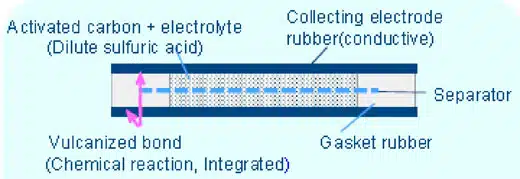
Figure 1: KEMET super capacitor construction

These features make KEMET supercapacitors an ideal choice for high reliability, harsh environments, including automotive applications. KEMET has released two supercapacitors that are qualified to an automotive testing protocol. These capacitors are manufactured in an ISO TS 16949 certified plant and are subjected to PPAP/PSW and change control.

Supercapacitors For Automotive

Modern advances in carbon-based materials enable porous electrodes to have a large surface area resulting in a high capacitance density and small physical form factor. Such high volumetric efficiency makes them an ideal candidate for replacing small secondary coin cell batteries. The ionic processes used to store energy in supercapacitors are also relatively fast. The device can fully charge within a few seconds, whereas a typical battery cell can take from ten minutes to several hours to fully charge. Moreover, there is no theoretical limit to a supercapacitor life cycle, whereas a lithium-ion secondary cell has a finite lifetime of about 500 cycles.

For all device types, the electrolyte properties determine the overall super capacitor terminal voltage. The voltage, when fully charged, is usually less than 3V. A conventional approach to constructing supercapacitors is comparable to that of a coin cell: lower and upper metal cases are joined by swaging to enclose the carbon electrodes and organic electrolyte.

With capabilities including high life cycle and fast charge and discharge times, small-cell supercapacitors can oust coin-type batteries from backup power duties in equipment ranging from IoT devices, smart meters, or medical devices to automotive electronics and industrial computing.

In automotive applications, the need for system backup during a power loss is becoming increasingly critical as connectivity and autonomous driving technology gain traction in modern vehicles. The automotive environment, however, is extraordinarily harsh with high temperature, humidity, and vibration. Traditional electrolytic capacitors and batteries will dry out over time under high-temperature conditions, resulting in increased series resistance and degradation of capacitance.

Specialized supercapacitors can be used in these situations to set design engineers free from the restrictions imposed by finite battery lifetimes. In addition, the supercapacitor’s benign open-circuit failure mode contrasts with typical short-circuit battery failures that may result in out gassing or ignition. As such, supercapacitors are the most cost-effective alternative to small backup batteries and can store enough energy to provide backup for durations ranging from a few seconds to several days, depending on the type of load and current demand.

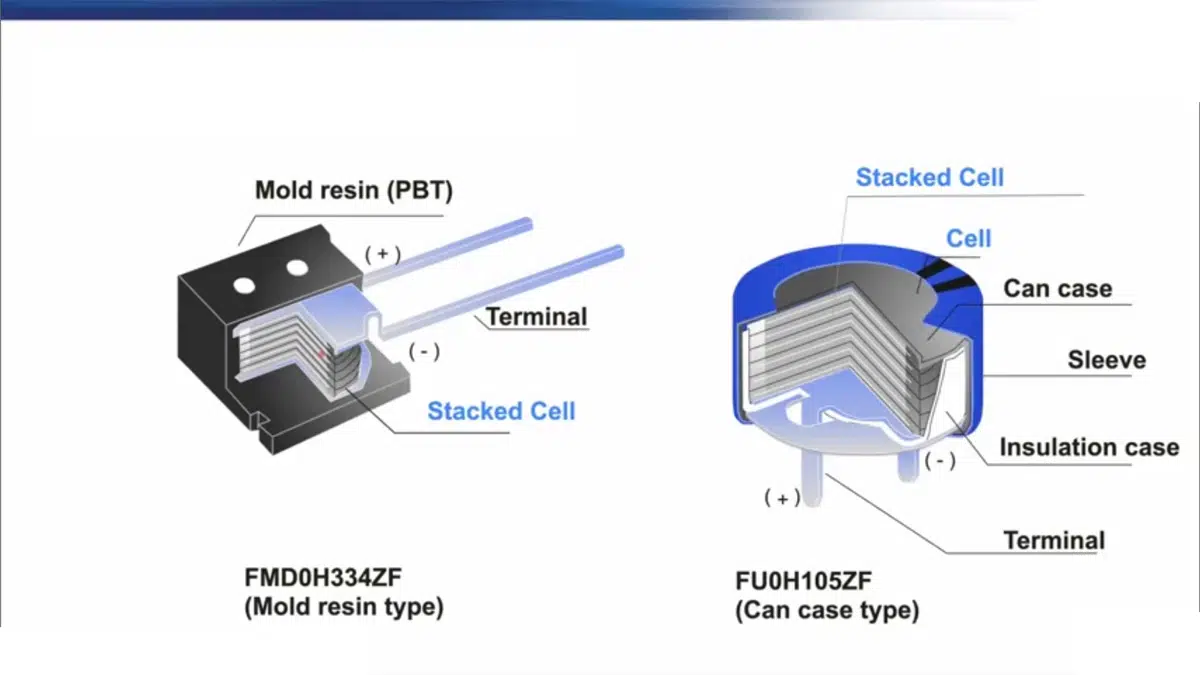
Figure 2. presents KEMET supercapacitor FMD0H334ZF, which offers 0.33F and 5.5V. This high-capacity supercapacitor is built with a resin-molded package that enables tape-and-reel packaging and is compatible with automated mounting. It is the world’s first supercapacitor that is rated for 1,000 hours in a high temperature and high humidity environment at 85°C-85% and is also qualified to an automotive testing protocol for an operating temperature range of -40°C to 85°C.

Figure 3. depicts another product, the FU0H105ZF supercapacitor, that offers 1F at 5.5V with the outer packaging built from a sealed metal can. This product is qualified to an automotive testing protocol and is a long-life device with operation exceeding 4,000 hours at 85°C. This harsh environment lifetime is equivalent to 10 years of life when referring to the mission profile near the dashboard of an automobile.
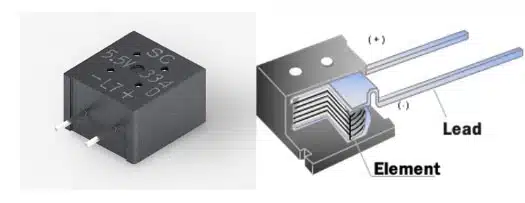
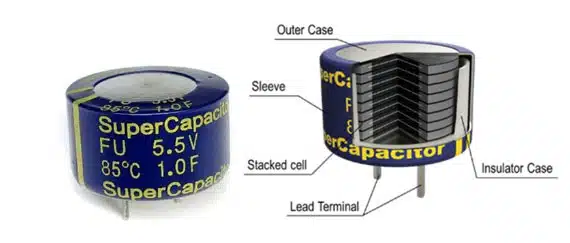
 Figure 2. KEMET FMD0H334ZF supercapacitor and its construction
Figure 3. KEMET FMU0H334ZF supercapacitor and its construction

Conclusion

Supercapacitors offer a high-performance alternative to batteries in many backup-power applications, delivering far greater cycle life and avoiding any need for designers to worry about battery replacement or recharging.

The latest supercapacitors using KEMET aqueous electrolyte are cutting-edge energy storage devices featuring high voltage, long life, and environmental resistance required by the automotive market. KEMET new supercapacitors are ideal for use in automotive, medical, aerospace, industry, and other areas as required for high-reliability performance.

Related

Source: KEMET

Recent Posts

Exxelia Publishes Micropen White Papers for Printed Electronics

26.1.2026
15

Stackpole Releases AlN High‑Power Thick Film Chip Resistors

26.1.2026
7

Samsung Q4 2025 Results: MLCC focus for AI, Server and Automotive

26.1.2026
7

Würth Elektronik Developed a Custom Transformer for Active Hand Orthosis

26.1.2026
7

Capacitor Technology Dossier

26.1.2026
43

Panasonic High Precision Chip Resistors Bridge Gap Between Thin and Thick Technology

23.1.2026
20

ROHM Extends 2012 Shunt Resistors Power Rating up to 1.25 W

23.1.2026
13

Passive Components in Quantum Computing

22.1.2026
81

0603 Automotive Chip Varistors as TVS Diode Replacements, TDK Tech Note

21.1.2026
24

Upcoming Events

Jan 27
16:00 - 17:00 CET

Simplifying Vehicle Development with Automotive Ethernet and Zonal Smart Switch Technologies

Feb 24
16:00 - 17:00 CET

Designing Qi2 Wireless Power Systems: Practical Development and EMC Optimization

Mar 3
16:00 - 17:00 CET

Cybersecurity at the Eleventh Hour – from RED to CRA – Information and Discussion

View Calendar

Popular Posts

  • Buck Converter Design and Calculation

    0 shares
    Share 0 Tweet 0
  • Boost Converter Design and Calculation

    0 shares
    Share 0 Tweet 0
  • LLC Resonant Converter Design and Calculation

    0 shares
    Share 0 Tweet 0
  • Flyback Converter Design and Calculation

    0 shares
    Share 0 Tweet 0
  • Ripple Current and its Effects on the Performance of Capacitors

    3 shares
    Share 3 Tweet 0
  • How Metal Prices Are Driving Passive Component Price Hikes

    0 shares
    Share 0 Tweet 0
  • MLCC and Ceramic Capacitors

    0 shares
    Share 0 Tweet 0
  • What is a Dielectric Constant and DF of Plastic Materials?

    4 shares
    Share 4 Tweet 0
  • Dual Active Bridge (DAB) Topology

    0 shares
    Share 0 Tweet 0
  • Degradation of Capacitors and its Failure Mechanisms

    0 shares
    Share 0 Tweet 0

Newsletter Subscription


Passive Components Blog

© EPCI - Leading Passive Components Educational and Information Site

  • Home
  • Privacy Policy
  • EPCI Membership & Advertisement
  • About

No Result
View All Result
  • Home
  • Knowledge Blog
  • PCNS

© EPCI - Leading Passive Components Educational and Information Site

This website uses cookies. By continuing to use this website you are giving consent to cookies being used. Visit our Privacy and Cookie Policy.
Go to mobile version