












Passive Components Blog
No Result
View All Result
  • Home
  • NewsFilter
    • All
    • Aerospace & Defence
    • Antenna
    • Applications
    • Automotive
    • Capacitors
    • Circuit Protection Devices
    • electro-mechanical news
    • Filters
    • Fuses
    • Inductors
    • Industrial
    • Integrated Passives
    • inter-connect news
    • Market & Supply Chain
    • Market Insights
    • Medical
    • Modelling and Simulation
    • New Materials & Supply
    • New Technologies
    • Non-linear Passives
    • Oscillators
    • Passive Sensors News
    • Resistors
    • RF & Microwave
    • Telecommunication
    • Weekly Digest

    VINATech Targets AI Data Center Supercapacitor Boom

    Littelfuse NANO2 415 SMD Fuse Wins 2025 Product of the Year

    TDK Introduces 350V Safety Film Capacitors for Compact EMI Suppression

    Molex Extends Cardinal Multi‑Port Coax Assemblies to 145 GHz for AI and 6G Test

    Samsung Launches Worlds First Automotive 47uF 4V MLCC in 0805 Size

    Würth Elektronik Present in IEEE APEC

    Samsung Three Pillars MLCC Strategy for AI Hardware Topology

    Bourns Releases High Clearance Transformer for Isolated DC/DC Supplies

    KYOCERA AVX Extends Ultra‑Broadband RF Capacitor Series

    Trending Tags

    • Ripple Current
    • RF
    • Leakage Current
    • Tantalum vs Ceramic
    • Snubber
    • Low ESR
    • Feedthrough
    • Derating
    • Dielectric Constant
    • New Products
    • Market Reports
  • VideoFilter
    • All
    • Antenna videos
    • Capacitor videos
    • Circuit Protection Video
    • Filter videos
    • Fuse videos
    • Inductor videos
    • Inter-Connect Video
    • Non-linear passives videos
    • Oscillator videos
    • Passive sensors videos
    • Resistor videos

    2026 Power Magnetics Design Trends: Flyback, DAB and Planar

    Enabling Software‑Defined Vehicle Architectures: Automotive Ethernet and Zonal Smart Power

    Calculating Resistance Value of a Flyback RC Snubber 

    One‑Pulse Characterization of Nonlinear Power Inductors

    Thermistor Linearization Challenges

    Coaxial Connectors and How to Connect with PCB

    PCB Manufacturing, Test Methods, Quality and Reliability

    Transformer Behavior – Current Transfer and Hidden Feedback

    Choosing the Right Capacitor: The Importance of Accurate Measurements

    Trending Tags

    • Capacitors explained
    • Inductors explained
    • Resistors explained
    • Filters explained
    • Application Video Guidelines
    • EMC
    • New Products
    • Ripple Current
    • Simulation
    • Tantalum vs Ceramic
  • Knowledge Blog
  • DossiersNew
  • Suppliers
    • Who is Who
  • PCNS
    • PCNS 2025
    • PCNS 2023
    • PCNS 2021
    • PCNS 2019
    • PCNS 2017
  • Events
  • Home
  • NewsFilter
    • All
    • Aerospace & Defence
    • Antenna
    • Applications
    • Automotive
    • Capacitors
    • Circuit Protection Devices
    • electro-mechanical news
    • Filters
    • Fuses
    • Inductors
    • Industrial
    • Integrated Passives
    • inter-connect news
    • Market & Supply Chain
    • Market Insights
    • Medical
    • Modelling and Simulation
    • New Materials & Supply
    • New Technologies
    • Non-linear Passives
    • Oscillators
    • Passive Sensors News
    • Resistors
    • RF & Microwave
    • Telecommunication
    • Weekly Digest

    VINATech Targets AI Data Center Supercapacitor Boom

    Littelfuse NANO2 415 SMD Fuse Wins 2025 Product of the Year

    TDK Introduces 350V Safety Film Capacitors for Compact EMI Suppression

    Molex Extends Cardinal Multi‑Port Coax Assemblies to 145 GHz for AI and 6G Test

    Samsung Launches Worlds First Automotive 47uF 4V MLCC in 0805 Size

    Würth Elektronik Present in IEEE APEC

    Samsung Three Pillars MLCC Strategy for AI Hardware Topology

    Bourns Releases High Clearance Transformer for Isolated DC/DC Supplies

    KYOCERA AVX Extends Ultra‑Broadband RF Capacitor Series

    Trending Tags

    • Ripple Current
    • RF
    • Leakage Current
    • Tantalum vs Ceramic
    • Snubber
    • Low ESR
    • Feedthrough
    • Derating
    • Dielectric Constant
    • New Products
    • Market Reports
  • VideoFilter
    • All
    • Antenna videos
    • Capacitor videos
    • Circuit Protection Video
    • Filter videos
    • Fuse videos
    • Inductor videos
    • Inter-Connect Video
    • Non-linear passives videos
    • Oscillator videos
    • Passive sensors videos
    • Resistor videos

    2026 Power Magnetics Design Trends: Flyback, DAB and Planar

    Enabling Software‑Defined Vehicle Architectures: Automotive Ethernet and Zonal Smart Power

    Calculating Resistance Value of a Flyback RC Snubber 

    One‑Pulse Characterization of Nonlinear Power Inductors

    Thermistor Linearization Challenges

    Coaxial Connectors and How to Connect with PCB

    PCB Manufacturing, Test Methods, Quality and Reliability

    Transformer Behavior – Current Transfer and Hidden Feedback

    Choosing the Right Capacitor: The Importance of Accurate Measurements

    Trending Tags

    • Capacitors explained
    • Inductors explained
    • Resistors explained
    • Filters explained
    • Application Video Guidelines
    • EMC
    • New Products
    • Ripple Current
    • Simulation
    • Tantalum vs Ceramic
  • Knowledge Blog
  • DossiersNew
  • Suppliers
    • Who is Who
  • PCNS
    • PCNS 2025
    • PCNS 2023
    • PCNS 2021
    • PCNS 2019
    • PCNS 2017
  • Events
No Result
View All Result
Passive Components Blog
No Result
View All Result

Littelfuse Releases Residual Current Monitor Series for High Current Charging Stations

24.10.2024
Reading Time: 3 mins read
A A

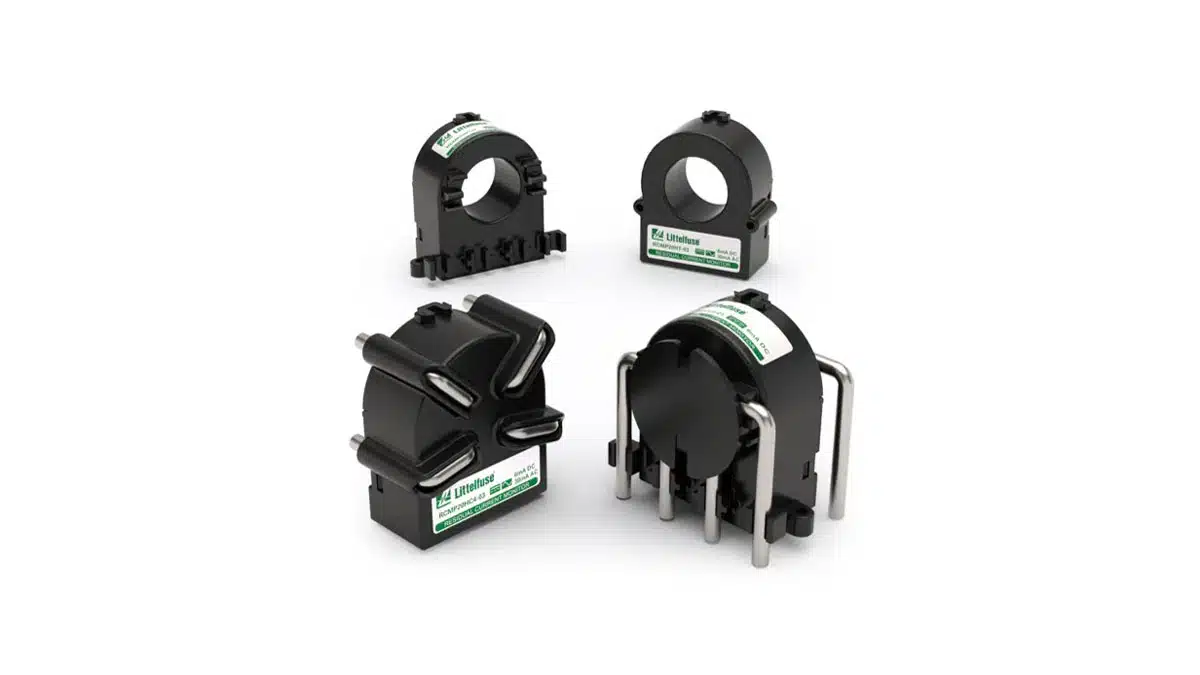
Littelfuse, Inc., an industrial technology manufacturing company empowering a sustainable, connected, and safer world, announced the RCMP20 residual current monitor series for high current Mode 2 and Mode 3 EV charging stations.

The RCMP20 Series sets a new standard in electric vehicle (EV) charging safety, offering superior performance and flexibility in a compact design while supporting higher charging currents than other solutions on the market. Featuring the largest current transformer (CT) aperture in the industry, this new line of products expands the Littelfuse EV infrastructure portfolio and enhances electrical safety in EV charging applications. View the video.

RelatedPosts

Littelfuse NANO2 415 SMD Fuse Wins 2025 Product of the Year

Littelfuse Unveils Ultra-Low-Power TMR Magnetic Switches

Littelfuse Introduces Automotive Current Sensors for EV Battery, Motor, and Safety Systems

The RCMP20 Residual Current Monitor Series incorporates the following key features and benefits:

  • Largest Current Transformer Aperture: The RCMP20 Series offers the largest current sense transformer (CT) aperture available, supporting higher AC charging currents, which is critical for modern EV chargers that demand high-performance capabilities.
  • Enhanced Thermal Performance: Integrated conductors with higher cross-sectional areas provide better thermal management, reducing printed circuit board (PCB) temperature rise and allowing for a more compact design without compromising performance.
  • High EMI Resilience: The modules are designed to resist electromagnetic interference (EMI), minimizing false circuit trips and improving overall charging station reliability.
  • Flexible Mounting Options: With vertical and horizontal mounting options and 2 to 4 integrated conductors, the RCMP20 Series allows design engineers to optimize space utilization and adapt to various charger configurations.
  • Compact Design with PCB Integration: The reduced footprint within the EV chargers allows for smaller, more compact designs, while still meeting safety code requirements. The integrated PCB with optional conductors streamlines installation, reduces component count, and simplifies assembly.

The RCMP20 Series is ideal for the following applications:

  • EV Infrastructure: As electric vehicle adoption grows, robust EV infrastructure is critical. The RCMP20 Series ensures safe, efficient, and reliable charging station operation.
  • IEC Mode 2 and Mode 3 AC Charging Stations: The RCMP20 Series covers a wide range of charging needs, offering protection for both portable chargers and high-power permanent stations.
  • Ground Fault Detection: It continuously monitors for AC and DC ground fault currents, ensuring compliance with electrical safety standards and preventing shock risks.

How it works

Mode 2 and Mode 3 EV charging stations differ mainly in how they handle fault currents, particularly AC and DC currents, and the level of protection they provide against electrical hazards.

  • Mode 2 charging stations are typically used with earlier portable chargers and high-powered stations. These stations may not have built-in protection against both AC and DC fault currents, which can create safety risks. The RCMP20-03 module helps enhance safety by monitoring both AC and DC residual currents. When a ground fault, leakage, or residual current exceeds the threshold, the RCMP20-03 triggers a circuit shutdown, preventing electrical hazards. It is compliant with IEC 62752 standards for Mode 2 chargers.
  • Mode 3 charging stations are used for more permanent and higher-powered charging setups. While they often have Type A RCDs (Residual Current Devices), these devices can miss dangerous DC currents, leaving users vulnerable. The RCMP20-01 module is specifically designed to detect DC residual currents that Type A RCDs overlook. When DC fault currents exceed the threshold, it signals a trip to a connected switching device, ensuring user protection and compliance with relevant safety standards.

In summary, Mode 2 systems with the RCMP20-03 monitor AC and DC faults to enhance protection for earlier or portable charging setups. In contrast, Mode 3 systems with the RCMP20-01 focus on detecting DC faults that standard RCDs miss, improving safety for permanent charging stations.

Related

Source: Littelfuse

Recent Posts

Würth Elektronik Present in IEEE APEC

24.2.2026
16

Bourns Releases High Clearance Transformer for Isolated DC/DC Supplies

24.2.2026
15

Bourns Extends Multilayer Chip Inductors Offer for RF and Wireless Designs

20.2.2026
17

Würth Elektronik Component Data Live in Accuris

19.2.2026
18

Coilcraft Releases Automotive Common Mode Chokes

19.2.2026
23

2026 Power Magnetics Design Trends: Flyback, DAB and Planar

13.2.2026
78

Vishay Releases Compact 0806 Low‑DCR Power Inductor

5.2.2026
38

Murata Publishes Power Delivery Guide for AI Servers

4.2.2026
135

Selecting Current Sense Transformers with Würth Elektronik REDEXPERT

3.2.2026
39

Upcoming Events

Mar 3
16:00 - 17:00 CET

Cybersecurity at the Eleventh Hour – from RED to CRA – Information and Discussion

Mar 21
All day

PSMA Capacitor Workshop 2026

Apr 21
16:00 - 17:00 CEST

Heatsink Solutions: Thermal Management in electronic devices

View Calendar

Popular Posts

  • Buck Converter Design and Calculation

    0 shares
    Share 0 Tweet 0
  • Boost Converter Design and Calculation

    0 shares
    Share 0 Tweet 0
  • Flyback Converter Design and Calculation

    0 shares
    Share 0 Tweet 0
  • LLC Resonant Converter Design and Calculation

    0 shares
    Share 0 Tweet 0
  • MLCC Manufacturers Consider Price Increase as AI Demand Outpaces Supply

    0 shares
    Share 0 Tweet 0
  • Dual Active Bridge (DAB) Topology

    0 shares
    Share 0 Tweet 0
  • Ripple Current and its Effects on the Performance of Capacitors

    3 shares
    Share 3 Tweet 0
  • What is a Dielectric Constant and DF of Plastic Materials?

    4 shares
    Share 4 Tweet 0
  • MLCC and Ceramic Capacitors

    0 shares
    Share 0 Tweet 0
  • MLCC Case Sizes Standards Explained

    0 shares
    Share 0 Tweet 0

Newsletter Subscription


Passive Components Blog

© EPCI - Leading Passive Components Educational and Information Site

  • Home
  • Privacy Policy
  • EPCI Membership & Advertisement
  • About

No Result
View All Result
  • Home
  • Knowledge Blog
  • PCNS

© EPCI - Leading Passive Components Educational and Information Site

This website uses cookies. By continuing to use this website you are giving consent to cookies being used. Visit our Privacy and Cookie Policy.
Go to mobile version