




Passive Components Blog
No Result
View All Result
  • Home
  • NewsFilter
    • All
    • Aerospace & Defence
    • Antenna
    • Applications
    • Automotive
    • Capacitors
    • Circuit Protection Devices
    • electro-mechanical news
    • Filters
    • Fuses
    • Inductors
    • Industrial
    • Integrated Passives
    • inter-connect news
    • Market & Supply Chain
    • Market Insights
    • Medical
    • Modelling and Simulation
    • New Materials & Supply
    • New Technologies
    • Non-linear Passives
    • Oscillators
    • Passive Sensors News
    • Resistors
    • RF & Microwave
    • Telecommunication
    • Weekly Digest

    Miniaturization of Tantalum Capacitors: Structural Limit Under Constant Rating

    Heatsink Design and Thermal Interface Materials for Reliable Electronics

    Murata New MLCC Bulk Case Packaging Cuts Packaging Material by 99%

    Wk 17 Electronics Supply Chain Digest

    Exxelia Introduces SMD High‑Voltage Mica Capacitors

    Modelithics Releases COMPLETE v26.1 for Keysight ADS

    April 2026 Interconnect, Passives and Electromechanical Components Market Insights

    SPICE Simulation of Non-Linear Resistors: Vishay’s Thermistor and PPTC Modelling Ecosystem

    KYOCERA AVX Introduces Traction‑Grade DC Link Film Capacitors

    Trending Tags

    • Ripple Current
    • RF
    • Leakage Current
    • Tantalum vs Ceramic
    • Snubber
    • Low ESR
    • Feedthrough
    • Derating
    • Dielectric Constant
    • New Products
    • Market Reports
  • VideoFilter
    • All
    • Antenna videos
    • Capacitor videos
    • Circuit Protection Video
    • Filter videos
    • Fuse videos
    • Inductor videos
    • Inter-Connect Video
    • Non-linear passives videos
    • Oscillator videos
    • Passive sensors videos
    • Resistor videos

    Why Power Inductors Use a Ferrite Core With an Air Gap

    Transformer-Based Power-Line Harvester Magnetic Design

    Thermal Modeling of Magnetics

    Standard vs Planar LLC transformers Comparison for Battery Chargers

    How Modern Tools Model Magnetic Components for Power Electronics

    Advanced Loss Modeling for Planar Magnetics in the Frenetic Planar Tool

    2026 Power Magnetics Design Trends: Flyback, DAB and Planar

    Enabling Software‑Defined Vehicle Architectures: Automotive Ethernet and Zonal Smart Power

    Calculating Resistance Value of a Flyback RC Snubber 

    Trending Tags

    • Capacitors explained
    • Inductors explained
    • Resistors explained
    • Filters explained
    • Application Video Guidelines
    • EMC
    • New Products
    • Ripple Current
    • Simulation
    • Tantalum vs Ceramic
  • Knowledge Blog
  • DossiersNew
  • Suppliers
    • Who is Who
  • PCNS
    • PCNS 2025
    • PCNS 2023
    • PCNS 2021
    • PCNS 2019
    • PCNS 2017
  • Events
  • Home
  • NewsFilter
    • All
    • Aerospace & Defence
    • Antenna
    • Applications
    • Automotive
    • Capacitors
    • Circuit Protection Devices
    • electro-mechanical news
    • Filters
    • Fuses
    • Inductors
    • Industrial
    • Integrated Passives
    • inter-connect news
    • Market & Supply Chain
    • Market Insights
    • Medical
    • Modelling and Simulation
    • New Materials & Supply
    • New Technologies
    • Non-linear Passives
    • Oscillators
    • Passive Sensors News
    • Resistors
    • RF & Microwave
    • Telecommunication
    • Weekly Digest

    Miniaturization of Tantalum Capacitors: Structural Limit Under Constant Rating

    Heatsink Design and Thermal Interface Materials for Reliable Electronics

    Murata New MLCC Bulk Case Packaging Cuts Packaging Material by 99%

    Wk 17 Electronics Supply Chain Digest

    Exxelia Introduces SMD High‑Voltage Mica Capacitors

    Modelithics Releases COMPLETE v26.1 for Keysight ADS

    April 2026 Interconnect, Passives and Electromechanical Components Market Insights

    SPICE Simulation of Non-Linear Resistors: Vishay’s Thermistor and PPTC Modelling Ecosystem

    KYOCERA AVX Introduces Traction‑Grade DC Link Film Capacitors

    Trending Tags

    • Ripple Current
    • RF
    • Leakage Current
    • Tantalum vs Ceramic
    • Snubber
    • Low ESR
    • Feedthrough
    • Derating
    • Dielectric Constant
    • New Products
    • Market Reports
  • VideoFilter
    • All
    • Antenna videos
    • Capacitor videos
    • Circuit Protection Video
    • Filter videos
    • Fuse videos
    • Inductor videos
    • Inter-Connect Video
    • Non-linear passives videos
    • Oscillator videos
    • Passive sensors videos
    • Resistor videos

    Why Power Inductors Use a Ferrite Core With an Air Gap

    Transformer-Based Power-Line Harvester Magnetic Design

    Thermal Modeling of Magnetics

    Standard vs Planar LLC transformers Comparison for Battery Chargers

    How Modern Tools Model Magnetic Components for Power Electronics

    Advanced Loss Modeling for Planar Magnetics in the Frenetic Planar Tool

    2026 Power Magnetics Design Trends: Flyback, DAB and Planar

    Enabling Software‑Defined Vehicle Architectures: Automotive Ethernet and Zonal Smart Power

    Calculating Resistance Value of a Flyback RC Snubber 

    Trending Tags

    • Capacitors explained
    • Inductors explained
    • Resistors explained
    • Filters explained
    • Application Video Guidelines
    • EMC
    • New Products
    • Ripple Current
    • Simulation
    • Tantalum vs Ceramic
  • Knowledge Blog
  • DossiersNew
  • Suppliers
    • Who is Who
  • PCNS
    • PCNS 2025
    • PCNS 2023
    • PCNS 2021
    • PCNS 2019
    • PCNS 2017
  • Events
No Result
View All Result
Passive Components Blog
No Result
View All Result

VINATech Targets AI Data Center Supercapacitor Boom

26.2.2026
Reading Time: 5 mins read
A A

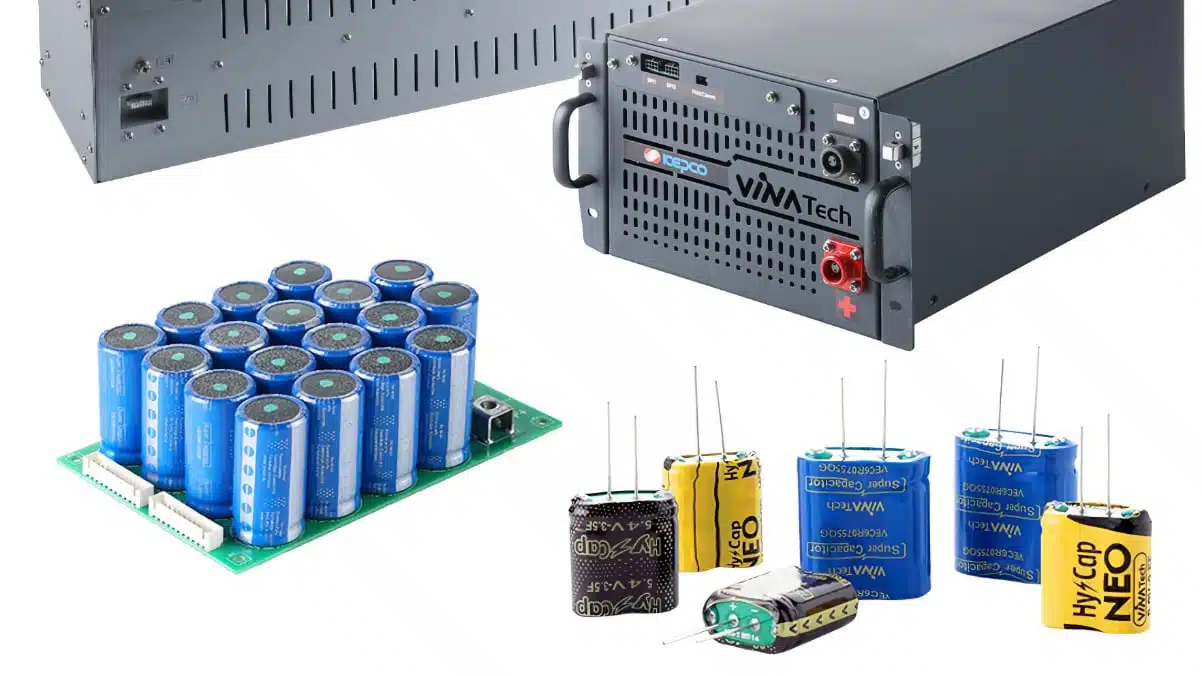
VINATech is sharpening its focus on AI data centers and large-scale energy infrastructure as it sets a bold target of reaching 1 trillion KRW in annual sales within the next five years.

The company plans to leverage its supercapacitor technology and global manufacturing footprint to position itself as a key power solutions provider for next‑generation digital and hydrogen mobility ecosystems.

RelatedPosts

VINATech Offers Smallest 100µF Al-Hybrid Capacitor

VINATech Supercapacitors Enhance Automotive Safety with Reliable E-Latch Emergency Power

VinaTech Supercapacitors: Enhancing Smart Meter Reliability and Efficiency

Supercapacitors as a Core Enabler for AI and Edge Infrastructure

Supercapacitors are increasingly being adopted wherever ultra‑fast power delivery, high cycle life and reliability are more critical than pure energy density. In comparison to secondary batteries, supercaps store roughly one hundredth of the energy but can deliver around 100 times higher power, making them ideal for peak‑power support and protection functions. Typical use cases range from auxiliary power units in electric and hydrogen vehicles to backup power for SSDs, where they protect data during sudden power interruptions.

VINATech has built its reputation as a dedicated supercapacitor specialist, becoming the first company worldwide to mass‑produce 3.0 V supercapacitors back in 2010. This early move into higher‑voltage devices underpins the company’s current strategy to serve demanding applications such as AI data centers, smart grids, industrial machinery and ultra‑fast charging infrastructure.

Strategic Focus on AI Data Centers and Fuel Cell Power

VINATech’s current growth narrative is tightly linked to the emergence of solid oxide fuel cells as power sources for energy‑hungry AI data centers. These systems require fast, robust power buffering to stabilize the grid side, a role in which supercapacitors are particularly well suited. Management expects that accelerating deployment of AI compute, combined with broader smart grid investment, could make the coming decade a “Supercap era” in which VINATech aims to play a leading role.

A cornerstone of this strategy is the long‑term supply agreement signed with Bloom Energy, under which VINATech will provide supercapacitor solutions for fuel cell systems powering AI data centers through 2027. In parallel, the company plans to move up the value chain: from today’s cell‑level sales to fully modular products in the first half of next year, and then to integrated supercapacitor packages including in‑house PCBs and software in the second half. The objective is to transform supercaps from commodity cells into high‑value modules and systems, with an internal estimate of up to 20‑fold higher added value compared to bare cells.

Global Manufacturing Expansion and Digitalized Production

To support anticipated demand, VINATech is restructuring and scaling its overseas production base, particularly in Vietnam. Current capacity stands at around 30 million units per month across three factories near Hanoi. The company is now developing a large, 172,000 m² site in Hưng Yên Province, scheduled for completion by 2028, that will consolidate these facilities into a single manufacturing campus. This consolidation is expected to increase overall supercapacitor capacity roughly fivefold while enabling a shift in mix from small‑sized to mid‑ and large‑sized products, improving profitability and addressing system‑level applications.

Digitalization is an integral part of the new manufacturing strategy. VINATech plans to implement an AI‑driven monitoring and control environment that tracks production parameters such as line temperature, humidity and individual machine yield in real time. This data‑centric approach is intended to support higher quality, better traceability and more efficient process optimization. While headquarters continues to focus on R&D and new product prototyping, VINATech is also preparing a new factory in India within the next three years to further diversify and regionalize its supply chain.

Building Synergy Between Supercaps and Hydrogen Fuel Cells

Beyond data center and grid applications, VINATech is actively integrating its supercapacitor technology with hydrogen fuel cell platforms. Its Wanju site in North Jeolla Province serves as a hydrogen technology hub, where the company produces carbon supports used in fuel cell stacks. These supports provide a stable framework for platinum catalysts, helping prevent catalyst wash‑out and maintain long‑term performance.

VINATech is the exclusive supplier of these carbon supports for Hyundai Motor Company’s hydrogen fuel cell vehicles, embedding the company in one of the most advanced fuel‑cell mobility ecosystems globally. Looking ahead, VINATech is developing hybrid powertrain architectures that combine supercapacitors with hydrogen fuel cells to improve fuel efficiency, transient response and overall system durability. By linking the membrane electrode assembly (MEA) plant in Wanju with its planned high‑volume supercap facility, the company aims to create a vertically integrated platform for hydrogen‑electric power solutions.

Financial Performance and Regional Recognition

VINATech’s strategic moves are supported by an improving financial profile and growing recognition in its domestic market. The company has been named an “Outstanding Regional Company for the MZ Generation” by the Ministry of Trade, Industry and Energy and the Korea Institute for Advancement of Technology, underscoring its appeal as an employer and innovation leader for younger professionals.

Source

This article is based on a manufacturer press release and related official information from VINATech and affiliated media, edited and structured for added context and clarity for readers in the energy storage and power electronics industry.


References

  1. VINATech News – Target AI Data Center and Sales by 2030 Trillion
  2. VINATech Product Overview – Supercapacitor Cells
  3. Original Korean Article (Domin Ilbo)

Related

Recent Posts

Miniaturization of Tantalum Capacitors: Structural Limit Under Constant Rating

27.4.2026
19

Murata New MLCC Bulk Case Packaging Cuts Packaging Material by 99%

27.4.2026
27

Exxelia Introduces SMD High‑Voltage Mica Capacitors

28.4.2026
11

Modelithics Releases COMPLETE v26.1 for Keysight ADS

23.4.2026
11

April 2026 Interconnect, Passives and Electromechanical Components Market Insights

22.4.2026
57

KYOCERA AVX Introduces Traction‑Grade DC Link Film Capacitors

21.4.2026
41

When More Capacitance Hurts Reliability: The Role of the Metallic Skeleton in Tantalum Anodes

20.4.2026
43

YAGEO Introduces High‑Current Y2/X1 Film Capacitors for Wide-bandgap Power Systems

17.4.2026
34

Amphenol Explanded Liquid Cooling Connectors for AI, ESS and EV Systems

17.4.2026
20

Upcoming Events

Apr 29
10:00 - 11:00 CDT

SEPIC Design Done Right

Apr 30
10:00 - 11:00 CDT

Programming Embedded Systems

May 5
16:00 - 17:00 CEST

Understanding and Selecting Capacitors – Fundamentals, Technologies and Latest Trends

View Calendar

Popular Posts

  • Buck Converter Design and Calculation

    0 shares
    Share 0 Tweet 0
  • Boost Converter Design and Calculation

    0 shares
    Share 0 Tweet 0
  • Flyback Converter Design and Calculation

    0 shares
    Share 0 Tweet 0
  • LLC Resonant Converter Design and Calculation

    0 shares
    Share 0 Tweet 0
  • MLCC and Ceramic Capacitors

    0 shares
    Share 0 Tweet 0
  • Dual Active Bridge (DAB) Topology

    0 shares
    Share 0 Tweet 0
  • Capacitor Charging and Discharging

    0 shares
    Share 0 Tweet 0
  • What Electronics Engineer Needs to Know About Passive Low Pass Filters

    0 shares
    Share 0 Tweet 0
  • MLCC Case Sizes Standards Explained

    0 shares
    Share 0 Tweet 0
  • Ripple Current and its Effects on the Performance of Capacitors

    3 shares
    Share 3 Tweet 0

Newsletter Subscription


Passive Components Blog

© EPCI - Leading Passive Components Educational and Information Site

  • Home
  • Privacy Policy
  • EPCI Membership & Advertisement
  • About

No Result
View All Result
  • Home
  • Knowledge Blog
  • PCNS

© EPCI - Leading Passive Components Educational and Information Site

This website uses cookies. By continuing to use this website you are giving consent to cookies being used. Visit our Privacy and Cookie Policy.
Go to mobile version