



Passive Components Blog
No Result
View All Result
  • Home
  • NewsFilter
    • All
    • Aerospace & Defence
    • Antenna
    • Applications
    • Automotive
    • Capacitors
    • Circuit Protection Devices
    • electro-mechanical news
    • Filters
    • Fuses
    • Inductors
    • Industrial
    • Integrated Passives
    • inter-connect news
    • Market & Supply Chain
    • Market Insights
    • Medical
    • Modelling and Simulation
    • New Materials & Supply
    • New Technologies
    • Non-linear Passives
    • Oscillators
    • Passive Sensors News
    • Resistors
    • RF & Microwave
    • Telecommunication
    • Weekly Digest

    2025 Annual Capacitor Technology Dossier

    Panasonic High Precision Chip Resistors Bridge Gap Between Thin and Thick Technology

    ROHM Extends 2012 Shunt Resistors Power Rating up to 1.25 W

    January 2026 Interconnect, Passives and Electromechanical Components Market Insights

    Passive Components in Quantum Computing

    0603 Automotive Chip Varistors as TVS Diode Replacements, TDK Tech Note

    Miniaturization of MLCCs and Electrolytics, KAVX Tech Chat

    Exxelia Offers Custom Naval Transformers and Inductors

    Researchers Demonstrated 32nm Aluminum Vacuum Gap Capacitor

    Trending Tags

    • Ripple Current
    • RF
    • Leakage Current
    • Tantalum vs Ceramic
    • Snubber
    • Low ESR
    • Feedthrough
    • Derating
    • Dielectric Constant
    • New Products
    • Market Reports
  • VideoFilter
    • All
    • Antenna videos
    • Capacitor videos
    • Circuit Protection Video
    • Filter videos
    • Fuse videos
    • Inductor videos
    • Inter-Connect Video
    • Non-linear passives videos
    • Oscillator videos
    • Passive sensors videos
    • Resistor videos

    One‑Pulse Characterization of Nonlinear Power Inductors

    Thermistor Linearization Challenges

    Coaxial Connectors and How to Connect with PCB

    PCB Manufacturing, Test Methods, Quality and Reliability

    Transformer Behavior – Current Transfer and Hidden Feedback

    Choosing the Right Capacitor: The Importance of Accurate Measurements

    RF Inductors: Selection and Design Challenges for High-Frequency Circuits

    Transformer Safety IEC 61558 Standard

    3-Phase EMI Filter Design, Simulation, Calculation and Test

    Trending Tags

    • Capacitors explained
    • Inductors explained
    • Resistors explained
    • Filters explained
    • Application Video Guidelines
    • EMC
    • New Products
    • Ripple Current
    • Simulation
    • Tantalum vs Ceramic
  • Knowledge Blog
  • DossiersNew
  • Suppliers
    • Who is Who
  • PCNS
    • PCNS 2025
    • PCNS 2023
    • PCNS 2021
    • PCNS 2019
    • PCNS 2017
  • Events
  • Home
  • NewsFilter
    • All
    • Aerospace & Defence
    • Antenna
    • Applications
    • Automotive
    • Capacitors
    • Circuit Protection Devices
    • electro-mechanical news
    • Filters
    • Fuses
    • Inductors
    • Industrial
    • Integrated Passives
    • inter-connect news
    • Market & Supply Chain
    • Market Insights
    • Medical
    • Modelling and Simulation
    • New Materials & Supply
    • New Technologies
    • Non-linear Passives
    • Oscillators
    • Passive Sensors News
    • Resistors
    • RF & Microwave
    • Telecommunication
    • Weekly Digest

    2025 Annual Capacitor Technology Dossier

    Panasonic High Precision Chip Resistors Bridge Gap Between Thin and Thick Technology

    ROHM Extends 2012 Shunt Resistors Power Rating up to 1.25 W

    January 2026 Interconnect, Passives and Electromechanical Components Market Insights

    Passive Components in Quantum Computing

    0603 Automotive Chip Varistors as TVS Diode Replacements, TDK Tech Note

    Miniaturization of MLCCs and Electrolytics, KAVX Tech Chat

    Exxelia Offers Custom Naval Transformers and Inductors

    Researchers Demonstrated 32nm Aluminum Vacuum Gap Capacitor

    Trending Tags

    • Ripple Current
    • RF
    • Leakage Current
    • Tantalum vs Ceramic
    • Snubber
    • Low ESR
    • Feedthrough
    • Derating
    • Dielectric Constant
    • New Products
    • Market Reports
  • VideoFilter
    • All
    • Antenna videos
    • Capacitor videos
    • Circuit Protection Video
    • Filter videos
    • Fuse videos
    • Inductor videos
    • Inter-Connect Video
    • Non-linear passives videos
    • Oscillator videos
    • Passive sensors videos
    • Resistor videos

    One‑Pulse Characterization of Nonlinear Power Inductors

    Thermistor Linearization Challenges

    Coaxial Connectors and How to Connect with PCB

    PCB Manufacturing, Test Methods, Quality and Reliability

    Transformer Behavior – Current Transfer and Hidden Feedback

    Choosing the Right Capacitor: The Importance of Accurate Measurements

    RF Inductors: Selection and Design Challenges for High-Frequency Circuits

    Transformer Safety IEC 61558 Standard

    3-Phase EMI Filter Design, Simulation, Calculation and Test

    Trending Tags

    • Capacitors explained
    • Inductors explained
    • Resistors explained
    • Filters explained
    • Application Video Guidelines
    • EMC
    • New Products
    • Ripple Current
    • Simulation
    • Tantalum vs Ceramic
  • Knowledge Blog
  • DossiersNew
  • Suppliers
    • Who is Who
  • PCNS
    • PCNS 2025
    • PCNS 2023
    • PCNS 2021
    • PCNS 2019
    • PCNS 2017
  • Events
No Result
View All Result
Passive Components Blog
No Result
View All Result

Op-amp balancing resistors are not a given

21.9.2017
Reading Time: 4 mins read
A A

source: Dataweek news

13 September 2017, Analogue, Mixed Signal, LSI  By Harry Holt, Analog Devices.

RelatedPosts

2025 Annual Capacitor Technology Dossier

Panasonic High Precision Chip Resistors Bridge Gap Between Thin and Thick Technology

ROHM Extends 2012 Shunt Resistors Power Rating up to 1.25 W

If you grew up with the 741 op-amp, it was drilled into your head to balance resistances seen by the op-amp inputs. Over time, with different circuit techniques and different IC processes, this may not be the right thing to do. In fact, it can lead to more DC error, more noise and more instability. Why did we start doing this and what changed so that it may not be the right thing to do today?

In the 1960s and 1970s, first generation op-amps were manufactured on a plain vanilla bipolar process. To get reasonable speeds, the differential pair tail current was generally in the 10 μA to 20 μA range. Therefore, with betas of 40 to 70, the input bias current was about one microamp.

However, the transistor matching wasn’t that close, so the input bias currents were not equal, resulting in a difference in the input bias currents (called input offset current) by 10% to 20% of the input bias current.

By adding a resistance (R3 in Figure 1) in the non-inverting input to ground, equal to the parallel combination of the input resistor and the feedback resistor, the impedances are made equal. Doing some algebraic manipulation, it can be shown that the error is reduced to Ioffset × Rfeedback. Because the Ioffset was 10% to 20% of Ibias, this would help in reducing the output offset error.

DC error

To reduce the input bias current on bipolar op-amps, input bias current cancellation was integrated into many op-amp designs. An example of this can be found in the OP07. With the addition of input bias current cancellation, the bias current is greatly reduced, but the input offset current can be 50% to 100% of the remaining bias current, so adding the resistor has very little effect. In some cases, adding the resistor could result in the output error actually increasing.

Noise

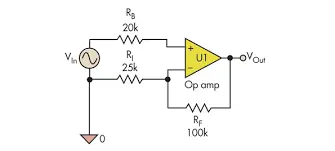
The thermal noise of a resistor is given by √4kTRB, so a 1 kΩ resistor will be 4 nV/√Hz. Adding a resistor will add noise. In Figure 2, surprisingly, even though the 909 Ω compensation resistor is the lowest value because of noise gain from that node to the output, it contributes the most noise at the Figure 2 output. Output noise due to R1 is 40 nV/√Hz, for R2, 12.6 nV/√Hz, and for R3, 42 nV/√Hz. So don’t use a resistor.

On the other hand, if the op-amp is powered from split supplies and one supply comes up before the other one, there may be latch-up problems with the ESD network, in which case it may be desirable to add some resistance to protect the part. But if used, a bypass cap should be placed across the resistor to reduce the noise contribution of the resistor.
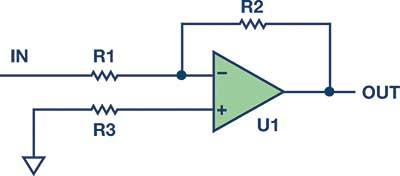
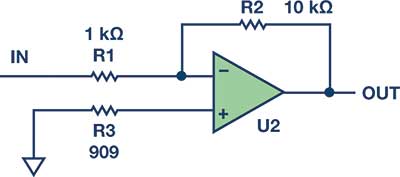
Figure 1. Classic inverting amplifier.

Figure 1. Classic inverting amplifier.
Figure 2. Noise analysis.

Figure 2. Noise analysis.
Figure 3. What you see.

Figure 3. What you see.
Figure 4. What the electrons see.

Figure 4. What the electrons see.

Stability

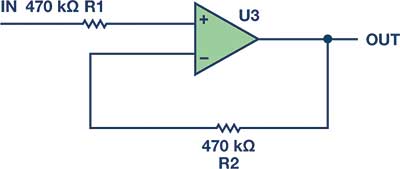
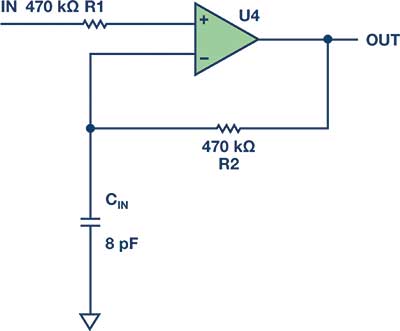
All op-amps have some input capacitance, both differential and common mode. If the op-amp is connected as a follower and the impedances are balanced by putting a resistor in the feedback path, the system may become prone to oscillation. The reason is that with a large feedback resistor, the input capacitance of the op-amp, and the stray capacitance on the PC board, an RC low-pass filter (LPF) is formed. This filter causes phase shift and will reduce the phase margin of the closed-loop system. If it reduces it too much, the op-amp will oscillate.

A customer was using an AD8628 CMOS op-amp in a 1 Hz, Sallen-Key low-pass filter circuit. Because of the low corner frequency, the resistors and capacitors were rather large (see Figure 3). The input resistor was 470 kΩ, so the customer put a 470 kΩ in the feedback. This resistor, in combination with the eight picofarads of input capacitance (see Figure 4), gave the customer a pole at 42 kHz.

The AD8628 has a gain bandwidth product of 2 MHz, so it still had plenty of gain at 42 kHz and it oscillated rail-to-rail. Changing the 470 kΩ resistor to a 0 Ω jumper solved the problem. So avoid large resistors in the feedback where large depends on the gain bandwidth of the op-amp. For high frequency op-amps, such as the ADA4817-1 with a gain bandwidth over 400 MHz, a 1 kΩ feedback would be large. Always read the data sheet for recommendations.

Summary

Over the years, rules of thumb are developed that serve a purpose. On a design review, it’s always good practice to look carefully at these rules and see if they are still applicable. With respect to adding a balancing resistor, if the op-amp is CMOS, JFET or bipolar with input bias current cancellation, you probably don’t need one.


 

Related

Recent Posts

Panasonic High Precision Chip Resistors Bridge Gap Between Thin and Thick Technology

23.1.2026
16

ROHM Extends 2012 Shunt Resistors Power Rating up to 1.25 W

23.1.2026
11

Passive Components in Quantum Computing

22.1.2026
69

Würth Elektronik Introduces Product Navigator for Passive Components

14.1.2026
79

Panasonic Passive Components for Reliable Robotic Arms

14.1.2026
100

How Metal Prices Are Driving Passive Component Price Hikes

8.1.2026
396

Modelithics COMPLETE Library v25.8 for Keysight ADS

7.1.2026
44

2025 Top Passive Components Blog Articles

5.1.2026
128

Bourns BTJ Thermal Jumper Chips for PCB Heat Management

22.12.2025
103

Upcoming Events

Jan 27
16:00 - 17:00 CET

Simplifying Vehicle Development with Automotive Ethernet and Zonal Smart Switch Technologies

Feb 24
16:00 - 17:00 CET

Designing Qi2 Wireless Power Systems: Practical Development and EMC Optimization

Mar 21
All day

PSMA Capacitor Workshop 2026

View Calendar

Popular Posts

  • Buck Converter Design and Calculation

    0 shares
    Share 0 Tweet 0
  • Boost Converter Design and Calculation

    0 shares
    Share 0 Tweet 0
  • LLC Resonant Converter Design and Calculation

    0 shares
    Share 0 Tweet 0
  • Flyback Converter Design and Calculation

    0 shares
    Share 0 Tweet 0
  • Ripple Current and its Effects on the Performance of Capacitors

    3 shares
    Share 3 Tweet 0
  • How Metal Prices Are Driving Passive Component Price Hikes

    0 shares
    Share 0 Tweet 0
  • MLCC and Ceramic Capacitors

    0 shares
    Share 0 Tweet 0
  • What is a Dielectric Constant and DF of Plastic Materials?

    4 shares
    Share 4 Tweet 0
  • Dual Active Bridge (DAB) Topology

    0 shares
    Share 0 Tweet 0
  • Degradation of Capacitors and its Failure Mechanisms

    0 shares
    Share 0 Tweet 0

Newsletter Subscription


Passive Components Blog

© EPCI - Leading Passive Components Educational and Information Site

  • Home
  • Privacy Policy
  • EPCI Membership & Advertisement
  • About

No Result
View All Result
  • Home
  • Knowledge Blog
  • PCNS

© EPCI - Leading Passive Components Educational and Information Site

This website uses cookies. By continuing to use this website you are giving consent to cookies being used. Visit our Privacy and Cookie Policy.
Go to mobile version