



Passive Components Blog
No Result
View All Result
  • Home
  • NewsFilter
    • All
    • Aerospace & Defence
    • Antenna
    • Applications
    • Automotive
    • Capacitors
    • Circuit Protection Devices
    • electro-mechanical news
    • Filters
    • Fuses
    • Inductors
    • Industrial
    • Integrated Passives
    • inter-connect news
    • Market & Supply Chain
    • Market Insights
    • Medical
    • Modelling and Simulation
    • New Materials & Supply
    • New Technologies
    • Non-linear Passives
    • Oscillators
    • Passive Sensors News
    • Resistors
    • RF & Microwave
    • Telecommunication
    • Weekly Digest

    Automotive Passive Components Technology Dossier

    Samsung Electro-Mechanics Signs 1.5T KRW Silicon Capacitor AI Contract

    Murata Expands Thermistor Production Capacity at Yokaichi Plant

    Hirose Expands Compact High‑Voltage EV connectors

    Qi2 Wireless Charging: Inductors, Capacitors and EMC Filters

    Samsung Introduced Low ESL 3-Terminal Reverse-Geometry MLCCs for High-Performance ADAS

    Würth Elektronik Presents New Bidirectional Digital Isolators

    Using Stress–Strain Curves to Diagnose Tantalum Powders for Capacitors

    Coilcraft Introduces SMT Current Sense Transformers for High‑Performance Power Electronics

    Trending Tags

    • Ripple Current
    • RF
    • Leakage Current
    • Tantalum vs Ceramic
    • Snubber
    • Low ESR
    • Feedthrough
    • Derating
    • Dielectric Constant
    • New Products
    • Market Reports
  • VideoFilter
    • All
    • Antenna videos
    • Capacitor videos
    • Circuit Protection Video
    • Filter videos
    • Fuse videos
    • Inductor videos
    • Inter-Connect Video
    • Non-linear passives videos
    • Oscillator videos
    • Passive sensors videos
    • Resistor videos

    Qi2 Wireless Charging: Inductors, Capacitors and EMC Filters

    Two‑capacitor paradox explained for engineers

    Capacitances of Nonlinear MLCCs: What Datasheets Don’t Tell You

    Tapped Inductor Buck Converter Fundamentals

    Planar vs Conventional Transformer: When it Make Sense

    Modeling Fringing Field Losses in Inductors & Transformers

    Why Power Inductors Use a Ferrite Core With an Air Gap

    Transformer-Based Power-Line Harvester Magnetic Design

    Thermal Modeling of Magnetics

    Trending Tags

    • Capacitors explained
    • Inductors explained
    • Resistors explained
    • Filters explained
    • Application Video Guidelines
    • EMC
    • New Products
    • Ripple Current
    • Simulation
    • Tantalum vs Ceramic
  • Knowledge Blog
  • DossiersNew
  • Suppliers
    • Who is Who
  • PCNS
    • PCNS 2025
    • PCNS 2023
    • PCNS 2021
    • PCNS 2019
    • PCNS 2017
  • Events
  • Home
  • NewsFilter
    • All
    • Aerospace & Defence
    • Antenna
    • Applications
    • Automotive
    • Capacitors
    • Circuit Protection Devices
    • electro-mechanical news
    • Filters
    • Fuses
    • Inductors
    • Industrial
    • Integrated Passives
    • inter-connect news
    • Market & Supply Chain
    • Market Insights
    • Medical
    • Modelling and Simulation
    • New Materials & Supply
    • New Technologies
    • Non-linear Passives
    • Oscillators
    • Passive Sensors News
    • Resistors
    • RF & Microwave
    • Telecommunication
    • Weekly Digest

    Automotive Passive Components Technology Dossier

    Samsung Electro-Mechanics Signs 1.5T KRW Silicon Capacitor AI Contract

    Murata Expands Thermistor Production Capacity at Yokaichi Plant

    Hirose Expands Compact High‑Voltage EV connectors

    Qi2 Wireless Charging: Inductors, Capacitors and EMC Filters

    Samsung Introduced Low ESL 3-Terminal Reverse-Geometry MLCCs for High-Performance ADAS

    Würth Elektronik Presents New Bidirectional Digital Isolators

    Using Stress–Strain Curves to Diagnose Tantalum Powders for Capacitors

    Coilcraft Introduces SMT Current Sense Transformers for High‑Performance Power Electronics

    Trending Tags

    • Ripple Current
    • RF
    • Leakage Current
    • Tantalum vs Ceramic
    • Snubber
    • Low ESR
    • Feedthrough
    • Derating
    • Dielectric Constant
    • New Products
    • Market Reports
  • VideoFilter
    • All
    • Antenna videos
    • Capacitor videos
    • Circuit Protection Video
    • Filter videos
    • Fuse videos
    • Inductor videos
    • Inter-Connect Video
    • Non-linear passives videos
    • Oscillator videos
    • Passive sensors videos
    • Resistor videos

    Qi2 Wireless Charging: Inductors, Capacitors and EMC Filters

    Two‑capacitor paradox explained for engineers

    Capacitances of Nonlinear MLCCs: What Datasheets Don’t Tell You

    Tapped Inductor Buck Converter Fundamentals

    Planar vs Conventional Transformer: When it Make Sense

    Modeling Fringing Field Losses in Inductors & Transformers

    Why Power Inductors Use a Ferrite Core With an Air Gap

    Transformer-Based Power-Line Harvester Magnetic Design

    Thermal Modeling of Magnetics

    Trending Tags

    • Capacitors explained
    • Inductors explained
    • Resistors explained
    • Filters explained
    • Application Video Guidelines
    • EMC
    • New Products
    • Ripple Current
    • Simulation
    • Tantalum vs Ceramic
  • Knowledge Blog
  • DossiersNew
  • Suppliers
    • Who is Who
  • PCNS
    • PCNS 2025
    • PCNS 2023
    • PCNS 2021
    • PCNS 2019
    • PCNS 2017
  • Events
No Result
View All Result
Passive Components Blog
No Result
View All Result

Automotive Passive Components Technology Dossier

21.5.2026
Reading Time: 5 mins read
A A

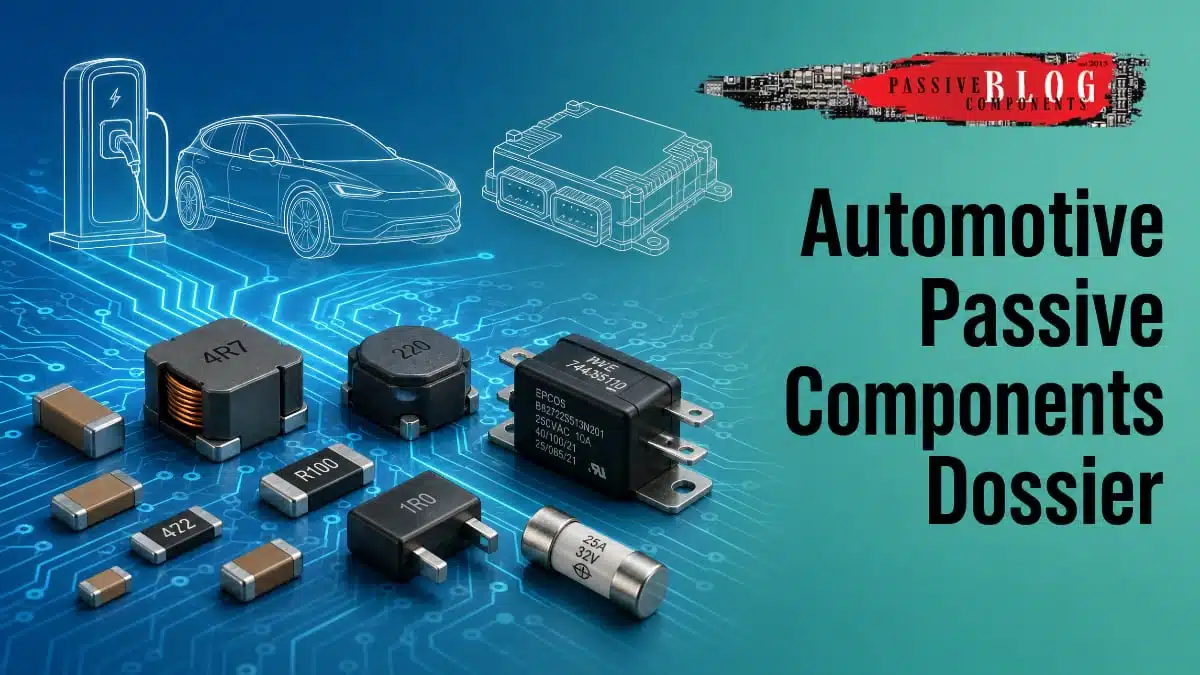
Passive Components Blog has released the Annual Automotive Passive Components Technology Dossier, a 36‑page comprehensive analysis about automotive passive components and how these devices evolved in period from May 2025 to May 2026.

Overview

The Automotive Passive Components Technology Dossier is a comprehensive annual report focused on the fast-changing role of passive electronic components in automotive applications across the latest 12-month period. It explains how capacitors, resistors, inductors, transformers, EMC filters, and circuit protection devices are evolving from commodity support parts into strategic enablers of electric powertrains, ADAS, zonal electronics, infotainment, connectivity, battery systems, and 48 V architectures.

RelatedPosts

Circuit Protection Technology Annual Dossier

Inductor Technology Dossier

Resistor Technology Dossier

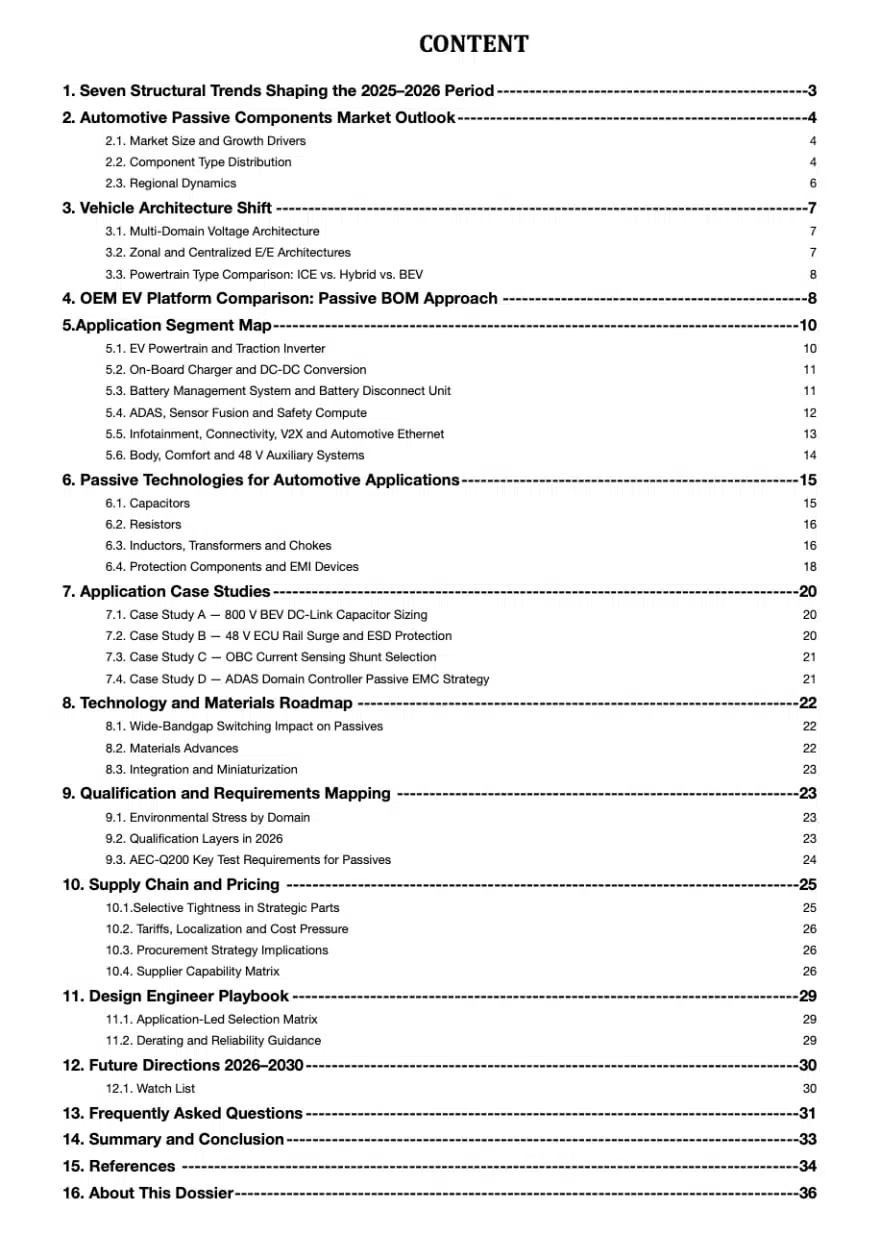
Unlike component-type dossiers that are organized primarily around capacitor, resistor, or inductor technology families, this dossier is structured by automotive application segment. That makes it particularly useful for engineers, sourcing teams, technical marketing, and product managers who need to understand which passive technologies matter most in traction inverters, on-board chargers, DC-DC converters, battery management systems, battery disconnect units, radar and camera modules, vehicle networking, and body electronics.

The report maps the latest automotive passive component trends over the past year, including the continued migration toward 800 V platforms, the impact of SiC and GaN wide-bandgap semiconductors on passive requirements, rising ADAS and domain-controller passive density, the increasing importance of functional safety and qualification, and the divergence between general-purpose passives and high-value automotive-grade segments. It also reviews key component stress factors such as voltage, temperature, vibration, EMI, thermal cycling, low ESL/ESR requirements, current sensing accuracy, and surge / transient robustness.

The dossier combines:

  • Market and technology trend analysis for automotive passive components across the latest 12 months.
  • Application-focused mapping of passive component requirements by vehicle subsystem.
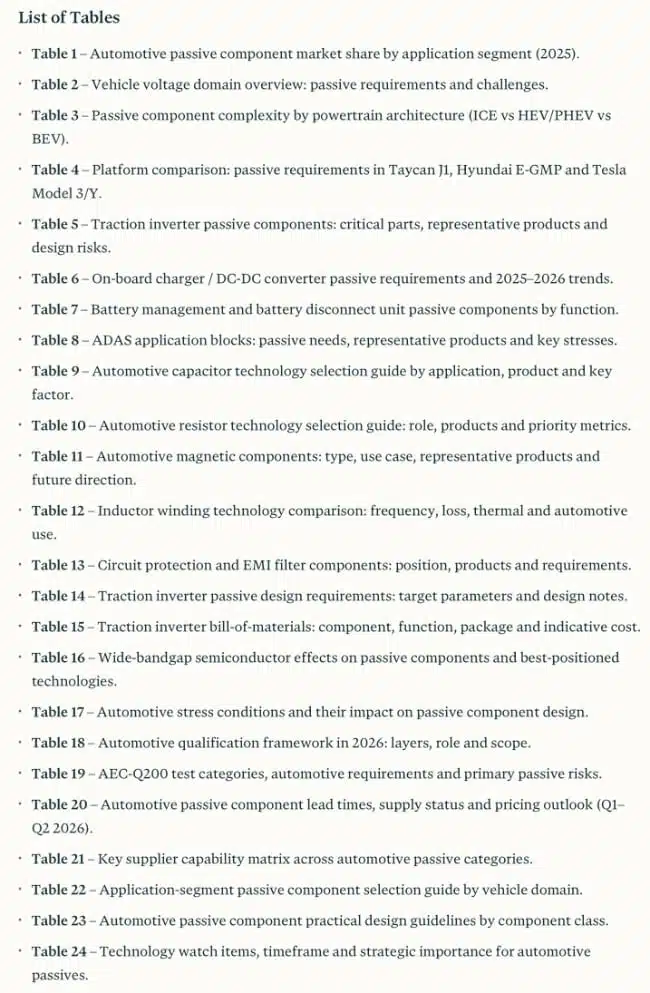
  • Comparative tables of best-fit capacitor, resistor, magnetic, EMC, and protection technologies.
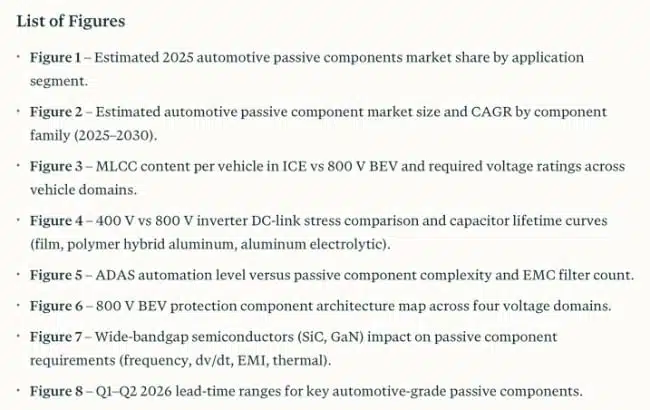
  • Figures and visual summaries for EV architecture, ADAS complexity, wide-bandgap impact, supply-chain lead times, and automotive protection structures.
  • Guidance on qualification, reliability, and forward-looking technology directions through 2026–2030.

What the dossier covers
Seven structural trends shaping automotive passive components requirements

  • 800 V vehicle platforms and higher power OBC/DC‑DC stages are driving up voltage, ripple, and lifetime demands on DC‑link capacitors, magnetics, and protection devices.
  • SiC and GaN wide‑bandgap semiconductors are increasing switching frequency and dv/dt, forcing lower‑ESL/ESR passives, better EMC filters, and new magnetic materials.
  • ADAS, automated driving, and zonal/domain controllers are sharply increasing decoupling, filtering, current‑sense, and ESD/EMI passive density per ECU.
  • Battery systems (BMS, BDU, contactors, pyroswitches) are creating new, safety‑critical roles for shunts, film capacitors, HV fuses, varistors, TVS, and PPTC devices.
  • Automotive Ethernet, radar, camera, LiDAR, V2X and high‑speed links are pushing RF passives, CMCs, ferrites, and ultra‑low‑ESL capacitors to tighter specs.
  • Qualification, reliability, and lifetime (AEC‑Q, ISO, LV standards, board‑level stress) are increasingly differentiating automotive‑grade passives from commodity parts.
  • Supply chain, lead‑time, and supplier capability dynamics are reshaping which vendors can reliably support EV, ADAS, and next‑generation automotive programs.

Who should read it

  • Automotive hardware and system architects responsible for EV powertrain, OBC/DC‑DC, BMS/BDU, ADAS, and zonal/controller architectures.
  • Power, EMC, and hardware design engineers selecting capacitors, magnetics, resistors, EMC parts, and protection devices for automotive platforms.
  • Component engineers, sourcing teams, and technical purchasers who need independent insight into automotive‑grade passives, lead times, and supplier positioning.
  • Product managers and technical marketing staff at passive component manufacturers and distributors who want an application‑driven view of automotive demand.

Why it stands apart

Unlike generic market reports that stop at high-level market sizing, the Passive Components Technology Dossier:

  • It is structured by automotive application domain (EV powertrain, OBC/DC‑DC, BMS/BDU, ADAS, networking, body/48 V) rather than by component type, reflecting how OEMs actually design vehicles.
  • It connects market, technology, and qualification trends into concrete passive requirements and selection tables for each subsystem, rather than treating passives generically.
  • It integrates the latest 12‑month EV, ADAS, WBG and supply‑chain developments into one dossier, providing an independent, component‑agnostic reference that can be used by both designers and decision‑makers.

Availability

The Annual Automotive Passive Components Technology Dossier is available now at 699 EUR exclusively from passive-components.eu as a paid download.

To learn more about other available dossiers and purchase your copy, visit the Technology Dossiers page on the passive-components.eu blog.

Related

Recent Posts

Samsung Electro-Mechanics Signs 1.5T KRW Silicon Capacitor AI Contract

21.5.2026
9

Murata Expands Thermistor Production Capacity at Yokaichi Plant

21.5.2026
7

Hirose Expands Compact High‑Voltage EV connectors

21.5.2026
7

Qi2 Wireless Charging: Inductors, Capacitors and EMC Filters

21.5.2026
15

Samsung Introduced Low ESL 3-Terminal Reverse-Geometry MLCCs for High-Performance ADAS

20.5.2026
26

Würth Elektronik Presents New Bidirectional Digital Isolators

20.5.2026
18

Using Stress–Strain Curves to Diagnose Tantalum Powders for Capacitors

20.5.2026
24

Coilcraft Introduces SMT Current Sense Transformers for High‑Performance Power Electronics

20.5.2026
18

Samsung Launches Ultra-Compact 008004 High Q MLCC for Next-Generation RF Applications

20.5.2026
19

Upcoming Events

Jun 2
16:00 - 17:00 CEST

Calculation, Simulation and Measurement of 800V EMC Filters

Jun 16
16:00 - 17:00 CEST

EMC with EMC – EMC‑compliant design with electromechanical connectors

View Calendar

Popular Posts

  • Buck Converter Design and Calculation

    0 shares
    Share 0 Tweet 0
  • Boost Converter Design and Calculation

    0 shares
    Share 0 Tweet 0
  • Flyback Converter Design and Calculation

    0 shares
    Share 0 Tweet 0
  • LLC Resonant Converter Design and Calculation

    0 shares
    Share 0 Tweet 0
  • MLCC and Ceramic Capacitors

    0 shares
    Share 0 Tweet 0
  • Capacitor Charging and Discharging

    0 shares
    Share 0 Tweet 0
  • What Electronics Engineer Needs to Know About Passive Low Pass Filters

    0 shares
    Share 0 Tweet 0
  • Dual Active Bridge (DAB) Topology

    0 shares
    Share 0 Tweet 0
  • Ripple Current and its Effects on the Performance of Capacitors

    3 shares
    Share 3 Tweet 0
  • Samsung Electro-Mechanics Releases High-Capacitance MLCCs for AI Server Applications

    0 shares
    Share 0 Tweet 0

Newsletter Subscription


Passive Components Blog

© EPCI - Leading Passive Components Educational and Information Site

  • Home
  • Privacy Policy
  • EPCI Membership & Advertisement
  • About

No Result
View All Result
  • Home
  • Knowledge Blog
  • PCNS

© EPCI - Leading Passive Components Educational and Information Site

This website uses cookies. By continuing to use this website you are giving consent to cookies being used. Visit our Privacy and Cookie Policy.
Go to mobile version