





Passive Components Blog
No Result
View All Result
  • Home
  • NewsFilter
    • All
    • Aerospace & Defence
    • Antenna
    • Applications
    • Automotive
    • Capacitors
    • Circuit Protection Devices
    • electro-mechanical news
    • Filters
    • Fuses
    • Inductors
    • Industrial
    • Integrated Passives
    • inter-connect news
    • Market & Supply Chain
    • Market Insights
    • Medical
    • Modelling and Simulation
    • New Materials & Supply
    • New Technologies
    • Non-linear Passives
    • Oscillators
    • Passive Sensors News
    • Resistors
    • RF & Microwave
    • Telecommunication
    • Weekly Digest

    Using Stress–Strain Curves to Diagnose Tantalum Powders for Capacitors

    Coilcraft Introduces SMT Current Sense Transformers for High‑Performance Power Electronics

    Samsung Launches Ultra-Compact 008004 High Q MLCC for Next-Generation RF Applications

    Nichicon Extends Rechargeable Batteries Temperature to Rival Supercapacitors

    Two‑capacitor paradox explained for engineers

    YAGEO Releases Compact RJ45 Connector for Multi‑Gigabit Ethernet

    Circuit Protection Technology Annual Dossier

    ESA SPCD 26 Registration Open

    Capacitances of Nonlinear MLCCs: What Datasheets Don’t Tell You

    Trending Tags

    • Ripple Current
    • RF
    • Leakage Current
    • Tantalum vs Ceramic
    • Snubber
    • Low ESR
    • Feedthrough
    • Derating
    • Dielectric Constant
    • New Products
    • Market Reports
  • VideoFilter
    • All
    • Antenna videos
    • Capacitor videos
    • Circuit Protection Video
    • Filter videos
    • Fuse videos
    • Inductor videos
    • Inter-Connect Video
    • Non-linear passives videos
    • Oscillator videos
    • Passive sensors videos
    • Resistor videos

    Two‑capacitor paradox explained for engineers

    Capacitances of Nonlinear MLCCs: What Datasheets Don’t Tell You

    Tapped Inductor Buck Converter Fundamentals

    Planar vs Conventional Transformer: When it Make Sense

    Modeling Fringing Field Losses in Inductors & Transformers

    Why Power Inductors Use a Ferrite Core With an Air Gap

    Transformer-Based Power-Line Harvester Magnetic Design

    Thermal Modeling of Magnetics

    Standard vs Planar LLC transformers Comparison for Battery Chargers

    Trending Tags

    • Capacitors explained
    • Inductors explained
    • Resistors explained
    • Filters explained
    • Application Video Guidelines
    • EMC
    • New Products
    • Ripple Current
    • Simulation
    • Tantalum vs Ceramic
  • Knowledge Blog
  • DossiersNew
  • Suppliers
    • Who is Who
  • PCNS
    • PCNS 2025
    • PCNS 2023
    • PCNS 2021
    • PCNS 2019
    • PCNS 2017
  • Events
  • Home
  • NewsFilter
    • All
    • Aerospace & Defence
    • Antenna
    • Applications
    • Automotive
    • Capacitors
    • Circuit Protection Devices
    • electro-mechanical news
    • Filters
    • Fuses
    • Inductors
    • Industrial
    • Integrated Passives
    • inter-connect news
    • Market & Supply Chain
    • Market Insights
    • Medical
    • Modelling and Simulation
    • New Materials & Supply
    • New Technologies
    • Non-linear Passives
    • Oscillators
    • Passive Sensors News
    • Resistors
    • RF & Microwave
    • Telecommunication
    • Weekly Digest

    Using Stress–Strain Curves to Diagnose Tantalum Powders for Capacitors

    Coilcraft Introduces SMT Current Sense Transformers for High‑Performance Power Electronics

    Samsung Launches Ultra-Compact 008004 High Q MLCC for Next-Generation RF Applications

    Nichicon Extends Rechargeable Batteries Temperature to Rival Supercapacitors

    Two‑capacitor paradox explained for engineers

    YAGEO Releases Compact RJ45 Connector for Multi‑Gigabit Ethernet

    Circuit Protection Technology Annual Dossier

    ESA SPCD 26 Registration Open

    Capacitances of Nonlinear MLCCs: What Datasheets Don’t Tell You

    Trending Tags

    • Ripple Current
    • RF
    • Leakage Current
    • Tantalum vs Ceramic
    • Snubber
    • Low ESR
    • Feedthrough
    • Derating
    • Dielectric Constant
    • New Products
    • Market Reports
  • VideoFilter
    • All
    • Antenna videos
    • Capacitor videos
    • Circuit Protection Video
    • Filter videos
    • Fuse videos
    • Inductor videos
    • Inter-Connect Video
    • Non-linear passives videos
    • Oscillator videos
    • Passive sensors videos
    • Resistor videos

    Two‑capacitor paradox explained for engineers

    Capacitances of Nonlinear MLCCs: What Datasheets Don’t Tell You

    Tapped Inductor Buck Converter Fundamentals

    Planar vs Conventional Transformer: When it Make Sense

    Modeling Fringing Field Losses in Inductors & Transformers

    Why Power Inductors Use a Ferrite Core With an Air Gap

    Transformer-Based Power-Line Harvester Magnetic Design

    Thermal Modeling of Magnetics

    Standard vs Planar LLC transformers Comparison for Battery Chargers

    Trending Tags

    • Capacitors explained
    • Inductors explained
    • Resistors explained
    • Filters explained
    • Application Video Guidelines
    • EMC
    • New Products
    • Ripple Current
    • Simulation
    • Tantalum vs Ceramic
  • Knowledge Blog
  • DossiersNew
  • Suppliers
    • Who is Who
  • PCNS
    • PCNS 2025
    • PCNS 2023
    • PCNS 2021
    • PCNS 2019
    • PCNS 2017
  • Events
No Result
View All Result
Passive Components Blog
No Result
View All Result

Passive Components Punch Through Walls

26.5.2016
Reading Time: 6 mins read
A A

source: Microwave&RF article

May 25, 2016 Chris DeMartino | Microwaves and RF.

RelatedPosts

Using Stress–Strain Curves to Diagnose Tantalum Powders for Capacitors

Coilcraft Introduces SMT Current Sense Transformers for High‑Performance Power Electronics

Samsung Launches Ultra-Compact 008004 High Q MLCC for Next-Generation RF Applications

Designers bank on passive components to help deliver the performance needed to satisfy ever-tougher demands. High-frequency passive components may lack the glamour of their active counterparts, but they play crucial roles when trying to meet system performance requirements. Such components, which include power dividers/combiners, directional couplers, hybrid couplers, and more, are needed to enable critical functionality for numerous applications. A distributed antenna system (DAS), for instance, relies heavily on high-performance passive components.

In addition, some suppliers offer passive components with superior power-handling capability to support high-power applications. This article takes a look at some of these passive-component solutions designed to meet these demanding requirements.

Distributed Antenna Systems

A DAS uses a network of antennas connected to a common location to provide wireless coverage to a specific area (Fig. 1). As a result, wireless coverage and capacity can be enhanced in areas that need a boost in service. A DAS can be deployed indoors or outdoors; settings include office buildings, convention centers, subways, airports, sports arenas, etc.

1. Implementation of a DAS will ultimately improve wireless coverage. (Courtesy of Microlab)
Passive components are an extremely important aspect of a DAS. For instance, power dividers and directional couplers allow signals to be distributed as required by the DAS. Because such a system may incorporate numerous passive components in its architecture, it’s important they provide adequate performance to satisfy the demands of the entire system.

Passive intermodulation (PIM) can occur due to the nonlinear mixing of two or more frequencies in a passive component, such as a cable, connector, or power divider. Causes of PIM include ferromagnetic materials, corrosion, and loose connections.

PIM can degrade the performance and reliability of a DAS. Specifically, unwanted intermodulation products generated by multiple signals in the downlink may appear in the uplink, thereby reducing quality of service. Thus, to help ensure reliable DAS performance, its passive components must have superior PIM characteristics.

One company focused on DAS applications is Radio Frequency Systems (RFS). “Growing demand for reliable wireless communications wherever people go, at all times, is driving network improvements to provide connectivity in even the most challenging environments,” says Eileen Januszkiewicz, commercial product manager of cables at RFS. “These environments include stadiums, airports, metro transportation systems, and hotels. The world will be watching the upcoming Summer Olympics, which will require unprecedented coverage capacity for millions of athletes, vendors, event managers, and spectators.”

Januszkiewicz adds, “Meeting communication needs in such venues requires cutting-edge infrastructure solutions. Passive DAS systems and components provide the flexibility for multi-band, multi-technology, multi-operator support. A single passive DAS solution can be shared by several operators delivering different wireless services using different technologies and frequency bands, including mission-critical (380-520 MHz), commercial wireless (698-2700 MHz), and broadband and ultra-broadband (380-2700 MHz) in 2G, 3G, 4G LTE, and TETRA.”

RFS has already delivered several DAS solutions, including its deployment of a passive DAS for the 2014 FIFA World Cup. Januszkiewicz explains, “RFS deployed a passive DAS solution that enabled wireless connectivity at four stadiums for the 2014 FIFA World Cup in Rio de Janeiro. The sophisticated, multi-operator solution used a new RF sectoring concept for each network, delivering a considerable increase in capacity when processing calls and ensuring 2G, 3G, 4G (LTE), and iDEN wireless communications throughout the venue for customers of five Brazilian operators. The networks were built with state-of-the-art indoor wireless infrastructure, including RF corrugated coaxial cables, RFS’s HYBRIFLEX hybrid cable, indoor and outdoor antennas, jumpers, and accessories.”

2. These components, which include couplers, tappers, power splitters, and hybrid combiners, are intended for DAS applications. (Courtesy of Radio Frequency Systems)

Earlier this year, the company unveiled a range of new passive RF components for DAS applications (Fig. 2). These products are intended to satisfy wireless in-building commercial and mission-critical communications requirements.

“RFS recently expanded its product portfolio of passive components,” says Januszkiewicz. “These components include couplers, power splitters, tappers, and hybrid combiners, complementing our comprehensive line of low-loss RF feeder cables and jumpers for DAS to help customers deploy future-proof solutions. All our passive DAS products share harmonized PIM specifications (–161 dBc) to maintain a high level of repeatability and reliability of services.”

Many other companies offer passive components for DAS applications. Among them is Microlab (which is part of the Wireless Telecom Group), which offers a variety of passive components such as tappers, power splitters, and directional couplers.

R&D Microwaves maintains its own line of DAS passive components. Covering a frequency range of 380 to 2700 MHz, these products include tappers, hybrids, and dividers/combiners. In addition, the company offers these components with different connector options, such as Type-N and 7/16 DIN.

For its part, Werlatone supplies a range of DAS-targeted passive components, which includes even and uneven splitters, unidirectional couplers, and dual directional couplers. All ports of non-isolated even and uneven splitters can communicate with one another. These components allow users to split a single run of a 50-Ω coaxial cable that simultaneously carries multiple service bands. By utilizing non-isolated even power splitters, one signal can be evenly split into two, three, or four signals, which can then enter corridors, tunnels, shafts, or rooms. Uneven splitters can be utilized to unevenly split a signal so that a shorter corridor, tunnel, shaft, or hallway is provided with a smaller portion of the power on the main coaxial run.

Also sparking interest is Westell, which offers a line of standard passive components as well as its ClearLink PIM-rated passive components. Standard passive components include power dividers, directional couplers, and cross band couplers. The ClearLink component lineup features power dividers, directional couplers, hybrid couplers, and power tappers.

Not to be outdone, Innowave RF supports DAS applications with products such as low-PIM power combiners/dividers. The company offers 2-, 3-, and 4-way power combiners/dividers, each covering a frequency range of 698 to 2700 MHz. These components achieve a PIM of –153 dBc when measured with two 20-W output tones.

High-Power Passives

3. Use of this new dual directional coupler helps satisfy the demand for smaller PAs. (Courtesy of Werlatone)
Suppliers of power-amplifier (PA) modules are feeling the pressure to deliver efficient PAs in smaller sizes. Utilizing smaller surface-mount passive components inside these PA modules can help accomplish that task. To demonstrate this, Werlatone developed a new dual directional coupler in response to the need for smaller PAs (Fig. 3).

“We have identified several market trends targeting smaller, more robust, and more efficient high-power RF amplifier modules,” says Glenn Werlau, president of Werlatone. “One transformation that is currently ongoing is the use of smaller surface-mount directional couplers within the modules, rather than larger connectorized devices.”

Werlau adds, “As a response to this market trend, we have introduced the first in a new series of surface-mount, 20- to 1000-MHz, mismatch-tolerant, dual directional couplers, conservatively rated at 250 W continuous-wave (CW). Our new design offers enhanced insertion loss, with less heat dissipation, resulting in a lower demand from the system power supply. Additionally, this design provides near-perfect main-line voltage standing wave ratio (VSWR) and a coupled port VSWR of less than 1.2:1, assuring near-optimum flatness. The first product is a 50-dB coupler. Further releases will be available with coupling values of 30 and 40 dB.”

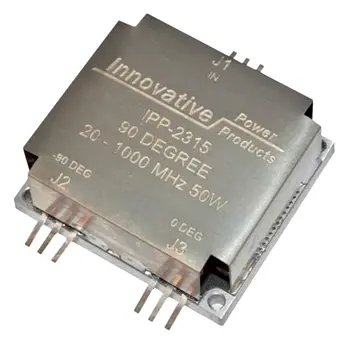
Innovative Power Products also specializes in high-power passive components. The company’s products include power dividers, directional couplers, hybrid couplers, and other. One of its newer products is the IPP-2315, a drop-in hybrid coupler that covers a frequency range of 20 to 1000 MHz (Fig. 4). This model has a maximum insertion loss of 0.8 dB along with a maximum VSWR of 1.35:1. Furthermore, the IPP-2315, which can handle as much as 50 W of CW power, maintains an amplitude balance of less than ±0.30 dB across the entire band.

4. This drop-in hybrid coupler covers a frequency range of 20 to 1000 MHz. (Courtesy of Innovative Power Products)
TRM Microwave’s line of high-power passive components achieves power-handling capability into the kilowatt range. Components include directional couplers, power combiner/dividers, and hybrid couplers. The company offers its products to satisfy a number of commercial and military requirements, such as combat radar systems, military radio communications, weather radar, RF jamming and countermeasures, aviation communications, and medical imaging and radiology.

No doubt, passive-component performance is a critical “component” in satisfying higher-level requirements. DAS applications represent one example, with suppliers having to adhere to stringent PIM requirements. And PA modules can benefit greatly from using high-performance passive components in small surface-mount packages. These are just two examples, but passive components take on great importance in a host of other applications, too. All that said, it is incumbent on passive-component suppliers to deliver products that can meet the ever-demanding requirements of today’s wireless world.
Related

Recent Posts

Using Stress–Strain Curves to Diagnose Tantalum Powders for Capacitors

20.5.2026
4

Coilcraft Introduces SMT Current Sense Transformers for High‑Performance Power Electronics

20.5.2026
5

Nichicon Extends Rechargeable Batteries Temperature to Rival Supercapacitors

19.5.2026
22

YAGEO Releases Compact RJ45 Connector for Multi‑Gigabit Ethernet

18.5.2026
16

Stackpole Releases Automotive Wide‑Termination Resistors

14.5.2026
28

SCHURTER Buys Biaodi to Boost High-Voltage Protection Portfolio

14.5.2026
53

Binder Hybrid Connector Simplifies One Cable Automation

13.5.2026
21

Planar vs Conventional Transformer: When it Make Sense

11.5.2026
88

Nichicon ADN Automotive Hybrid Aluminum Capacitors Now Available in EMEA

11.5.2026
45

Upcoming Events

Jun 2
16:00 - 17:00 CEST

Calculation, Simulation and Measurement of 800V EMC Filters

Jun 16
16:00 - 17:00 CEST

EMC with EMC – EMC‑compliant design with electromechanical connectors

View Calendar

Popular Posts

  • Buck Converter Design and Calculation

    0 shares
    Share 0 Tweet 0
  • Boost Converter Design and Calculation

    0 shares
    Share 0 Tweet 0
  • Flyback Converter Design and Calculation

    0 shares
    Share 0 Tweet 0
  • LLC Resonant Converter Design and Calculation

    0 shares
    Share 0 Tweet 0
  • MLCC and Ceramic Capacitors

    0 shares
    Share 0 Tweet 0
  • Capacitor Charging and Discharging

    0 shares
    Share 0 Tweet 0
  • What Electronics Engineer Needs to Know About Passive Low Pass Filters

    0 shares
    Share 0 Tweet 0
  • Dual Active Bridge (DAB) Topology

    0 shares
    Share 0 Tweet 0
  • Ripple Current and its Effects on the Performance of Capacitors

    3 shares
    Share 3 Tweet 0
  • Samsung Electro-Mechanics Releases High-Capacitance MLCCs for AI Server Applications

    0 shares
    Share 0 Tweet 0

Newsletter Subscription


Passive Components Blog

© EPCI - Leading Passive Components Educational and Information Site

  • Home
  • Privacy Policy
  • EPCI Membership & Advertisement
  • About

No Result
View All Result
  • Home
  • Knowledge Blog
  • PCNS

© EPCI - Leading Passive Components Educational and Information Site

This website uses cookies. By continuing to use this website you are giving consent to cookies being used. Visit our Privacy and Cookie Policy.
Go to mobile version