




Passive Components Blog
No Result
View All Result
  • Home
  • NewsFilter
    • All
    • Aerospace & Defence
    • Antenna
    • Applications
    • Automotive
    • Capacitors
    • Circuit Protection Devices
    • electro-mechanical news
    • Filters
    • Fuses
    • Inductors
    • Industrial
    • Integrated Passives
    • inter-connect news
    • Market & Supply Chain
    • Market Insights
    • Medical
    • Modelling and Simulation
    • New Materials & Supply
    • New Technologies
    • Non-linear Passives
    • Oscillators
    • Passive Sensors News
    • Resistors
    • RF & Microwave
    • Telecommunication
    • Weekly Digest

    TAIYO YUDEN Releases 220uF 1210 Automotive MLCC

    HEICO’s Exxelia Expands High-Voltage Ceramic Capacitor Portfolio with CalRamic Acquisition

    Vishay Extends Automotive Ferrite Beads for High‑Current EMC Noise Filtering

    CapXon Earns EcoVadis Bronze Medal for Sustainability Performance

    All‑Water Supercapacitor Based on 1‑nm Clay Channels and Nanoconfined Water Electrolyte

    Littelfuse Unveils High‑Current 48V SMD Fuse for AI Data Center Protection

    Modelithics Releases COMPLETE Library v26.2 for Keysight Genesys

    Why Isolated DC/DC Power Supplies Fail Late, Würth Elektronik Podcast

    Wk 23 Electronics Supply Chain Digest

    Trending Tags

    • Ripple Current
    • RF
    • Leakage Current
    • Tantalum vs Ceramic
    • Snubber
    • Low ESR
    • Feedthrough
    • Derating
    • Dielectric Constant
    • New Products
    • Market Reports
  • VideoFilter
    • All
    • Antenna videos
    • Capacitor videos
    • Circuit Protection Video
    • Filter videos
    • Fuse videos
    • Inductor videos
    • Inter-Connect Video
    • Non-linear passives videos
    • Oscillator videos
    • Passive sensors videos
    • Resistor videos

    Why Isolated DC/DC Power Supplies Fail Late, Würth Elektronik Podcast

    Designing 800 V DC EMC Filters: Calculation, Simulation and Measurement

    Current Sense Transformer Datasheet and Design‑in Guide

    Designing a USB Type‑C Flyback Planar Transformer with Frenetic’s Planar Tool

    Magnetics Design in High‑Frequency GaN Converters

    Qi2 Wireless Charging: Inductors, Capacitors and EMC Filters

    Two‑capacitor paradox explained for engineers

    Capacitances of Nonlinear MLCCs: What Datasheets Don’t Tell You

    Tapped Inductor Buck Converter Fundamentals

    Trending Tags

    • Capacitors explained
    • Inductors explained
    • Resistors explained
    • Filters explained
    • Application Video Guidelines
    • EMC
    • New Products
    • Ripple Current
    • Simulation
    • Tantalum vs Ceramic
  • Knowledge Blog
  • DossiersNew
  • Suppliers
    • Who is Who
  • PCNS
    • PCNS 2025
    • PCNS 2023
    • PCNS 2021
    • PCNS 2019
    • PCNS 2017
  • Events
  • Home
  • NewsFilter
    • All
    • Aerospace & Defence
    • Antenna
    • Applications
    • Automotive
    • Capacitors
    • Circuit Protection Devices
    • electro-mechanical news
    • Filters
    • Fuses
    • Inductors
    • Industrial
    • Integrated Passives
    • inter-connect news
    • Market & Supply Chain
    • Market Insights
    • Medical
    • Modelling and Simulation
    • New Materials & Supply
    • New Technologies
    • Non-linear Passives
    • Oscillators
    • Passive Sensors News
    • Resistors
    • RF & Microwave
    • Telecommunication
    • Weekly Digest

    TAIYO YUDEN Releases 220uF 1210 Automotive MLCC

    HEICO’s Exxelia Expands High-Voltage Ceramic Capacitor Portfolio with CalRamic Acquisition

    Vishay Extends Automotive Ferrite Beads for High‑Current EMC Noise Filtering

    CapXon Earns EcoVadis Bronze Medal for Sustainability Performance

    All‑Water Supercapacitor Based on 1‑nm Clay Channels and Nanoconfined Water Electrolyte

    Littelfuse Unveils High‑Current 48V SMD Fuse for AI Data Center Protection

    Modelithics Releases COMPLETE Library v26.2 for Keysight Genesys

    Why Isolated DC/DC Power Supplies Fail Late, Würth Elektronik Podcast

    Wk 23 Electronics Supply Chain Digest

    Trending Tags

    • Ripple Current
    • RF
    • Leakage Current
    • Tantalum vs Ceramic
    • Snubber
    • Low ESR
    • Feedthrough
    • Derating
    • Dielectric Constant
    • New Products
    • Market Reports
  • VideoFilter
    • All
    • Antenna videos
    • Capacitor videos
    • Circuit Protection Video
    • Filter videos
    • Fuse videos
    • Inductor videos
    • Inter-Connect Video
    • Non-linear passives videos
    • Oscillator videos
    • Passive sensors videos
    • Resistor videos

    Why Isolated DC/DC Power Supplies Fail Late, Würth Elektronik Podcast

    Designing 800 V DC EMC Filters: Calculation, Simulation and Measurement

    Current Sense Transformer Datasheet and Design‑in Guide

    Designing a USB Type‑C Flyback Planar Transformer with Frenetic’s Planar Tool

    Magnetics Design in High‑Frequency GaN Converters

    Qi2 Wireless Charging: Inductors, Capacitors and EMC Filters

    Two‑capacitor paradox explained for engineers

    Capacitances of Nonlinear MLCCs: What Datasheets Don’t Tell You

    Tapped Inductor Buck Converter Fundamentals

    Trending Tags

    • Capacitors explained
    • Inductors explained
    • Resistors explained
    • Filters explained
    • Application Video Guidelines
    • EMC
    • New Products
    • Ripple Current
    • Simulation
    • Tantalum vs Ceramic
  • Knowledge Blog
  • DossiersNew
  • Suppliers
    • Who is Who
  • PCNS
    • PCNS 2025
    • PCNS 2023
    • PCNS 2021
    • PCNS 2019
    • PCNS 2017
  • Events
No Result
View All Result
Passive Components Blog
No Result
View All Result

TAIYO YUDEN Releases 220uF 1210 Automotive MLCC

11.6.2026
Reading Time: 6 mins read
A A

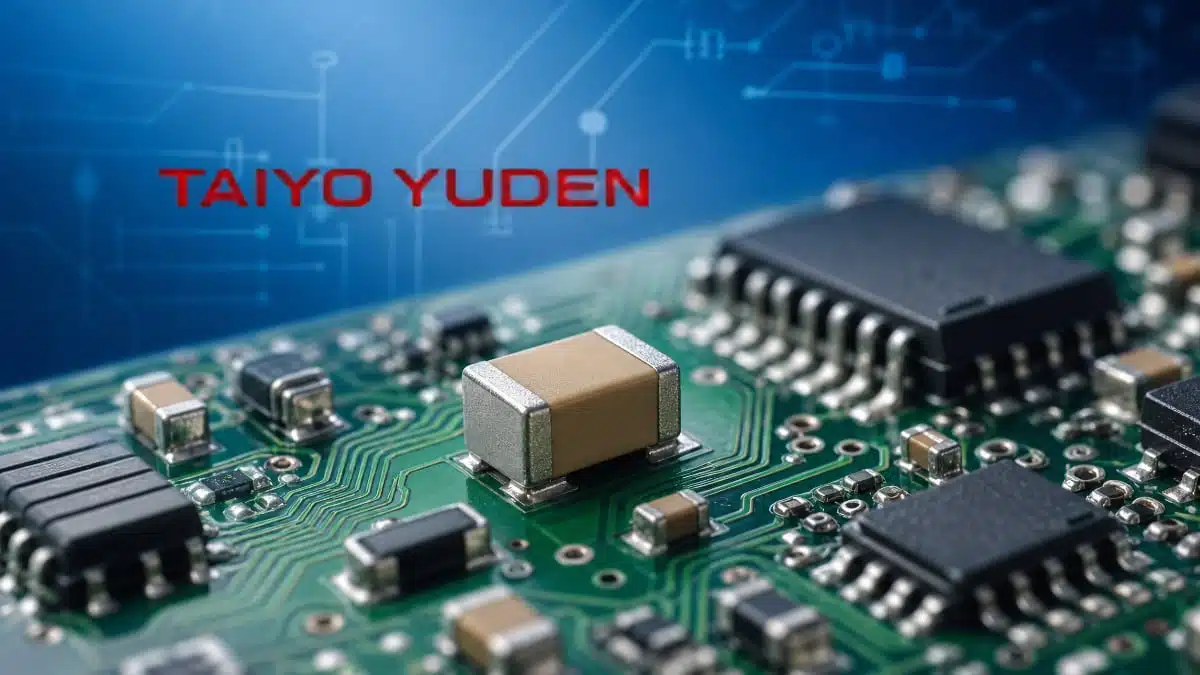
TAIYO YUDEN has released a new automotive‑grade multilayer ceramic capacitor (MLCC), type MAASA32MAD7227MP1D71, offering 220 µF in a 3225 (1210) package while meeting AEC‑Q200 requirements for passive components in vehicles.

This MLCC capacitor more than doubles the capacitance of the company’s previous 100 µF part in the same size, targeting output smoothing and decoupling in demanding automotive ECUs and safety systems. For designers, it provides a way to increase bulk capacitance and stability without increasing footprint or moving to larger, less integration‑friendly capacitor technologies.

RelatedPosts

TAIYO YUDEN Releases Mini Metal Power Inductors

Conductive Polymer Capacitor Market and Design‑In Guide to 2035

Taiyo Yuden Releases 165C Automotive Multilayer Metal Power Inductor in 1608 Size

Key features and benefits

  • High capacitance in 3225 size – 220 µF nominal capacitance in a 3.2 × 2.5 × 2.8 mm (maximum height) MLCC, enabling significant energy storage and ripple smoothing in a compact footprint.
  • More than double previous generation – Capacitance is more than twice that of TAIYO YUDEN’s conventional 100 µF MLCC in the same 3225 case size (MAASP32MAD7107MPCA01), allowing drop‑in upgrades where higher capacitance is needed.
  • Automotive‑grade reliability – Complies with AEC‑Q200 passive component reliability testing, supporting use in harsh automotive environments where vibration, temperature cycling, and long lifetime are critical.
  • Optimized for output smoothing and decoupling – Designed for stabilizing DC rails and suppressing dynamic load transients in control units, safety modules, and information systems.
  • Supports highly integrated ECUs and SDV architectures – Addresses rising IC processing power and current consumption driven by ADAS and software‑defined vehicle concepts, where local high‑value decoupling is needed close to power pins.
  • Potential for BoM and space reduction – High capacitance in a single device can reduce the number of parallel capacitors around high‑current ICs, simplifying layout and potentially improving reliability by lowering solder joint count.

Typical applications

The MAASA32MAD7227MP1D71 is targeted at a wide range of automotive electronic systems where stable power rails and high dynamic load currents coexist.

  • Control systems such as engine control units (ECUs), where high‑capacitance MLCCs help maintain supply stability during injector and actuator events.
  • Safety systems including anti‑lock braking systems (ABS) and advanced driver assistance systems (ADAS), where transient loads from radar, camera, and processing SoCs require robust local decoupling.
  • Information and display systems, for example instrument clusters and infotainment modules, which combine digital processing, graphics engines, and communication interfaces on shared power rails.
  • Networked automotive electronics and domain controllers in evolving SDV architectures, where increasing processing density and scalable power distribution benefit from compact bulk capacitance near point‑of‑load regulators.

In many of these cases, the capacitor will sit directly at the output of a DC‑DC converter or close to a large digital or mixed‑signal IC, working in combination with smaller‑value MLCCs and sometimes with aluminum or polymer capacitors to shape the overall impedance profile over frequency.

Technical highlights

The table below summarizes the key attributes mentioned in the press material and associated product page. Where a specific parameter is not explicitly stated in the release, it should be taken from the official datasheet according to the manufacturer.

ParameterValue / Note
Part numberMAASA32MAD7227MP1D71
Capacitance220 µF nominal
Size code3225 (approx. 3.2 × 2.5 mm footprint)
Maximum height2.8 mm
TechnologyMultilayer ceramic capacitor (MLCC)
QualificationAEC‑Q200 compliant (passive automotive component reliability standard)
Application class/detailsFor output smoothing and decoupling in automotive systems
Production locationTamamura Plant, Gunma Prefecture, Japan
Mass production startMay 2026

In practice, achieving 220 µF in this case size suggests an optimized dielectric system and internal structure aimed at high volumetric efficiency, which can be particularly attractive where board area and height restrictions are strict in ECUs and camera modules. Exact details such as rated voltage, allowable ripple current, temperature range, and tolerance are provided in the official datasheet and should be verified at design‑in according to the specific use case.

Design‑in notes for engineers

  • Check voltage derating strategy
    When using very high capacitance MLCCs in automotive environments, it is important to apply appropriate voltage derating relative to the rated voltage specified in the datasheet, especially at higher ambient temperatures and under DC bias.
  • Consider DC bias and temperature effects
    The effective capacitance of high‑value MLCCs typically decreases under DC bias and over temperature, so designers should size the component with adequate margin based on the worst‑case operating point defined in the system requirements and manufacturer curves.
  • Combine with smaller capacitors for high‑frequency decoupling
    A single 220 µF MLCC is effective for low‑frequency energy storage and load‑step smoothing, but it is usually complemented with smaller‑value MLCCs (for example in the nF to low‑µF range) placed very close to IC power pins to ensure low impedance at higher frequencies.
  • Layout and mechanical considerations
    In vibration‑intensive automotive environments, layout strategies such as placing the MLCC close to the neutral mechanical axis of the board, using appropriate pad design, and managing board flex can help reduce mechanical stress and risk of cracking.
  • Thermal and ripple current assessment
    High‑capacitance MLCCs in switching power paths are subject to ripple current and self‑heating; designers should compare the expected ripple profile against the manufacturer’s specified limits and verify temperature rise during validation testing.
  • Qualification and documentation
    Since the device is AEC‑Q200 compliant, design teams should obtain the detailed qualification report, PPAP documentation if required, and ensure that internal quality and reliability teams review and approve the component for the relevant automotive design level.

By treating the MAASA32MAD7227MP1D71 as a compact bulk capacitor that can often replace multiple lower‑value parts, engineers can simplify the capacitor network around power regulators while maintaining or improving transient performance, provided system‑level impedance and EMC requirements are carefully validated.

Source

This article is based on information provided by TAIYO YUDEN in their official product news release and associated online product specification resources.


References

  1. TAIYO YUDEN news release – “TAIYO YUDEN Achieves 220 μF in 3225-Size Multilayer Ceramic Capacitors for Automotive Applications”
  2. TAIYO YUDEN product specification search – MAASA32MAD7227MP1D71

Related

Recent Posts

HEICO’s Exxelia Expands High-Voltage Ceramic Capacitor Portfolio with CalRamic Acquisition

10.6.2026
12

Vishay Extends Automotive Ferrite Beads for High‑Current EMC Noise Filtering

10.6.2026
5

CapXon Earns EcoVadis Bronze Medal for Sustainability Performance

10.6.2026
8

All‑Water Supercapacitor Based on 1‑nm Clay Channels and Nanoconfined Water Electrolyte

10.6.2026
14

Modelithics Releases COMPLETE Library v26.2 for Keysight Genesys

8.6.2026
11

Power Converter Dossier: Passive Components Design and Selection Guide 2026

5.6.2026
36

Evans Group Unifies Four High-Rel Capacitor Leaders

5.6.2026
26

Skeleton Releases Graphene‑Based UPS for AI Data Centers

5.6.2026
32

TDK Releases DC-link Film Capacitors with Ultra-low Inductance for SiC Power Converters

4.6.2026
48

Upcoming Events

Jun 16
16:00 - 17:00 CEST

EMC with EMC – EMC‑compliant design with electromechanical connectors

Jul 14
16:00 - 17:00 CEST

EMC Design Essentials: Mastering Varistors and Common Mode Chokes

Jul 21
16:00 - 17:00 CEST

Safety by design: X and Y Interference suppression capacitors for power line filters

View Calendar

Popular Posts

  • Buck Converter Design and Calculation

    0 shares
    Share 0 Tweet 0
  • Boost Converter Design and Calculation

    0 shares
    Share 0 Tweet 0
  • MLCC and Ceramic Capacitors

    0 shares
    Share 0 Tweet 0
  • LLC Resonant Converter Design and Calculation

    0 shares
    Share 0 Tweet 0
  • Flyback Converter Design and Calculation

    0 shares
    Share 0 Tweet 0
  • What Electronics Engineer Needs to Know About Passive Low Pass Filters

    0 shares
    Share 0 Tweet 0
  • SEPIC Converter Design and Calculation

    0 shares
    Share 0 Tweet 0
  • Dual Active Bridge (DAB) Topology

    0 shares
    Share 0 Tweet 0
  • Capacitor Charging and Discharging

    0 shares
    Share 0 Tweet 0
  • Earthing Systems and IEC Classification Explained

    0 shares
    Share 0 Tweet 0

Newsletter Subscription


Passive Components Blog

© EPCI - Leading Passive Components Educational and Information Site

  • Home
  • Privacy Policy
  • EPCI Membership & Advertisement
  • About

No Result
View All Result
  • Home
  • Knowledge Blog
  • Dossiers
  • PCNS

© EPCI - Leading Passive Components Educational and Information Site

This website uses cookies. By continuing to use this website you are giving consent to cookies being used. Visit our Privacy and Cookie Policy.
Go to mobile version