




Passive Components Blog
No Result
View All Result
  • Home
  • NewsFilter
    • All
    • Aerospace & Defence
    • Antenna
    • Applications
    • Automotive
    • Capacitors
    • Circuit Protection Devices
    • electro-mechanical news
    • Filters
    • Fuses
    • Inductors
    • Industrial
    • Integrated Passives
    • inter-connect news
    • Market & Supply Chain
    • Market Insights
    • Medical
    • Modelling and Simulation
    • New Materials & Supply
    • New Technologies
    • Non-linear Passives
    • Oscillators
    • Passive Sensors News
    • Resistors
    • RF & Microwave
    • Telecommunication
    • Weekly Digest

    Knowles Releases 3825 X1/Y2 Safety MLCCs for High‑Voltage Applications

    Knowles Expands High Q Ceramic Core Inductors

    TAIYO YUDEN Releases 220uF 1210 Automotive MLCC

    HEICO’s Exxelia Expands High-Voltage Ceramic Capacitor Portfolio with CalRamic Acquisition

    Vishay Extends Automotive Ferrite Beads for High‑Current EMC Noise Filtering

    CapXon Earns EcoVadis Bronze Medal for Sustainability Performance

    All‑Water Supercapacitor Based on 1‑nm Clay Channels and Nanoconfined Water Electrolyte

    Littelfuse Unveils High‑Current 48V SMD Fuse for AI Data Center Protection

    Modelithics Releases COMPLETE Library v26.2 for Keysight Genesys

    Trending Tags

    • Ripple Current
    • RF
    • Leakage Current
    • Tantalum vs Ceramic
    • Snubber
    • Low ESR
    • Feedthrough
    • Derating
    • Dielectric Constant
    • New Products
    • Market Reports
  • VideoFilter
    • All
    • Antenna videos
    • Capacitor videos
    • Circuit Protection Video
    • Filter videos
    • Fuse videos
    • Inductor videos
    • Inter-Connect Video
    • Non-linear passives videos
    • Oscillator videos
    • Passive sensors videos
    • Resistor videos

    Why Isolated DC/DC Power Supplies Fail Late, Würth Elektronik Podcast

    Designing 800 V DC EMC Filters: Calculation, Simulation and Measurement

    Current Sense Transformer Datasheet and Design‑in Guide

    Designing a USB Type‑C Flyback Planar Transformer with Frenetic’s Planar Tool

    Magnetics Design in High‑Frequency GaN Converters

    Qi2 Wireless Charging: Inductors, Capacitors and EMC Filters

    Two‑capacitor paradox explained for engineers

    Capacitances of Nonlinear MLCCs: What Datasheets Don’t Tell You

    Tapped Inductor Buck Converter Fundamentals

    Trending Tags

    • Capacitors explained
    • Inductors explained
    • Resistors explained
    • Filters explained
    • Application Video Guidelines
    • EMC
    • New Products
    • Ripple Current
    • Simulation
    • Tantalum vs Ceramic
  • Knowledge Blog
  • DossiersNew
  • Suppliers
    • Who is Who
  • PCNS
    • PCNS 2025
    • PCNS 2023
    • PCNS 2021
    • PCNS 2019
    • PCNS 2017
  • Events
  • Home
  • NewsFilter
    • All
    • Aerospace & Defence
    • Antenna
    • Applications
    • Automotive
    • Capacitors
    • Circuit Protection Devices
    • electro-mechanical news
    • Filters
    • Fuses
    • Inductors
    • Industrial
    • Integrated Passives
    • inter-connect news
    • Market & Supply Chain
    • Market Insights
    • Medical
    • Modelling and Simulation
    • New Materials & Supply
    • New Technologies
    • Non-linear Passives
    • Oscillators
    • Passive Sensors News
    • Resistors
    • RF & Microwave
    • Telecommunication
    • Weekly Digest

    Knowles Releases 3825 X1/Y2 Safety MLCCs for High‑Voltage Applications

    Knowles Expands High Q Ceramic Core Inductors

    TAIYO YUDEN Releases 220uF 1210 Automotive MLCC

    HEICO’s Exxelia Expands High-Voltage Ceramic Capacitor Portfolio with CalRamic Acquisition

    Vishay Extends Automotive Ferrite Beads for High‑Current EMC Noise Filtering

    CapXon Earns EcoVadis Bronze Medal for Sustainability Performance

    All‑Water Supercapacitor Based on 1‑nm Clay Channels and Nanoconfined Water Electrolyte

    Littelfuse Unveils High‑Current 48V SMD Fuse for AI Data Center Protection

    Modelithics Releases COMPLETE Library v26.2 for Keysight Genesys

    Trending Tags

    • Ripple Current
    • RF
    • Leakage Current
    • Tantalum vs Ceramic
    • Snubber
    • Low ESR
    • Feedthrough
    • Derating
    • Dielectric Constant
    • New Products
    • Market Reports
  • VideoFilter
    • All
    • Antenna videos
    • Capacitor videos
    • Circuit Protection Video
    • Filter videos
    • Fuse videos
    • Inductor videos
    • Inter-Connect Video
    • Non-linear passives videos
    • Oscillator videos
    • Passive sensors videos
    • Resistor videos

    Why Isolated DC/DC Power Supplies Fail Late, Würth Elektronik Podcast

    Designing 800 V DC EMC Filters: Calculation, Simulation and Measurement

    Current Sense Transformer Datasheet and Design‑in Guide

    Designing a USB Type‑C Flyback Planar Transformer with Frenetic’s Planar Tool

    Magnetics Design in High‑Frequency GaN Converters

    Qi2 Wireless Charging: Inductors, Capacitors and EMC Filters

    Two‑capacitor paradox explained for engineers

    Capacitances of Nonlinear MLCCs: What Datasheets Don’t Tell You

    Tapped Inductor Buck Converter Fundamentals

    Trending Tags

    • Capacitors explained
    • Inductors explained
    • Resistors explained
    • Filters explained
    • Application Video Guidelines
    • EMC
    • New Products
    • Ripple Current
    • Simulation
    • Tantalum vs Ceramic
  • Knowledge Blog
  • DossiersNew
  • Suppliers
    • Who is Who
  • PCNS
    • PCNS 2025
    • PCNS 2023
    • PCNS 2021
    • PCNS 2019
    • PCNS 2017
  • Events
No Result
View All Result
Passive Components Blog
No Result
View All Result

Knowles Releases 3825 X1/Y2 Safety MLCCs for High‑Voltage Applications

11.6.2026
Reading Time: 8 mins read
A A

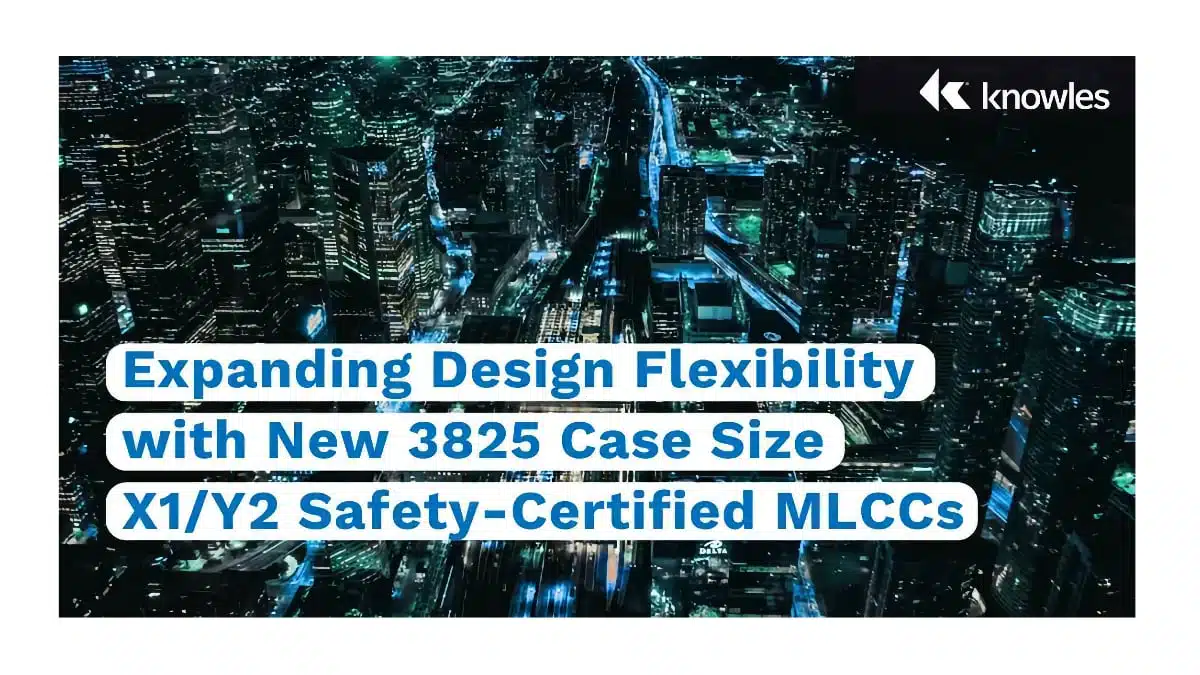
Knowles Precision Devices has expanded its X1/Y2 safety‑certified multilayer ceramic capacitor (MLCC) portfolio with a new 3825 case size aimed at compact, high‑voltage AC line and DC line filtering.

The new Knowles Precision Devices X1/Y2 MLCC ceramic safety capacitor combine safety approvals, extended creepage distance, and higher capacitance values to help designers meet insulation and EMC requirements in increasingly dense automotive and industrial power electronics.

RelatedPosts

Knowles Expands High Q Ceramic Core Inductors

Knowles Doubles Capacitance of its Class I Ceramic C0G Capacitors

Knowles Releases High Q Non-Magnetic X7R MLCCs for Medical Imaging

Key features and benefits

  • Safety‑certified X1/Y2 construction suitable for across‑the‑line and line‑to‑ground interference suppression in mains‑connected equipment, reducing the need to trade off footprint against insulation distance.
  • Capacitance values from 1 nF up to 18 nF at 310 Vac, enabling more effective noise attenuation and EMI filter tuning in space‑constrained designs where film capacitors may be too large.
  • Minimum creepage distance of 7 mm in 3825 case size, supporting required clearance on high‑voltage nodes while keeping the footprint in a standard surface‑mount MLCC outline.
  • Rated to 1500 Vdc and Humidity Grade IIIB (85 °C/85% RH for 1,000 hours), providing robustness against high voltage stress and long‑term exposure to moisture in harsh environments.
  • AEC‑Q200 qualified with flexible terminations, helping absorb PCB flex and thermal cycling, which is critical in automotive ECUs, power modules, and industrial drives.
  • Surface‑mount form factor, allowing automated assembly and reflow soldering, simplifying manufacturing compared to leaded safety capacitors in similar voltage classes.

Typical applications

The new 3825 X1/Y2 MLCCs target safety‑critical and high‑reliability power electronics where both insulation and compact size are important.

  • AC line filters in on‑board chargers, server power supplies, and industrial SMPS input stages
  • Line‑to‑ground Y capacitors and line‑to‑line X capacitors for EMC compliance in single‑ and three‑phase equipment
  • Noise suppression on high‑voltage DC bus nodes in EV traction inverters, DC fast chargers, and renewable energy inverters
  • Auxiliary power supplies, housekeeping SMPS, and bias supplies inside EV and industrial power units
  • Industrial control, automation, and drives where high surge immunity and long‑term reliability under humidity are required

In many of these positions, the 3825 safety MLCCs can reduce board area compared with traditional safety‑rated film capacitors, while still maintaining certified insulation distances and surge withstand capability.

Technical highlights

The 3825 case size devices extend the existing Knowles X1/Y2 safety MLCC family by adding higher capacitance values and a larger creepage path within a surface‑mount package.

Core electrical and environmental parameters

  • X1/Y2 safety classification for mains applications
  • Capacitance range in 3825 series: approximately 1 nF to 18 nF, depending on voltage rating
  • AC voltage ratings from 310 Vac up to 660 Vac according to series options
  • DC withstand rating of 1500 Vdc
  • Humidity Grade IIIB, tested at 85 °C/85% RH for 1,000 hours
  • Operating temperature range from −55 °C to +125 °C (typical for this platform; exact limits according to manufacturer datasheet)
  • AEC‑Q200 qualification for automotive environments

In practice, the combination of high AC rating and 1500 Vdc withstand is important where capacitors see both continuous mains or high DC bias and superimposed surge events. Humidity Grade IIIB indicates the parts are qualified for use in moisture‑prone environments such as under‑hood automotive or outdoor industrial cabinets, but designers should still follow conformal coating and derating guidelines defined in the datasheet for the harshest conditions.

Mechanical and insulation characteristics

  • 3825 case size surface‑mount MLCC
  • Minimum creepage distance of 7 mm across the component body
  • Flexible termination system to improve resistance to board bending and thermal stress

The 7 mm creepage distance is a key parameter for meeting safety standards at higher mains voltages, especially when working with reinforced insulation or higher overvoltage categories. The flexible termination structure helps mitigate board flex cracking, a common failure mode for large MLCCs in power electronics assemblies.

3825 safety MLCC options overview

The manufacturer presents the 3825 case size X1/Y2 MLCCs in multiple capacitance and voltage combinations. Exact ordering codes and full detail are provided in the official product and safety‑cap catalog, but the portfolio can be summarized as follows:

Parameter3825 X1/Y2 safety MLCCs
Case size3825 surface‑mount MLCC
Safety classX1/Y2
AC voltage ratings310 Vac up to 660 Vac (per series option, see datasheet)
Capacitance rangeApprox. 1 nF to 18 nF, depending on voltage class
DC rating1500 Vdc withstand
CreepageMinimum 7 mm
QualificationAEC‑Q200, Humidity Grade IIIB

When selecting a part, engineers should match both the AC rating and the safety class to the applicable equipment standard, then choose the capacitance needed for the required impedance and EMI performance.

Design‑in notes for engineers

When designing with safety‑certified MLCCs in high‑voltage power electronics, paying attention to both electrical and mechanical aspects is crucial.

Electrical design considerations

  • Verify safety class and insulation requirements: Confirm that X1/Y2 classification, creepage distance, and surge performance meet the applicable system standard (such as requirements for across‑the‑line and line‑to‑ground capacitors in mains‑connected equipment).
  • Check AC and DC derating: Even though the 3825 series is rated up to 310 Vac and beyond (depending on variant) and 1500 Vdc, apply appropriate derating for worst‑case mains tolerance, overvoltage category, and ambient temperature.
  • Capacitance selection for EMI: Choose capacitance to balance conducted noise attenuation against leakage current and inrush behavior. Higher values up to 18 nF at 310 Vac help in achieving better low‑frequency attenuation, but may increase leakage.
  • Consider harmonic and surge stresses: Evaluate resonances between Y capacitors, X capacitors, common‑mode chokes, and line impedance. Use the datasheet surge test data as a guide and, where possible, validate with surge and burst testing on the assembled system.

Layout and mechanical implementation

  • Respect creepage and clearance on the PCB: The 7 mm creepage across the component supports high‑voltage operation, but PCB layout (tracking, solder mask, slots) must also be designed to meet system‑level creepage and clearance requirements.
  • Place near EMI entry points: For best performance, position X1/Y2 capacitors close to AC input connectors, rectifiers, or common‑mode chokes, minimizing loop area and stray inductance.
  • Account for board flex and vibration: Although these parts use flexible terminations, avoid placing large MLCCs near board edges, mounting holes, or connectors where flexing is highest; consider mechanical support or coating where appropriate.
  • Thermal environment: Ensure local hotspot temperatures remain within the specified operating range from −55 °C to +125 °C according to the series datasheet, especially near power semiconductors and resistive losses in input networks.

Qualification and lifecycle management

  • Use AEC‑Q200 data for risk assessment: The automotive‑grade qualification gives additional confidence for use in mission‑critical systems, but designers should still perform application‑specific reliability analysis.
  • Second‑source planning: While safety and creepage constraints often limit true second sources, consider designing footprints that can accept alternative safety capacitor styles (for example, film devices) as a contingency, even if the primary design uses the 3825 MLCCs.

Source

The information in this article is based on an official communication from Knowles Precision Devices about the expansion of its X1/Y2 safety‑certified MLCC portfolio with a new 3825 case size, complemented by data available on the manufacturer’s safety‑certified MLCC product pages and distributor listings.


References

  1. Knowles blog: Expanding Design Flexibility with New 3825 Case Size X1/Y2 Safety‑Certified MLCCs
  2. Knowles safety‑certified MLCC portfolio overview
  3. 3825 Series X1/Y2 safety‑certified MLCCs at DigiKey

Related

Recent Posts

Knowles Expands High Q Ceramic Core Inductors

11.6.2026
2

TAIYO YUDEN Releases 220uF 1210 Automotive MLCC

11.6.2026
9

HEICO’s Exxelia Expands High-Voltage Ceramic Capacitor Portfolio with CalRamic Acquisition

10.6.2026
17

Vishay Extends Automotive Ferrite Beads for High‑Current EMC Noise Filtering

10.6.2026
8

CapXon Earns EcoVadis Bronze Medal for Sustainability Performance

10.6.2026
11

All‑Water Supercapacitor Based on 1‑nm Clay Channels and Nanoconfined Water Electrolyte

10.6.2026
19

Littelfuse Unveils High‑Current 48V SMD Fuse for AI Data Center Protection

9.6.2026
7

Modelithics Releases COMPLETE Library v26.2 for Keysight Genesys

8.6.2026
13

Power Converter Dossier: Passive Components Design and Selection Guide 2026

5.6.2026
43

Upcoming Events

Jun 16
16:00 - 17:00 CEST

EMC with EMC – EMC‑compliant design with electromechanical connectors

Jul 14
16:00 - 17:00 CEST

EMC Design Essentials: Mastering Varistors and Common Mode Chokes

Jul 21
16:00 - 17:00 CEST

Safety by design: X and Y Interference suppression capacitors for power line filters

View Calendar

Popular Posts

  • Buck Converter Design and Calculation

    0 shares
    Share 0 Tweet 0
  • Boost Converter Design and Calculation

    0 shares
    Share 0 Tweet 0
  • MLCC and Ceramic Capacitors

    0 shares
    Share 0 Tweet 0
  • LLC Resonant Converter Design and Calculation

    0 shares
    Share 0 Tweet 0
  • Flyback Converter Design and Calculation

    0 shares
    Share 0 Tweet 0
  • SEPIC Converter Design and Calculation

    0 shares
    Share 0 Tweet 0
  • What Electronics Engineer Needs to Know About Passive Low Pass Filters

    0 shares
    Share 0 Tweet 0
  • Dual Active Bridge (DAB) Topology

    0 shares
    Share 0 Tweet 0
  • Capacitor Charging and Discharging

    0 shares
    Share 0 Tweet 0
  • Earthing Systems and IEC Classification Explained

    0 shares
    Share 0 Tweet 0

Newsletter Subscription


Passive Components Blog

© EPCI - Leading Passive Components Educational and Information Site

  • Home
  • Privacy Policy
  • EPCI Membership & Advertisement
  • About

No Result
View All Result
  • Home
  • Knowledge Blog
  • Dossiers
  • PCNS

© EPCI - Leading Passive Components Educational and Information Site

This website uses cookies. By continuing to use this website you are giving consent to cookies being used. Visit our Privacy and Cookie Policy.
Go to mobile version