



Passive Components Blog
No Result
View All Result
  • Home
  • NewsFilter
    • All
    • Aerospace & Defence
    • Antenna
    • Applications
    • Automotive
    • Capacitors
    • Circuit Protection Devices
    • electro-mechanical news
    • Filters
    • Fuses
    • Inductors
    • Industrial
    • Integrated Passives
    • inter-connect news
    • Market & Supply Chain
    • Market Insights
    • Medical
    • Modelling and Simulation
    • New Materials & Supply
    • New Technologies
    • Non-linear Passives
    • Oscillators
    • Passive Sensors News
    • Resistors
    • RF & Microwave
    • Telecommunication
    • Weekly Digest

    TrendForce: CSP in‑house AI ASIC Boom Reshapes Capacitor Demand

    Würth Elektroniks Flexible EMI Shielding Sheets Provides Quick and Easy Schielding Solution

    Samsung Introduces Automotive 1206 100uF X7T MLCC for Power Rails in ADAS and SoCs

    Hirose Releases Ultra‑low Profile FPC‑to‑board Connector

    YMIN Hybrid Aluminum Capacitors for Automotive LiDAR Power Rails

    Samsung Presents Ultra‑Thin Silicon Capacitors for AI and Server PDN

    YAGEO Introduces 310VAC SMD Y2 Safety MP Capacitors for Compact EMI Filtering

    DMASS: European Components Distribution Returns To Growth In Q1 2026

    German Component Distribution Market Rebounds in Q1 2026 According to FBDi

    Trending Tags

    • Ripple Current
    • RF
    • Leakage Current
    • Tantalum vs Ceramic
    • Snubber
    • Low ESR
    • Feedthrough
    • Derating
    • Dielectric Constant
    • New Products
    • Market Reports
  • VideoFilter
    • All
    • Antenna videos
    • Capacitor videos
    • Circuit Protection Video
    • Filter videos
    • Fuse videos
    • Inductor videos
    • Inter-Connect Video
    • Non-linear passives videos
    • Oscillator videos
    • Passive sensors videos
    • Resistor videos

    Why Isolated DC/DC Power Supplies Fail Late, Würth Elektronik Podcast

    Designing 800 V DC EMC Filters: Calculation, Simulation and Measurement

    Current Sense Transformer Datasheet and Design‑in Guide

    Designing a USB Type‑C Flyback Planar Transformer with Frenetic’s Planar Tool

    Magnetics Design in High‑Frequency GaN Converters

    Qi2 Wireless Charging: Inductors, Capacitors and EMC Filters

    Two‑capacitor paradox explained for engineers

    Capacitances of Nonlinear MLCCs: What Datasheets Don’t Tell You

    Tapped Inductor Buck Converter Fundamentals

    Trending Tags

    • Capacitors explained
    • Inductors explained
    • Resistors explained
    • Filters explained
    • Application Video Guidelines
    • EMC
    • New Products
    • Ripple Current
    • Simulation
    • Tantalum vs Ceramic
  • Knowledge Blog
  • DossiersNew
  • Suppliers
    • Who is Who
  • PCNS
    • PCNS 2025
    • PCNS 2023
    • PCNS 2021
    • PCNS 2019
    • PCNS 2017
  • Events
  • Home
  • NewsFilter
    • All
    • Aerospace & Defence
    • Antenna
    • Applications
    • Automotive
    • Capacitors
    • Circuit Protection Devices
    • electro-mechanical news
    • Filters
    • Fuses
    • Inductors
    • Industrial
    • Integrated Passives
    • inter-connect news
    • Market & Supply Chain
    • Market Insights
    • Medical
    • Modelling and Simulation
    • New Materials & Supply
    • New Technologies
    • Non-linear Passives
    • Oscillators
    • Passive Sensors News
    • Resistors
    • RF & Microwave
    • Telecommunication
    • Weekly Digest

    TrendForce: CSP in‑house AI ASIC Boom Reshapes Capacitor Demand

    Würth Elektroniks Flexible EMI Shielding Sheets Provides Quick and Easy Schielding Solution

    Samsung Introduces Automotive 1206 100uF X7T MLCC for Power Rails in ADAS and SoCs

    Hirose Releases Ultra‑low Profile FPC‑to‑board Connector

    YMIN Hybrid Aluminum Capacitors for Automotive LiDAR Power Rails

    Samsung Presents Ultra‑Thin Silicon Capacitors for AI and Server PDN

    YAGEO Introduces 310VAC SMD Y2 Safety MP Capacitors for Compact EMI Filtering

    DMASS: European Components Distribution Returns To Growth In Q1 2026

    German Component Distribution Market Rebounds in Q1 2026 According to FBDi

    Trending Tags

    • Ripple Current
    • RF
    • Leakage Current
    • Tantalum vs Ceramic
    • Snubber
    • Low ESR
    • Feedthrough
    • Derating
    • Dielectric Constant
    • New Products
    • Market Reports
  • VideoFilter
    • All
    • Antenna videos
    • Capacitor videos
    • Circuit Protection Video
    • Filter videos
    • Fuse videos
    • Inductor videos
    • Inter-Connect Video
    • Non-linear passives videos
    • Oscillator videos
    • Passive sensors videos
    • Resistor videos

    Why Isolated DC/DC Power Supplies Fail Late, Würth Elektronik Podcast

    Designing 800 V DC EMC Filters: Calculation, Simulation and Measurement

    Current Sense Transformer Datasheet and Design‑in Guide

    Designing a USB Type‑C Flyback Planar Transformer with Frenetic’s Planar Tool

    Magnetics Design in High‑Frequency GaN Converters

    Qi2 Wireless Charging: Inductors, Capacitors and EMC Filters

    Two‑capacitor paradox explained for engineers

    Capacitances of Nonlinear MLCCs: What Datasheets Don’t Tell You

    Tapped Inductor Buck Converter Fundamentals

    Trending Tags

    • Capacitors explained
    • Inductors explained
    • Resistors explained
    • Filters explained
    • Application Video Guidelines
    • EMC
    • New Products
    • Ripple Current
    • Simulation
    • Tantalum vs Ceramic
  • Knowledge Blog
  • DossiersNew
  • Suppliers
    • Who is Who
  • PCNS
    • PCNS 2025
    • PCNS 2023
    • PCNS 2021
    • PCNS 2019
    • PCNS 2017
  • Events
No Result
View All Result
Passive Components Blog
No Result
View All Result

Reducing Cost of Producing Supercapacitors

22.8.2016
Reading Time: 3 mins read
A A

source: ScienceDaily article

Thu, 08/18/2016 – 1:55pm by South Dakota State University
The ability to absorb and discharge energy quickly make supercapacitors an integral part of energy harvesting systems, such as the regenerative braking systems of hybrid vehicles, according to explainthatstuff.com. However, supercapacitors are expensive.

RelatedPosts

TrendForce: CSP in‑house AI ASIC Boom Reshapes Capacitor Demand

Würth Elektroniks Flexible EMI Shielding Sheets Provides Quick and Easy Schielding Solution

Samsung Introduces Automotive 1206 100uF X7T MLCC for Power Rails in ADAS and SoCs

About half the materials cost comes from the use of activated carbon to coat the electrodes, according to Materials Today. Supercapacitor-grade activated carbon can cost $15 per kilogram.

Two South Dakota State University engineering researchers are using biochar, an inexpensive carbon-rich material and a new method of creating the porous surface needed to capture electricity to reduce the cost of supercapacitors.

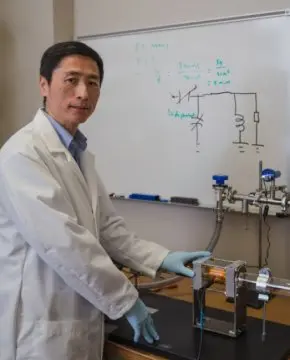
Associate professor Qi Hua Fan of electrical engineering and computer Science uses plasma etching to active the biochar. Associate professor Zhengrong Gu of agricultural and biosystems engineering uses the activated biochar to make supercapacitors. Biochar is a byproduct of the pyrolysis process that turns plant materials into biofuel.

Activating biochar

“Raw biochar needs activation to create the porous structure needed to trap ions,” explained Fan. Traditional chemical activation requires a high temperature, in the range of 1,700 Fahrenheit for two hours, and a chemical catalyst, followed by chemical washing and prolonged drying. This makes it an energy-intensive, time-consuming process.

The charcoal-like biochar can be made from crop residue, such as corn stover, wood or even dried distillers grain with solubles, known as DDGS. However, for this research, Fan used commercially available biochar made from yellow pine.

Several research groups had analyzed the specific capacitance and performance of this type of biochar, he explained, “so we had a baseline.” In addition, a company could supply the quantities of biochar necessary to make sure that test results were repeatable.

To do the plasma etching, oxygen was used and excited by radio frequency through a dielectric barrier discharge. Fan then gave the activated biochar to Gu, who made the supercapacitors. The research was supported by a five-month, proof-of-concept grant from the North Central Regional Sun Grant Center. Two graduate students worked on the project.

Increasing capacitance, improving efficiency

When the researchers compared capacitor performance, they found that those made using plasma treatment had 1.7 times higher specific capacitance, 171.4 Farads, compared to 99.5 Farads using chemical activation. “That’s a big improvement,” Fan pointed out.

The process took only five minutes with no external heating or chemicals needed. “It is very fast and consumes very little energy,” he noted. “The energy required to activate biochar is equivalent to what we use for a light bulb.”

In a paper published in the Journal of Power Sources, Fan, Gu and assistant physics professor Parashu Kharel explain, “oxygen plasma was capable of creating various pore sizes that would allow easy access for the electrolyte ions to the porous surface, leading to a higher capacitance than the chemically activated biochar.”

In addition, oxygen plasma-activated capacitors had lower estimated resistance, 3.3 ohms, as opposed to 14.5 ohms for chemically treated capacitors. This was attributed to the ions having easier access to the micropores and mesopores created by plasma processing.

And, Fan added, “Yellow pine is not the best biochar for supercapacitors.” He expects a similar improvement in performance using biochar derived from other types of biomass.

However, he pointed out, the process must be optimized for each type of structure. “Activation depends on what kind of plasma, what conditions are used and how long we treat the material.”

Fan has filed a patent application for the plasma activation process he developed. The next step will be to apply for funding to expand this promising processing technique for other types of biochar.

“No matter what kind of parameters we eventually end up with, this will be very efficient,” he added.

Related

Recent Posts

TrendForce: CSP in‑house AI ASIC Boom Reshapes Capacitor Demand

18.6.2026
6

Samsung Introduces Automotive 1206 100uF X7T MLCC for Power Rails in ADAS and SoCs

17.6.2026
16

YMIN Hybrid Aluminum Capacitors for Automotive LiDAR Power Rails

17.6.2026
15

Samsung Presents Ultra‑Thin Silicon Capacitors for AI and Server PDN

17.6.2026
20

YAGEO Introduces 310VAC SMD Y2 Safety MP Capacitors for Compact EMI Filtering

16.6.2026
17

DMASS: European Components Distribution Returns To Growth In Q1 2026

16.6.2026
17

German Component Distribution Market Rebounds in Q1 2026 According to FBDi

16.6.2026
14

Nippon Chemi-Con Announces New Capacitor series for AI, Automotive and Immersion Cooling

16.6.2026
23

Ultrahigh Energy Storage in Lead‑Free BiFeO₃‑Based Ceramic Capacitors via Local Polar Structure Design

16.6.2026
24

Upcoming Events

Jul 14
16:00 - 17:00 CEST

EMC Design Essentials: Mastering Varistors and Common Mode Chokes

Jul 21
16:00 - 17:00 CEST

Safety by design: X and Y Interference suppression capacitors for power line filters

View Calendar

Popular Posts

  • Boost Converter Design and Calculation

    0 shares
    Share 0 Tweet 0
  • Buck Converter Design and Calculation

    0 shares
    Share 0 Tweet 0
  • LLC Resonant Converter Design and Calculation

    0 shares
    Share 0 Tweet 0
  • Flyback Converter Design and Calculation

    0 shares
    Share 0 Tweet 0
  • MLCC and Ceramic Capacitors

    0 shares
    Share 0 Tweet 0
  • Earthing Systems and IEC Classification Explained

    0 shares
    Share 0 Tweet 0
  • SEPIC Converter Design and Calculation

    0 shares
    Share 0 Tweet 0
  • Dual Active Bridge (DAB) Topology

    0 shares
    Share 0 Tweet 0
  • What Electronics Engineer Needs to Know About Passive Low Pass Filters

    0 shares
    Share 0 Tweet 0
  • MLCC Case Sizes Standards Explained

    0 shares
    Share 0 Tweet 0

Newsletter Subscription


Passive Components Blog

© EPCI - Leading Passive Components Educational and Information Site

  • Home
  • Privacy Policy
  • EPCI Membership & Advertisement
  • About

No Result
View All Result
  • Home
  • Knowledge Blog
  • Dossiers
  • PCNS

© EPCI - Leading Passive Components Educational and Information Site

This website uses cookies. By continuing to use this website you are giving consent to cookies being used. Visit our Privacy and Cookie Policy.
Go to mobile version