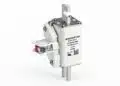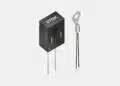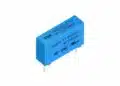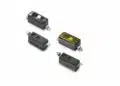


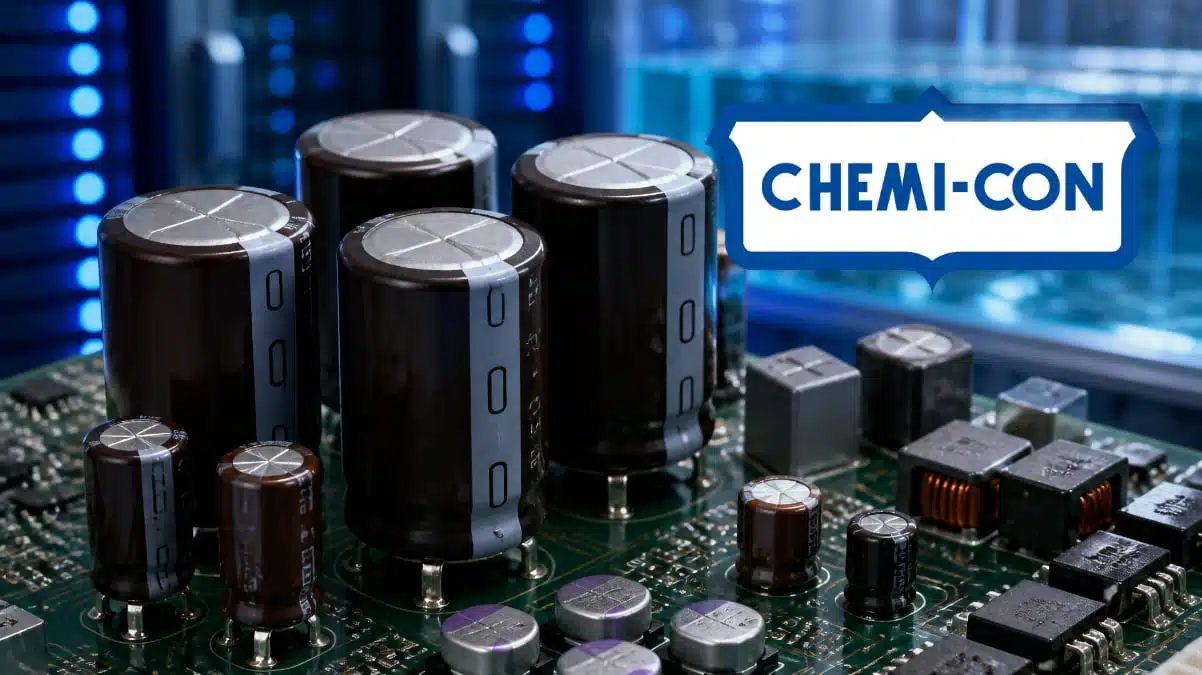
Nippon Chemi-Con has announced a comprehensive update of its new/under development capacitor portfolio with multiple new and upgraded series targeting AI servers, liquid immersion cooling, automotive power electronics, and high‑reliability industrial applications.
The lineup spans conductive polymer, hybrid and aluminum electrolytic capacitors, plus a new EDLC supercapacitor series, giving design engineers more options for high temperature, high ripple current and high vibration environments.
Key features and benefits
Broad coverage from low-voltage logic to high-voltage DC links
- New and upgraded series span polymer, hybrid, aluminum electrolytic (SMD, radial, snap‑in) and EDLC technologies, enabling coherent platform designs from point-of-load to bulk energy storage according to the manufacturer product overview.
- Voltage ratings extend from typical logic rails up to 500 V DC for snap‑in types, supporting on‑board chargers, microinverters, energy storage and data‑center power stages as indicated by the series descriptions.
- High capacitance per volume is emphasized across several series (PXG, LBYA, KHU/LHU), allowing smaller footprints or higher energy buffering in constrained layouts according to manufacturer claims.
Support for liquid immersion cooling
- Multiple series (PXLA, PSLA, HXUA, MHU, KZUA, KHUA) are explicitly designed or upgraded for operation in liquid immersion cooling environments using new sealing and composite sealing technologies.
- These constructions aim to prevent coolant ingress while maintaining long lifetime at elevated temperatures, which is critical for emerging direct‑to‑chip and full‑rack immersion systems in AI servers and infrastructure according to the manufacturer’s application notes.
Automotive-grade reliability and vibration resistance
- Several aluminum electrolytic series (KXQ, GXF, KVC, LVB, LBYA) are targeted at automotive electrical systems such as on‑board chargers, SRS airbag systems and auxiliary power, with AEC‑Q200 compliance where specified.
- Snap‑in series KVC and LVB feature vibration‑resistant structures and higher ripple current capability (approximately 1.2× versus previous KVA/LVA series), enabling component count reduction in high‑vibration environments like vehicle powertrains according to manufacturer data.
High temperature and lifetime performance
- Hybrid and electrolytic series offer endurance up to 5,000 hours at 105 °C, 6,000 hours at 105–135 °C, and in some cases withstanding short‑term exposure up to 150 °C, which helps extend system lifetime margins under derated operating conditions according to datasheet summaries.
- The new DKG EDLC series guarantees operation at 2.7 V for 2,000 hours at elevated temperature, providing higher voltage and reduced size compared to conventional 2.5 V supercapacitors as specified by the manufacturer.
Typical applications
Nippon Chemi-Con positions the new and upgraded series primarily for AI/data‑center power, automotive electronics and high‑reliability industrial power conversion according to its new series list.
- AI servers (motherboard and GPU power, DC input stages)
- Liquid immersion cooled racks and tanks in data centers and infrastructure
- On‑board chargers and high‑voltage automotive power supplies
- Mechatronic integrated inverters in vehicles
- SRS airbag systems and other safety‑critical automotive modules
- Microinverters and distributed renewable energy systems
- Industrial drives, UPS and energy storage DC links
- General high‑reliability, high‑ripple and high‑vibration power supplies
Example application mapping
| Series / family | Technology | Typical target applications (according to manufacturer) |
|---|---|---|
| PXG (upgrade) | Conductive polymer | DC input circuits, USB Power Delivery, AI server DC input where high capacitance at 16–25 V is required. |
| PXLA, PSLA (new) | Conductive polymer | AI servers (motherboard, GPU) using liquid immersion cooling, where 5,000 h at 105 °C and immersion‑capable sealing are beneficial. |
| HXF, HXUA (upgrade/new) | Hybrid | Automotive inverters and AI server/infrastructure power needing high ripple, high reliability and immersion‑capable hybrid capacitors. |
| MHU (upgrade) | SMD aluminum electrolytic | Automotive and infrastructure equipment in immersion‑cooled systems, SMD mounting with long life at 125 °C. |
| KXQ (upgrade) | Radial aluminum electrolytic | On‑board chargers input smoothing, automotive power input stages, high‑capacitance long‑life use cases. |
| LBYA (new) | Radial aluminum electrolytic | Automotive SRS airbag systems, microinverters, AI server power needing very high capacitance under 100 V. |
| KZUA (new) | Radial aluminum electrolytic | AI server power in liquid immersion cooling with long life at 105 °C. |
| GXF (upgrade) | Radial aluminum electrolytic | Automotive electrical equipment and high‑reliability power supplies with high temperature and ripple stress. |
| KHU, KHUA, LHU (upgrade) | Snap‑in aluminum electrolytic | Data center server power and new energy storage DC links up to 500 V with high capacity and long life (3,000–5,000 h at 105 °C). |
| KVC, LVB (new) | Snap‑in aluminum electrolytic | Automotive on‑board chargers and high‑vibration power supplies needing high ripple current and AEC‑Q200 compliance. |
| DKG (new) | EDLC supercapacitor | Compact energy buffering where higher voltage, reduced size and long life are required compared to conventional 2.5 V EDLCs. |
Technical highlights
This section summarizes the main technical differentiators as stated by Nippon Chemi-Con, without reproducing full datasheet tables.
Conductive polymer series
- PXG (upgrade)
- Conductive polymer aluminum capacitors with rated voltages in the 16–25 V range, now including 25 V parts with approximately 20–40% higher capacitance than previous versions.
- Uses new high‑gain electrode foils and technology to uniformly form conductive polymers, improving volumetric efficiency and potentially reducing series resistance according to the manufacturer description.
- Targeted to DC input circuits and USB Power Delivery, with added large‑capacity options aimed at AI server applications.
- PXLA, PSLA (new)
- Conductive polymer capacitors specifically developed for liquid immersion cooling using new sealing technologies.
- Guaranteed for 5,000 hours at 105 °C, which in typical derated operation (lower temperature and voltage) can translate into significantly longer expected service life.
- Intended for AI server motherboards and GPU power stages where high heat dissipation is required and immersion cooling is adopted.
Hybrid capacitor series
- HXF (upgrade)
- Hybrid capacitors combining conductive polymer and liquid electrolyte to achieve high reliability and high ripple current capability.
- According to the manufacturer, they can withstand heat up to 150 °C for short periods, making them suitable for harsh environments such as automotive mechatronic integrated inverters.
- The latest update introduces new 63 V high‑capacity and 80 V products for AI server applications.
- HXUA (new)
- Hybrid capacitors designed for liquid immersion cooling with composite sealing technology, offering long life and vibration resistance up to 40 G according to the manufacturer.
- Guaranteed for 6,000 hours at 125–135 °C, positioning them for high‑reliability automotive and infrastructure markets adopting immersion cooling.
Aluminum electrolytic (E‑Cap) SMD and radial series
- MHU (upgrade, SMD)
- SMD aluminum electrolytic capacitors for liquid immersion cooling, using composite sealing for long life and 40 G vibration resistance.
- Guaranteed for 5,000 hours at 125 °C, suited to automotive and infrastructure equipment exposed to high temperature and vibration.
- KXQ (upgrade, radial THD)
- Small‑size, high‑capacitance radial capacitors for input smoothing in on‑board chargers, with lifetime ratings of 10,000 or 12,000 hours at 105 °C according to the manufacturer.
- Compliant with AEC‑Q200 and now extended with taller case sizes (45 mm and 50 mm length) and 500 V rated versions to support higher OBC output power.
- LBYA (new, radial THD)
- New series with rated voltages up to 100 V targeting SRS airbag systems, microinverters and AI server power supplies requiring high capacitance.
- Achieves approximately 1.2× higher capacitance per unit volume compared to the preceding LBV series; a 35 V, 16 × 25 mm size capacitor reaches 5,200 µF versus 4,300 µF previously, with capacitance tolerance specified without negative deviation.
- Guaranteed capacitance equal to or above nominal is advantageous for safety‑critical and tightly dimensioned designs, as it provides predictable minimum energy storage.
- KZUA (new, radial THD)
- Aluminum electrolytic series for liquid immersion cooling, using new sealing technologies as with other immersion‑capable lines.
- Guaranteed for 6,000 hours at 105 °C, targeting AI servers and infrastructure where high heat dissipation and immersion are required.
- GXF (upgrade, radial THD)
- Developed for automotive electrical equipment and high‑reliability power supplies that require high temperature capability, high ripple current and high reliability.
- New versions add 275 V, 300 V and 450 V products targeted at automotive electrical equipment DC links and power conversion stages.
Aluminum electrolytic snap‑in series
- KHUA, KHU, LHU (upgrades)
- Snap‑in aluminum electrolytic capacitors with maximum rated voltage up to 500 V and product heights up to 100 mm for high‑voltage, large‑capacity applications such as data center servers and energy storage.
- Utilize new electrode foils to increase capacitance at high voltages; endurance is 3,000 hours at 105 °C for KHU and KHUA, and 5,000 hours at 105 °C for LHU according to the manufacturer.
- KHUA additionally features a structure adapted for liquid immersion cooling, combining high voltage and large capacity with immersion compatibility.
- KVC, LVB (new snap‑in series)
- Both series incorporate vibration‑resistant structures to ensure high reliability in high‑vibration environments such as automotive on‑board chargers.
- Rated ripple current is about 1.2 times higher than existing KVA (for KVC) and LVA (for LVB) series of the same size, supporting higher power density and potential component count reduction.
- KVC offers 3,000 hours endurance at 105 °C and LVB 5,000 hours at 105 °C; both are compliant with AEC‑Q200.
Supercapacitor EDLC DKG series
- DKG (new EDLC series)
- Electric double‑layer supercapacitor series characterized by higher withstand voltage and long life.
- Guarantees 2.7 V operation for 2,000 hours (2.7 V at 65 °C or 2.5 V at 70 °C, according to the manufacturer summary).
- Offers higher rated voltage and up to 20% smaller size than conventional 2.5 V EDLCs, contributing to reduced mounting volume for energy buffering applications.
Design‑in notes for engineers
Immersion‑capable sealing and mechanical robustness
- When using immersion‑cooling series (PXLA, PSLA, HXUA, MHU, KZUA, KHUA), ensure that only capacitors explicitly specified by the manufacturer for immersion are placed inside the coolant volume and that mounting orientation and clearance follow datasheet recommendations.
- For series rated to 40 G vibration resistance (HXUA, MHU), PCB layout, mechanical support and potting (if any) should still be evaluated at system level, as overall robustness depends on the complete assembly and not solely on component ratings.
Lifetime and derating strategy
- Lifetime figures such as 3,000 hours at 105 °C or 6,000 hours at 125 °C are typically used with Arrhenius‑type acceleration models; operating at lower temperature and voltage will significantly extend expected service life, so conservative derating is recommended in automotive and server applications.
- For safety‑critical and difficult‑to‑service systems (for example SRS, in‑vehicle inverters, immersion‑cooled racks), it is advisable to combine manufacturer lifetime data with system‑level thermal simulations and, where possible, field‑oriented HALT/HASS validation.
Capacitance tolerance and energy margins
- The zero‑negative‑tolerance specification of LBYA means that design calculations can assume at least nominal capacitance for energy storage and time constants, which simplifies worst‑case analysis for safety‑critical circuits compared with conventional asymmetric tolerances.
- For DC link and input filters using KXQ, GXF, KHU/KHUA/LHU, appropriate design margins should consider both initial capacitance and expected decrease over lifetime as described in the corresponding datasheets.
Ripple current and thermal management
- Snap‑in series KVC and LVB, with 1.2× higher ripple current ratings than their predecessors, can potentially reduce the number of parallel capacitors in OBC input and DC link stages, but designers must still check actual ripple waveforms at maximum load and ambient temperature against datasheet limits.
- In immersion‑cooled systems, the improved heat transfer from liquid contact can further reduce internal hot‑spot temperatures; however, only components with suitable sealing should be exposed to coolant to avoid degradation.
EDLC integration
- The DKG series, with higher rated voltage and reduced size, is suitable where supercapacitors are used for short‑term backup, ride‑through or peak‑shaving; system designers should review the specified derating conditions at 2.7 V versus 2.5 V to ensure adequate reliability at the desired temperature range.
- As with other EDLCs, cell balancing and voltage management are critical when series‑connecting multiple DKG devices for higher system voltage; the manufacturer datasheet should be consulted for recommended balancing and protection practices.
Source
The information in this article is based on a Nippon Chemi-Con New/Under Development Series product announcement and associated series‑level documentation provided on the manufacturer’s website at the time of publication.[chemi-con.co]
References
- Nippon Chemi-Con – New/Under Development Series (Apr. 30, 2026)
- Nippon Chemi-Con – PXG series overview
- Nippon Chemi-Con – HXF series overview
- Nippon Chemi-Con – MHU series overview
- Nippon Chemi-Con – KXQ series overview
- Nippon Chemi-Con – GXF series overview
- Nippon Chemi-Con – KHU series overview
- Nippon Chemi-Con – LHU series overview
- Nippon Chemi-Con – DKG EDLC series overview