





Passive Components Blog
No Result
View All Result
  • Home
  • NewsFilter
    • All
    • Aerospace & Defence
    • Antenna
    • Applications
    • Automotive
    • Capacitors
    • Circuit Protection Devices
    • electro-mechanical news
    • Filters
    • Fuses
    • Inductors
    • Industrial
    • Integrated Passives
    • inter-connect news
    • Market & Supply Chain
    • Market Insights
    • Medical
    • Modelling and Simulation
    • New Materials & Supply
    • New Technologies
    • Non-linear Passives
    • Oscillators
    • Passive Sensors News
    • Resistors
    • RF & Microwave
    • Telecommunication
    • Weekly Digest

    SCHURTER Introduces PPTC Resettable Overcurrent Protection for Compact Electronics

    TrendForce: CSP in‑house AI ASIC Boom Reshapes Capacitor Demand

    Würth Elektroniks Flexible EMI Shielding Sheets Provides Quick and Easy Schielding Solution

    Samsung Introduces Automotive 1206 100uF X7T MLCC for Power Rails in ADAS and SoCs

    Hirose Releases Ultra‑low Profile FPC‑to‑board Connector

    YMIN Hybrid Aluminum Capacitors for Automotive LiDAR Power Rails

    Samsung Presents Ultra‑Thin Silicon Capacitors for AI and Server PDN

    YAGEO Introduces 310VAC SMD Y2 Safety MP Capacitors for Compact EMI Filtering

    DMASS: European Components Distribution Returns To Growth In Q1 2026

    Trending Tags

    • Ripple Current
    • RF
    • Leakage Current
    • Tantalum vs Ceramic
    • Snubber
    • Low ESR
    • Feedthrough
    • Derating
    • Dielectric Constant
    • New Products
    • Market Reports
  • VideoFilter
    • All
    • Antenna videos
    • Capacitor videos
    • Circuit Protection Video
    • Filter videos
    • Fuse videos
    • Inductor videos
    • Inter-Connect Video
    • Non-linear passives videos
    • Oscillator videos
    • Passive sensors videos
    • Resistor videos

    Why Isolated DC/DC Power Supplies Fail Late, Würth Elektronik Podcast

    Designing 800 V DC EMC Filters: Calculation, Simulation and Measurement

    Current Sense Transformer Datasheet and Design‑in Guide

    Designing a USB Type‑C Flyback Planar Transformer with Frenetic’s Planar Tool

    Magnetics Design in High‑Frequency GaN Converters

    Qi2 Wireless Charging: Inductors, Capacitors and EMC Filters

    Two‑capacitor paradox explained for engineers

    Capacitances of Nonlinear MLCCs: What Datasheets Don’t Tell You

    Tapped Inductor Buck Converter Fundamentals

    Trending Tags

    • Capacitors explained
    • Inductors explained
    • Resistors explained
    • Filters explained
    • Application Video Guidelines
    • EMC
    • New Products
    • Ripple Current
    • Simulation
    • Tantalum vs Ceramic
  • Knowledge Blog
  • DossiersNew
  • Suppliers
    • Who is Who
  • PCNS
    • PCNS 2025
    • PCNS 2023
    • PCNS 2021
    • PCNS 2019
    • PCNS 2017
  • Events
  • Home
  • NewsFilter
    • All
    • Aerospace & Defence
    • Antenna
    • Applications
    • Automotive
    • Capacitors
    • Circuit Protection Devices
    • electro-mechanical news
    • Filters
    • Fuses
    • Inductors
    • Industrial
    • Integrated Passives
    • inter-connect news
    • Market & Supply Chain
    • Market Insights
    • Medical
    • Modelling and Simulation
    • New Materials & Supply
    • New Technologies
    • Non-linear Passives
    • Oscillators
    • Passive Sensors News
    • Resistors
    • RF & Microwave
    • Telecommunication
    • Weekly Digest

    SCHURTER Introduces PPTC Resettable Overcurrent Protection for Compact Electronics

    TrendForce: CSP in‑house AI ASIC Boom Reshapes Capacitor Demand

    Würth Elektroniks Flexible EMI Shielding Sheets Provides Quick and Easy Schielding Solution

    Samsung Introduces Automotive 1206 100uF X7T MLCC for Power Rails in ADAS and SoCs

    Hirose Releases Ultra‑low Profile FPC‑to‑board Connector

    YMIN Hybrid Aluminum Capacitors for Automotive LiDAR Power Rails

    Samsung Presents Ultra‑Thin Silicon Capacitors for AI and Server PDN

    YAGEO Introduces 310VAC SMD Y2 Safety MP Capacitors for Compact EMI Filtering

    DMASS: European Components Distribution Returns To Growth In Q1 2026

    Trending Tags

    • Ripple Current
    • RF
    • Leakage Current
    • Tantalum vs Ceramic
    • Snubber
    • Low ESR
    • Feedthrough
    • Derating
    • Dielectric Constant
    • New Products
    • Market Reports
  • VideoFilter
    • All
    • Antenna videos
    • Capacitor videos
    • Circuit Protection Video
    • Filter videos
    • Fuse videos
    • Inductor videos
    • Inter-Connect Video
    • Non-linear passives videos
    • Oscillator videos
    • Passive sensors videos
    • Resistor videos

    Why Isolated DC/DC Power Supplies Fail Late, Würth Elektronik Podcast

    Designing 800 V DC EMC Filters: Calculation, Simulation and Measurement

    Current Sense Transformer Datasheet and Design‑in Guide

    Designing a USB Type‑C Flyback Planar Transformer with Frenetic’s Planar Tool

    Magnetics Design in High‑Frequency GaN Converters

    Qi2 Wireless Charging: Inductors, Capacitors and EMC Filters

    Two‑capacitor paradox explained for engineers

    Capacitances of Nonlinear MLCCs: What Datasheets Don’t Tell You

    Tapped Inductor Buck Converter Fundamentals

    Trending Tags

    • Capacitors explained
    • Inductors explained
    • Resistors explained
    • Filters explained
    • Application Video Guidelines
    • EMC
    • New Products
    • Ripple Current
    • Simulation
    • Tantalum vs Ceramic
  • Knowledge Blog
  • DossiersNew
  • Suppliers
    • Who is Who
  • PCNS
    • PCNS 2025
    • PCNS 2023
    • PCNS 2021
    • PCNS 2019
    • PCNS 2017
  • Events
No Result
View All Result
Passive Components Blog
No Result
View All Result

Hirose Releases Ultra‑low Profile FPC‑to‑board Connector

17.6.2026
Reading Time: 7 mins read
A A

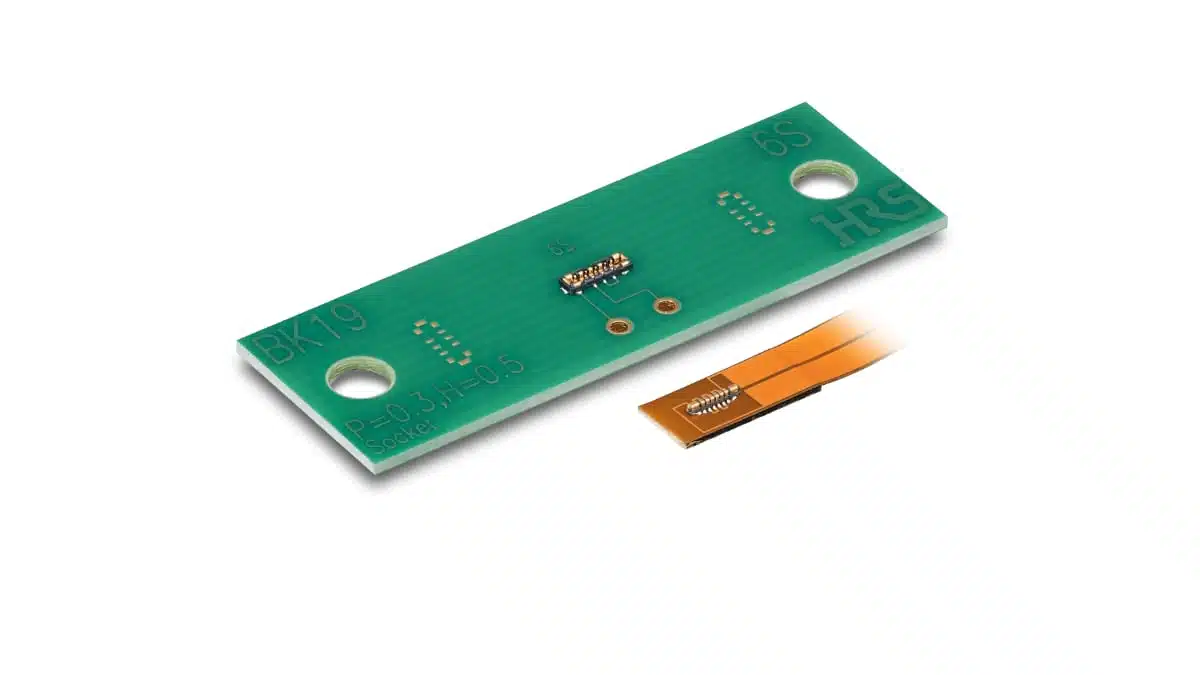
Hirose’s new BK19 series is an ultra‑miniature single‑row FPC‑to‑board connector that combines signal and power in one interface for space‑constrained mobile and wearable designs.

It targets applications where every fraction of a millimeter in height and width matters, while still requiring robust mechanical reliability in daily use.

RelatedPosts

Hirose Releases 0.5 mm Floating Board-to-Board Connector for EV Powertrain Designs

Hirose Expands Compact High‑Voltage EV connectors

Hirose Introduced BGA connector for PCIe Gen6 for AI and Edge Computing

Key features and benefits

  • Ultra‑low profile and narrow width
    0.3 mm pitch, approximately 1.2 mm connector width and 0.5 mm stacking height enable very tight z‑height budgets in smartphones, smartwatches and other ultra‑slim portable devices. These dimensions give mechanical designers more freedom to allocate volume to batteries, cameras or sensors instead of connectors.
  • Hybrid signal + power in a single row
    Single‑row configuration with six signal positions and two power positions allows both low‑level interfaces and power rail connection through one compact component, reducing connector count and routing complexity on dense boards.
  • Fully armored housing for mechanical robustness
    The connector features a fully armored design intended to protect the insulating housing from chipping and cracking during handling, rework or drop events. This is particularly relevant for thin end devices that may experience flexing and mechanical shocks.
  • Dimpled contact lock for high extraction force
    A dimpled contact lock structure increases extraction force, helping to maintain a secure connection under vibration, bending and repeated user handling. This supports reliability targets in mobile and wearable products that are frequently moved or worn on the body.
  • Wide self‑alignment range for easier assembly
    Generous self‑alignment in both pitch and width directions (±0.3 mm each, according to the manufacturer) improves mating tolerance in automated assembly and manual rework. This helps mitigate the usual assembly challenges associated with very small FPC‑to‑board connectors.
  • Insert‑molded plug and receptacle to prevent solder wicking
    Insert‑molded construction of both plug and receptacle is intended to block solder wicking into the contact area during reflow. This supports stable electrical performance and reduces assembly defects for high‑volume production.

Typical applications

According to Hirose, the BK19 series is designed for compact, highly integrated consumer and portable equipment where connector footprint and height are strongly constrained.

Typical use cases include:

  • Smartphones and feature phones, especially in display, camera, button and sensor interconnects where mating height directly impacts device thickness.
  • Wearable devices such as smartwatches and fitness trackers that demand minimal profile and robust resistance against daily mechanical stress.
  • VR and AR glasses where internal space for electronics and cabling is extremely limited and weight needs to be minimized.
  • Portable gaming devices, handheld consoles and accessories where hybrid power/signal connectors can simplify the internal harness and PCB layout.
  • Compact medical devices, including portable monitors and diagnostic tools, where small, reliable interconnects are needed and board real estate is at a premium.

In many of these applications, the FPC‑to‑board connector is used to bridge mechanical hinges, curved housings or stacked board configurations, making both low profile and self‑alignment important for manufacturability.

Technical highlights

The BK19 series focuses on miniaturization in all three dimensions while retaining mechanical robustness. Key structural and dimensional points from the manufacturer include:

  • Single‑row structure with 6 signal contacts and 2 power contacts.
  • Target use as an FPC‑to‑board interface with hybrid power and signal functionality.
  • Nominal contact pitch of 0.3 mm.
  • Connector body width of approximately 1.2 mm.
  • Mated stacking height of approximately 0.5 mm.
  • Metal mold covers at both ends of the connector to assist alignment and protect the housing.
  • Fully armored design around the housing.
  • Self‑alignment tolerance in pitch and width directions of approximately ±0.3 mm.
  • Insert‑molded plug and receptacle structure designed to suppress solder wicking during reflow.

For detailed electrical characteristics such as rated current per contact, voltage rating, contact resistance, insulation resistance and operating temperature range, designers should refer to the official BK19 series datasheet. These parameters are critical when using the power contacts to carry system rails or battery connections in compact consumer devices.

Dimensional overview

The following table summarizes the main mechanical parameters as described in the press information; always verify final values in the current datasheet before design‑in:

ParameterTypical value / description
Contact pitch0.3 mm
ConfigurationSingle row, 6 signal + 2 power
Connector widthApprox. 1.2 mm
Stacking height (mated)Approx. 0.5 mm
Self‑alignment (pitch dir.)Approx. ±0.3 mm
Self‑alignment (width dir.)Approx. ±0.3 mm

Design‑in notes for engineers

  • Check electrical ratings early
    Before assigning the BK19 power positions to battery or system rails, confirm the maximum rated current and voltage per contact in the datasheet, including any derating curves over temperature. This will determine whether the connector can carry continuous loads, transient peaks or only low‑power auxiliary rails.
  • Use the hybrid structure to reduce connector count
    Combining power and signal in one row can simplify flexible cable routing and reduce the number of connectors in the system. When doing so, maintain appropriate creepage and clearance on the FPC and main board layout, especially if the power contacts carry higher voltages.
  • Leverage self‑alignment for assembly robustness
    The relatively wide self‑alignment window is helpful for automated pick‑and‑place and for FPC insertion in final assembly. Ensure that the recommended land pattern, board stiffeners and FPC reinforcement are followed so that the connector can fully self‑align without mechanical obstruction.
  • Account for 0.5 mm stacking height in mechanical stack‑ups
    In very thin devices, small tolerances in plastic parts and display modules can consume much of the mechanical budget. Include the BK19 stacking height, FPC thickness and any stiffeners in the mechanical stack‑up analysis to avoid interference or unwanted stress on the connector.
  • Protect the connector in high‑stress regions
    While the housing is fully armored, additional mechanical design measures such as local ribs, shielding cans or bracket support may be beneficial if the connector is located near a hinge, edge or area subject to bending. The goal is to allow the connector to absorb normal handling loads but avoid concentrated stress from enclosure deformation.
  • Follow soldering and reflow recommendations
    Insert‑molded construction helps prevent solder wicking, but correct stencil design, solder volume and reflow profiles remain essential. Use the land pattern and reflow guidance provided by the manufacturer, and verify joint quality with X‑ray or cross‑sections during initial process qualification.
  • Plan for potential future variants
    Since larger pin‑count versions are under development, it may be useful to reserve some PCB and housing space in platform‑type designs. This can ease migration from an 8‑position connector to a higher pin‑count BK19 variant in next‑generation product revisions.

Source

This article is based on information from the official Hirose Electric press release for the BK19 series and related product documentation published by the manufacturer.

References

  1. Hirose Electric BK19 series press release
  2. Hirose BK19 series product page
  3. Hirose BK19 series press release PDF

Related

Recent Posts

Molex Expanded AirBorn SInergy Hybrid Connectors with 25 A Power Modules

16.6.2026
15

Hirose Releases 0.5 mm Floating Board-to-Board Connector for EV Powertrain Designs

15.6.2026
8

Hirose Expands Compact High‑Voltage EV connectors

21.5.2026
46

YAGEO Releases Compact RJ45 Connector for Multi‑Gigabit Ethernet

18.5.2026
37

Binder Hybrid Connector Simplifies One Cable Automation

13.5.2026
34

binder Releases Tool‑Tightenable M12 Connectors for Improved Reliability

30.4.2026
28

Kyocera Developed Multilayer Ceramic Core Substrate for AI Packages

30.4.2026
138

Heatsink Design and Thermal Interface Materials for Reliable Electronics

27.4.2026
116

Amphenol Explanded Liquid Cooling Connectors for AI, ESS and EV Systems

17.4.2026
85

Upcoming Events

Jul 14
16:00 - 17:00 CEST

EMC Design Essentials: Mastering Varistors and Common Mode Chokes

Jul 21
16:00 - 17:00 CEST

Safety by design: X and Y Interference suppression capacitors for power line filters

View Calendar

Popular Posts

  • Boost Converter Design and Calculation

    0 shares
    Share 0 Tweet 0
  • Buck Converter Design and Calculation

    0 shares
    Share 0 Tweet 0
  • LLC Resonant Converter Design and Calculation

    0 shares
    Share 0 Tweet 0
  • Flyback Converter Design and Calculation

    0 shares
    Share 0 Tweet 0
  • MLCC and Ceramic Capacitors

    0 shares
    Share 0 Tweet 0
  • Earthing Systems and IEC Classification Explained

    0 shares
    Share 0 Tweet 0
  • Dual Active Bridge (DAB) Topology

    0 shares
    Share 0 Tweet 0
  • SEPIC Converter Design and Calculation

    0 shares
    Share 0 Tweet 0
  • MLCC Case Sizes Standards Explained

    0 shares
    Share 0 Tweet 0
  • What Electronics Engineer Needs to Know About Passive Low Pass Filters

    0 shares
    Share 0 Tweet 0

Newsletter Subscription


Passive Components Blog

© EPCI - Leading Passive Components Educational and Information Site

  • Home
  • Privacy Policy
  • EPCI Membership & Advertisement
  • About

No Result
View All Result
  • Home
  • Knowledge Blog
  • Dossiers
  • PCNS

© EPCI - Leading Passive Components Educational and Information Site

This website uses cookies. By continuing to use this website you are giving consent to cookies being used. Visit our Privacy and Cookie Policy.
Go to mobile version