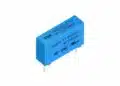



YMIN presents hybrid aluminum electrolytic capacitors from its VHT series as bulk and output filtering options for LiDAR power stages, particularly where designers are evaluating alternatives to MLCC arrays.
Automotive LiDAR modules place unusual demands on local power networks because they combine pulsed loads, dense DC‑DC conversion, and operation in mechanically harsh environments.
Solid–liquid hybrid aluminum capacitors are emerging as a practical alternative to large MLCC banks in automotive LiDAR power stages such as L3/L4 autonomous driving. They address long‑term reliability risks of ceramic capacitors under vibration and temperature cycling while helping OEMs and Tier‑1 suppliers optimize total cost of ownership over the vehicle lifetime.
Key features and benefits
- Hybrid aluminum capacitors are presented by YMIN as an option for LiDAR power rails where vibration, temperature cycling, and ripple current matter in long‑term operation.
- The article’s main technical argument is that hybrid capacitors avoid the ceramic dielectric behavior associated with MLCC piezoelectric effects, which the manufacturer links to possible long‑term stability concerns in vibration‑exposed LiDAR designs.
- In practical circuit terms, this positions the parts not as a universal replacement for MLCCs, but as candidates for bulk energy storage and converter output filtering where capacitance density and mechanical robustness are more important than the very highest‑frequency decoupling.
Typical applications
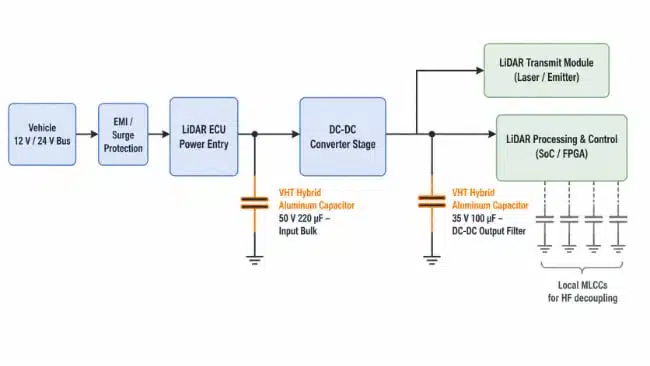
The source places the capacitors in two main positions inside a LiDAR power architecture.
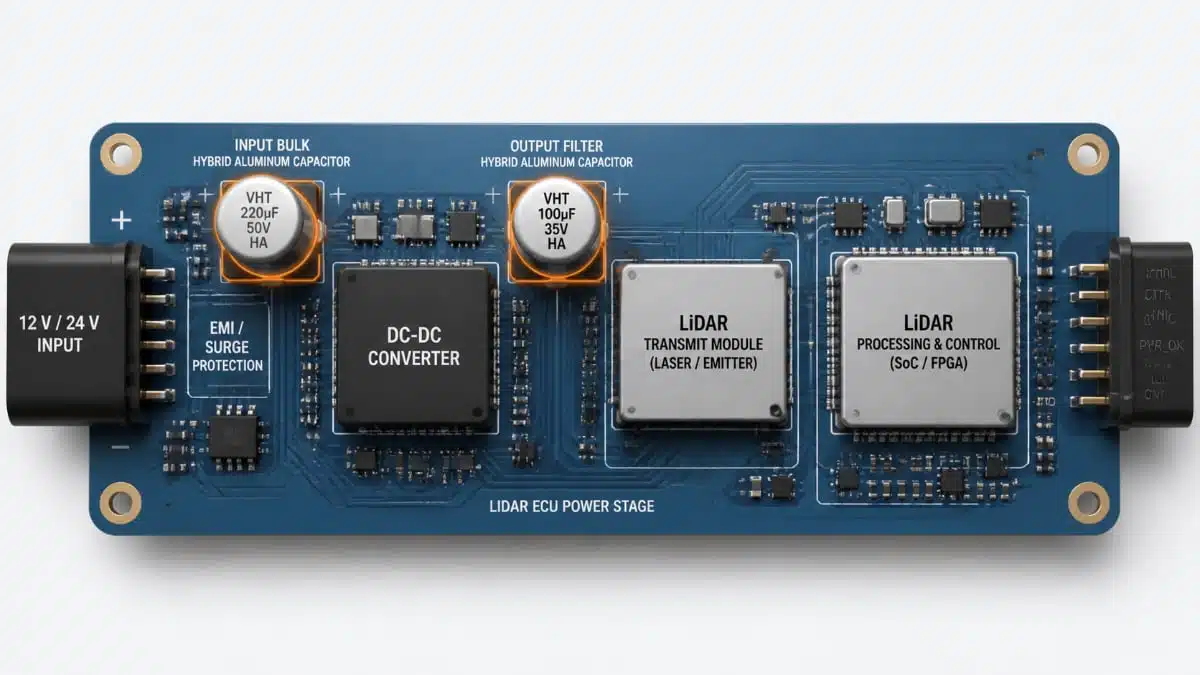
- Input bulk capacitance for the LiDAR transmit circuit and the main computing core.
- Output filtering at the DC‑DC converter stage feeding downstream processing devices such as FPGAs and other compute ICs.
- General power stabilization in LiDAR modules that combine high transient current demand with compact board layouts.
In real designs, that means these parts are more likely to sit on intermediate and bulk power rails than directly at the pins of high‑speed logic devices.
Technical highlights
YMIN specifically identifies two VHT series examples for LiDAR use.
| Series | Rated voltage | Capacitance | Case size | Suggested function |
|---|---|---|---|---|
| VHT | 50 V | 220 µF | 10 × 13 mm | Input capacitor for LiDAR transmit circuit and computing core |
| VHT | 35 V | 100 µF | 6.3 × 7.7 mm | Output capacitor for DC‑DC conversion stage |
The manufacturer also emphasizes low ESR behavior for ripple filtering, especially at the converter output stage. In practice, that usually means the capacitor is intended to reduce supply ripple and support transient load stability, while smaller ceramics still handle the highest‑frequency local decoupling.
Hybrid capacitor vs. MLCC behavior
- Hybrid aluminum capacitors do not use ceramic dielectrics and therefore avoid the inverse piezoelectric effect that can induce internal mechanical stress under alternating electric fields.
- In LiDAR systems exposed to vibration and wide temperature swings, repeated mechanical strain in ceramic capacitors can lead over time to microcracks, capacitance loss and increased leakage. Hybrid aluminum construction addresses this failure mechanism at its root by using a different dielectric and mechanical structure.
Design-in notes for engineers
- Treat the published VHT examples as application positions, not as a complete design recipe; ripple current, ESR, impedance versus frequency, endurance, and temperature data should still be verified in the manufacturer datasheet before final selection.
- If the goal is to reduce dependence on large MLCC banks, review the target rail’s transient current profile and switching frequency first, because hybrid aluminum capacitors and MLCCs solve overlapping but not identical problems.
- For LiDAR modules exposed to vibration, mechanical mounting, board flex, and thermal cycling should be reviewed together with capacitor placement; the component choice alone does not determine field reliability.
- A mixed approach is often the most realistic one: hybrid capacitors for bulk storage and converter output smoothing, MLCCs for high‑frequency bypass close to IC supply pins.
- The source discusses long‑term stability and leakage/capacitance degradation risks in MLCC‑based approaches, but it does not provide comparative lifetime test tables in the article itself; those details should be confirmed from official product documentation where available.
Source
This article is based on an official press release and related product information published by Yongming (YMIN) Electronics about hybrid solid–liquid aluminum capacitors for automotive LiDAR and L3/L4 intelligent driving applications, complemented with general design‑in guidance that should be verified against the latest manufacturer datasheet.