





Passive Components Blog
No Result
View All Result
  • Home
  • NewsFilter
    • All
    • Aerospace & Defence
    • Antenna
    • Applications
    • Automotive
    • Capacitors
    • Circuit Protection Devices
    • electro-mechanical news
    • Filters
    • Fuses
    • Inductors
    • Industrial
    • Integrated Passives
    • inter-connect news
    • Market & Supply Chain
    • Market Insights
    • Medical
    • Modelling and Simulation
    • New Materials & Supply
    • New Technologies
    • Non-linear Passives
    • Oscillators
    • Passive Sensors News
    • Resistors
    • RF & Microwave
    • Telecommunication
    • Weekly Digest

    Top 10 Connector Vendors by Product Type

    Bourns Releases High‑Q Air Coil Inductors for RF Aplications

    CMSE 2026 Announces Call for Presentations on High-Reliability Military and Space Electronics

    ESA Call for Papers 6th Space Passive Component Days – SPCD 2026

    Würth Elektronik Offers Halogen‑Free EMC Gaskets for Displays and Housings

    Component Distribution Supply Chain January 2026

    Binder Unveils M8 Flange Solder Connectors for Flexible Cabling

    Power Electronics Tools for Passives and Magnetic Designs

    Modelithics Releases Component Model Library for SIMULIA CST Studio Suite

    Trending Tags

    • Ripple Current
    • RF
    • Leakage Current
    • Tantalum vs Ceramic
    • Snubber
    • Low ESR
    • Feedthrough
    • Derating
    • Dielectric Constant
    • New Products
    • Market Reports
  • VideoFilter
    • All
    • Antenna videos
    • Capacitor videos
    • Circuit Protection Video
    • Filter videos
    • Fuse videos
    • Inductor videos
    • Inter-Connect Video
    • Non-linear passives videos
    • Oscillator videos
    • Passive sensors videos
    • Resistor videos

    One‑Pulse Characterization of Nonlinear Power Inductors

    Thermistor Linearization Challenges

    Coaxial Connectors and How to Connect with PCB

    PCB Manufacturing, Test Methods, Quality and Reliability

    Transformer Behavior – Current Transfer and Hidden Feedback

    Choosing the Right Capacitor: The Importance of Accurate Measurements

    RF Inductors: Selection and Design Challenges for High-Frequency Circuits

    Transformer Safety IEC 61558 Standard

    3-Phase EMI Filter Design, Simulation, Calculation and Test

    Trending Tags

    • Capacitors explained
    • Inductors explained
    • Resistors explained
    • Filters explained
    • Application Video Guidelines
    • EMC
    • New Products
    • Ripple Current
    • Simulation
    • Tantalum vs Ceramic
  • Knowledge Blog
  • DossiersNew
  • Suppliers
    • Who is Who
  • PCNS
    • PCNS 2025
    • PCNS 2023
    • PCNS 2021
    • PCNS 2019
    • PCNS 2017
  • Events
  • Home
  • NewsFilter
    • All
    • Aerospace & Defence
    • Antenna
    • Applications
    • Automotive
    • Capacitors
    • Circuit Protection Devices
    • electro-mechanical news
    • Filters
    • Fuses
    • Inductors
    • Industrial
    • Integrated Passives
    • inter-connect news
    • Market & Supply Chain
    • Market Insights
    • Medical
    • Modelling and Simulation
    • New Materials & Supply
    • New Technologies
    • Non-linear Passives
    • Oscillators
    • Passive Sensors News
    • Resistors
    • RF & Microwave
    • Telecommunication
    • Weekly Digest

    Top 10 Connector Vendors by Product Type

    Bourns Releases High‑Q Air Coil Inductors for RF Aplications

    CMSE 2026 Announces Call for Presentations on High-Reliability Military and Space Electronics

    ESA Call for Papers 6th Space Passive Component Days – SPCD 2026

    Würth Elektronik Offers Halogen‑Free EMC Gaskets for Displays and Housings

    Component Distribution Supply Chain January 2026

    Binder Unveils M8 Flange Solder Connectors for Flexible Cabling

    Power Electronics Tools for Passives and Magnetic Designs

    Modelithics Releases Component Model Library for SIMULIA CST Studio Suite

    Trending Tags

    • Ripple Current
    • RF
    • Leakage Current
    • Tantalum vs Ceramic
    • Snubber
    • Low ESR
    • Feedthrough
    • Derating
    • Dielectric Constant
    • New Products
    • Market Reports
  • VideoFilter
    • All
    • Antenna videos
    • Capacitor videos
    • Circuit Protection Video
    • Filter videos
    • Fuse videos
    • Inductor videos
    • Inter-Connect Video
    • Non-linear passives videos
    • Oscillator videos
    • Passive sensors videos
    • Resistor videos

    One‑Pulse Characterization of Nonlinear Power Inductors

    Thermistor Linearization Challenges

    Coaxial Connectors and How to Connect with PCB

    PCB Manufacturing, Test Methods, Quality and Reliability

    Transformer Behavior – Current Transfer and Hidden Feedback

    Choosing the Right Capacitor: The Importance of Accurate Measurements

    RF Inductors: Selection and Design Challenges for High-Frequency Circuits

    Transformer Safety IEC 61558 Standard

    3-Phase EMI Filter Design, Simulation, Calculation and Test

    Trending Tags

    • Capacitors explained
    • Inductors explained
    • Resistors explained
    • Filters explained
    • Application Video Guidelines
    • EMC
    • New Products
    • Ripple Current
    • Simulation
    • Tantalum vs Ceramic
  • Knowledge Blog
  • DossiersNew
  • Suppliers
    • Who is Who
  • PCNS
    • PCNS 2025
    • PCNS 2023
    • PCNS 2021
    • PCNS 2019
    • PCNS 2017
  • Events
No Result
View All Result
Passive Components Blog
No Result
View All Result

Samsung Releases 1uF 25V 0402 MLCC for AI Power Modules 

27.11.2025
Reading Time: 3 mins read
A A

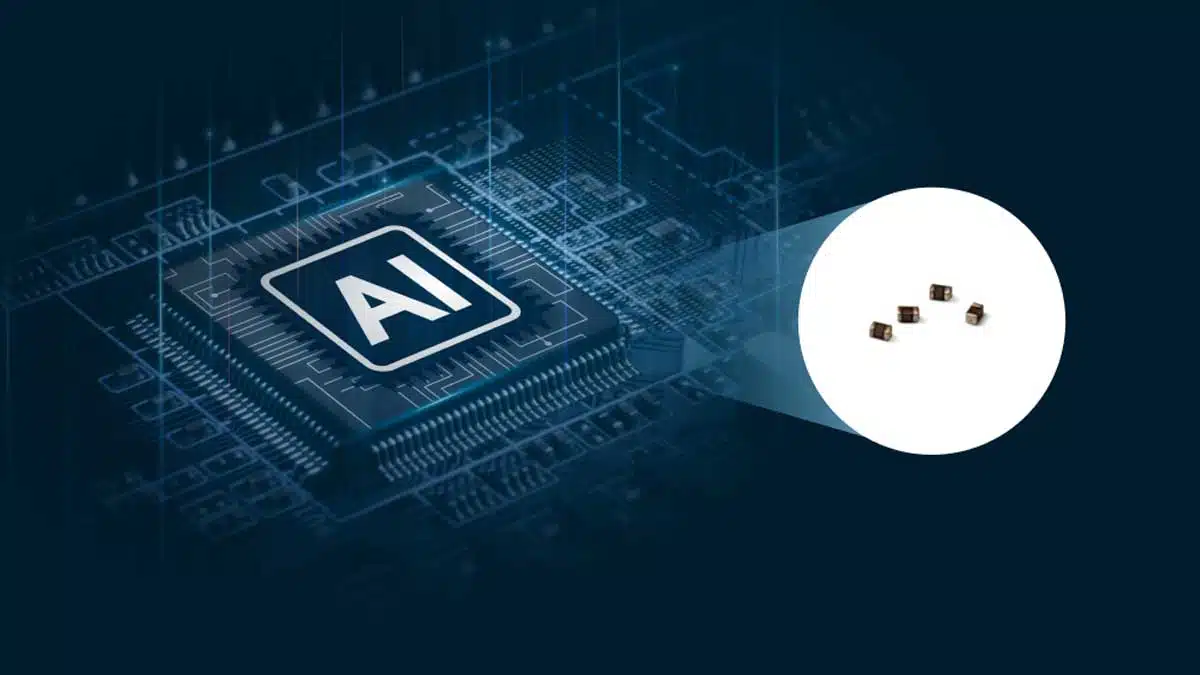
Samsung Electro-Mechanics introduces its High-Capacitance 1µF, 25V MLCC ceramic capacitors in 0402 inch case size for AI Power Module applications.

Samsung Electro-Mechanics has unveiled an ultra-compact, high-capacitance multilayer ceramic capacitor (MLCC) designed specifically for AI server power applications, addressing the growing demand for miniaturization and enhanced power density in next-generation computing infrastructure.

RelatedPosts

Samsung Q4 2025 Results: MLCC focus for AI, Server and Automotive

Samsung Unveils World First CLLC Resonant 1kV 33nF C0G MLCC in 1210 Size

Samsung MLCC Replacing Aluminum Polymer Capacitors in AI Systems

The Challenge: Miniaturization in AI Server Power Design

AI servers require significantly more power than conventional servers due to multiple high-performance chips including memory, GPU, and CPU.

The efficiency of power modules that supply stable power directly to GPUs critically impacts overall server performance. These power modules take a 12V input and provide the low voltages required by GPUs and CPUs (0.8–1.5V) through DC/DC conversion.
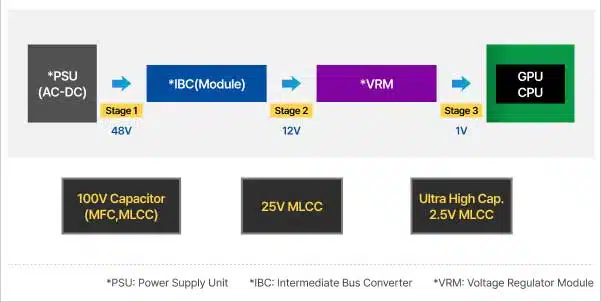
Schematic diagram of AI power conversion per stage; source: Samsung Electro-Mechanics

High-performance semiconductors mounted on server mainboards operate at low voltages (0.8–1.5V) to improve power efficiency. During fast-paced operations, peak currents with large fluctuations occur, requiring substantial quantities of MLCCs to stabilize the power supply. As component integration increases and PCB areas shrink, the need for ultra-small, high-capacitance MLCCs that meet both requirements simultaneously continues to grow.

The Solution: Ultra-Compact, High-Performance MLCC

To support the hundreds to thousands of MLCCs required at the server VRM 12V input stage, Samsung Electro-Mechanics has released an innovative product: 0402 inch, 1µF, 25V, X7S rated MLCC. This component effectively removes power instability (noise/ripple) caused by the current load of power-consuming GPUs and CPUs, thereby improving both server performance and reliability.

Key Features and Benefits

FeatureBenefit
25V RatingEffective noise suppression on the 12V power rail
0402 inch Ultra-Small Form FactorSaves over 50% mounting area compared to conventional 0603 size, enabling higher component density and greater total capacitance
X7S Temperature Rating (-55°C to 125°C)Ensures power stabilization in high-temperature operating environments

Product Specifications

Part NumberSize (inch/mm)CapacitanceRated VoltageTCCAvailability
CL05Y105KA56UW#0402 / 10051µF25VdcX7SSamples Available

Industry Impact

This product is ideally suited for AI server power-module designs and significantly improves power density. More than just a component, it represents foundational technology aimed at surpassing the limits of high-performance computing and driving the stable establishment of next-generation AI infrastructure.

Related

Source: source: Samsung Electro-Mechanics

Recent Posts

CMSE 2026 Announces Call for Presentations on High-Reliability Military and Space Electronics

28.1.2026
20

ESA Call for Papers 6th Space Passive Component Days – SPCD 2026

28.1.2026
20

Samsung Q4 2025 Results: MLCC focus for AI, Server and Automotive

26.1.2026
54

Capacitor Technology Dossier

26.1.2026
71

Passive Components in Quantum Computing

22.1.2026
123

Miniaturization of MLCCs and Electrolytics, KAVX Tech Chat

21.1.2026
69

Researchers Demonstrated 32nm Aluminum Vacuum Gap Capacitor

20.1.2026
40

Conductive Polymer Capacitor Market and Design‑In Guide to 2035

20.1.2026
141

TDK Releases High Performance 105C DC Link Film Capacitors

19.1.2026
64

Upcoming Events

Feb 24
16:00 - 17:00 CET

Designing Qi2 Wireless Power Systems: Practical Development and EMC Optimization

Mar 3
16:00 - 17:00 CET

Cybersecurity at the Eleventh Hour – from RED to CRA – Information and Discussion

Mar 21
All day

PSMA Capacitor Workshop 2026

View Calendar

Popular Posts

  • Buck Converter Design and Calculation

    0 shares
    Share 0 Tweet 0
  • Boost Converter Design and Calculation

    0 shares
    Share 0 Tweet 0
  • LLC Resonant Converter Design and Calculation

    0 shares
    Share 0 Tweet 0
  • Flyback Converter Design and Calculation

    0 shares
    Share 0 Tweet 0
  • Ripple Current and its Effects on the Performance of Capacitors

    3 shares
    Share 3 Tweet 0
  • How Metal Prices Are Driving Passive Component Price Hikes

    0 shares
    Share 0 Tweet 0
  • MLCC and Ceramic Capacitors

    0 shares
    Share 0 Tweet 0
  • Dual Active Bridge (DAB) Topology

    0 shares
    Share 0 Tweet 0
  • Degradation of Capacitors and its Failure Mechanisms

    0 shares
    Share 0 Tweet 0
  • What is a Dielectric Constant and DF of Plastic Materials?

    4 shares
    Share 4 Tweet 0

Newsletter Subscription


Passive Components Blog

© EPCI - Leading Passive Components Educational and Information Site

  • Home
  • Privacy Policy
  • EPCI Membership & Advertisement
  • About

No Result
View All Result
  • Home
  • Knowledge Blog
  • PCNS

© EPCI - Leading Passive Components Educational and Information Site

This website uses cookies. By continuing to use this website you are giving consent to cookies being used. Visit our Privacy and Cookie Policy.
Go to mobile version