






Passive Components Blog
No Result
View All Result
  • Home
  • NewsFilter
    • All
    • Aerospace & Defence
    • Antenna
    • Applications
    • Automotive
    • Capacitors
    • Circuit Protection Devices
    • electro-mechanical news
    • Filters
    • Fuses
    • Inductors
    • Industrial
    • Integrated Passives
    • inter-connect news
    • Market & Supply Chain
    • Market Insights
    • Medical
    • Modelling and Simulation
    • New Materials & Supply
    • New Technologies
    • Non-linear Passives
    • Oscillators
    • Passive Sensors News
    • Resistors
    • RF & Microwave
    • Telecommunication
    • Weekly Digest

    Bourns Releases Compact High Current Shielded Power Inductors

    March 2026 Interconnect, Passives and Electromechanical Components Market Insights

    Molex Completes Acquisition of Smiths Interconnect, Expanding Portfolio of High-Reliability Connectivity Solutions

    APEC 2026 Power Electronics Trends and Implications for Passive Components

    Hydra Enhances Film Capacitor Robustness by Novel Gel Filler

    Würth Elektronik Releases Heat Sinks for TO and IC packages

    Würth Elektronik ICS to Acquire MRS Electronic and Expand Vehicle Electronics Portfolio

    Indias ECMS Wave Brings New Capacity For Passive Components Manufacturing in India

    Binder Introduces Triangular Moulding for M16 and M12 Cable Connectors

    Trending Tags

    • Ripple Current
    • RF
    • Leakage Current
    • Tantalum vs Ceramic
    • Snubber
    • Low ESR
    • Feedthrough
    • Derating
    • Dielectric Constant
    • New Products
    • Market Reports
  • VideoFilter
    • All
    • Antenna videos
    • Capacitor videos
    • Circuit Protection Video
    • Filter videos
    • Fuse videos
    • Inductor videos
    • Inter-Connect Video
    • Non-linear passives videos
    • Oscillator videos
    • Passive sensors videos
    • Resistor videos

    Transformer-Based Power-Line Harvester Magnetic Design

    Thermal Modeling of Magnetics

    Standard vs Planar LLC transformers Comparison for Battery Chargers

    How Modern Tools Model Magnetic Components for Power Electronics

    Advanced Loss Modeling for Planar Magnetics in the Frenetic Planar Tool

    2026 Power Magnetics Design Trends: Flyback, DAB and Planar

    Enabling Software‑Defined Vehicle Architectures: Automotive Ethernet and Zonal Smart Power

    Calculating Resistance Value of a Flyback RC Snubber 

    One‑Pulse Characterization of Nonlinear Power Inductors

    Trending Tags

    • Capacitors explained
    • Inductors explained
    • Resistors explained
    • Filters explained
    • Application Video Guidelines
    • EMC
    • New Products
    • Ripple Current
    • Simulation
    • Tantalum vs Ceramic
  • Knowledge Blog
  • DossiersNew
  • Suppliers
    • Who is Who
  • PCNS
    • PCNS 2025
    • PCNS 2023
    • PCNS 2021
    • PCNS 2019
    • PCNS 2017
  • Events
  • Home
  • NewsFilter
    • All
    • Aerospace & Defence
    • Antenna
    • Applications
    • Automotive
    • Capacitors
    • Circuit Protection Devices
    • electro-mechanical news
    • Filters
    • Fuses
    • Inductors
    • Industrial
    • Integrated Passives
    • inter-connect news
    • Market & Supply Chain
    • Market Insights
    • Medical
    • Modelling and Simulation
    • New Materials & Supply
    • New Technologies
    • Non-linear Passives
    • Oscillators
    • Passive Sensors News
    • Resistors
    • RF & Microwave
    • Telecommunication
    • Weekly Digest

    Bourns Releases Compact High Current Shielded Power Inductors

    March 2026 Interconnect, Passives and Electromechanical Components Market Insights

    Molex Completes Acquisition of Smiths Interconnect, Expanding Portfolio of High-Reliability Connectivity Solutions

    APEC 2026 Power Electronics Trends and Implications for Passive Components

    Hydra Enhances Film Capacitor Robustness by Novel Gel Filler

    Würth Elektronik Releases Heat Sinks for TO and IC packages

    Würth Elektronik ICS to Acquire MRS Electronic and Expand Vehicle Electronics Portfolio

    Indias ECMS Wave Brings New Capacity For Passive Components Manufacturing in India

    Binder Introduces Triangular Moulding for M16 and M12 Cable Connectors

    Trending Tags

    • Ripple Current
    • RF
    • Leakage Current
    • Tantalum vs Ceramic
    • Snubber
    • Low ESR
    • Feedthrough
    • Derating
    • Dielectric Constant
    • New Products
    • Market Reports
  • VideoFilter
    • All
    • Antenna videos
    • Capacitor videos
    • Circuit Protection Video
    • Filter videos
    • Fuse videos
    • Inductor videos
    • Inter-Connect Video
    • Non-linear passives videos
    • Oscillator videos
    • Passive sensors videos
    • Resistor videos

    Transformer-Based Power-Line Harvester Magnetic Design

    Thermal Modeling of Magnetics

    Standard vs Planar LLC transformers Comparison for Battery Chargers

    How Modern Tools Model Magnetic Components for Power Electronics

    Advanced Loss Modeling for Planar Magnetics in the Frenetic Planar Tool

    2026 Power Magnetics Design Trends: Flyback, DAB and Planar

    Enabling Software‑Defined Vehicle Architectures: Automotive Ethernet and Zonal Smart Power

    Calculating Resistance Value of a Flyback RC Snubber 

    One‑Pulse Characterization of Nonlinear Power Inductors

    Trending Tags

    • Capacitors explained
    • Inductors explained
    • Resistors explained
    • Filters explained
    • Application Video Guidelines
    • EMC
    • New Products
    • Ripple Current
    • Simulation
    • Tantalum vs Ceramic
  • Knowledge Blog
  • DossiersNew
  • Suppliers
    • Who is Who
  • PCNS
    • PCNS 2025
    • PCNS 2023
    • PCNS 2021
    • PCNS 2019
    • PCNS 2017
  • Events
No Result
View All Result
Passive Components Blog
No Result
View All Result

Supercapacitors Emerge as a Promising Solution to AI-Induced Power Energy Spikes

6.5.2025
Reading Time: 4 mins read
A A

To address AI-induced energy spikes, companies are turning into integration of supercapacitors into data center infrastructure.

The rapid growth of artificial intelligence (AI) and its increasing reliance on high-powered GPUs create unique challenges for energy management in data centers.

RelatedPosts

Bourns Releases Compact High Current Shielded Power Inductors

March 2026 Interconnect, Passives and Electromechanical Components Market Insights

Molex Completes Acquisition of Smiths Interconnect, Expanding Portfolio of High-Reliability Connectivity Solutions

The power consumption of AI servers is five times higher than that of general servers, creating challenging dynamic energy spike loads in addition that has to be addressed..

NVIDIA recently unveiled its latest GB300 server, which is slated for launch in the second half of 2025. A notable feature of this server is its integration of a supercapacitor into its power system design.
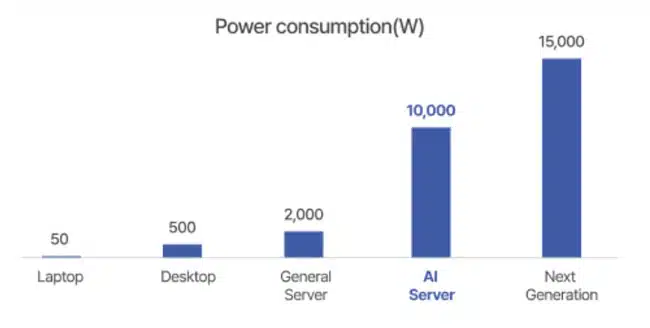
Power consumption of computing devices vs servers and AI servers; source: Samsung Electro-Mechanics

In AI training centers, thousands of GPUs operate simultaneously, resulting in synchronized energy spikes that can overwhelm power systems. As AI models grow exponentially in size, these energy fluctuations will become more pronounced, posing significant challenges to grid stability.

Traditional methods to manage such power surges include backup lithium-ion batteries and dummy computational tasks designed to create a steady energy demand. However, backup batteries degrade rapidly under the stress of frequent high-rate charging and discharging cycles. Dummy calculations, on the other hand, waste energy by performing unnecessary tasks solely to maintain a balanced load.

Supercapacitors emerge as a promising solution to this problem due to their ability to charge and discharge rapidly without significant degradation over time. Unlike batteries that rely on chemical reactions to store energy, supercapacitors store energy electrostatically, enabling them to efficiently handle quick energy bursts. Siemens Energy’s E-statcom, Eaton’s XLHV, and Delta Electronics’ Power Capacitance Shelf are among the products designed to manage these surges effectively.

Siemens Energy’s E-statcom can handle up to 75 megawatts per unit and has a lifespan of 12 to 20 years, providing millisecond-scale power support at the data center level. Eaton’s XLHV is compact enough to fit in a standard server rack and can deliver up to 420 kilowatts with similar longevity. Delta Electronics offers the Power Capacitance Shelf, a hybrid solution that bridges the gap between supercapacitors and lithium-ion batteries. It can support a 15-kilowatt load for up to five seconds.
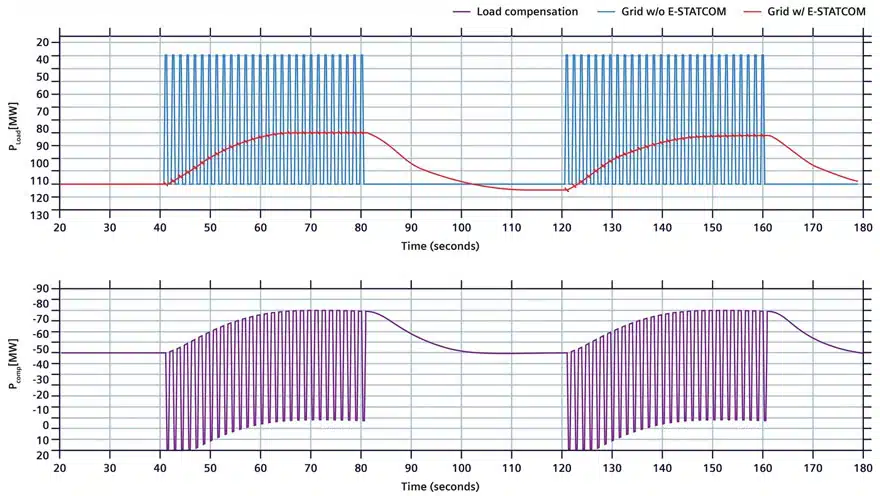
AI workloads occasionally require significant power, leading to a fluctuating load on the power grid (blue). Banks of supercapacitors can store energy on short timescales (purple), effectively compensating for these power surges and resulting in a smoother power demand on the grid (red). Source: Siemens Energy.

These supercapacitor systems help smooth out the erratic power demands from AI workloads, promoting grid stability. This role becomes even more critical with the increasing reliance on renewable energy sources, which are inherently variable due to factors like weather conditions. By maintaining predictable loads, supercapacitors facilitate better energy planning and distribution.

Conclusion

Supercapacitors represent a transformative development in managing the energy demands of AI data centers. Their rapid response capabilities, durability, and efficiency in handling short-term power bursts make them an ideal complement to traditional energy storage solutions.

As AI models grow and renewable energy becomes more prevalent, the role of supercapacitors in maintaining grid stability will only become more vital. While not a universal replacement for all battery applications, they effectively address the unique challenges posed by AI-induced energy fluctuations.

Further reference articles:

  • Supercapacitors Supports AI’s Power Demands
  • NVIDIA GB300 Boost Hybrid Supercapacitor Demand
  • Samsung Electro-Mechanics Offers Industry High Capacitance MLCCs for AI Servers

Related

Recent Posts

Bourns Releases Compact High Current Shielded Power Inductors

2.4.2026
8

March 2026 Interconnect, Passives and Electromechanical Components Market Insights

2.4.2026
26

APEC 2026 Power Electronics Trends and Implications for Passive Components

1.4.2026
43

Hydra Enhances Film Capacitor Robustness by Novel Gel Filler

1.4.2026
21

Würth Elektronik Releases Heat Sinks for TO and IC packages

31.3.2026
16

Indias ECMS Wave Brings New Capacity For Passive Components Manufacturing in India

31.3.2026
34

Binder Introduces Triangular Moulding for M16 and M12 Cable Connectors

31.3.2026
3

Panasonic High Precision Chip Resistors Bridge Gap Between Thin and Thick Technology

30.3.2026
73

Samsung Introduces 35V MLCCs Flying Capacitors for USB PD Fast Charging

27.3.2026
33

Upcoming Events

Apr 8
17:00 - 18:00 CEST

Trade Secrets of the Flyback Converter

Apr 21
16:00 - 17:00 CEST

Heatsink Solutions: Thermal Management in electronic devices

May 5
16:00 - 17:00 CEST

Understanding and Selecting Capacitors – Fundamentals, Technologies and Latest Trends

View Calendar

Popular Posts

  • Buck Converter Design and Calculation

    0 shares
    Share 0 Tweet 0
  • Boost Converter Design and Calculation

    0 shares
    Share 0 Tweet 0
  • Flyback Converter Design and Calculation

    0 shares
    Share 0 Tweet 0
  • LLC Resonant Converter Design and Calculation

    0 shares
    Share 0 Tweet 0
  • Dual Active Bridge (DAB) Topology

    0 shares
    Share 0 Tweet 0
  • MLCC and Ceramic Capacitors

    0 shares
    Share 0 Tweet 0
  • Ripple Current and its Effects on the Performance of Capacitors

    3 shares
    Share 3 Tweet 0
  • Plastic Materials Dielectric Constant and DF

    4 shares
    Share 4 Tweet 0
  • Capacitor Charging and Discharging

    0 shares
    Share 0 Tweet 0
  • MLCC Case Sizes Standards Explained

    0 shares
    Share 0 Tweet 0

Newsletter Subscription


Passive Components Blog

© EPCI - Leading Passive Components Educational and Information Site

  • Home
  • Privacy Policy
  • EPCI Membership & Advertisement
  • About

No Result
View All Result
  • Home
  • Knowledge Blog
  • PCNS

© EPCI - Leading Passive Components Educational and Information Site

This website uses cookies. By continuing to use this website you are giving consent to cookies being used. Visit our Privacy and Cookie Policy.
Go to mobile version