










Passive Components Blog
No Result
View All Result
  • Home
  • NewsFilter
    • All
    • Aerospace & Defence
    • Antenna
    • Applications
    • Automotive
    • Capacitors
    • Circuit Protection Devices
    • electro-mechanical news
    • Filters
    • Fuses
    • Inductors
    • Industrial
    • Integrated Passives
    • inter-connect news
    • Market & Supply Chain
    • Market Insights
    • Medical
    • Modelling and Simulation
    • New Materials & Supply
    • New Technologies
    • Non-linear Passives
    • Oscillators
    • Passive Sensors News
    • Resistors
    • RF & Microwave
    • Telecommunication
    • Weekly Digest

    Bourns Unveils High Volt GDT for High‑Energy Surge Protection

    TDK Releases DC Link Aluminum Capacitors for EV On‑Board Chargers

    Capacitech C-Link Supercapacitors for AI Data Center Voltage Spikes Mitigation

    Wk 8 Electronics Supply Chain Digest

    Modelithics Library for MATLAB: Measurement-Based Models for Microwave and RF Passive Components

    Bourns Extends Multilayer Chip Inductors Offer for RF and Wireless Designs

    Researchers developed a polymer capacitor by combining two cheap, commercially available plastics. The new polymer capacitor makes use of the transparent material — pictured here, with vintage Penn State athletic marks visible through it — to store four times the energy and withstand significantly more heat.  Credit: Penn State

    Penn State Demonstrated Polymer Alloy Capacitor Film with 4× Energy Density up to 250C

    ECIA January 2026 Reports Strong Sales Confidence

    Vishay Unveils Ultra-Compact 0201 Thick Film Chip Resistors

    Trending Tags

    • Ripple Current
    • RF
    • Leakage Current
    • Tantalum vs Ceramic
    • Snubber
    • Low ESR
    • Feedthrough
    • Derating
    • Dielectric Constant
    • New Products
    • Market Reports
  • VideoFilter
    • All
    • Antenna videos
    • Capacitor videos
    • Circuit Protection Video
    • Filter videos
    • Fuse videos
    • Inductor videos
    • Inter-Connect Video
    • Non-linear passives videos
    • Oscillator videos
    • Passive sensors videos
    • Resistor videos

    2026 Power Magnetics Design Trends: Flyback, DAB and Planar

    Enabling Software‑Defined Vehicle Architectures: Automotive Ethernet and Zonal Smart Power

    Calculating Resistance Value of a Flyback RC Snubber 

    One‑Pulse Characterization of Nonlinear Power Inductors

    Thermistor Linearization Challenges

    Coaxial Connectors and How to Connect with PCB

    PCB Manufacturing, Test Methods, Quality and Reliability

    Transformer Behavior – Current Transfer and Hidden Feedback

    Choosing the Right Capacitor: The Importance of Accurate Measurements

    Trending Tags

    • Capacitors explained
    • Inductors explained
    • Resistors explained
    • Filters explained
    • Application Video Guidelines
    • EMC
    • New Products
    • Ripple Current
    • Simulation
    • Tantalum vs Ceramic
  • Knowledge Blog
  • DossiersNew
  • Suppliers
    • Who is Who
  • PCNS
    • PCNS 2025
    • PCNS 2023
    • PCNS 2021
    • PCNS 2019
    • PCNS 2017
  • Events
  • Home
  • NewsFilter
    • All
    • Aerospace & Defence
    • Antenna
    • Applications
    • Automotive
    • Capacitors
    • Circuit Protection Devices
    • electro-mechanical news
    • Filters
    • Fuses
    • Inductors
    • Industrial
    • Integrated Passives
    • inter-connect news
    • Market & Supply Chain
    • Market Insights
    • Medical
    • Modelling and Simulation
    • New Materials & Supply
    • New Technologies
    • Non-linear Passives
    • Oscillators
    • Passive Sensors News
    • Resistors
    • RF & Microwave
    • Telecommunication
    • Weekly Digest

    Bourns Unveils High Volt GDT for High‑Energy Surge Protection

    TDK Releases DC Link Aluminum Capacitors for EV On‑Board Chargers

    Capacitech C-Link Supercapacitors for AI Data Center Voltage Spikes Mitigation

    Wk 8 Electronics Supply Chain Digest

    Modelithics Library for MATLAB: Measurement-Based Models for Microwave and RF Passive Components

    Bourns Extends Multilayer Chip Inductors Offer for RF and Wireless Designs

    Researchers developed a polymer capacitor by combining two cheap, commercially available plastics. The new polymer capacitor makes use of the transparent material — pictured here, with vintage Penn State athletic marks visible through it — to store four times the energy and withstand significantly more heat.  Credit: Penn State

    Penn State Demonstrated Polymer Alloy Capacitor Film with 4× Energy Density up to 250C

    ECIA January 2026 Reports Strong Sales Confidence

    Vishay Unveils Ultra-Compact 0201 Thick Film Chip Resistors

    Trending Tags

    • Ripple Current
    • RF
    • Leakage Current
    • Tantalum vs Ceramic
    • Snubber
    • Low ESR
    • Feedthrough
    • Derating
    • Dielectric Constant
    • New Products
    • Market Reports
  • VideoFilter
    • All
    • Antenna videos
    • Capacitor videos
    • Circuit Protection Video
    • Filter videos
    • Fuse videos
    • Inductor videos
    • Inter-Connect Video
    • Non-linear passives videos
    • Oscillator videos
    • Passive sensors videos
    • Resistor videos

    2026 Power Magnetics Design Trends: Flyback, DAB and Planar

    Enabling Software‑Defined Vehicle Architectures: Automotive Ethernet and Zonal Smart Power

    Calculating Resistance Value of a Flyback RC Snubber 

    One‑Pulse Characterization of Nonlinear Power Inductors

    Thermistor Linearization Challenges

    Coaxial Connectors and How to Connect with PCB

    PCB Manufacturing, Test Methods, Quality and Reliability

    Transformer Behavior – Current Transfer and Hidden Feedback

    Choosing the Right Capacitor: The Importance of Accurate Measurements

    Trending Tags

    • Capacitors explained
    • Inductors explained
    • Resistors explained
    • Filters explained
    • Application Video Guidelines
    • EMC
    • New Products
    • Ripple Current
    • Simulation
    • Tantalum vs Ceramic
  • Knowledge Blog
  • DossiersNew
  • Suppliers
    • Who is Who
  • PCNS
    • PCNS 2025
    • PCNS 2023
    • PCNS 2021
    • PCNS 2019
    • PCNS 2017
  • Events
No Result
View All Result
Passive Components Blog
No Result
View All Result

TDK Releases DC Link Aluminum Capacitors for EV On‑Board Chargers

23.2.2026
Reading Time: 8 mins read
A A

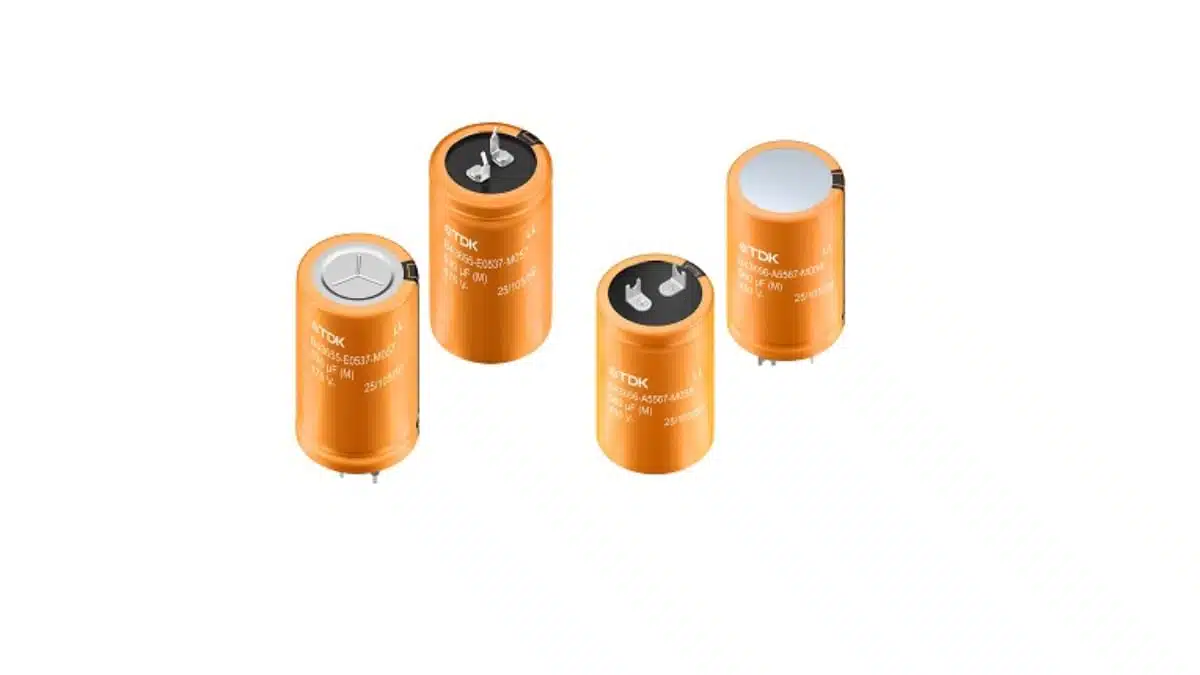
TDK has introduced two new aluminum electrolytic DC link capacitor series, B43655 and B43656, targeted at on‑board chargers (OBCs) in electric vehicles.

These DC link snap‑in capacitors address the trend toward higher battery voltages and higher charging currents while maintaining compact size and long life in forced‑cooling environments. Their combination of high CV product, high ripple capability and AEC‑Q200 qualification makes them relevant for both design engineers and sourcing teams working on next‑generation EV platforms.

RelatedPosts

TDK Releases High Temp 175C Automotive NTC thermistors

TDK Unveils 125C Compact DC Link Film Capacitors

TDK Releases Stackable µPOL 25A Power Modules

Key features and benefits

The B43655 aluminum capacitors series is designed for 800 V battery architectures, with rated voltages up to 475 V and 500 V and capacitance values from 110 µF to 880 µF, making it suitable as the main DC link energy buffer in modern high‑voltage OBC designs. At the same time, the B43656 series is rated at 450 V and optimized for even higher ripple currents up to 4.42 A at 105 °C, targeting high‑power topologies that stress the DC link with significant AC content.

Key features of B43655 and B43656 include:

  • Extremely high CV product with ultra‑compact snap‑in can sizes, allowing designers to minimize board footprint and mechanical height in the OBC power stage.
  • High ripple current capability (up to 3.29 A for B43655 and 4.42 A for B43656 at 120 Hz, 105 °C) supporting higher charging power without excessive self‑heating.
  • ESR values down to 100 mΩ (typical at 120 Hz, 20 °C) to reduce conduction losses and improve overall OBC efficiency.
  • Design optimized for base cooling and high ripple current density, which fits forced‑air or cold‑plate concepts in automotive chargers.
  • Useful life of more than 3,000 hours at 105 °C, supporting demanding thermal profiles in compact EV power electronics.
  • Available types with tight length tolerance (±0.5 mm), which simplifies mechanical integration, heatsink contact and automated assembly tooling in series production.
  • Integrated pressure relief device on the case wall, contributing to controlled failure behavior under severe overload conditions.
  • RoHS‑compliant construction and qualification according to AEC‑Q200 Rev. E, which reduces risk for automotive qualification and sourcing approval.

In practical terms, the low ESR and high ripple ratings help keep capacitor temperature rise under control at high charging power, which is often a limiting factor in compact OBC designs. The dimensional options and tolerance control support platform reuse across several vehicle variants without major mechanical redesign.

Typical applications

The primary target application for these series is the DC link of on‑board chargers in battery electric vehicles. In this role, the capacitors smooth the rectified AC line, provide energy buffering for high‑frequency switching stages, and stabilize the DC bus seen by downstream converter stages.

Typical use cases include:

  • DC link capacitors directly after the PFC stage in single‑ or three‑phase OBC topologies in EVs with 400 V and 800 V battery systems, depending on series selection.
  • Energy buffering at the DC bus of high‑frequency LLC or phase‑shifted full‑bridge stages within the charger.
  • Use in forced‑cooled automotive power modules where base‑cooling concepts are already implemented, such as integrated OBC plus DC/DC units.
  • Potential suitability for other automotive DC link functions that require AEC‑Q200 qualified aluminum electrolytics with high ripple capability, according to the manufacturer’s datasheet.

Because the parts are AEC‑Q200 qualified and designed for base cooling, they are particularly attractive where the capacitor bank sits close to heatsinks or power modules and shares the vehicle’s thermal management system.

Technical highlights

From a component selection perspective, the most relevant electrical parameters of the new series can be summarized as follows. Values are typical ranges; exact ratings are according to the manufacturer datasheet.

  • B43655 series
    • Rated voltage: 475 V and 500 V DC.
    • Capacitance range: 110 µF to 880 µF.
    • Typical ESR range: 100 mΩ to 800 mΩ at 120 Hz, 20 °C.
    • Ripple current (IAC,R): approximately 0.76 A to 3.29 A at 120 Hz, 105 °C.
    • Designed explicitly to meet 800 V battery architecture requirements in e‑mobility OBCs.
  • B43656 series
    • Rated voltage: 450 V DC.
    • Capacitance range: 120 µF to 820 µF.
    • Typical ESR range: 120 mΩ to 830 mΩ at 120 Hz, 20 °C.
    • Ripple current (IAC,R): approximately 1.08 A to 4.42 A at 120 Hz, 105 °C.
  • Mechanical and qualification data (both series)
    • Case style: snap‑in aluminum electrolytic capacitors with diameters from 22 mm to 35 mm and lengths from 25 mm to 60 mm (depending on rating).
    • Several variants with tight length tolerance ±0.5 mm, easing mechanical stack‑up in compact charger enclosures.
    • AEC‑Q200 Rev. E qualification and RoHS‑compatible materials.

In practice, the combination of high rated voltage and compact can sizes enables designers to hit required DC link capacitance with fewer cans, reducing assembly complexity and cost. The specified useful life at 105 °C is a key design‑in parameter for meeting automotive lifetime targets, especially when combined with the manufacturer’s lifetime calculation tools.

Design‑in notes for engineers

When designing DC link stages in EV on‑board chargers, the key trade‑offs are often between capacitance, ripple current capability, ESR and mechanical constraints. The B43655 and B43656 series are optimized for forced‑cooling and base‑cooled setups, so the thermal path from capacitor base to heatsink should be considered early in mechanical design.

Practical design‑in hints:

  • Series selection
    • For 800 V battery systems and DC bus voltages approaching this range, B43655 (475 V / 500 V) is the natural choice to maintain adequate voltage derating.
    • For lower DC bus voltages or where even higher ripple currents are required, B43656 (450 V) can be attractive thanks to its higher ripple ratings.
  • Ripple and ESR considerations
    • Use the specified ESR and ripple current data at 105 °C to estimate self‑heating, and combine this with the manufacturer’s AlCap Useful Life Calculation Tool to check lifetime under real operating conditions.
    • Because these capacitors have relatively low ESR, they help limit bus voltage ripple and loss, but layout (bus bar or bus PCB) remains critical to overall loop impedance.
  • Thermal management
    • The parts are optimized for base cooling and high ripple current density, so achieving good thermal contact at the base can significantly extend useful life compared with purely free‑air cooled mounting.
    • Forced air or liquid‑cooled cold plates should be evaluated together with capacitor placement, especially in compact OBC housings.
  • Mechanical and tolerance aspects
    • The availability of types with ±0.5 mm length tolerance is useful when multiple capacitors are mounted in tight mechanical frames or clamped arrangements, reducing mechanical stress distribution issues.
    • The pressure relief device on the case wall is a safety‑relevant feature; ensure that mechanical design does not block or constrain this area.
  • Standards and qualification
    • AEC‑Q200 Rev. E qualification is advantageous for EV platforms where many subsystems must comply with automotive component standards; this can reduce validation effort at OEM and Tier‑1 level.
    • RoHS‑compliance is important for global deployments and regulatory conformity.

For detailed electrical curves (impedance versus frequency, ripple current derating versus temperature, lifetime curves), engineers should consult the official datasheets and use them in conjunction with the AlCap tool.

Source

This article is based on information from an official TDK Corporation press release on the B43655 and B43656 aluminum electrolytic DC link capacitor series for electric vehicle on‑board chargers, complemented with general application context for power electronics design engineers.


References

  1. TDK press release: TDK introduces two new DC link capacitor series optimized for on-board chargers in electric vehicles
  2. TDK Aluminum Electrolytic Capacitors – snap‑in portfolio overview
  3. TDK AlCap Useful Life Calculation Tool

Related

Recent Posts

Bourns Unveils High Volt GDT for High‑Energy Surge Protection

23.2.2026
0

Capacitech C-Link Supercapacitors for AI Data Center Voltage Spikes Mitigation

23.2.2026
2
Researchers developed a polymer capacitor by combining two cheap, commercially available plastics. The new polymer capacitor makes use of the transparent material — pictured here, with vintage Penn State athletic marks visible through it — to store four times the energy and withstand significantly more heat.  Credit: Penn State

Penn State Demonstrated Polymer Alloy Capacitor Film with 4× Energy Density up to 250C

19.2.2026
22

Vishay Unveils Ultra-Compact 0201 Thick Film Chip Resistors

19.2.2026
11

Würth Elektronik Component Data Live in Accuris

19.2.2026
16

Coilcraft Releases Automotive Common Mode Chokes

19.2.2026
13

MLCC Manufacturers Consider Price Increase as AI Demand Outpaces Supply

18.2.2026
214

YAGEO Extends Antenna Portfolio with Wi‑Fi 6E/7 and Tri‑band GNSS Solutions

17.2.2026
13

SCHURTER Introduces 2410 SMD Fuse for Robust AC/DC Protection

17.2.2026
13

Upcoming Events

Feb 24
16:00 - 17:00 CET

Mastering Galvanic Isolation: Ensuring Safety in Power Electronics

Feb 25
16:00 - 17:00 CET

Magnetic Modeling – How Frenetic Models Magnetics

Mar 3
16:00 - 17:00 CET

Cybersecurity at the Eleventh Hour – from RED to CRA – Information and Discussion

View Calendar

Popular Posts

  • Buck Converter Design and Calculation

    0 shares
    Share 0 Tweet 0
  • Boost Converter Design and Calculation

    0 shares
    Share 0 Tweet 0
  • LLC Resonant Converter Design and Calculation

    0 shares
    Share 0 Tweet 0
  • Flyback Converter Design and Calculation

    0 shares
    Share 0 Tweet 0
  • Ripple Current and its Effects on the Performance of Capacitors

    3 shares
    Share 3 Tweet 0
  • Dual Active Bridge (DAB) Topology

    0 shares
    Share 0 Tweet 0
  • What is a Dielectric Constant and DF of Plastic Materials?

    4 shares
    Share 4 Tweet 0
  • MLCC and Ceramic Capacitors

    0 shares
    Share 0 Tweet 0
  • MLCC Case Sizes Standards Explained

    0 shares
    Share 0 Tweet 0
  • SEPIC Converter Design and Calculation

    0 shares
    Share 0 Tweet 0

Newsletter Subscription


Passive Components Blog

© EPCI - Leading Passive Components Educational and Information Site

  • Home
  • Privacy Policy
  • EPCI Membership & Advertisement
  • About

No Result
View All Result
  • Home
  • Knowledge Blog
  • PCNS

© EPCI - Leading Passive Components Educational and Information Site

This website uses cookies. By continuing to use this website you are giving consent to cookies being used. Visit our Privacy and Cookie Policy.
Go to mobile version