










Passive Components Blog
No Result
View All Result
  • Home
  • NewsFilter
    • All
    • Aerospace & Defence
    • Antenna
    • Applications
    • Automotive
    • Capacitors
    • Circuit Protection Devices
    • electro-mechanical news
    • Filters
    • Fuses
    • Inductors
    • Industrial
    • Integrated Passives
    • inter-connect news
    • Market & Supply Chain
    • Market Insights
    • Medical
    • Modelling and Simulation
    • New Materials & Supply
    • New Technologies
    • Non-linear Passives
    • Oscillators
    • Passive Sensors News
    • Resistors
    • RF & Microwave
    • Telecommunication
    • Weekly Digest

    Nvidia Vera Rubin: Why One AI Rack Needs So Many More MLCC Capacitors

    Stackpole Introduces 1400A Busbar Shunt Resistors

    Tecate Unveils High‑temp 105C Supercapacitors for Harsh‑Environment Designs

    Bourns Expands 1000V High‑Power Fuses for Semiconductor and Battery Protection

    Passive Components in 2026: From Invisible Commodity to Design Parameter

    Bourns Introduces High Current Chip Ferrite Beads for Dense Power Rails

    Wk 22 Electronics Supply Chain Digest

    Vishay Releases High‑Current Radial Inductors up to 209 A

    May 2026 Interconnect, Passives and Electromechanical Components Market Insights

    Trending Tags

    • Ripple Current
    • RF
    • Leakage Current
    • Tantalum vs Ceramic
    • Snubber
    • Low ESR
    • Feedthrough
    • Derating
    • Dielectric Constant
    • New Products
    • Market Reports
  • VideoFilter
    • All
    • Antenna videos
    • Capacitor videos
    • Circuit Protection Video
    • Filter videos
    • Fuse videos
    • Inductor videos
    • Inter-Connect Video
    • Non-linear passives videos
    • Oscillator videos
    • Passive sensors videos
    • Resistor videos

    Current Sense Transformer Datasheet and Design‑in Guide

    Designing a USB Type‑C Flyback Planar Transformer with Frenetic’s Planar Tool

    Magnetics Design in High‑Frequency GaN Converters

    Qi2 Wireless Charging: Inductors, Capacitors and EMC Filters

    Two‑capacitor paradox explained for engineers

    Capacitances of Nonlinear MLCCs: What Datasheets Don’t Tell You

    Tapped Inductor Buck Converter Fundamentals

    Planar vs Conventional Transformer: When it Make Sense

    Modeling Fringing Field Losses in Inductors & Transformers

    Trending Tags

    • Capacitors explained
    • Inductors explained
    • Resistors explained
    • Filters explained
    • Application Video Guidelines
    • EMC
    • New Products
    • Ripple Current
    • Simulation
    • Tantalum vs Ceramic
  • Knowledge Blog
  • DossiersNew
  • Suppliers
    • Who is Who
  • PCNS
    • PCNS 2025
    • PCNS 2023
    • PCNS 2021
    • PCNS 2019
    • PCNS 2017
  • Events
  • Home
  • NewsFilter
    • All
    • Aerospace & Defence
    • Antenna
    • Applications
    • Automotive
    • Capacitors
    • Circuit Protection Devices
    • electro-mechanical news
    • Filters
    • Fuses
    • Inductors
    • Industrial
    • Integrated Passives
    • inter-connect news
    • Market & Supply Chain
    • Market Insights
    • Medical
    • Modelling and Simulation
    • New Materials & Supply
    • New Technologies
    • Non-linear Passives
    • Oscillators
    • Passive Sensors News
    • Resistors
    • RF & Microwave
    • Telecommunication
    • Weekly Digest

    Nvidia Vera Rubin: Why One AI Rack Needs So Many More MLCC Capacitors

    Stackpole Introduces 1400A Busbar Shunt Resistors

    Tecate Unveils High‑temp 105C Supercapacitors for Harsh‑Environment Designs

    Bourns Expands 1000V High‑Power Fuses for Semiconductor and Battery Protection

    Passive Components in 2026: From Invisible Commodity to Design Parameter

    Bourns Introduces High Current Chip Ferrite Beads for Dense Power Rails

    Wk 22 Electronics Supply Chain Digest

    Vishay Releases High‑Current Radial Inductors up to 209 A

    May 2026 Interconnect, Passives and Electromechanical Components Market Insights

    Trending Tags

    • Ripple Current
    • RF
    • Leakage Current
    • Tantalum vs Ceramic
    • Snubber
    • Low ESR
    • Feedthrough
    • Derating
    • Dielectric Constant
    • New Products
    • Market Reports
  • VideoFilter
    • All
    • Antenna videos
    • Capacitor videos
    • Circuit Protection Video
    • Filter videos
    • Fuse videos
    • Inductor videos
    • Inter-Connect Video
    • Non-linear passives videos
    • Oscillator videos
    • Passive sensors videos
    • Resistor videos

    Current Sense Transformer Datasheet and Design‑in Guide

    Designing a USB Type‑C Flyback Planar Transformer with Frenetic’s Planar Tool

    Magnetics Design in High‑Frequency GaN Converters

    Qi2 Wireless Charging: Inductors, Capacitors and EMC Filters

    Two‑capacitor paradox explained for engineers

    Capacitances of Nonlinear MLCCs: What Datasheets Don’t Tell You

    Tapped Inductor Buck Converter Fundamentals

    Planar vs Conventional Transformer: When it Make Sense

    Modeling Fringing Field Losses in Inductors & Transformers

    Trending Tags

    • Capacitors explained
    • Inductors explained
    • Resistors explained
    • Filters explained
    • Application Video Guidelines
    • EMC
    • New Products
    • Ripple Current
    • Simulation
    • Tantalum vs Ceramic
  • Knowledge Blog
  • DossiersNew
  • Suppliers
    • Who is Who
  • PCNS
    • PCNS 2025
    • PCNS 2023
    • PCNS 2021
    • PCNS 2019
    • PCNS 2017
  • Events
No Result
View All Result
Passive Components Blog
No Result
View All Result

Tecate Unveils High‑temp 105C Supercapacitors for Harsh‑Environment Designs

2.6.2026
Reading Time: 5 mins read
A A

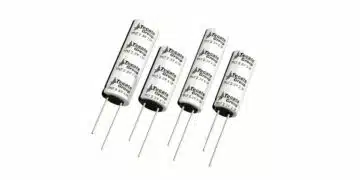
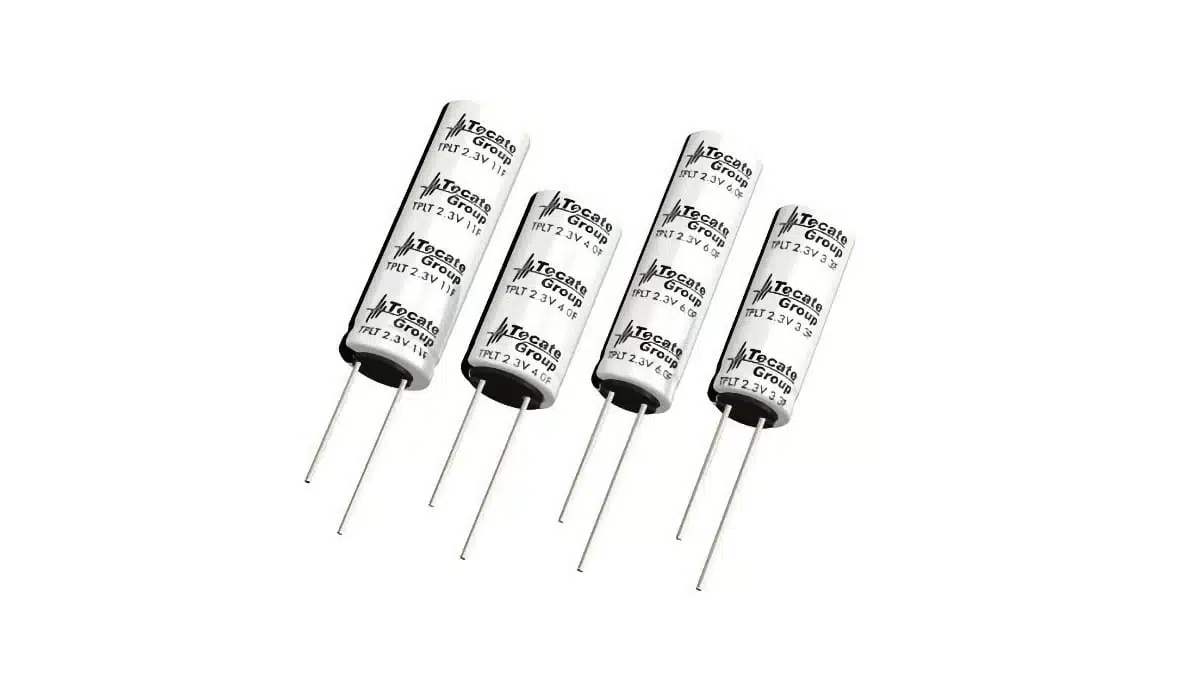
Tecate Group has introduced a new series of 2.3 V supercapacitor cells rated for continuous operation up to 105°C, targeting applications where standard 65–85°C devices are at their limits.

The TPLT supercapacitor series extends the usable temperature envelope for energy‑storage and backup functions, helping designers reduce derating, cooling effort and mechanical constraints in harsh environments.

RelatedPosts

Tecate Releases Small-Cell 3V Supercapacitors

Tecate Group Releases Hybrid Lithium Ion 3.8 Volt Capacitors

Tecate Group Announces Industry-Leading 3-Volt Family of Ultracapacitors

Key features and benefits

  • High temperature capability up to 105°C (221°F) – allows installation closer to heat sources, such as under‑hood, power modules or tightly packed industrial enclosures, without immediate lifetime penalties associated with 65–85°C‑class parts.
  • 2.3 V single‑cell rating – fits well into typical series string architectures for 12 V, 24 V and 48 V systems using standard balancing approaches.
  • Initial capacitance range from 3.3 F to 11 F – the first release includes 3.3 F, 4 F, 6 F and 11 F cells, giving designers flexibility from compact power bursts to higher‑energy short‑term backup.
  • Improved high‑temperature performance vs. legacy TPL/TPLH series – the manufacturer states a roughly 60% improvement in high‑temperature capability over existing 65°C and 85°C‑rated supercapacitor lines, which can translate into longer service life in hot environments when appropriately derated.
  • Reduced cooling and thermal‑management effort – higher allowable ambient temperature can reduce or eliminate forced‑air cooling, simplify heatsinking, and enable denser layouts, particularly in sealed or fanless equipment.
  • Targeted for demanding environments – the series is positioned for automotive, industrial, and energy‑sector electronics where ambient and self‑heating can be difficult to control over the full mission profile.

Typical applications

The TPLT supercapacitor cells are suitable wherever frequent charge/discharge cycling, high power density and wide temperature range are more critical than very high energy density. Example use cases include:

  • Automotive under‑hood systems, such as start‑stop buffers, power net stabilization and support for electric water pumps or steering systems.
  • Industrial control and drive systems, for DC bus stabilization, pulse power support and brown‑out ride‑through in cabinets exposed to elevated ambient temperatures.
  • Oil and gas electronics, where equipment can see high ambient temperatures and limited airflow, but still require reliable power buffering and backup.
  • Backup energy for embedded systems, gateways or PLCs, providing short‑term hold‑up for safe shutdown or data retention when mains power is interrupted.
  • High‑pulse loads in transportation, automation and power conversion, where low internal resistance and stable performance over a broad temperature range are required.

Technical highlights

According to the manufacturer, the TPLT line launches as a family of 2.3 V cylindrical supercapacitor cells with four initial capacitance values. Exact dimensions, ESR, lifetime ratings and mechanical options are defined in the individual datasheets and should be consulted during design‑in.

TPLT initial capacitance range

Series nameCell voltageAvailable capacitancesMax operating temperature
TPLT2.3 V3.3 F, 4 F, 6 F, 11 F105°C (continuous)

The new series is positioned above Tecate’s existing TPL and TPLH lines, which are specified for operation up to 65°C, or up to 85°C with voltage derating according to the manufacturer’s documentation. The roughly 60% improvement in high‑temperature capability reflects the move from a 65°C baseline toward a 105°C continuous rating, which can have a major impact on expected lifetime in thermally stressed installations when similar derating rules are applied.

From an application perspective, higher temperature tolerance primarily addresses:

  • Slower degradation of electrolyte and separator materials at a given ambient temperature.
  • Reduced risk of capacitance loss and ESR increase over time in environments where equipment runs hot for extended periods.
  • More headroom for self‑heating due to ripple currents and high‑power pulses, especially in compact mechanical designs.

Design‑in notes for engineers

For design engineers and component specifiers, the move from a 65–85°C‑class supercapacitor to a 105°C‑rated device impacts both electrical and mechanical design. The following points can be useful during evaluation:

  • System‑level temperature analysis – assess worst‑case ambient plus self‑heating at the supercapacitor location; 105°C rating allows less conservative placement near power semiconductors or in sealed housings, but lifetime still depends strongly on actual operating temperature over time.
  • Voltage derating strategy – even with 2.3 V cell rating, consider applying conservative derating at the upper end of the temperature range to maximize lifetime, especially in mission‑critical or safety‑relevant systems.
  • Series connection and balancing – for 12–48 V rails, plan series stacks with appropriate passive or active balancing, taking into account tolerance spread and any expected differences in cell temperature within the pack.
  • ESR and ripple currents – while higher temperature can temporarily reduce ESR, long‑term operation at elevated temperatures tends to increase it; verify ripple current ratings and thermal rise in the target environment using the manufacturer’s application data.
  • Mechanical mounting and spacing – higher operating temperatures can stress solder joints, plastics and adjacent components; ensure that land patterns, creepage/clearance distances and any retention hardware support the intended thermal cycling range.
  • Protection and monitoring – include over‑voltage protection and, where appropriate, temperature monitoring near the supercapacitor bank to avoid abusive conditions in field operation.
  • Qualification and testing – for automotive and industrial programs, plan validation with realistic thermal profiles, including power cycling and high‑temperature storage tests based on the manufacturer’s recommended conditions.

Source

This article is based on a Tecate Group press release announcing the TPLT high‑temperature supercapacitor cell series and associated information provided on the company website and product pages.


References

  1. Tecate Group press release – New ultracapacitor cells rated for operation up to 105°C (221°F)
  2. Tecate Group – Supercapacitors product overview

Related

Recent Posts

Nvidia Vera Rubin: Why One AI Rack Needs So Many More MLCC Capacitors

2.6.2026
6

Stackpole Introduces 1400A Busbar Shunt Resistors

2.6.2026
4

Bourns Expands 1000V High‑Power Fuses for Semiconductor and Battery Protection

2.6.2026
3

Passive Components in 2026: From Invisible Commodity to Design Parameter

2.6.2026
10

Bourns Introduces High Current Chip Ferrite Beads for Dense Power Rails

1.6.2026
9

Vishay Releases High‑Current Radial Inductors up to 209 A

29.5.2026
22

May 2026 Interconnect, Passives and Electromechanical Components Market Insights

29.5.2026
86

Passive Components Enable Safe and Reliable ADAS Architectures

28.5.2026
63

YMIN Releases Square Supercapacitors for AI Server Power System

27.5.2026
51

Upcoming Events

Jun 2
16:00 - 17:00 CEST

Calculation, Simulation and Measurement of 800V EMC Filters

Jun 16
16:00 - 17:00 CEST

EMC with EMC – EMC‑compliant design with electromechanical connectors

View Calendar

Popular Posts

  • Buck Converter Design and Calculation

    0 shares
    Share 0 Tweet 0
  • Boost Converter Design and Calculation

    0 shares
    Share 0 Tweet 0
  • Flyback Converter Design and Calculation

    0 shares
    Share 0 Tweet 0
  • MLCC and Ceramic Capacitors

    0 shares
    Share 0 Tweet 0
  • LLC Resonant Converter Design and Calculation

    0 shares
    Share 0 Tweet 0
  • Capacitor Charging and Discharging

    0 shares
    Share 0 Tweet 0
  • What Electronics Engineer Needs to Know About Passive Low Pass Filters

    0 shares
    Share 0 Tweet 0
  • Dual Active Bridge (DAB) Topology

    0 shares
    Share 0 Tweet 0
  • Ripple Current and its Effects on the Performance of Capacitors

    3 shares
    Share 3 Tweet 0
  • SEPIC Converter Design and Calculation

    0 shares
    Share 0 Tweet 0

Newsletter Subscription


Passive Components Blog

© EPCI - Leading Passive Components Educational and Information Site

  • Home
  • Privacy Policy
  • EPCI Membership & Advertisement
  • About

No Result
View All Result
  • Home
  • Knowledge Blog
  • Dossiers
  • PCNS

© EPCI - Leading Passive Components Educational and Information Site

This website uses cookies. By continuing to use this website you are giving consent to cookies being used. Visit our Privacy and Cookie Policy.
Go to mobile version