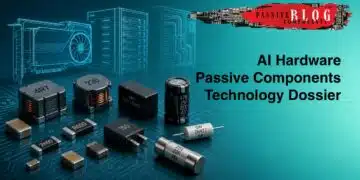









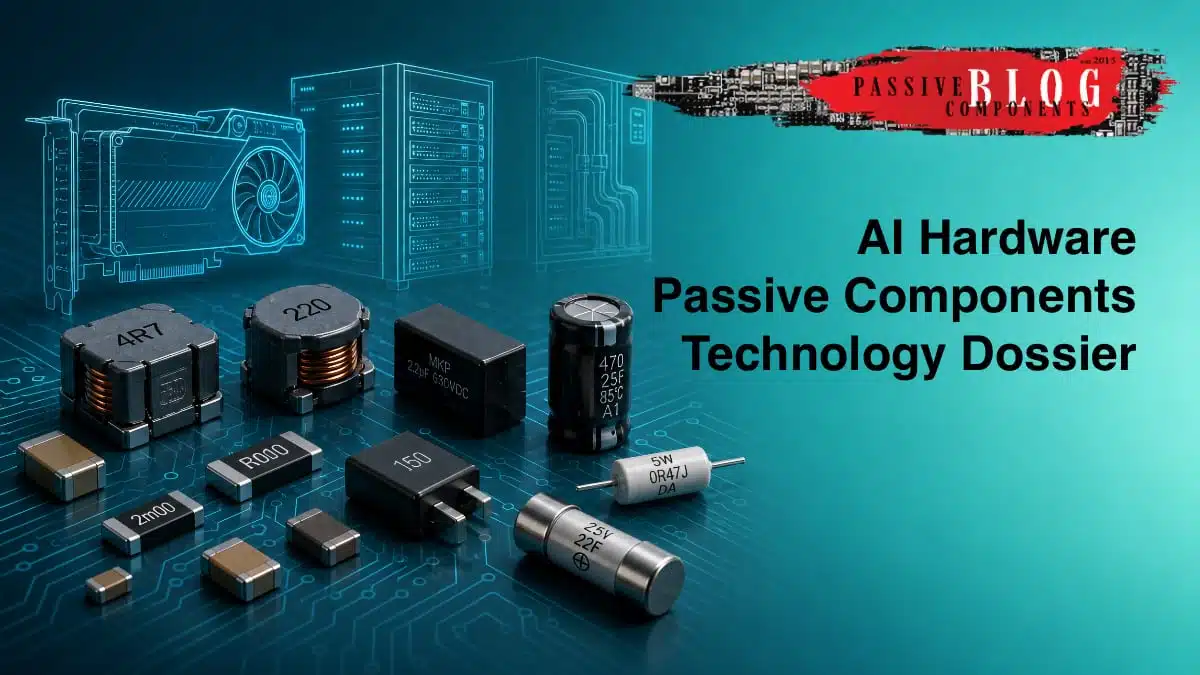
Passive Components Blog has published its AI Hardware Passive Components Dossier 06/26 technical and market report. It is a compact, high‑information, architecture‑focused study of how AI hardware designs influence and limit the use of passive electronic components, and what AI hardware evolution means for choosing those components.
In practical terms, this dossier is for teams who need to turn today’s AI server and Offline‑AI hype requirements into hard decisions on passive components such as MLCC stacks, TLVR magnetics, silicon capacitors, supercapacitors and PDN checklists.
From NVIDIA Rubin Ultra NVL576 racks at 600 kW to GB200/GB300 platforms, AI accelerator boards and the emerging Offline‑AI ecosystem of robots, autonomous vehicles and drones, it distils these architectures into clear maps of where capacitors, magnetics, resistors, supercapacitors and EMI elements have moved from ‘background parts’ to first‑order limits on power delivery, performance, efficiency, reliability and supply‑risk.
The result is a shared, application‑aware reference that lets engineers, component managers and sourcing leads work from common stress‑point and PDN views, instead of scattered datasheets and generic AI reports.
What the dossier covers
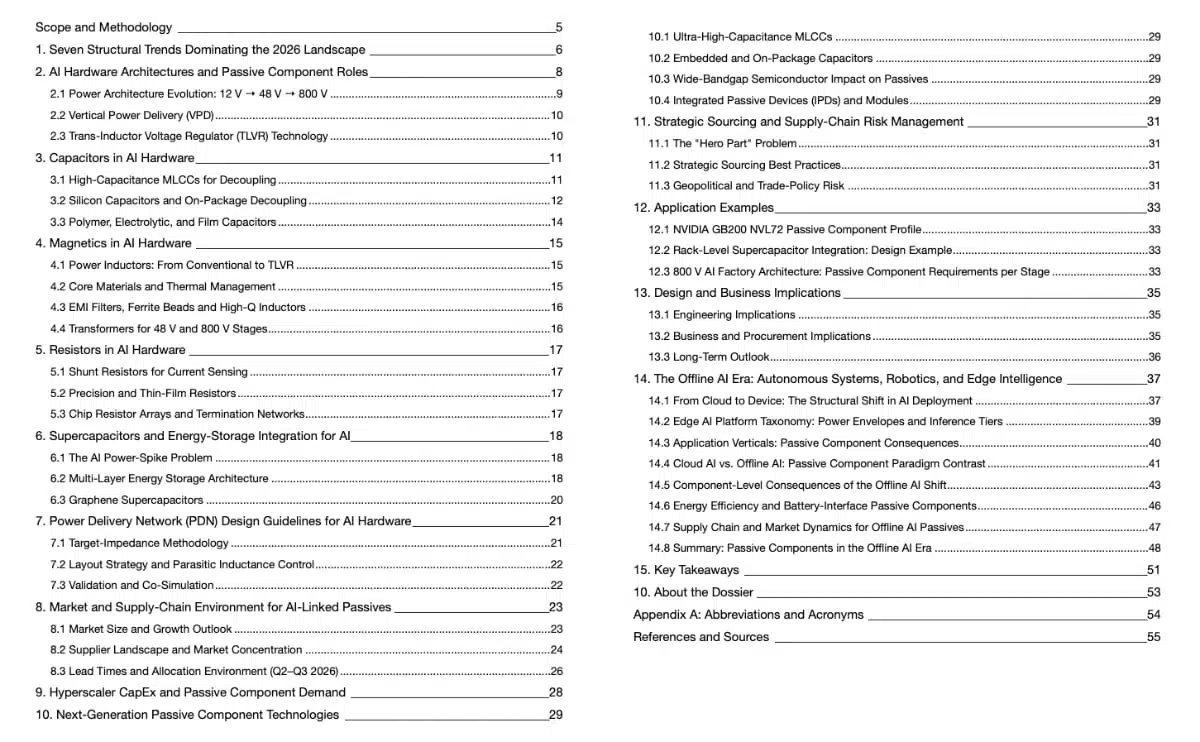
The Passive Components for AI Hardware Dossier 06/26 is a comprehensive annual report focused on AI‑critical passive components across cloud data‑centre and Offline‑AI platforms. It combines hardware‑architecture mapping, component‑technology deep dives, application chapters and design/sourcing guidance into one reference you can use throughout the 2026–2027 design cycle. Structured into fifteen chapters plus abbreviations and references, the dossier covers:
Seven structural trends reshaping AI hardware passives
How the migration from 12 V to 48 V and toward 800 V DC distribution, the adoption of Vertical Power Delivery (VPD) and Trans‑Inductor Voltage Regulator (TLVR) topologies, the explosion in per‑rack MLCC and inductor counts, and the emergence of on‑package silicon capacitors and rack‑level supercapacitor buffers are redefining passive‑component roles and bottlenecks in AI servers.
AI hardware architecture and PDN fundamentals
A hardware‑centric view that traces rack‑level thermal design power from H100 DGX to Rubin Ultra NVL576 and maps voltage layers (800 V DC facility, 48 V rack bus, board‑level 12 V, sub‑1.8 V POL rails) to their key passive technologies and critical parameters. The dossier explains how VPD, TLVR and on‑package decoupling change PDN design, decoupling hierarchies and magnetics requirements.
Key passive technologies in AI hardware
Application‑driven chapters for:
- Capacitors: High‑capacitance MLCCs for GPU/HBM decoupling, mid‑ and high‑voltage MLCCs for 48 V and 800 V links, polymer and electrolytic capacitors for bulk energy storage, and film capacitors for DC‑link and snubber roles.
- Silicon capacitors and embedded decoupling: Deep‑trench silicon capacitors (DTCs), embedded ECAP devices and substrate‑integrated passives from Samsung EM, Murata/IPDiA, TSMC iCAP, Empower Semiconductor and others, including competitive landscape and performance metrics.
- Magnetics: TLVR and coupled inductors, VRM and bus inductors, core materials and thermal‑loss modelling, transformers for 48 V and 800 V stages, and EMI‑critical ferrite beads, high‑Q inductors and common‑mode chokes.
- Resistors: Shunt resistors for current sensing at very high currents, precision/ thin‑film resistors for reference paths, and termination networks for high‑speed SerDes and clocking.
- Supercapacitors and rack‑level energy storage: Supercapacitor modules and lithium‑ion capacitors for peak shaving, UPS‑level buffering and AI power‑spike mitigation, including multi‑layer energy‑storage architectures.
Each family is covered in terms of its roles in AI hardware, stress mechanisms, technology options, derating rules and the 2025–2026 shifts in design practice.
PDN design guidelines and checklists for AI hardware
A dedicated chapter provides target‑impedance methodology, decoupling tiering from die‑level ECAPs out to rack‑level supercapacitors, layout and parasitic‑inductance control, and PI/SI/EMC co‑simulation guidance tailored to AI GPU boards and racks. Practical checklists highlight MLCC DC‑bias derating, TLVR inductor core‑loss modelling, shunt resistor temperature behaviour and 800 V compatibility planning.
Market and supply‑chain view for AI‑linked passives
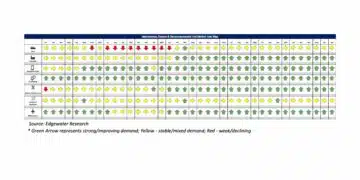
A qualitative 2025–2026 view of AI‑server and Offline‑AI demand, segment growth, supplier concentration and structural supply tightness for MLCCs, TLVR inductors, silicon capacitors, AEC‑Q‑grade passives and rack‑level supercapacitor systems. The dossier discusses lead‑time ranges, price moves and “hero part” risks, and translates them into sourcing strategies, allocation management and supplier‑engagement priorities.
Application examples and Offline‑AI platform impact
Examples show how passives are actually deployed in:
• NVIDIA GB200 NVL72 racks and GB300 evolutions.
• Rack‑level supercapacitor integration for peak‑shaving and energy buffering.
• 800 V “AI factory” architectures, with passive requirements per stage (MVAC → 800 V DC, 800 V bus, 800 V → 48 V resonant conversion, 48 V PDN, GPU/HBM POL).
The dossier then explores the Offline‑AI era—autonomous vehicles, robots, drones and other physical‑AI platforms—quantifying projected device volumes and mapping their passive‑component consequences, especially for AEC‑Q200 and industrial‑grade MLCCs, inductors and resistors.
CONTENT
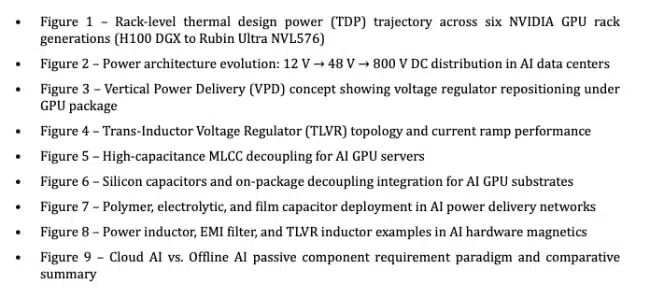
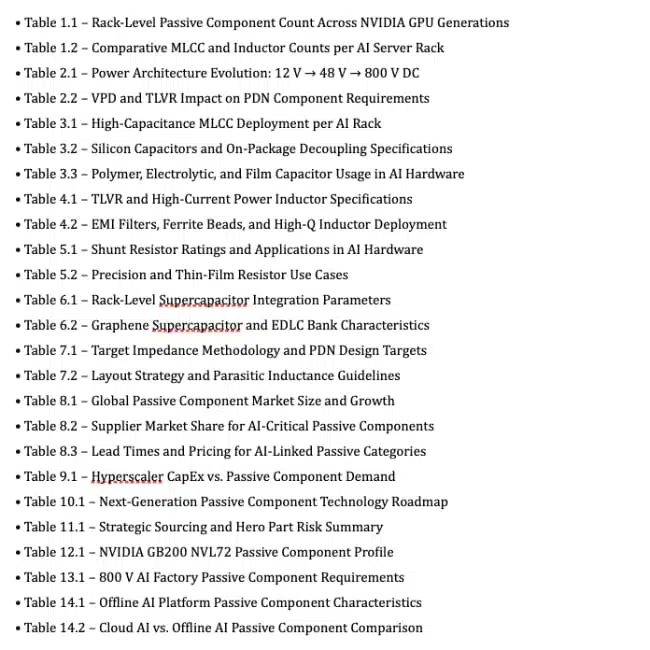
Key questions the dossier answers
Key questions this dossier helps to answer
- How do next‑generation AI server platforms (GB200, GB300, Rubin VR200, Rubin Ultra NVL576) change passive‑component requirements, per‑rack MLCC and inductor counts, and PDN architectures compared with traditional enterprise servers?
- Which voltage layers (800 V facility, 48 V rack bus, board‑level 12 V, sub‑1.8 V POL) drive the most demanding requirements for MLCCs, DC‑link capacitors, inductors, transformers and EMI filters in AI racks?
- Where do MLCCs, on‑package silicon capacitors, polymer/electrolytic capacitors, film capacitors and supercapacitors each make the most sense in AI power‑delivery paths and energy‑storage architectures?
- How do VPD and TLVR topologies redistribute loss, transient and stability constraints from semiconductors into magnetics, decoupling networks and layout‑sensitive passives?
- What are the emerging reliability and design‑failure concerns in AI hardware (e.g., MLCC bias derating, TLVR core‑loss under real workloads, shunt resistor thermal gradients, supercapacitor cycling) and how should derating, qualification and review flows be adapted?
- How can engineering and sourcing teams use shared PDN checklists and stress‑point maps to make AI‑hardware passive decisions traceable to mission profiles, thermal margins and supply risk, rather than ad‑hoc part selection?
- In the Offline‑AI era, which passive families actually set performance, robustness and supply risk for robots, autonomous platforms and industrial edge systems—and where do automotive/industrial‑grade passives collide with data‑centre capacity?
Who should read it
- AI hardware and power‑electronics design engineers architecting GPU servers, accelerator boards and rack‑level PDNs who need AI‑specific passive guidance rather than generic component datasheets.
- PDN, layout and magnetics specialists responsible for target‑impedance profiles, decoupling hierarchies, TLVR/VPD implementations and EMI compliance in high‑current, high‑frequency AI boards.
- Component engineers and technology managers owning approved‑component lists and reliability rules for MLCCs, inductors, resistors, supercapacitors and silicon capacitors in AI data‑centre and edge platforms.
- Sourcing, category and supply‑chain managers managing risk, qualification and supplier strategies for AI‑linked passives, and needing an application‑aware view of which passive families are becoming structurally critical vs. commodity.
- System architects and product/platform owners planning 48 V and 800 V DC AI‑factory architectures and Offline‑AI devices, and wanting to understand how hardware choices implicitly lock in passive‑component families and supply exposures.
Why it stands apart
Unlike generic “AI hardware” or semiconductor‑centric reports, this dossier is passive‑centric and architecture‑led:
- It starts from real AI hardware paths (48 V rack bus + multiphase TLVR, 800 V DC links, GPU/HBM PDNs, rack‑level energy storage) and maps exactly which passive families become first‑order constraints in each case.
- It combines hardware‑architecture views, component‑technology maps, application chapters, PDN design guidance and market/supply‑risk analysis in one volume, so engineers and sourcing teams can work from the same terminology and visuals.
- It treats passives not as isolated catalogue parts, but as an ecosystem: MLCC decoupling stacks, silicon ECAPs, TLVR magnetics, shunt networks, EMI filters and supercapacitor buffers are always discussed in context of mission profile, control strategy and packaging.
- A dedicated design‑guidance chapter and worked AI hardware examples show how to turn “good practice” statements on decoupling, magnetics, current sensing and energy buffering into concrete design and review actions.
The result is a compact, high‑density reference that can be read in an afternoon and used all year for architecture, design and sourcing decisions around passive components in AI hardware.
Availability
The AI Hardware Passive Components Technology Dossier is available now at 699 EUR exclusively from passive-components.eu as a paid download.
To learn more about other available dossiers and purchase your copy, visit the Technology Dossiers page on the passive-components.eu blog.
Check all technical report dossiers available here: