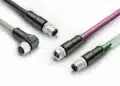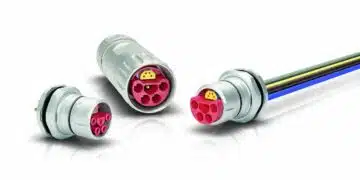











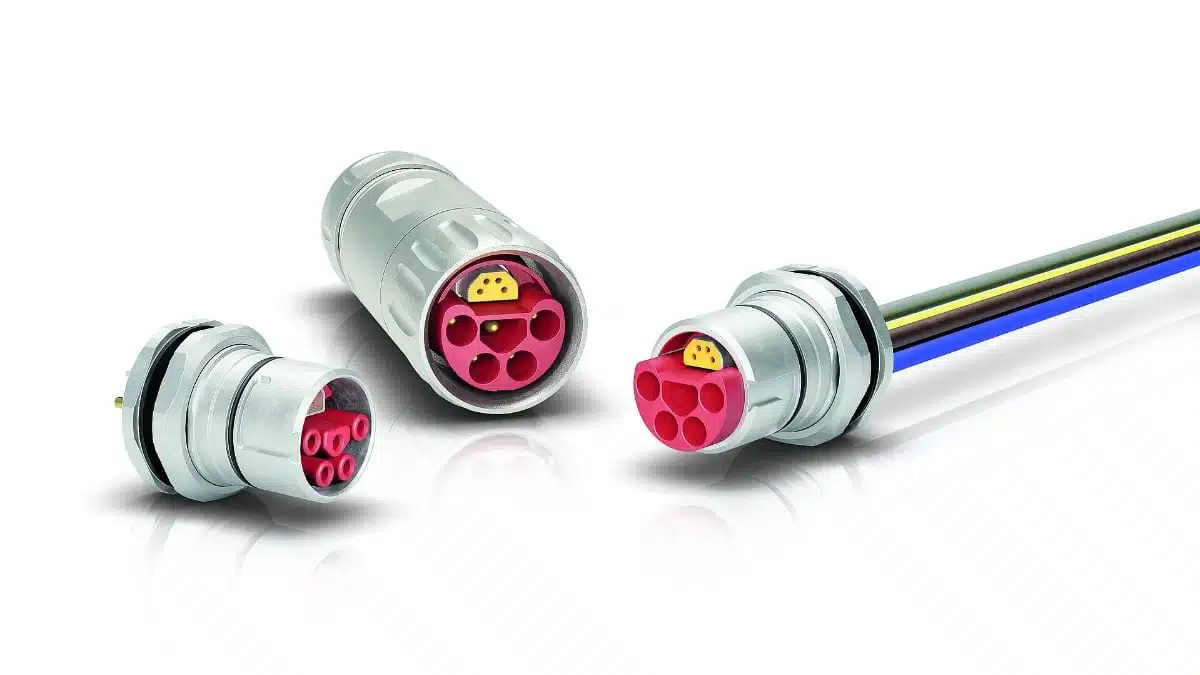
The Binder B23 series is a new generation of hybrid circular connectors that combines power and shielded Ethernet in a single interface for industrial automation.
It targets One Cable Automation concepts where servo drives, decentralized I/O and modular machines need high current capability together with reliable data links over minimal cabling.
Key features and benefits
- Hybrid power and data in one interface
The B23 combines power contacts and shielded data pairs in a single circular connector, allowing both supply and communication to run over the same cable. This can significantly reduce the number of cables and connectors in a machine, which simplifies routing and lowers material and installation cost. - High power density for compact drives
The connector supports currents up to 28 A at voltages up to 630 V, which is sufficient for many small and medium servo motors, decentralized drives and motion modules. For designers, this means that one hybrid connector can replace separate power plugs in many typical automation power classes. - Integrated Ethernet data path
The data interface is designed for shielded Ethernet or EtherCAT according to Cat5 with transmission rates up to 100 Mbit/s. This covers a large portion of today’s industrial Ethernet control networks, enabling synchronous drive communication and diagnostic channels over the same hybrid connection. - Fast, robust bayonet locking
A bayonet quick-locking mechanism provides a secure mating with clear tactile feedback and short locking time compared to threaded variants. This is beneficial in installations with many connectors or frequent service, and it supports reliable IP-rated connections in the field. - Field-attachable screw clamp termination
The B23 uses screw clamp contacts for field assembly, eliminating the need for special crimp tools. This is particularly attractive for maintenance teams and panel builders who must assemble or modify cabling on site with standard tools. - Standardized interface for multi-vendor use
The interface follows IEC 61076-2-118, enabling manufacturer‑independent compatibility at the device and cable level. This helps purchasing teams avoid lock‑in to a single vendor and supports second‑source strategies. - Decentralization-ready mechanical design
With compact dimensions and protection up to IP65/IP67 according to the product variants, the connector is suitable for mounting directly on machines and drives in harsh industrial environments. This supports trends toward cabinet‑less, distributed automation architectures.
Typical applications
In practice, the B23 series fits into a range of One Cable Automation use cases where both energy and Ethernet‑based communication are required at the same point in the machine.
- Servo drives and compact inverters mounted on the machine frame
One hybrid cable from the cabinet or power distribution to each drive reduces bulk in drag chains and reduces assembly time. - Decentralized I/O and motion modules
Modular machine zones with local control electronics can be supplied and networked via a single hybrid feed, simplifying topology changes and expansion. - Robotics and flexible manufacturing cells
Robot axes, tool changers and mobile modules benefit from fewer, lighter cables, which improves mechanical flexibility and simplifies maintenance. - Machine platforms without central control cabinets
For cabinet‑less concepts, having a sealed, power‑plus‑Ethernet connector at each functional module supports fast commissioning and reconfiguration. - General industrial automation systems with hybrid power/data requirements
Wherever a device needs both significant power and deterministic Ethernet communication, the B23 provides a compact, standardized interface option.
Technical highlights
The following table summarizes the key functional parameters and interfaces as specified by the manufacturer.
| Parameter | B23 specification (according to manufacturer) |
|---|---|
| Interface type | Hybrid circular power + shielded data |
| Power contacts | 4 power contacts plus PE (protective earth) |
| Power rating | Up to 28 A, up to 630 V |
| Data interface | Shielded Ethernet / EtherCAT, Cat5 |
| Data rate | Up to 100 Mbit/s |
| Locking mechanism | Bayonet quick-locking |
| Termination (field) | Screw clamp |
| Standard | IEC 61076-2-118 |
| Ingress protection | Up to IP65/IP67 (according to variant) |
| Mounting styles | Field‑attachable cable connector, panel mount |
From a system perspective, the power rating enables the B23 to serve many typical 3‑phase motor and actuator sizes in factory automation, especially in the low‑to‑mid kilowatt range depending on supply voltage and duty cycle. The 100 Mbit/s Ethernet capability is sufficient for most real‑time industrial Ethernet protocols that target motion control and distributed I/O.
Product portfolio and mechanical variants
Binder currently offers the B23 series in several mechanical versions to cover both device and cable‑side integration:
- Male cable connector, 9 contacts (4 + PE + 4 data), screw clamp, IP67
- Female cable connector, 9 contacts (4 + PE + 4 data), screw clamp, IP67
- Male panel mount connector with THT contacts, IP65/IP67, rear mounting
- Male panel mount connector with THT contacts and pre‑assembled stranded wires, IP65/IP67
- Female panel mount connector with THT contacts, IP65/IP67, rear mounting
- Female panel mount connector with THT contacts and pre‑assembled stranded wires, IP65/IP67
These panel and cable combinations allow designers to create complete hybrid interfaces from the device housing through to the field cabling using consistent geometry and mating.
Availability and part numbers
According to the press release and linked product pages, the first wave of B23 products focuses on 9‑contact hybrid configurations that integrate four power contacts, a PE contact and four data contacts.
Example order codes from the manufacturer’s catalog include:
| Function | Example part number | Key characteristics |
|---|---|---|
| Male cable connector | 99 6327 000 09 | 9 contacts (4+PE+4), 8.0–17.0 mm cable, screw clamp, IP67 |
| Female cable connector | 99 6328 000 09 | 9 contacts (4+PE+4), 8.0–17.0 mm cable, screw clamp, IP67 |
| Male panel mount connector | 09 6313 000 09 | 9 contacts (4+PE+4), THT, IP65/IP67, rear mounting |
| Male panel mount connector with leads | 09 6313 700 09 | As above, with stranded wires attached |
| Female panel mount connector | 09 6314 000 09 | 9 contacts (4+PE+4), THT, IP65/IP67, rear mounting |
| Female panel mount connector with leads | 09 6314 700 09 | As above, with stranded wires attached |
For detailed dimensional drawings, mating dimensions, recommended torque and cable preparation lengths, designers should refer to the official datasheets linked from the Binder B23 product family page, as those documents contain the definitive mechanical data.
Design-in notes for engineers
- Clarify power budget and derating early
Calculate the maximum continuous and peak current for each device and compare against the 28 A rating, including ambient temperature and bundling effects. Always apply the manufacturer’s derating curves from the datasheet rather than using the nominal current as a fixed limit. - Check system voltage and insulation coordination
The maximum 630 V rating must be evaluated against the system’s rated voltage, overvoltage category and pollution degree. Ensure that the B23 creepage and clearance distances in the datasheet match the safety requirements of the application and relevant standards. - Integrate EMC and cabling strategy
For 100 Mbit/s Ethernet or EtherCAT, the quality of shield termination and cable routing is critical. Plan for a continuous 360‑degree shield connection where specified, use appropriate hybrid cable types recommended by the manufacturer, and route power and data sections to avoid unnecessary coupling. - Choose termination style based on installation model
Screw clamp field termination is attractive for flexible, on‑site configuration but requires torque‑controlled tightening and periodic inspection in high‑vibration environments. For higher volume equipment, panel‑mount versions with THT contacts or pre‑assembled leads can reduce assembly time and variability. - Consider ingress protection and cleaning practices
Select IP65/IP67 variants when connectors are exposed to wash‑down, dust or coolant mist. In environments with frequent cleaning, check the datasheet for applicable chemical resistance and recommended mating/unmating cycles under those conditions. - Plan for future expansion and multi‑vendor ecosystems
Because the interface follows IEC 61076‑2‑118, it is sensible to design panel cutouts and PCB footprints with some margin to accommodate potential alternative suppliers in the future. Purchasing teams should document the interface standard in the internal component database to simplify cross‑referencing. - Document One Cable Automation topology
For complex machines, it is helpful to create a clear wiring diagram that separates hybrid power/data trunks and pure data branches. This reduces the risk of mis‑mating during commissioning when both conventional Ethernet and hybrid connectors coexist.
Source
This article is based on information provided in the official Binder press release on the B23 hybrid connector series for One Cable Automation and on the associated product information published by the manufacturer. For any missing or application‑specific parameters, readers should refer to the current Binder datasheets and catalogs.