
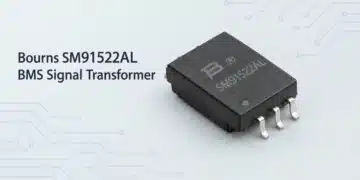






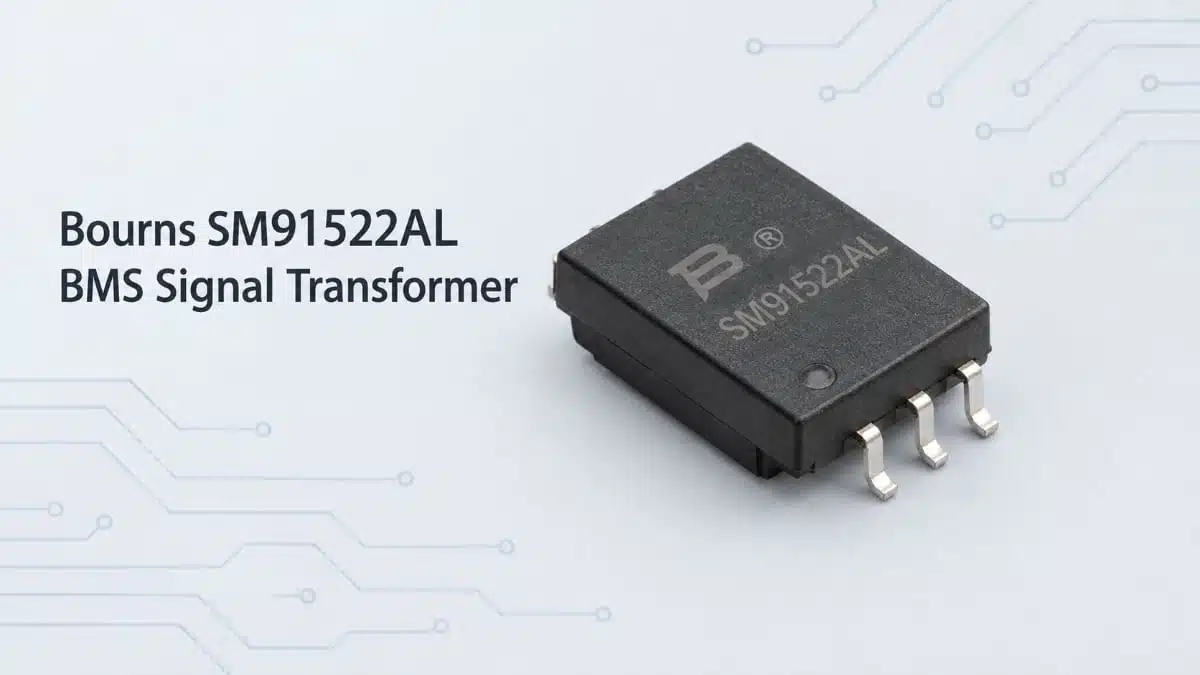
Bourns has introduced the SM91522AL, a single-channel battery management system signal transformer with functional insulation and integrated common-mode chokes.
The component combines communication-path isolation and common-mode noise rejection in a 15.63 × 9.00 × 3.50 mm package for integrated BMS designs and thin battery packs.
Key features and benefits
- Integration: A single communication channel combines a signal transformer with common-mode chokes for noise rejection in BMS communication circuits.
- Package height of 3.50 mm supports height-constrained battery electronics.
- Working voltage of 1,000 V DC and dielectric withstand test level of 4,300 V DC.
- Inductance range of 150–450 µH across an operating temperature range of −40 °C to +125 °C.
- Automotive-grade construction with AEC-Q200 compliance.
- Developed for use with Analog Devices LTC6804-1/681X, NXP MC33771/33772 and Texas Instruments BQ79616 battery-monitoring ICs.
Technical highlights
The SM91522AL is a signal-path component for isolated communication in high-voltage BMS architectures. Its transformer provides functional insulation, while the integrated common-mode chokes address noise on the communication connection.
| Parameter | Value | Selection relevance |
|---|---|---|
| Model | SM91522AL | Single channel |
| Insulation category | Functional | Communication isolation |
| Inductance | 150–450 µH | Across operating temperature |
| Working voltage | 1,000 V DC | Operating voltage rating |
| Dielectric withstand | 4,300 V DC | Hi-Pot test level |
| Operating temperature | −40 °C to +125 °C | Thermal design range |
| Package dimensions | 15.63 × 9.00 × 3.50 mm | Mechanical integration |
| Qualification | AEC-Q200 compliant | Automotive component selection |
The working-voltage rating and Hi-Pot level serve different purposes. The 1,000 V DC rating governs operating-voltage selection; the 4,300 V DC figure is a dielectric withstand test level, not an operating-voltage rating.
The 150–450 µH inductance range also matters when matching the transformer to the communication interface. Transformer selection should account for signal voltage, pulse width and frequency rather than treating inductance as an isolated nominal value. These interface conditions influence the required primary inductance.
Typical applications
Target applications include:
- Battery management systems in hybrid and electric powertrain systems.
- Energy-storage battery packs with battery management systems.
In both applications, the component fits the communication path rather than the battery power path. Functional insulation supports communication between electrically separated circuit domains, and the integrated chokes provide common-mode noise rejection.
The 3.50 mm package height is relevant where the BMS board must fit within a thin battery assembly. The −40 °C to +125 °C operating range and AEC-Q200 compliance support automotive component selection, alongside the electrical requirements of the selected monitoring interface.
Application fit
Battery-monitoring modules can use transformer-coupled communication links to form a daisy-chained network through a battery pack. In this arrangement, the transformer couples the communication signal between modules, while common-mode filtering addresses noise on the interconnection.
The SM91522AL combines these functions within one component. Its intended IC families provide a starting point for interface selection, but the schematic must still match the chosen monitoring IC’s communication circuit, termination and filtering requirements.
The functional-insulation category should be assessed separately from the voltage ratings. A high dielectric withstand test level does not, by itself, establish a different insulation category.
Design-in notes for engineers
- Match the transformer to the selected monitoring IC, including its signal voltage, pulse width, frequency and recommended interface network.
- Assess the full 150–450 µH inductance range across the intended operating temperatures.
- Evaluate the voltage across the isolation barrier against the 1,000 V DC working-voltage rating; keep this assessment distinct from the Hi-Pot test requirement.
- Allocate mechanical space for the 15.63 × 9.00 × 3.50 mm package before fixing board placement and enclosure clearances.
- Evaluate communication integrity and common-mode noise susceptibility with the intended interconnect, termination and filtering arrangement.
- Validate final selection under the actual operating conditions before production release.
Further reading
- Inductor Selection Guide for BMS Battery Management System
- How to Select the Right Transformer for High Voltage Energy Storage Applications
Source
This article is based on the Bourns product announcement and official product documentation. Engineers should refer to the current manufacturer datasheet for final design and qualification.
References
- Bourns Releases New AEC-Q200 Compliant, Automotive Grade BMS Transformer — Model SM91522AL, Bourns, October 20, 2026.
- Selecting BMS Transformers for Isolated Communications in High Voltage Energy Storage, Bourns, October 2018.