






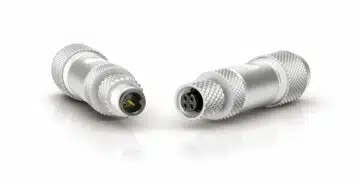



A multi-position wire-to-board connector brings signal and auxiliary power circuits together at the interface between a wiring harness and an electronic control module.
Amphenol Industrial Operations has introduced the HDPC 64 Pin Series, a rectangular connector family with central jackscrew locking and environmental sealing. The series combines 64 positions with ratings up to 250 V AC/DC and up to 7.5 A, depending on conductor size and application conditions.
Key features and benefits
- 64-position interface for signal and auxiliary low-voltage power circuits.
- Wire-to-board architecture for harness connections to electronic control modules.
- Central jackscrew locking to retain the mating connector.
- IP66/IPX9K environmental protection in the mated condition.
- Operating temperature range from −55 °C to +125 °C.
- Copper-alloy contacts with plated contact configurations.
- UL94 V-0 flammability classification and a design intended to meet SAE USCAR-2 performance requirements.
Technical highlights
The HDPC 64 Pin Series brings multiple sensing, communication, control and auxiliary power connections into a single interface. Its selection depends on the electrical loading of the individual circuits, the harness conductors and the mechanical integration of the mating pair.
| Parameter | Value | Conditions or configuration |
|---|---|---|
| Contact positions | 64 | Rectangular interface |
| Connection architecture | Wire-to-board | Harness to electronic module |
| Rated voltage | Up to 250 V AC/DC | Signal and auxiliary power |
| Current rating | Up to 7.5 A | Conductor- and application-dependent |
| Operating temperature | −55 °C to +125 °C | Series operating range |
| Environmental protection | IP66/IPX9K | Mated condition |
| Locking mechanism | Central jackscrew | Mechanical retention |
| Contact material | Copper alloy | Plated configurations |
| Flammability | UL94 V-0 | Housing material |
The current rating is conditional rather than a blanket loading allowance for every position. Conductor selection and the intended combination of loaded circuits therefore belong in the same assessment. The voltage rating also needs to be considered separately from the series’ intended role in auxiliary low-voltage power and signal connections.
The central jackscrew provides mechanical retention at the interface. Electrical performance also depends on the mating contact system: contact force, wipe and PCB alignment should be considered alongside housing retention when integrating the connector with a control-module assembly.
Environmental protection applies to the mated connector. That condition matters when planning assembly, servicing and equipment exposure.
Typical applications
The HDPC 64 Pin Series targets electronic control units, vehicle controllers, power distribution units and centralized control systems. These systems bring multiple sensing, communication and auxiliary functions to a common module, making the 64-position wire-to-board arrangement relevant to harness integration.
Target end markets include:
- Commercial vehicles and heavy-duty trucks.
- Construction, off-highway, agricultural and forestry machinery.
- Mining equipment.
- Specialty and emergency vehicles.
- Marine and waterborne equipment.
- Industrial automation.
- Telematics and fleet-management systems.
Within vehicle electronics, target functions include engine and transmission control, vehicle stability electronics, navigation and telematics. The −55 °C to +125 °C operating range and mated IP66/IPX9K protection are important selection parameters where the control-module interface faces temperature extremes and environmental exposure.
Application fit
The main architectural choice is whether to consolidate signal and auxiliary power circuits into a common harness-to-board interface. The HDPC 64 Pin Series provides 64 positions for that arrangement, with a central locking point rather than separate retention mechanisms for multiple connector interfaces.
That consolidation should be considered together with circuit allocation and harness routing. Power-circuit loading, conductor selection and signal assignments need to be resolved as part of the connector and module design, rather than after the mechanical interface has been fixed.
The series is designed to meet SAE USCAR-2 performance requirements. The connector’s electrical, mechanical and environmental requirements should be matched to the intended equipment and its operating profile.
Design-in notes for engineers
- Allocate the signal and auxiliary power circuits before fixing the harness pinout and module interface.
- Assess conductor size and application conditions against the up-to-7.5 A current rating.
- Check operating voltage and relevant transient conditions against the up-to-250 V AC/DC rating.
- Include the mating pair, central jackscrew engagement, harness routing and assembly access in the mechanical layout.
- Plan environmental protection around the mated IP66/IPX9K condition.
- Assess connector contact resistance together with electrical loading and service exposure.
- Validate the assembled connection under the actual electrical, thermal, mechanical and environmental operating conditions before production release.
Further reading
- Connector Design/Selection/Assembly
- Connector Testing Introduction
- Test Explanations: Connector Resistance
Source
This article is based on the Amphenol Industrial Operations product announcement and official product documentation. Engineers should refer to the current manufacturer datasheet for final design and qualification.
References
- Amphenol Industrial Operations Introduces HDPC 64 Pin Series — Amphenol Industrial Operations, November 19, 2026.