






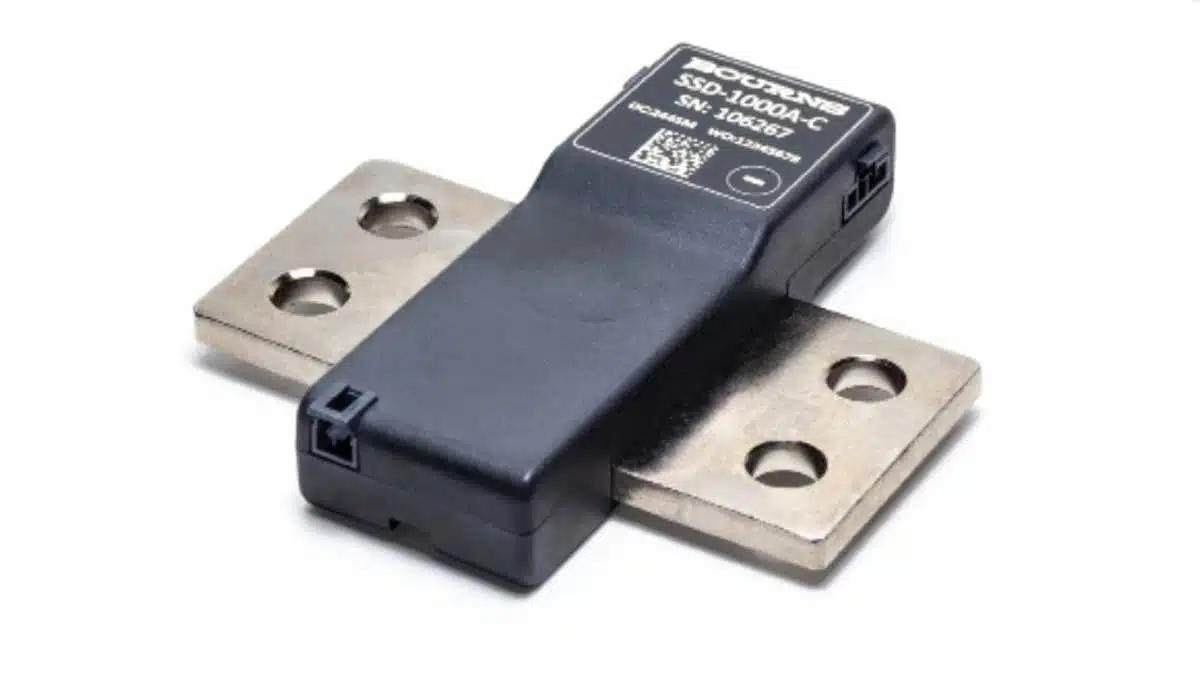
Bourns has extended its Riedon SSD-1000A Series digital current sensors with a new assembly option using AEC-Q compliant components, targeting demanding automotive and industrial environments.
The SSD-1000A Series combines a precision DC shunt, reinforced isolation and a 24‑bit digital interface, making it suitable for accurate high-current measurement in battery and energy systems where long‑term stability and safety are essential.
Key features and benefits
The SSD-1000A Series is a family of digital DC shunt‑based current sensors with integrated isolation and digital communication. It is designed to deliver precise current measurement in harsh environments such as energy storage, drives and EV infrastructure.
Key functional features include:
- 24‑bit isolated shunt current sensor with CANbus or RS‑485/MODBUS interface, enabling direct connection to digital control systems without external transducers.
- Nominal current ranges of 100 A, 250 A, 500 A and 1000 A, with peak current capability up to 2 kA, 5 kA, 10 kA and 20 kA respectively, allowing one platform to cover a wide spectrum from medium to very high current applications.
- 1500 VDC reinforced galvanic isolation between the measurement side and the control interface, improving safety and helping meet isolation requirements in battery systems and industrial drives.
- Integrated 24‑bit ADC with buffered analog inputs and an internal 16‑bit microcontroller rated to +150 °C, supporting high measurement resolution and stable operation over elevated temperatures.
- ECC flash memory with automatic single‑bit error correction plus internal and external CRC error detection, which reduces the risk of corrupted measurement data in noisy environments.
- Advanced non‑linear temperature compensation built into the device, helping to maintain accuracy over wide operating temperature and current ranges.
- Optional assembly using AEC‑Q compliant components for the SSD‑1000A model, supporting use in automotive‑grade designs where qualified components are required.
- RoHS compliant construction in line with Directive 2015/863.
For designers, the combination of a precision shunt, reinforced isolation and digital output means the SSD‑1000A can simplify system architecture compared to discrete shunt plus isolated amplifier plus ADC solutions, potentially reducing board space and design complexity.
Typical applications
The SSD‑1000A Series is aimed at battery‑related and high‑current systems where accurate, isolated current measurement is critical for control, safety and efficiency.
Typical use cases highlighted by the manufacturer include:
- EV charging stations: Current monitoring on DC output stages, protection paths and internal power modules, where high peak current capability and reinforced isolation are important.
- Battery systems and large‑scale energy storage banks: State‑of‑charge and state‑of‑health monitoring, pack balancing and fault detection in high‑capacity battery racks.
- Renewable energy generation infrastructure: Current sensing in PV inverters, DC combiners and battery‑coupled renewable systems that require high isolation and digital communication.
- Industrial motor drives: Monitoring of DC link or phase currents in variable‑speed drives and servo systems, supporting precise torque and overload control.
- Building automation systems: Current measurement for power distribution and backup systems in critical infrastructure installations.
In many of these applications, having a shunt‑based sensor with digital bus output allows closer integration into existing CANbus or RS‑485 field networks, simplifying wiring and diagnostics.
Technical highlights
While detailed electrical and timing characteristics must be taken from the official datasheet, the product release identifies several core technical aspects that guide selection and design‑in.
Important technical highlights include:
- Digital interfaces: Support for CANbus and RS‑485/MODBUS, which are widely used in automotive, industrial and energy systems, easing integration into existing control architectures.
- Measurement concept: DC shunt‑based sensing with a high‑resolution 24‑bit ADC, offering high linearity and stability when correctly designed and cooled according to the datasheet.
- Isolation: 1500 VDC reinforced galvanic isolation rating, which can support compliance with relevant safety standards in battery, EV and grid‑connected systems depending on the end‑equipment design.
- Embedded processing: A 16‑bit microcontroller with a maximum operating temperature of +150 °C handles measurement, compensation and communication, enabling on‑board temperature compensation and diagnostic features.
- Reliability: ECC flash memory with automatic single‑bit error correction and CRC‑based error detection enhances robustness against data corruption due to electrical noise or transient events.
For exact limits such as accuracy over temperature, bandwidth, response time and power dissipation, design engineers should refer to the SSD‑CANbus and SSD‑RS485 datasheets specified by Bourns.
Availability and part numbers
The SSD‑1000A Series is presented as a digital current sensor product line derived from former Riedon technology, now under the Bourns Sensors and Controls portfolio. Current ranges of 100 A, 250 A, 500 A and 1000 A give purchasing teams flexibility to align part selection with system current ratings and derating guidelines.
The product extension specifically introduces an assembly option using AEC‑Q200 compliant components for the SSD‑1000A, intended for applications that require automotive‑grade component assemblies. Procurement teams should verify the exact ordering codes and configuration options (such as interface variant and AEC‑Q option) in the manufacturer datasheet and product selector before finalizing BOMs.
Bourns directs users to the SSD‑CANbus and SSD‑RS485 datasheets for interactive programming and configuration details, which is relevant both for hardware engineers and for firmware teams responsible for the system‑side communication stack.
Design‑in notes for engineers
When designing in the SSD‑1000A Series, there are several practical points to consider to fully leverage its performance and reliability.
System and safety considerations:
- The 1500 VDC reinforced isolation rating supports use in high‑voltage battery and industrial systems, but final clearance/creepage distances, PCB layout and system‑level isolation coordination must follow the applicable safety standards and datasheet recommendations.
- In EV charging, battery storage and renewable systems, ensure the isolation barrier is correctly referenced and that common‑mode transients remain within specified limits.
Thermal and mechanical aspects:
- As a shunt‑based device, power dissipation will depend on current and shunt resistance; thermal design (copper area, airflow, mechanical mounting) should be checked against the datasheet to avoid excessive temperature rise.
- The presence of advanced temperature compensation reduces measurement drift, but the device must still be operated within its specified temperature and power limits.
Digital interface and programming:
- The availability of CANbus and RS‑485/MODBUS interfaces allows direct integration into existing control networks; engineers should plan message mapping, addressing and diagnostic data handling early in the design.
- Bourns points to interactive interface sections in the SSD‑CANbus and SSD‑RS485 datasheets for programming information, which typically cover configuration registers, scaling and calibration procedures.
Quality and compliance:
- For automotive and transportation designs, the option to use AEC‑Q compliant components in the SSD‑1000A assembly can support qualification and PPAP discussions, but full system compliance still depends on the complete design and test plan.
- RoHS compliance helps ensure global market access where hazardous substance restrictions apply.
In both new designs and platform upgrades, the SSD‑1000A Series can be an alternative to standalone shunts combined with isolated amplifiers, particularly when high resolution, digital bus connectivity and reinforced isolation are required in a single sensor module.
Source
The information in this article is based on the official product extension release for the Bourns Riedon SSD‑1000A Series digital current sensors and associated product documentation from Bourns Sensors and Controls.