




Researchers in Europe with expertise in nanofluidics, electrochemistry, clay mineralogy, and electron microscopy to design and characterize a new type of supercapacitor that uses only water as the electrolyte.
This work is a collaboration between researchers from institutions including École Polytechnique Fédérale de Lausanne (EPFL), the Technical University of Hamburg, and the Massachusetts Institute of Technology, together with several European partners in materials science and geomechanics.
The article “All‑water supercapacitor enabled by 1‑nm clay channels” was published as an open‑access research paper in Nature Communications in June 2026.
Introduction
The article addresses one of the central challenges in sustainable energy storage: how to build electrochemical devices using only abundant, environmentally benign materials while still achieving practical performance. Conventional batteries and supercapacitors rely on concentrated salt solutions, organic solvents, or metal‑oxide electrodes that introduce issues of cost, safety, and large‑scale resource availability. In contrast, the authors explore whether pure water, when forced into extreme nanoscale confinement, can act as an effective electrolyte on its own, without added salts or complex chemistries.
At the heart of the study is the observation that water behaves very differently when confined to channels only about one nanometer thick. In this regime, its dielectric response, proton transport, and interfacial polarization are strongly modified compared with bulk water, enabling unexpectedly high proton conductivity and unusual dielectric anisotropy. The authors leverage these properties by using layered natural clays, which naturally form 1‑nm interlayer water galleries, combined with conductive graphene to build a new type of electrochemical capacitor.
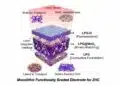
This device, which the authors refer to as a “blue capacitor,” integrates electrodes, separator, and electrolyte into a single layered membrane. The membrane consists of stacked clay and graphene nanosheets, with nanometer‑scale water channels running across the entire structure and connecting both electrodes. By relying on geometric confinement of water instead of chemically complex electrolytes, the work aims to open a new route toward scalable, all‑water energy‑storage systems based on abundant, low‑impact materials.
Key points
- The authors demonstrate a supercapacitor‑like device (“blue capacitor”) in which pure water confined in 1‑nm clay channels acts as the sole electrolyte, without added salts or organic solvents.
- The device architecture is a membrane‑electrode unit (MEU) made by vacuum‑filtering layered clay and graphene suspensions into a three‑layer van der Waals heterostructure with aligned 1‑nm water channels spanning electrodes and separator.
- Hydrated smectite‑type montmorillonite clays provide extended networks of slit‑like nanochannels, confirmed by synchrotron small‑angle X‑ray scattering and X‑ray diffraction, which show ~1‑nm interlayer water layers upon hydration.
- Cleaned and hydrated clays exhibit proton conductivities comparable to advanced proton‑conducting membranes, highlighting the key role of nanoconfined interlayer water in charge transport.
- Electrochemical testing shows stable operation up to about 1.6 ± 0.1 V before the onset of confined‑water electrolysis, with specific capacitance up to around 40 F g−1 and energy densities on the order of 10 Wh kg−1 of electrode material.
- The capacitor displays near‑unity coulombic efficiency (about 97 ± 2%) and maintains stable performance over more than 60,000 charge–discharge cycles at 1 V and 10 mA, with no detectable degradation.
- Cyclic voltammetry, electrochemical impedance spectroscopy, and buffer experiments indicate that the dominant mechanism is electrical double‑layer capacitance at graphene–water interfaces, mediated by mobile protonic species in confined water.
- Control experiments with dry vs. wet clays show that removing water collapses the capacitance by orders of magnitude, while rehydration restores performance, confirming that nanoconfined water is essential for both ionic transport and charge storage.
- The device uses only naturally abundant clays, carbon‑based electrodes, and water, suggesting a path toward sustainable, low‑cost electrochemical energy‑storage technologies based on confined aqueous electrolytes.
Extended summary
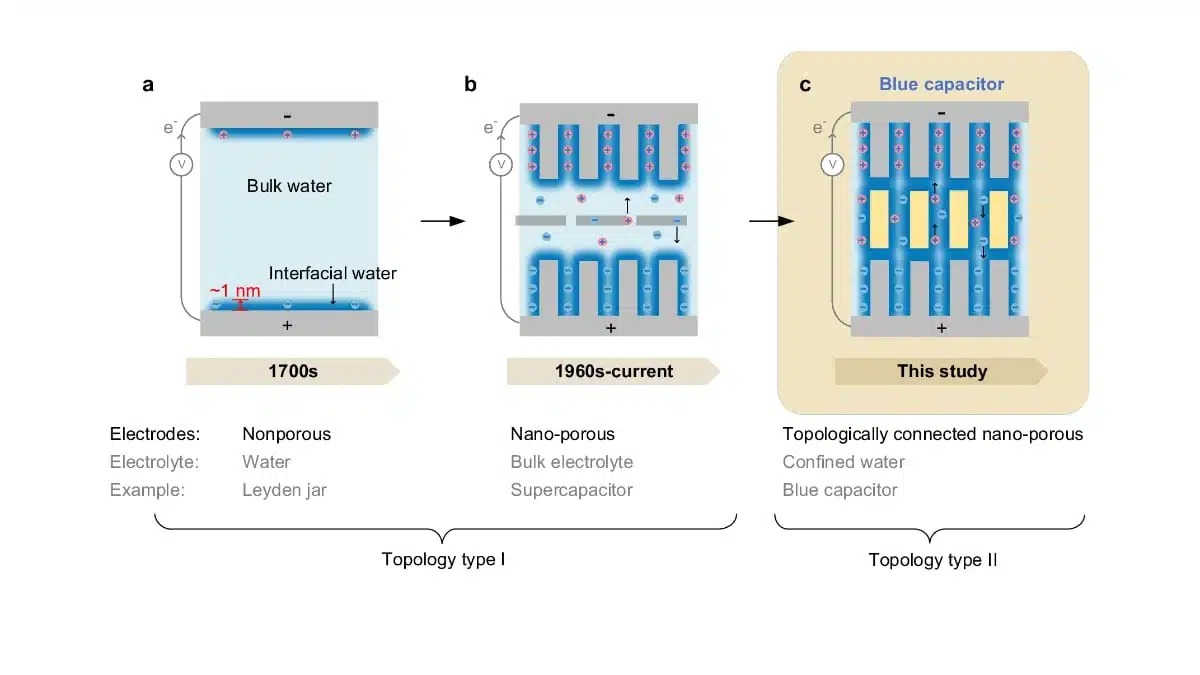
The article starts from the longstanding observation that water at interfaces can sustain large‑scale charge separation, as in thunderclouds, yet this phenomenon has been difficult to translate into controllable, reversible energy‑storage devices. Conventional double‑layer capacitors employ high surface‑area carbon electrodes immersed in bulk electrolytes to form electrical double layers, but they typically rely on concentrated salts or organic ionic liquids. The authors propose a new topology for electrochemical energy storage, where the electrolyte is not a bulk liquid in an open pore space but rather water confined within continuous 1‑nm channels integrated into the electrode–separator architecture.
Natural clays, especially smectite‑type montmorillonites, provide a suitable platform because they form layered silica–alumina structures with interlayer gaps that swell to about 1 nm when hydrated. Synchrotron small‑angle X‑ray scattering and X‑ray diffraction measurements on wet and dry clay samples show that water penetrates and expands the interlayer spacing to values consistent with monolayer‑like water films. Electrical measurements on carefully cleaned and hydrated clays reveal proton conductivity under wet conditions that approaches that of state‑of‑the‑art proton‑conducting membranes, while conductivity collapses in the dry state. This behavior is consistent with charge compensation in clays via mobile ionic species in hydrated interlayers and provides the physical basis for using clay‑hosted water as an electrolyte.
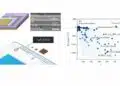
Building on this, the authors design a membrane‑electrode unit (MEU) that combines clay and graphene to form a continuous network of nanoconfined water channels that connect both electrodes. The MEU is fabricated by stepwise vacuum filtration of aqueous suspensions through nanoporous polymer filters. First, a graphene–clay composite suspension forms one electrode layer, then a pure clay suspension forms the separator, and finally a second graphene–clay layer forms the counter‑electrode. The filtration is carried out under controlled conditions with repeated checks of pH and conductivity to ensure extremely low levels of ionic contamination. The resulting free‑standing nanocomposite film has a typical thickness of 100–200 μm and an internal three‑layer structure with aligned, parallel hydrophilic channels about 1 nm wide that run continuously from one electrode to the other.
Electron microscopy (SEM, STEM, iDPC‑STEM) and energy‑dispersive X‑ray spectroscopy (EDX) are used extensively to validate the morphology and purity of the MEUs. Cross‑sectional images show a highly layered structure with closely packed, parallel flakes and no significant voids or gaps at the electrode–separator interfaces. EDX mapping detects only the expected elements from clay (O, Si, Al) and graphene (C), confirming the absence of extraneous species. High‑resolution STEM imaging of the separator region reveals well‑defined clay nanosheet stacks and confirms the presence of regular interlayer spacings that can host water layers. Taken together, these structural studies support the concept of a continuous nanochannel network filled with confined water.
Before electrochemical testing, the dry membranes are equilibrated in saturated water vapor for 48 hours, leading to water uptake through capillary condensation into the nanoscale galleries until the sample mass stabilizes. Graphite plates serve as current collectors, and the MEUs are assembled into a test fixture that applies controlled contact pressure and seals the device to prevent water loss. Electrochemical characterization includes cyclic voltammetry (CV), galvanostatic charge–discharge (CD), long‑term cycling, and electrochemical impedance spectroscopy (EIS) over a voltage window initially spanning 0–2.1 V and later optimized to 0–1.6 V based on the onset of hydrogen evolution.
The blue capacitor exhibits electrochemical behavior typical of double‑layer capacitors rather than Faradaic batteries. Cyclic voltammograms in the operating window show nearly rectangular shapes, and charge–discharge curves are close to linear, indicating capacitive storage. EIS spectra display a low‑frequency response consistent with capacitive behavior and lack signatures of significant Faradaic processes such as redox reactions or pseudocapacitance. Long‑term cycling at 1 V and 10 mA shows stable capacitance, coulombic efficiency, and energy efficiency with no detectable performance decay after more than 60,000 cycles. The authors attribute this remarkable stability to the absence of chemical reactions and to the high purity of the water and clay components, which suppress corrosion and side reactions.
A key design parameter is the fraction of graphene in the clay–graphene composite electrodes. By systematically varying the graphene concentration, the authors map the trade‑off between electronic conductivity and effective capacitance. At low graphene fractions, poor electronic connectivity limits the device performance, while at very high graphene fractions, the overall volume fraction of active clay–water nanochannels is reduced. The optimal composition appears around 35% graphene, where the MEU combines high electronic conductivity with maximal specific capacitance. The authors also note that reducing the separator thickness would lower the series resistance but introduces the risk of shorting the electrodes, so there is a design trade‑off that requires further optimization.
A central finding is that nanoconfined water in the clay channels can sustain higher operation voltages than bulk neutral water. The device operates stably up to about 1.6 ± 0.1 V, above which signs of water electrolysis and efficiency losses become apparent. This threshold is significantly higher than the standard 1.23 V water electrolysis potential under neutral conditions, indicating that confinement and interfacial effects modify the electrochemical stability window. Within this window, the blue capacitor achieves specific capacitances up to about 40 F g−1 and specific energy around 10 Wh kg−1 (per electrode mass), values comparable to some commercial supercapacitors that rely on conventional electrolytes.
To probe the charge‑storage mechanism in more detail, the authors compare devices in wet and dry states and perform buffer experiments. When the clay membranes are dehydrated, the capacitance drops by several orders of magnitude, and cyclic voltammograms lose their rectangular shape. Rehydration restores the capacitive response, demonstrating that water confined in the nanochannels is essential for both charge transport and storage. Introducing a pH‑neutral buffer into the system strongly suppresses the capacitance, indicating that proton activity is central to the mechanism. Temperature‑dependent impedance measurements yield an activation energy of about 0.17 eV, consistent with proton‑mediated transport in water, although the measurements cannot uniquely distinguish between structural (Grotthuss) and vehicular diffusion mechanisms.
The authors interpret these observations in terms of electrical double‑layer formation at graphene–water interfaces, combined with protonic conduction along nanoconfined water layers. Hydrated clay galleries are only about a nanometer thick, a scale comparable to the Debye screening length and molecular correlation lengths in water under these conditions. In this regime, water molecules form interfacial layers with modified structure and dielectric properties, and protonic species such as hydronium and hydroxide ions can move rapidly along hydrogen‑bonded networks. Under an applied electric field, these protonic species migrate through the hydrated channels and accumulate at the electrode interfaces, building up an electrical double layer that stores charge. The authors propose a relay‑like proton hopping mechanism along confined water chains, similar to a Grotthuss process, while noting that their macroscopic experiments cannot directly resolve microscopic proton trajectories.
Interestingly, the authors find that the intrinsic structural charge of the clay framework, arising from isomorphic substitutions, is not the dominant factor dictating electrochemical performance. Devices built from different clay types with varying lattice charge densities but similar surface areas show qualitatively similar behavior as long as they provide hydrated nanometer‑scale channels. This suggests that the main requirement is the presence of continuous nanoconfined water pathways, while the clay primarily acts as a mechanically robust, structurally ordered host for the water.
From an application perspective, the “blue capacitor” differs fundamentally from standard supercapacitors. Instead of having electrodes immersed in a bulk electrolyte reservoir, it integrates electrolyte, separator, and electrodes into a single layered nanochannel architecture, where water is immobilized within the clay interlayers. The device uses only naturally abundant clays, graphene‑based carbon, and pure water, avoiding critical metals, concentrated salt solutions, and organic solvents. While the present work is a proof of concept, its combination of reasonable capacitance, extended cycling stability, and intrinsically benign materials points toward possible routes for large‑scale, sustainable electrochemical energy‑storage systems that exploit the unusual properties of nanoconfined water.
Conclusion
The study demonstrates a new electrochemical energy‑storage concept in which ultraconfined water within one‑nanometer clay–graphene channels acts as the only electrolyte. By combining natural clays and graphene into a continuous network of hydrated nanochannels, the authors realize a “blue capacitor” that delivers stable electrical double‑layer capacitance, near‑unity coulombic efficiency, and long‑term cycling stability comparable to commercial supercapacitors, but without added salts or organic liquids. The work provides direct device‑level evidence that nanoconfined water can function as a practical electrolyte in macroscopic systems.
At the same time, the authors acknowledge several limitations and open questions. The present devices are laboratory‑scale demonstrators, and further research is needed to optimize separator thickness, electrode composition, and overall architecture for higher power density and reduced internal resistance. A detailed microscopic description of proton transport and interfacial polarization in the clay nanochannels is still incomplete and will require complementary spectroscopic and modeling studies. Future work may explore different layered hosts, surface chemistries, and channel geometries, as well as potential applications in areas such as biointerfaces and neuromorphic systems where confined aqueous electrolytes and protonic conduction are particularly relevant.
Overall, the article establishes a link between the physics of nanoconfined water and practical electrochemical device engineering. It opens a pathway toward scalable, all‑water supercapacitors based on abundant layered materials and could inspire new generations of sustainable energy‑storage and sensing technologies that harness the unique properties of water at the nanoscale.
References
- Artemov, V. et al. “All‑water supercapacitor enabled by 1‑nm clay channels.” Nature Communications, 17, Article 5014 (2026). https://www.nature.com/articles/s41467-026-73924-1