




Passive Components Blog
No Result
View All Result
  • Home
  • NewsFilter
    • All
    • Aerospace & Defence
    • Antenna
    • Applications
    • Automotive
    • Capacitors
    • Circuit Protection Devices
    • electro-mechanical news
    • Filters
    • Fuses
    • Inductors
    • Industrial
    • Integrated Passives
    • inter-connect news
    • Market & Supply Chain
    • Market Insights
    • Medical
    • Modelling and Simulation
    • New Materials & Supply
    • New Technologies
    • Non-linear Passives
    • Oscillators
    • Passive Sensors News
    • Resistors
    • RF & Microwave
    • Telecommunication
    • Weekly Digest

    MLCCs in the Age of AI: Q2 2026 Market Tightness

    AI Hardware Demand for Passive Components Dossier

    June 2026 Interconnect, Passives and Electromechanical Components Market Insights

    KYOCERA AVX Presents Antenna Integrator Studio Tutorial for Antenna Placement and RF Design

    Power Design Simulation Tools for Faster Inductor Selection and Loss Optimization

    Wk 25 Electronics Supply Chain Digest

    Skeleton Supercapacitor Achieves UL‑certified 3,500 A Peak Current for AI Data Centers

    Bourns Planar Transformers for SiC and GaN Gate Driver Isolation

    100 V Hybrid Polymer Capacitor from VINA Enesol Targets 48–72 V Power Platforms

    Trending Tags

    • Ripple Current
    • RF
    • Leakage Current
    • Tantalum vs Ceramic
    • Snubber
    • Low ESR
    • Feedthrough
    • Derating
    • Dielectric Constant
    • New Products
    • Market Reports
  • VideoFilter
    • All
    • Antenna videos
    • Capacitor videos
    • Circuit Protection Video
    • Filter videos
    • Fuse videos
    • Inductor videos
    • Inter-Connect Video
    • Non-linear passives videos
    • Oscillator videos
    • Passive sensors videos
    • Resistor videos

    KYOCERA AVX Presents Antenna Integrator Studio Tutorial for Antenna Placement and RF Design

    Power Design Simulation Tools for Faster Inductor Selection and Loss Optimization

    EMC‑Compliant PCB and Connector Design Guidelines

    Why Isolated DC/DC Power Supplies Fail Late, Würth Elektronik Podcast

    Designing 800 V DC EMC Filters: Calculation, Simulation and Measurement

    Current Sense Transformer Datasheet and Design‑in Guide

    Designing a USB Type‑C Flyback Planar Transformer with Frenetic’s Planar Tool

    Magnetics Design in High‑Frequency GaN Converters

    Qi2 Wireless Charging: Inductors, Capacitors and EMC Filters

    Trending Tags

    • Capacitors explained
    • Inductors explained
    • Resistors explained
    • Filters explained
    • Application Video Guidelines
    • EMC
    • New Products
    • Ripple Current
    • Simulation
    • Tantalum vs Ceramic
  • Knowledge Blog
  • DossiersNew
  • Suppliers
    • Who is Who
  • PCNS
    • PCNS 2025
    • PCNS 2023
    • PCNS 2021
    • PCNS 2019
    • PCNS 2017
  • Events
  • Home
  • NewsFilter
    • All
    • Aerospace & Defence
    • Antenna
    • Applications
    • Automotive
    • Capacitors
    • Circuit Protection Devices
    • electro-mechanical news
    • Filters
    • Fuses
    • Inductors
    • Industrial
    • Integrated Passives
    • inter-connect news
    • Market & Supply Chain
    • Market Insights
    • Medical
    • Modelling and Simulation
    • New Materials & Supply
    • New Technologies
    • Non-linear Passives
    • Oscillators
    • Passive Sensors News
    • Resistors
    • RF & Microwave
    • Telecommunication
    • Weekly Digest

    MLCCs in the Age of AI: Q2 2026 Market Tightness

    AI Hardware Demand for Passive Components Dossier

    June 2026 Interconnect, Passives and Electromechanical Components Market Insights

    KYOCERA AVX Presents Antenna Integrator Studio Tutorial for Antenna Placement and RF Design

    Power Design Simulation Tools for Faster Inductor Selection and Loss Optimization

    Wk 25 Electronics Supply Chain Digest

    Skeleton Supercapacitor Achieves UL‑certified 3,500 A Peak Current for AI Data Centers

    Bourns Planar Transformers for SiC and GaN Gate Driver Isolation

    100 V Hybrid Polymer Capacitor from VINA Enesol Targets 48–72 V Power Platforms

    Trending Tags

    • Ripple Current
    • RF
    • Leakage Current
    • Tantalum vs Ceramic
    • Snubber
    • Low ESR
    • Feedthrough
    • Derating
    • Dielectric Constant
    • New Products
    • Market Reports
  • VideoFilter
    • All
    • Antenna videos
    • Capacitor videos
    • Circuit Protection Video
    • Filter videos
    • Fuse videos
    • Inductor videos
    • Inter-Connect Video
    • Non-linear passives videos
    • Oscillator videos
    • Passive sensors videos
    • Resistor videos

    KYOCERA AVX Presents Antenna Integrator Studio Tutorial for Antenna Placement and RF Design

    Power Design Simulation Tools for Faster Inductor Selection and Loss Optimization

    EMC‑Compliant PCB and Connector Design Guidelines

    Why Isolated DC/DC Power Supplies Fail Late, Würth Elektronik Podcast

    Designing 800 V DC EMC Filters: Calculation, Simulation and Measurement

    Current Sense Transformer Datasheet and Design‑in Guide

    Designing a USB Type‑C Flyback Planar Transformer with Frenetic’s Planar Tool

    Magnetics Design in High‑Frequency GaN Converters

    Qi2 Wireless Charging: Inductors, Capacitors and EMC Filters

    Trending Tags

    • Capacitors explained
    • Inductors explained
    • Resistors explained
    • Filters explained
    • Application Video Guidelines
    • EMC
    • New Products
    • Ripple Current
    • Simulation
    • Tantalum vs Ceramic
  • Knowledge Blog
  • DossiersNew
  • Suppliers
    • Who is Who
  • PCNS
    • PCNS 2025
    • PCNS 2023
    • PCNS 2021
    • PCNS 2019
    • PCNS 2017
  • Events
No Result
View All Result
Passive Components Blog
No Result
View All Result

CapXon Earns EcoVadis Bronze Medal for Sustainability Performance

10.6.2026
Reading Time: 4 mins read
A A

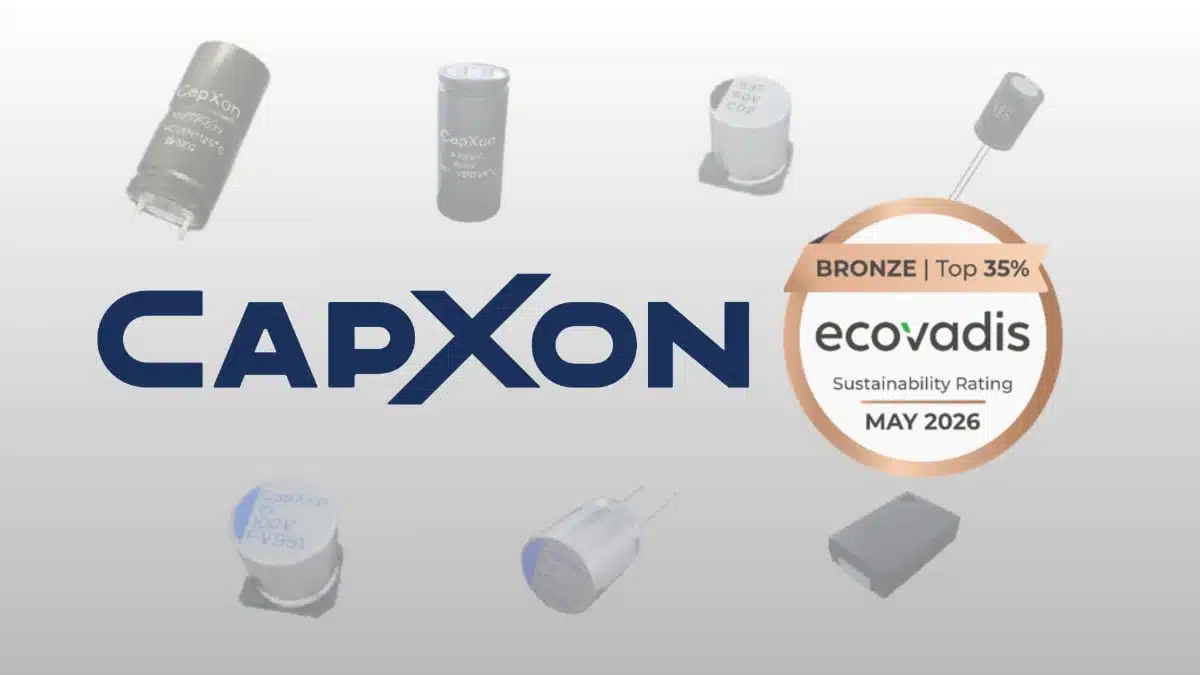
CapXon has been awarded the EcoVadis Bronze Medal, recognizing the company’s sustainability performance and placing it among the leading organizations assessed by EcoVadis worldwide.

This distinction underlines CapXon’s progress in embedding environmental, social, and ethical considerations into its operations and global supply chain.

RelatedPosts

MLCCs in the Age of AI: Q2 2026 Market Tightness

AI Hardware Demand for Passive Components Dossier

June 2026 Interconnect, Passives and Electromechanical Components Market Insights

CapXon’s Position in the Global Supply Chain

Founded in 1980, CapXon has developed into a global supplier of aluminum electrolytic capacitors with a monthly production capacity exceeding one billion pieces. With around 2,500 employees, the company supports a broad range of electronics applications, from consumer and industrial electronics to power and automotive systems. This large-scale footprint means that improvements in CapXon’s sustainability performance can have a meaningful impact across multiple tiers of the electronics supply chain.

EcoVadis Assessment Focus Areas

EcoVadis is a globally recognized provider of business sustainability ratings that assesses companies using a standardized methodology aligned with international CSR standards. The assessment evaluates a company’s management system across four key themes: environment, labor and human rights, ethics, and sustainable procurement. To qualify for a medal, companies must reach minimum scores in each of these themes, ensuring balanced performance rather than isolated strengths.

What the Bronze Medal Signifies

The EcoVadis medal scheme awards Bronze, Silver, Gold, and Platinum distinctions to companies that achieve defined percentile ranks within the global EcoVadis database. A Bronze Medal recognizes that a company has established a structured sustainability management system and ranks within a defined upper tier of all assessed organizations worldwide. For electronics manufacturers and their customers, this level of recognition helps demonstrate that ESG topics are systematically addressed rather than treated as isolated initiatives.

Sustainability Embedded in CapXon’s Operations

CapXon’s Bronze Medal reflects concrete steps taken to integrate environmental protection, labor and human rights, ethics, and responsible sourcing into its day‑to‑day operations. Internally, this includes policies and controls aimed at reducing environmental impact and strengthening transparency around ESG topics, while externally it supports more reliable, sustainable sourcing options for OEMs and EMS providers. As electronics manufacturers face increased expectations from end customers and regulators, such structured sustainability efforts at component level become an important differentiator.

Framework for Continuous Improvement

Beyond the immediate recognition, the EcoVadis assessment provides CapXon with a detailed scorecard and benchmarks against peers, serving as a roadmap for further ESG improvements. This feedback enables the company to identify high‑impact areas such as supply chain due diligence, climate‑related measures, and ethics training, and to prioritize the next steps in a data‑driven manner. For customers and partners, the use of an independent rating framework supports more transparent ESG dialogue and simplifies reporting into their own sustainability and compliance systems.

Supporting Sustainable Electronics Manufacturing

Demand for electronics that meet stricter environmental and social criteria is increasing across automotive, industrial, communications, and consumer sectors. By combining high‑volume aluminum electrolytic capacitor production with an externally validated sustainability program, CapXon positions itself as a long‑term partner for customers seeking to align technical performance, cost, and ESG requirements. The EcoVadis Bronze Medal adds an additional layer of assurance for OEMs and procurement teams working to reduce sustainability risks in their passive component supply base.

Source

This article is based on information provided by CapXon in its EcoVadis Bronze Medal communication, complemented with publicly available background information on EcoVadis and sustainability ratings.

References

  1. EcoVadis medals and badges – methodology overview
  2. Understanding EcoVadis medals and badges (EcoVadis support)
  3. CapXon corporate information and product overview
  4. EcoVadis corporate website

Related

Recent Posts

MLCCs in the Age of AI: Q2 2026 Market Tightness

30.6.2026
15

AI Hardware Demand for Passive Components Dossier

30.6.2026
13

June 2026 Interconnect, Passives and Electromechanical Components Market Insights

29.6.2026
30

Skeleton Supercapacitor Achieves UL‑certified 3,500 A Peak Current for AI Data Centers

26.6.2026
46

100 V Hybrid Polymer Capacitor from VINA Enesol Targets 48–72 V Power Platforms

26.6.2026
100

DigiKey Releases Season Two of Sustainable Futures Series

24.6.2026
26

Using a Virtual Anode Thermal Model to Evaluate Miniaturization Risk in Tantalum Capacitors

24.6.2026
40

High‑Speed Supercapacitor Balancing for AI Data Center Power Systems

23.6.2026
90

Practical Value of Structural Diagnostics for Tantalum Capacitor Anodes

22.6.2026
34

Upcoming Events

Jun 30
17:00 - 18:00 CEST

PSMA Capacitor Committee Webinar: High Voltage Pulse Capacitors

Jul 2
17:30 - 18:30 CEST

Can Claude design a production-ready Custom Magnetic Component?

Jul 14
16:00 - 17:00 CEST

EMC Design Essentials: Mastering Varistors and Common Mode Chokes

View Calendar

Popular Posts

  • Boost Converter Design and Calculation

    0 shares
    Share 0 Tweet 0
  • Buck Converter Design and Calculation

    0 shares
    Share 0 Tweet 0
  • LLC Resonant Converter Design and Calculation

    0 shares
    Share 0 Tweet 0
  • Flyback Converter Design and Calculation

    0 shares
    Share 0 Tweet 0
  • MLCC and Ceramic Capacitors

    0 shares
    Share 0 Tweet 0
  • Nvidia Vera Rubin: Why One AI Rack Needs So Many More MLCC Capacitors

    0 shares
    Share 0 Tweet 0
  • Earthing Systems and IEC Classification Explained

    0 shares
    Share 0 Tweet 0
  • Dual Active Bridge (DAB) Topology

    0 shares
    Share 0 Tweet 0
  • SEPIC Converter Design and Calculation

    0 shares
    Share 0 Tweet 0
  • MLCC Case Sizes Standards Explained

    0 shares
    Share 0 Tweet 0

Newsletter Subscription


Passive Components Blog

© EPCI - Leading Passive Components Educational and Information Site

  • Home
  • Privacy Policy
  • EPCI Membership & Advertisement
  • About

No Result
View All Result
  • Home
  • Knowledge Blog
  • Dossiers
  • PCNS

© EPCI - Leading Passive Components Educational and Information Site

This website uses cookies. By continuing to use this website you are giving consent to cookies being used. Visit our Privacy and Cookie Policy.
Go to mobile version