



Crosslinked PEI dielectrics could extend the operating envelope of film capacitors without requiring a new base polymer.
A collaboration led by Yi Liu at Lawrence Berkeley National Laboratory and BongSoo Kim at Ulsan National Institute of Science and Technology (UNIST) demonstrated a crosslinker that improves both mechanical restraint and electrical insulation. The peer-reviewed study was published in Nature Communications on October 19, 2026, as an accepted article in press.
Key takeaways
- PEI containing 5 wt% of the crosslinker delivered 6.0 J/cm³ discharged energy density with greater than 90% charge–discharge efficiency at 200°C and 650 MV/m.
- Leakage current density fell from 4.2 × 10⁻⁷ to 2.8 × 10⁻⁸ A/cm² at 200°C and 200 MV/m—a fifteenfold reduction.
- At 200°C, the optimized material achieved a Weibull characteristic breakdown field of 718 MV/m, with a shape parameter of 22 and ten breakdown measurements.
- Laboratory capacitors maintained energy-storage performance through 100,000 cycles at 200°C and 500 MV/m. The reported approximately 60-year lifetime at 200 MV/m is an extrapolation, not a demonstrated service life.
Background
A high glass-transition temperature does not automatically make a polymer a good high-temperature capacitor dielectric. A rigid backbone can resist softening while still allowing excessive charge transport under simultaneous thermal and electrical stress. Leakage then dissipates energy, broadens the charge–discharge loop and reduces the useful energy recovered from the capacitor.
For an approximately linear dielectric, stored energy density scales with permittivity and the square of electric field. Raising the usable field can therefore be valuable even without increasing dielectric constant. The challenge is maintaining insulation, efficiency and mechanical integrity at that field—not simply surviving a short breakdown test.
Crosslinking connects polymer chains into a network, restricting their movement. Conventional approaches, however, often require particular reactive groups or introduce residues and defects that undermine insulation. This study asks whether one additive can crosslink chemically different commercial polymers while also suppressing charge transport.
For the wider construction context, see Film and Foil Organic Dielectric Capacitors.
What the researchers found
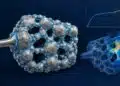
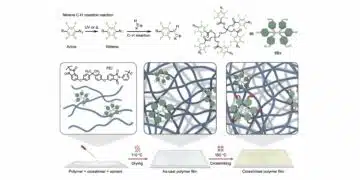
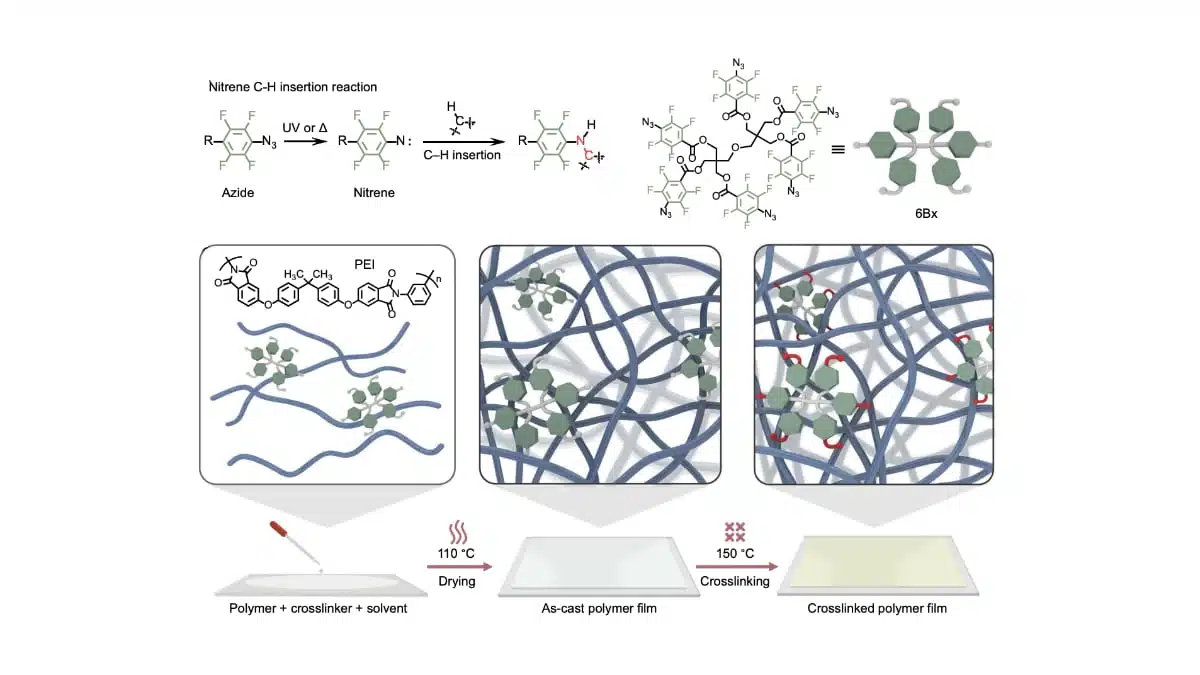
The additive, designated 6Bx, is a six-arm molecule bearing perfluorophenyl azide groups. Heating generates reactive nitrenes that insert into polymer carbon–hydrogen bonds, creating covalent connections between chains. The fluorinated junctions also introduce electron-withdrawing groups that help immobilize charge carriers.
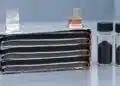
The benchmark material was commercial Ultem 1000 polyetherimide, or PEI. Films were solution drop-cast onto glass, vacuum-dried at 110°C for ten hours, then treated at 150°C for another ten hours. Electrical-test films were nominally 11 ± 2 µm thick. The preferred formulation contained 5 wt% 6Bx; higher loading did not produce the best electrical performance.
This distinction matters: the optimum dielectric was not the formulation with the greatest solvent-insoluble fraction. At 5 wt% loading, approximately 78% of the film mass remained after solvent extraction; complete retention required 20 wt%.
Experimental characterization combined infrared spectroscopy, X-ray scattering, thermal analysis, mechanical measurements and electrical testing. Molecular-dynamics simulations indicated reduced free volume and chain mobility. Density-functional calculations and isothermal relaxation-current measurements supported the proposed charge-trapping mechanism; the latter identified trap-depth peaks at 1.42 and 1.50 eV.
| Parameter | Pristine PEI | Crosslinked PEI | Conditions and interpretation |
|---|---|---|---|
| Young’s modulus | 628 MPa | 1,205 MPa | 200°C; crosslinked formulation contains 5 wt% 6Bx |
| Leakage current density | 4.2 × 10⁻⁷ A/cm² | 2.8 × 10⁻⁸ A/cm² | 200°C, 200 MV/m |
| Fitted hopping distance | 1.97 nm | 1.05 nm | Hopping-conduction fit to current–field measurements at 200°C |
| Charge–discharge efficiency | 68% at 550 MV/m | >90% at 650 MV/m | 200°C; different fields, not a matched-field comparison |
| High-efficiency discharged energy density | — | 6.0 J/cm³ | 200°C, 650 MV/m, efficiency >90% |
| Maximum discharged energy density | — | 7.1 J/cm³ | 200°C, 750 MV/m, efficiency 73.8% |
The separation between maximum energy density and high-efficiency energy density is important. The 7.1 J/cm³ result required accepting substantially greater loss; 6.0 J/cm³ is the more relevant headline when discussing efficient energy recovery.
The paper reports little change in dielectric constant or dielectric loss after crosslinking. The principal benefit is therefore better insulation and thermomechanical stability, rather than increased intrinsic polarization.
Why it matters for passive components
Crosslinked PEI dielectrics target insulation-limited operation
The direct component opportunity is polymer film capacitors for hot power-electronics environments. Suppressing leakage could reduce the conduction contribution to internal heating, while greater mechanical restraint could help the dielectric retain integrity under combined temperature and field.
However, charge–discharge efficiency measured from displacement–field loops is not interchangeable with high-frequency dissipation factor, ESR or ripple-current capability. Those parameters require additional measurements in a practical capacitor construction.
The work also demonstrates a broader materials-processing concept. Crosslinking was investigated in six commercial polymer systems: PEI, PMMA, PVDF-CTFE, a soluble polyimide, fluorene polyester and a fluorinated polyimide. This establishes applicability across the tested chemistries—not universality across every capacitor polymer. In particular, the reported set does not establish compatibility with polypropylene capacitor-film production.
The result does not directly address MLCCs, electrolytic capacitors, supercapacitors or magnetic components. Its relevance is specifically to electrostatic polymer dielectrics and their insulation-limited operating envelope.
From lab to component
An editorial maturity estimate is TRL 3–4: an experimentally validated materials concept with laboratory capacitor structures, but not a qualified wound or stacked component.
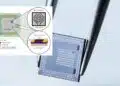
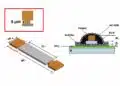
The strongest scaling evidence is a 10 × 10 cm film carrying 81 test capacitors, each with a 28 mm² electrode area. Testing at 200°C and 500 MV/m showed a relatively narrow distribution of energy-storage performance. That is useful evidence of local film uniformity, but it is not equivalent to continuous-web manufacturing yield or large-area capacitor reliability.
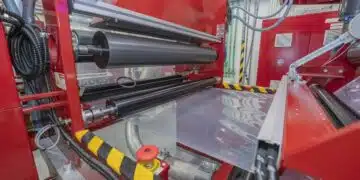
Production translation would have to address coating throughput, solvent removal, crosslinker distribution and the lengthy thermal treatment. Nitrogen evolves during azide activation, making void control an important manufacturing question. Thin-film handling, slitting, metallization adhesion and winding behavior remain additional gates.
Self-healing is particularly consequential. Improved breakdown resistance does not establish that a metallized film will clear faults safely or retain insulation afterward. The distinction between dielectric survival and controlled fault isolation is explained in Fuse Function of PP Capacitors Segmented Film Explained.
The lifetime claim also needs careful interpretation. The approximately 60-year prediction at 200°C and 200 MV/m comes from a power-law fit to accelerated time-dependent dielectric-breakdown measurements. It is not a measured operating duration, a component warranty or proof that the same failure mechanism governs decades of lower-field exposure.
Finally, a commercial base polymer does not make the complete formulation commercially qualified. Crosslinker synthesis cost, azide-handling safety, fluorinated-material assessment, solvent management and final-material regulatory compliance require separate evaluation.
What engineers should watch
- Industrial film production: continuous coating, substantially thinner layers, defect density and batch-to-batch reproducibility.
- Real electrode systems: aluminum or zinc metallization adhesion, electrode injection, end connections and stability after thermal processing.
- Fault behavior: self-healing, carbonized residues, segmented-electrode compatibility and capacitance loss after repeated clearing.
- Application-relevant losses: frequency-dependent dissipation, ESR, ripple-current heating and pulse endurance under representative waveforms.
- Lifetime validation: lower-field aging, failure distributions, extrapolation uncertainty and combined humidity–temperature–voltage stress.
- Process economics: crosslinker supply, synthesis yield, solvent recovery and whether curing time can be shortened without sacrificing insulation.
Summary
The study demonstrates a useful combination: crosslinking that restrains polymer motion while introducing charge traps, improving PEI’s high-temperature insulation without relying on higher permittivity. Laboratory films delivered 6.0 J/cm³ at greater than 90% efficiency at 200°C, alongside cycling and film-uniformity evidence.
The engineering takeaway is that stronger insulation can raise useful energy density even when dielectric constant barely changes. Turning that result into a capacitor still requires thin-film manufacturing, metallization, fault-management and lifetime qualification.
Further reading
Source
This article is based on the peer-reviewed paper published in Nature Communications, available through the journal’s gold open-access route under a Creative Commons Attribution–NonCommercial–NoDerivatives 4.0 International license. No matching institutional press release was verified in the accessible sources. These are research results, not qualified commercial components; design decisions should await manufacturer data and application-appropriate qualification.
References
- Lu Fan, Hyomin Kang, Zongliang Xie, Xi Chen, He Li, Shiqi Lai, Ashlin M. Deatherage, Tiffany Chen, Sherrie Qian, Tao Han, Steve W. Shelton, Eric A. Dailing, Myeongjae Lee, Yalin Wang, Jinhui Tao, Ting Xu, Yi Yin, BongSoo Kim and Yi Liu, “Polymer-agnostic crosslinking enables robust high-temperature dielectrics for energy storage,” Nature Communications, accepted article in press, published October 19, 2026. Volume and article number were not supplied on the accessed early-publication page. https://doi.org/10.1038/s41467-026-78724-1. License: CC BY-NC-ND 4.0. Publisher landing page and accepted-manuscript PDF consulted.