





Passive Components Blog
No Result
View All Result
  • Home
  • NewsFilter
    • All
    • Aerospace & Defence
    • Antenna
    • Applications
    • Automotive
    • Capacitors
    • Circuit Protection Devices
    • electro-mechanical news
    • Filters
    • Fuses
    • Inductors
    • Industrial
    • Integrated Passives
    • inter-connect news
    • Market & Supply Chain
    • Market Insights
    • Medical
    • Modelling and Simulation
    • New Materials & Supply
    • New Technologies
    • Non-linear Passives
    • Oscillators
    • Passive Sensors News
    • Resistors
    • RF & Microwave
    • Telecommunication
    • Weekly Digest

    Bourns Releases Compact High Current Shielded Power Inductors

    March 2026 Interconnect, Passives and Electromechanical Components Market Insights

    Molex Completes Acquisition of Smiths Interconnect, Expanding Portfolio of High-Reliability Connectivity Solutions

    APEC 2026 Power Electronics Trends and Implications for Passive Components

    Hydra Enhances Film Capacitor Robustness by Novel Gel Filler

    Würth Elektronik Releases Heat Sinks for TO and IC packages

    Würth Elektronik ICS to Acquire MRS Electronic and Expand Vehicle Electronics Portfolio

    Indias ECMS Wave Brings New Capacity For Passive Components Manufacturing in India

    Binder Introduces Triangular Moulding for M16 and M12 Cable Connectors

    Trending Tags

    • Ripple Current
    • RF
    • Leakage Current
    • Tantalum vs Ceramic
    • Snubber
    • Low ESR
    • Feedthrough
    • Derating
    • Dielectric Constant
    • New Products
    • Market Reports
  • VideoFilter
    • All
    • Antenna videos
    • Capacitor videos
    • Circuit Protection Video
    • Filter videos
    • Fuse videos
    • Inductor videos
    • Inter-Connect Video
    • Non-linear passives videos
    • Oscillator videos
    • Passive sensors videos
    • Resistor videos

    Transformer-Based Power-Line Harvester Magnetic Design

    Thermal Modeling of Magnetics

    Standard vs Planar LLC transformers Comparison for Battery Chargers

    How Modern Tools Model Magnetic Components for Power Electronics

    Advanced Loss Modeling for Planar Magnetics in the Frenetic Planar Tool

    2026 Power Magnetics Design Trends: Flyback, DAB and Planar

    Enabling Software‑Defined Vehicle Architectures: Automotive Ethernet and Zonal Smart Power

    Calculating Resistance Value of a Flyback RC Snubber 

    One‑Pulse Characterization of Nonlinear Power Inductors

    Trending Tags

    • Capacitors explained
    • Inductors explained
    • Resistors explained
    • Filters explained
    • Application Video Guidelines
    • EMC
    • New Products
    • Ripple Current
    • Simulation
    • Tantalum vs Ceramic
  • Knowledge Blog
  • DossiersNew
  • Suppliers
    • Who is Who
  • PCNS
    • PCNS 2025
    • PCNS 2023
    • PCNS 2021
    • PCNS 2019
    • PCNS 2017
  • Events
  • Home
  • NewsFilter
    • All
    • Aerospace & Defence
    • Antenna
    • Applications
    • Automotive
    • Capacitors
    • Circuit Protection Devices
    • electro-mechanical news
    • Filters
    • Fuses
    • Inductors
    • Industrial
    • Integrated Passives
    • inter-connect news
    • Market & Supply Chain
    • Market Insights
    • Medical
    • Modelling and Simulation
    • New Materials & Supply
    • New Technologies
    • Non-linear Passives
    • Oscillators
    • Passive Sensors News
    • Resistors
    • RF & Microwave
    • Telecommunication
    • Weekly Digest

    Bourns Releases Compact High Current Shielded Power Inductors

    March 2026 Interconnect, Passives and Electromechanical Components Market Insights

    Molex Completes Acquisition of Smiths Interconnect, Expanding Portfolio of High-Reliability Connectivity Solutions

    APEC 2026 Power Electronics Trends and Implications for Passive Components

    Hydra Enhances Film Capacitor Robustness by Novel Gel Filler

    Würth Elektronik Releases Heat Sinks for TO and IC packages

    Würth Elektronik ICS to Acquire MRS Electronic and Expand Vehicle Electronics Portfolio

    Indias ECMS Wave Brings New Capacity For Passive Components Manufacturing in India

    Binder Introduces Triangular Moulding for M16 and M12 Cable Connectors

    Trending Tags

    • Ripple Current
    • RF
    • Leakage Current
    • Tantalum vs Ceramic
    • Snubber
    • Low ESR
    • Feedthrough
    • Derating
    • Dielectric Constant
    • New Products
    • Market Reports
  • VideoFilter
    • All
    • Antenna videos
    • Capacitor videos
    • Circuit Protection Video
    • Filter videos
    • Fuse videos
    • Inductor videos
    • Inter-Connect Video
    • Non-linear passives videos
    • Oscillator videos
    • Passive sensors videos
    • Resistor videos

    Transformer-Based Power-Line Harvester Magnetic Design

    Thermal Modeling of Magnetics

    Standard vs Planar LLC transformers Comparison for Battery Chargers

    How Modern Tools Model Magnetic Components for Power Electronics

    Advanced Loss Modeling for Planar Magnetics in the Frenetic Planar Tool

    2026 Power Magnetics Design Trends: Flyback, DAB and Planar

    Enabling Software‑Defined Vehicle Architectures: Automotive Ethernet and Zonal Smart Power

    Calculating Resistance Value of a Flyback RC Snubber 

    One‑Pulse Characterization of Nonlinear Power Inductors

    Trending Tags

    • Capacitors explained
    • Inductors explained
    • Resistors explained
    • Filters explained
    • Application Video Guidelines
    • EMC
    • New Products
    • Ripple Current
    • Simulation
    • Tantalum vs Ceramic
  • Knowledge Blog
  • DossiersNew
  • Suppliers
    • Who is Who
  • PCNS
    • PCNS 2025
    • PCNS 2023
    • PCNS 2021
    • PCNS 2019
    • PCNS 2017
  • Events
No Result
View All Result
Passive Components Blog
No Result
View All Result

Fuse Function of PP Capacitors Segmented Film Explained

6.1.2022
Reading Time: 4 mins read
A A

The article explains safe built-in fuse function technology of segmented metallized PP dielectric films utilized in Panasonic Industry’s box type film capacitors.

When speaking about a device’s overall reliability, we know that is first and foremost a question of the components it is consisting of. Next to the ability of withstanding rough operational conditions such as vibrations and shocks, it is high voltage stress that can pose a severe risk of damage to components such as capacitors in high power designs – as found in automotive applications, industrial power supplies, DC/DC, AC/DC converters, solar inverters and many more.

RelatedPosts

Panasonic High Precision Chip Resistors Bridge Gap Between Thin and Thick Technology

Panasonic Releases Transparent EMI Shielding Film for Displays

Panasonic Expands Automotive PP Film Capacitors Voltage Range

In those contexts, high voltage stress cannot be abolished – but there are to avoid overall and fatal product failure: The fuse function is an integral part of the Panasonic Industry Film Capacitor technology which is worth a closer look for everyone designing next-gen high voltage applications.

Film Caps – a brief clarification on the basic principle

Film capacitors, commonly also known as plastic film capacitors, or polymer film capacitors, are electrical capacitors utilizing an insulating plastic film as the dielectric. The dielectric film materials vary depending on required dielectric strength, primarily Polypropylene (PP), Polyester (PET), Polyphenylene sulfide (PPS) etc. The electrodes could be metallized aluminum, zinc or Al-Zn alloy applied directly to the surface of the plastic.
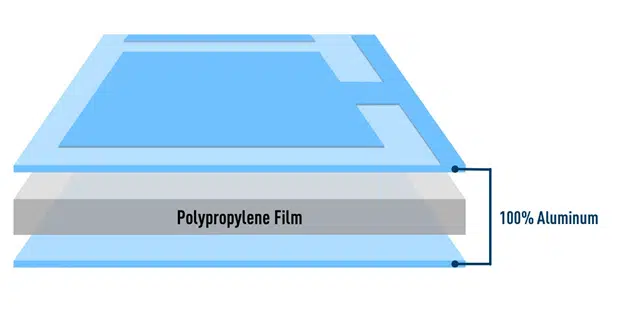
Figure 1. Basic principle of polypropylene film capacitor with segmented metallization; source: Panasonic Industry

Film Caps – and the benefits of self-healing

To a certain but remarkable extent, metallized film capacitors have the ability to “repair” themselves. This so called “self-healing” ability applies when a capacitor with metallized films has the foils exposed to each other due to dielectric breakdown under voltage stress. The combination of the foils’ thinness and the high energy density at the damaged area causes the foils to vaporize – and the capacitor stays in operation. However, when too many of such damaged areas fail in a very short period of time, metallized film capacitors short circuit upon failure. In pursuit of higher safety and higher reliability for most of the industries’ innovations, the market correspondingly shows an increased demand for film capacitors to also open upon failure.

Better safe – built-in fuse function with patterned metallization

Specific patterned metallization technology – better known as “fuse function” emerges from a segmented thin layer of vapor deposited aluminum.  

Those segments isolate the failure caused by overvoltage, therefore the damage is only encapsulated in a few areas of the capacitor. In case too many of those areas fail in a very short period of time, the capacitor will then open in a safe manner.
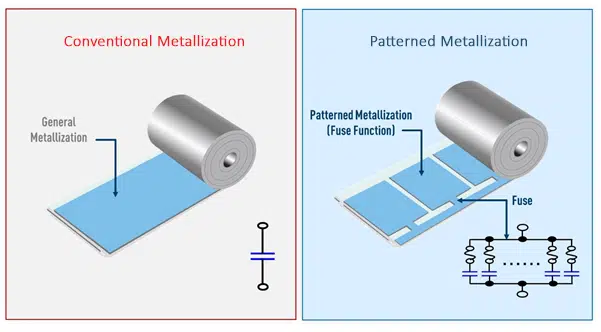
Figure 2. Comparison of conventional (left) and patterned metallization with fuse function (right); source: Panasonic Industry

A comparison

The difference is apparent: When “treating” dielectric material with high- or overvoltage, the un-patterned version reveals a far more severe damage than the patterned fuse function film cap concept.
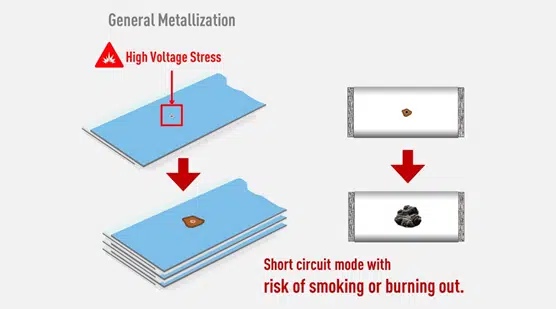
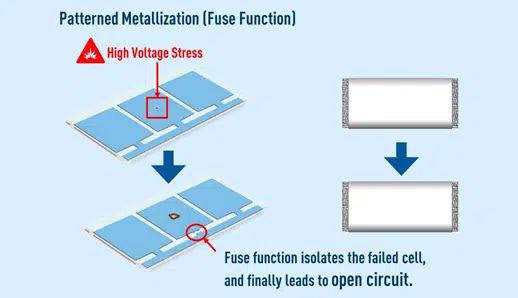
Figure 3. High voltage stress applied to dielectric material with conventional metallization; source: Panasonic Industry
Figure 4. High voltage stress applied to dielectric material with patterned fuse function ; source: Panasonic Industry

This patterned built-in fuse function should be a core criterion for everyone involved in high voltage application design and looking for the ideal type of capacitor. Or – shortly said: Better patterned than sorry!

To have a closer look, you can watch Panasonic Industry’s comparison in motion:

Related

Recent Posts

March 2026 Interconnect, Passives and Electromechanical Components Market Insights

2.4.2026
28

APEC 2026 Power Electronics Trends and Implications for Passive Components

1.4.2026
45

Hydra Enhances Film Capacitor Robustness by Novel Gel Filler

1.4.2026
23

Indias ECMS Wave Brings New Capacity For Passive Components Manufacturing in India

31.3.2026
34

Samsung Introduces 35V MLCCs Flying Capacitors for USB PD Fast Charging

27.3.2026
33

New J‑STD‑075B Standard Elevates Process Sensitivity Classification for Passive and Solid-State Components

27.3.2026
44

Modelithics Expands COMPLETE+3D Library for Ansys HFSS

27.3.2026
8

Equivalent Circuit Constants of Crystal Units Explained

26.3.2026
35

Nanocrystalline Cores for Low‑Loss MHz Chip Inductors

25.3.2026
42

Upcoming Events

Apr 8
17:00 - 18:00 CEST

Trade Secrets of the Flyback Converter

Apr 21
16:00 - 17:00 CEST

Heatsink Solutions: Thermal Management in electronic devices

May 5
16:00 - 17:00 CEST

Understanding and Selecting Capacitors – Fundamentals, Technologies and Latest Trends

View Calendar

Popular Posts

  • Buck Converter Design and Calculation

    0 shares
    Share 0 Tweet 0
  • Boost Converter Design and Calculation

    0 shares
    Share 0 Tweet 0
  • Flyback Converter Design and Calculation

    0 shares
    Share 0 Tweet 0
  • LLC Resonant Converter Design and Calculation

    0 shares
    Share 0 Tweet 0
  • Dual Active Bridge (DAB) Topology

    0 shares
    Share 0 Tweet 0
  • MLCC and Ceramic Capacitors

    0 shares
    Share 0 Tweet 0
  • Ripple Current and its Effects on the Performance of Capacitors

    3 shares
    Share 3 Tweet 0
  • Capacitor Charging and Discharging

    0 shares
    Share 0 Tweet 0
  • Plastic Materials Dielectric Constant and DF

    4 shares
    Share 4 Tweet 0
  • MLCC Case Sizes Standards Explained

    0 shares
    Share 0 Tweet 0

Newsletter Subscription


Passive Components Blog

© EPCI - Leading Passive Components Educational and Information Site

  • Home
  • Privacy Policy
  • EPCI Membership & Advertisement
  • About

No Result
View All Result
  • Home
  • Knowledge Blog
  • PCNS

© EPCI - Leading Passive Components Educational and Information Site

This website uses cookies. By continuing to use this website you are giving consent to cookies being used. Visit our Privacy and Cookie Policy.
Go to mobile version