







Passive Components Blog
No Result
View All Result
  • Home
  • NewsFilter
    • All
    • Aerospace & Defence
    • Antenna
    • Applications
    • Automotive
    • Capacitors
    • Circuit Protection Devices
    • electro-mechanical news
    • Filters
    • Fuses
    • Inductors
    • Industrial
    • Integrated Passives
    • inter-connect news
    • Market & Supply Chain
    • Market Insights
    • Medical
    • Modelling and Simulation
    • New Materials & Supply
    • New Technologies
    • Non-linear Passives
    • Oscillators
    • Passive Sensors News
    • Resistors
    • RF & Microwave
    • Telecommunication
    • Weekly Digest

    DigiKey Launches “Engineering Unlocked” Video Series

    Equivalent Circuit Constants of Crystal Units Explained

    Vishay Releases Compact High‑Accuracy Hall Effect Linear Position Sensor

    Nanocrystalline Cores for Low‑Loss MHz Chip Inductors

    Exxelia Miniaturized 400 MHz Inverted‑F Antenna

    Würth Elektronik Unveils High-Current Automotive Power Inductor

    Transformer-Based Power-Line Harvester Magnetic Design

    Tantalum Capacitor Anode Manufacturing Quality Management

    Middle East Conflict: The Potential Impact to Passive Components

    Trending Tags

    • Ripple Current
    • RF
    • Leakage Current
    • Tantalum vs Ceramic
    • Snubber
    • Low ESR
    • Feedthrough
    • Derating
    • Dielectric Constant
    • New Products
    • Market Reports
  • VideoFilter
    • All
    • Antenna videos
    • Capacitor videos
    • Circuit Protection Video
    • Filter videos
    • Fuse videos
    • Inductor videos
    • Inter-Connect Video
    • Non-linear passives videos
    • Oscillator videos
    • Passive sensors videos
    • Resistor videos

    Transformer-Based Power-Line Harvester Magnetic Design

    Thermal Modeling of Magnetics

    Standard vs Planar LLC transformers Comparison for Battery Chargers

    How Modern Tools Model Magnetic Components for Power Electronics

    Advanced Loss Modeling for Planar Magnetics in the Frenetic Planar Tool

    2026 Power Magnetics Design Trends: Flyback, DAB and Planar

    Enabling Software‑Defined Vehicle Architectures: Automotive Ethernet and Zonal Smart Power

    Calculating Resistance Value of a Flyback RC Snubber 

    One‑Pulse Characterization of Nonlinear Power Inductors

    Trending Tags

    • Capacitors explained
    • Inductors explained
    • Resistors explained
    • Filters explained
    • Application Video Guidelines
    • EMC
    • New Products
    • Ripple Current
    • Simulation
    • Tantalum vs Ceramic
  • Knowledge Blog
  • DossiersNew
  • Suppliers
    • Who is Who
  • PCNS
    • PCNS 2025
    • PCNS 2023
    • PCNS 2021
    • PCNS 2019
    • PCNS 2017
  • Events
  • Home
  • NewsFilter
    • All
    • Aerospace & Defence
    • Antenna
    • Applications
    • Automotive
    • Capacitors
    • Circuit Protection Devices
    • electro-mechanical news
    • Filters
    • Fuses
    • Inductors
    • Industrial
    • Integrated Passives
    • inter-connect news
    • Market & Supply Chain
    • Market Insights
    • Medical
    • Modelling and Simulation
    • New Materials & Supply
    • New Technologies
    • Non-linear Passives
    • Oscillators
    • Passive Sensors News
    • Resistors
    • RF & Microwave
    • Telecommunication
    • Weekly Digest

    DigiKey Launches “Engineering Unlocked” Video Series

    Equivalent Circuit Constants of Crystal Units Explained

    Vishay Releases Compact High‑Accuracy Hall Effect Linear Position Sensor

    Nanocrystalline Cores for Low‑Loss MHz Chip Inductors

    Exxelia Miniaturized 400 MHz Inverted‑F Antenna

    Würth Elektronik Unveils High-Current Automotive Power Inductor

    Transformer-Based Power-Line Harvester Magnetic Design

    Tantalum Capacitor Anode Manufacturing Quality Management

    Middle East Conflict: The Potential Impact to Passive Components

    Trending Tags

    • Ripple Current
    • RF
    • Leakage Current
    • Tantalum vs Ceramic
    • Snubber
    • Low ESR
    • Feedthrough
    • Derating
    • Dielectric Constant
    • New Products
    • Market Reports
  • VideoFilter
    • All
    • Antenna videos
    • Capacitor videos
    • Circuit Protection Video
    • Filter videos
    • Fuse videos
    • Inductor videos
    • Inter-Connect Video
    • Non-linear passives videos
    • Oscillator videos
    • Passive sensors videos
    • Resistor videos

    Transformer-Based Power-Line Harvester Magnetic Design

    Thermal Modeling of Magnetics

    Standard vs Planar LLC transformers Comparison for Battery Chargers

    How Modern Tools Model Magnetic Components for Power Electronics

    Advanced Loss Modeling for Planar Magnetics in the Frenetic Planar Tool

    2026 Power Magnetics Design Trends: Flyback, DAB and Planar

    Enabling Software‑Defined Vehicle Architectures: Automotive Ethernet and Zonal Smart Power

    Calculating Resistance Value of a Flyback RC Snubber 

    One‑Pulse Characterization of Nonlinear Power Inductors

    Trending Tags

    • Capacitors explained
    • Inductors explained
    • Resistors explained
    • Filters explained
    • Application Video Guidelines
    • EMC
    • New Products
    • Ripple Current
    • Simulation
    • Tantalum vs Ceramic
  • Knowledge Blog
  • DossiersNew
  • Suppliers
    • Who is Who
  • PCNS
    • PCNS 2025
    • PCNS 2023
    • PCNS 2021
    • PCNS 2019
    • PCNS 2017
  • Events
No Result
View All Result
Passive Components Blog
No Result
View All Result

Gartner Says Global Chip Shortage Expected to Persist Until Second Quarter of 2022

13.5.2021
Reading Time: 2 mins read
A A
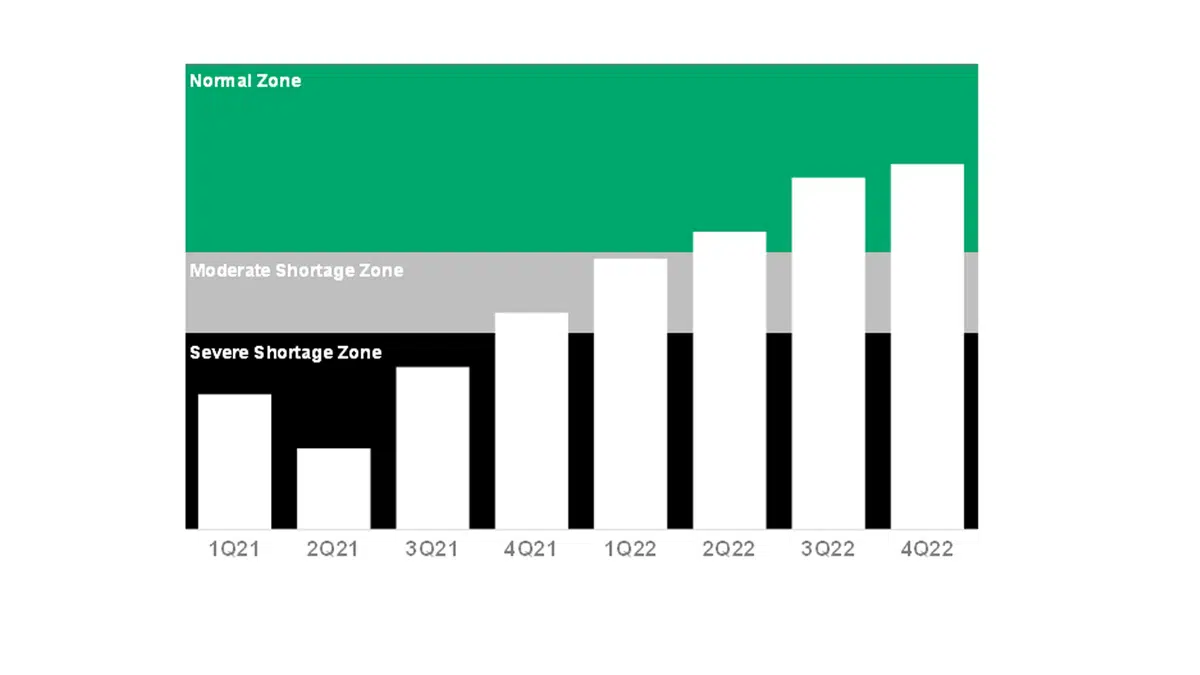
Gartner Index of Inventory Semiconductor Supply Chain Tracking - Projected Worldwide Semiconductor Inventory Index Movement, 2021-2022 Note: 1Q21 is a modelled estimate and is subject to change based on actual financials reported by vendors in 2Q21. The index bar for 2Q21 to 4Q22 is only a directional estimate. Source: Gartner (May 2021)

Gartner Index of Inventory Semiconductor Supply Chain Tracking - Projected Worldwide Semiconductor Inventory Index Movement, 2021-2022 Note: 1Q21 is a modelled estimate and is subject to change based on actual financials reported by vendors in 2Q21. The index bar for 2Q21 to 4Q22 is only a directional estimate. Source: Gartner (May 2021)

The worldwide semiconductor shortage will persist through 2021, and is expected to recover to normal levels by the second quarter of 2022, according to Gartner, Inc.

“The semiconductor shortage will severely disrupt the supply chain and will constrain the production of many electronic equipment types in 2021. Foundries are increasing wafer prices, and in turn, chip companies are increasing device prices,” said Kanishka Chauhan, principal research analyst at Gartner.

RelatedPosts

DigiKey Launches “Engineering Unlocked” Video Series

Equivalent Circuit Constants of Crystal Units Explained

Vishay Releases Compact High‑Accuracy Hall Effect Linear Position Sensor

The chip shortage started primarily with devices, such as power management, display devices and microcontrollers, fabricated on legacy nodes at 8-inch foundry fabs, which have a limited supply. The shortage has now extended to other devices, and there are capacity constraints and shortages for substrates, wire bonding, passives, materials, and testing, all of which are parts of the supply chain beyond chip fabs. These are highly commoditized industries with minimal flexibility/capacity to invest aggressively on a short notice.

Across most categories, device shortages are expected to be pushed out until the second quarter of 2022 (see Figure 1), while substrate capacity constraints could potentially extend to fourth quarter of 2022. 

Gartner analysts recommend that OEMs dependent directly or indirectly on semiconductors take four key actions to mitigate risk and revenue loss during the global chip shortage:

  • Extend supply chain visibility –The chip shortage makes it essential for supply chain leaders to extend the supply chain visibility beyond the supplier to the silicon level, which will be critical in projecting supply constraints and bottlenecks and eventually, projecting when the crisis situation will improve. 

  • Guarantee supply with companion model and/or preinvestments – OEMs with smaller and critical component requirements must look to partner with similar entities and approach chip foundries and/or OSAT players as a combined entity to gain some leverage. Additionally, if scale allows, preinvesting in a commoditized part of the chip supply chain and/or foundries, could guarantee the company a long-term supply.

  • Track leading indicators – While no relevant parameter by itself will project how the shortage situation will evolve, a combination of relevant parameters can help guide organizations in the right direction.  

    “Since the current chip shortage is a dynamic situation, it is essential to understand how it changes on a continuous basis. Tracking leading indicators, such as capital investments, inventory index and semiconductor industry revenue growth projections as an early indicator of inventory situations, can help organizations stay updated on the issue and see how the overall industry is growing,” said Gaurav Gupta, research vice president at Gartner.

  • Diversify supplier base – Qualifying a different source of chips and/or OSAT partner will require additional work and investment, but it would go a long way in reducing risk. Additionally, creating strategic and tight relationships with distributors, resellers and traders can help with finding the small volume for urgent components.


Related

Source: Gartner

Recent Posts

Middle East Conflict: The Potential Impact to Passive Components

23.3.2026
96

Inductor Technology Dossier

19.3.2026
49

Rutheniums Critical Role in Passive Component Supply Chains

19.3.2026
36

Murata to Decouple China Rare Earth Supply in 3 Years

19.3.2026
172

Hirose Electric to Establish Automotive Connector Plant in India

19.3.2026
17

Samsung Outlines Growth Roadmap at its 52nd General Shareholders Meeting

19.3.2026
25

February 2026 Interconnect, Passives and Electromechanical Components Market Insights

9.3.2026
98

ECIA February 2026 Industry Pulse Signals Strong Component Growth

6.3.2026
43

Inductors and Ferrite Beads Price Hikes 

5.3.2026
94

Upcoming Events

Apr 21
16:00 - 17:00 CEST

Heatsink Solutions: Thermal Management in electronic devices

May 5
16:00 - 17:00 CEST

Understanding and Selecting Capacitors – Fundamentals, Technologies and Latest Trends

May 19
16:00 - 17:00 CEST

Designing Qi2 Wireless Power Systems: Practical Development and EMC Optimization

View Calendar

Popular Posts

  • Buck Converter Design and Calculation

    0 shares
    Share 0 Tweet 0
  • Boost Converter Design and Calculation

    0 shares
    Share 0 Tweet 0
  • Flyback Converter Design and Calculation

    0 shares
    Share 0 Tweet 0
  • LLC Resonant Converter Design and Calculation

    0 shares
    Share 0 Tweet 0
  • Dual Active Bridge (DAB) Topology

    0 shares
    Share 0 Tweet 0
  • MLCC and Ceramic Capacitors

    0 shares
    Share 0 Tweet 0
  • Ripple Current and its Effects on the Performance of Capacitors

    3 shares
    Share 3 Tweet 0
  • MLCC Case Sizes Standards Explained

    0 shares
    Share 0 Tweet 0
  • What is a Dielectric Constant and DF of Plastic Materials?

    4 shares
    Share 4 Tweet 0
  • MLCC Manufacturers Consider Price Increase as AI Demand Outpaces Supply

    0 shares
    Share 0 Tweet 0

Newsletter Subscription


Passive Components Blog

© EPCI - Leading Passive Components Educational and Information Site

  • Home
  • Privacy Policy
  • EPCI Membership & Advertisement
  • About

No Result
View All Result
  • Home
  • Knowledge Blog
  • PCNS

© EPCI - Leading Passive Components Educational and Information Site

This website uses cookies. By continuing to use this website you are giving consent to cookies being used. Visit our Privacy and Cookie Policy.
Go to mobile version