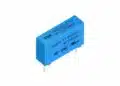


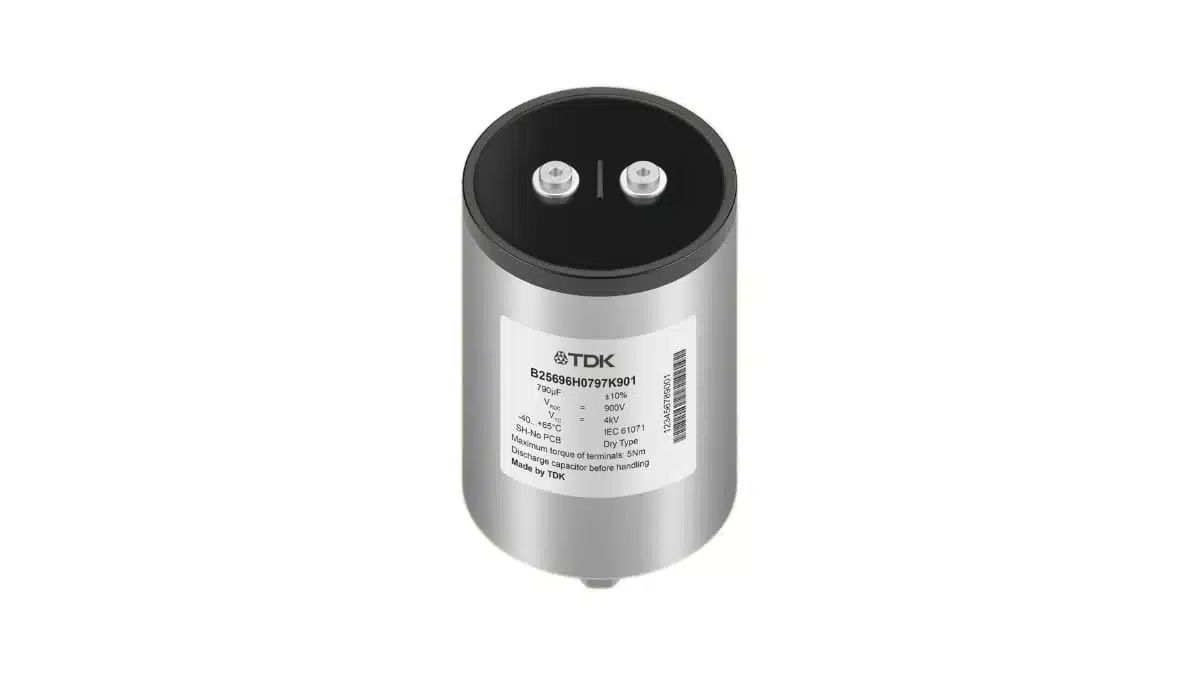
TDK has introduced the B25696H series of high-frequency DC-link film capacitors, targeting next‑generation SiC‑based power converters where low inductance and low losses are critical.
These cylindrical MKP film capacitors are optimized for high switching frequencies and high power density, making them attractive for designers of ESS, SSTs, traction converters, and industrial drives.
Key features and benefits
- Ultra‑low ESL for SiC topologies
Internal busbar geometry and winding arrangement reduce self‑inductance down to about 30 nH, which helps to limit voltage overshoot on fast SiC edges and reduces stress on power devices. - Low ESR across a wide frequency range
ESR values down to approximately 0.8 mΩ at 10 kHz with stable behavior up to 100 kHz support efficient operation at elevated switching frequencies and lower converter losses. - High ripple current capability
Rated ripple currents up to about 91 A at 10 kHz and 60 °C ambient enable compact, high‑power DC links without excessive capacitor heating. - Metallized polypropylene MKP dielectric
The self‑healing MKP dielectric improves robustness against transient overvoltage events and partial breakdowns, an advantage in demanding industrial and traction converters. - Long service life with derating
A specified service life of 100,000 hours at 75 °C hotspot and rated voltage, extendable up to 200,000 hours with appropriate voltage and temperature derating, supports long‑lifetime systems like ESS and traction. - Mechanical robustness and easy mounting
Aluminum can construction with resin top, screw female terminals (M6), and an M12 mounting bolt simplify mechanical integration and high‑current busbar connections.
Typical applications
The B25696H series is positioned as a DC‑link capacitor platform for high‑power, high‑frequency converters where SiC devices are used and parasitic inductance strongly impacts switching behavior. The low ESL and high ripple current capability make it relevant across a range of energy and traction systems.
- Renewable energy converters (string and central solar inverters, wind converters) where compact DC links and high efficiency are key.
- Energy storage systems, including battery‑based ESS and hybrid systems, requiring long life and high cycling capability on the DC bus.
- Solid‑state transformers and medium‑frequency isolated converters that operate at higher switching frequencies than conventional grid transformers.
- Traction converters for trains, metros, and trams, where high reliability and strong mechanical robustness in demanding environments are needed.
- Industrial motor drives and high‑power inverters that benefit from reduced DC‑link inductance and better EMC behavior at fast switching speeds.
Application positioning overview
| Application area | Role of B25696H DC‑link capacitor | Key benefit in practice |
|---|---|---|
| Solar / wind inverters | Main DC bus energy buffer and ripple smoothing | Higher efficiency and smaller DC‑link volume |
| Energy storage systems | Interface capacitor between battery and converter | Long life and high ripple handling |
| Traction converters | DC‑link on propulsion inverters | Robustness and reduced voltage overshoot |
| Solid‑state transformers | High‑frequency DC‑link and energy transfer stage | Low ESL for fast SiC switching |
| Industrial motor drives | DC bus filtering and energy storage in power stage | Lower losses and improved thermal margins |
Technical highlights
TDK’s new series is specified as MKP DC high‑frequency film capacitors for DC‑link use in SiC power electronics, with a focus on very low inductance and low ESR. The combination of electrical and mechanical parameters targets compact, modular DC‑link implementations.
Electrical characteristics
- Capacitance range: approximately 47 µF to 1280 µF, providing options from smaller DC links up to high‑energy storage blocks.
- Rated DC voltage range: around 900 V to 2000 V, suitable for typical DC bus levels in three‑phase inverters, traction systems, and ESS.
- Self‑inductance: values as low as about 30 nH thanks to the internal busbar configuration and optimized current paths.
- ESR: down to approximately 0.8 mΩ at 10 kHz with stable ESR behavior up to about 100 kHz, enabling efficient operation at high switching frequencies.
- Ripple current capability: up to roughly 91 A at 10 kHz and 60 °C ambient, supporting high‑power operation.
In practice, the low ESL and ESR help to limit transient overshoot and reduce power losses, which is particularly important when switching SiC MOSFETs or diodes at high dv/dt and di/dt. This can translate into simplified snubber networks and improved EMC behavior at the converter level.
Mechanical and thermal characteristics
- Dielectric system: metallized polypropylene (MKP) film in cylindrical winding.
- Case: aluminum can with resin top for environmental protection and mechanical stability.
- Terminals: screw female terminals (M6) for high‑current connections, plus threaded mounting bolt (M12) for secure attachment.
- Diameter options: approximately 85 mm and 100 mm, covering different power levels and capacitance values.
- Operating temperature range: from about −40 °C to +85 °C hotspot, covering most industrial and traction environments.
- Lifetime: 100,000 hours at 75 °C hotspot and rated voltage, up to 200,000 hours with derating, according to the manufacturer datasheet.
From a thermal point of view, the combination of MKP dielectric, aluminum housing, and specified ripple capability provides a predictable temperature rise that can be assessed using TDK’s CapThermal simulation tool. This supports more accurate lifetime estimation in the actual customer application.
Summary of key parameters
| Parameter | Typical range / value |
|---|---|
| Capacitance | 47 µF … 1280 µF |
| Rated DC voltage | 900 V … 2000 V |
| Self‑inductance | down to approx. 30 nH |
| ESR at 10 kHz | down to approx. 0.8 mΩ |
| Ripple current (10 kHz) | up to approx. 91 A at 60 °C ambient |
| Operating temperature | about −40 °C … +85 °C hotspot |
| Expected lifetime | up to 200,000 h with suitable derating |
| Diameter | about 85 mm and 100 mm |
| Terminals / mounting | M6 screw terminals, M12 mounting bolt |
Exact values for individual part numbers, such as capacitance/voltage combinations and detailed tolerance classes, should be taken from the manufacturer datasheet.
Design‑in notes for engineers
- Understand the DC‑link function in SiC converters
In SiC‑based converters, very fast voltage and current edges mean that DC‑link parasitics directly influence overshoot, EMI, and device stress, so selecting a low‑ESL, low‑ESR capacitor like this series can reduce snubber effort and overall losses. - Match capacitance and voltage to bus requirements
Choose capacitance and rated voltage based on DC‑bus level, required energy storage, and permissible ripple, using the manufacturer datasheet and selection tools to avoid under‑dimensioning. - Consider thermal behavior and lifetime
Evaluate the ripple current profile and ambient conditions, then use TDK’s CapThermal online tool to estimate hotspot temperature and life expectancy under real operating conditions. - Plan the mechanical and electrical layout carefully
Use short, low‑inductance busbar or copper bar connections to the M6 terminals and take advantage of the cylindrical form factor and M12 mounting bolt to optimize mechanical stability and vibration resistance. - Coordinate with protection and EMC design
Although the low ESL/ESR characteristics improve switching behavior, snubbers, common‑mode chokes, and surge protection must still be coordinated around the actual DC‑link impedance, especially in high‑power and traction systems. - Check standards and insulation requirements
Verify creepage, clearance, and insulation coordination according to the applicable system standards and ensure the selected capacitor variant meets the necessary safety margins.
For early design studies, combining the catalogue data with thermal simulation (CapThermal) allows a realistic assessment of temperature rise, margin to maximum hotspot temperature, and expected life at the given operating point. This can be particularly useful when moving from Si‑based to SiC‑based designs and targeting higher switching frequencies or higher ambient temperatures.
Source
The information in this article is based on the official TDK Electronics press release and related product information for the B25696H series of DC‑link film capacitors, complemented by general engineering context for SiC‑based power electronics.