




Passive Components Blog
No Result
View All Result
  • Home
  • NewsFilter
    • All
    • Aerospace & Defence
    • Antenna
    • Applications
    • Automotive
    • Capacitors
    • Circuit Protection Devices
    • electro-mechanical news
    • Filters
    • Fuses
    • Inductors
    • Industrial
    • Integrated Passives
    • inter-connect news
    • Market & Supply Chain
    • Market Insights
    • Medical
    • Modelling and Simulation
    • New Materials & Supply
    • New Technologies
    • Non-linear Passives
    • Oscillators
    • Passive Sensors News
    • Resistors
    • RF & Microwave
    • Telecommunication
    • Weekly Digest

    YAGEO Introduces 310VAC SMD Y2 Safety MP Capacitors for Compact EMI Filtering

    DMASS: European Components Distribution Returns To Growth In Q1 2026

    German Component Distribution Market Rebounds in Q1 2026 According to FBDi

    Nippon Chemi-Con Announces New Capacitor series for AI, Automotive and Immersion Cooling

    Ultrahigh Energy Storage in Lead‑Free BiFeO₃‑Based Ceramic Capacitors via Local Polar Structure Design

    Molex Expanded AirBorn SInergy Hybrid Connectors with 25 A Power Modules

    Murata Expands Ansys Simulation Models for RF inductors, MLCCs, and Power Inductors

    Sumida Introduces SMD Metal Inductors for High‑Current Automotive DC/DC Converters

    Hirose Releases 0.5 mm Floating Board-to-Board Connector for EV Powertrain Designs

    Trending Tags

    • Ripple Current
    • RF
    • Leakage Current
    • Tantalum vs Ceramic
    • Snubber
    • Low ESR
    • Feedthrough
    • Derating
    • Dielectric Constant
    • New Products
    • Market Reports
  • VideoFilter
    • All
    • Antenna videos
    • Capacitor videos
    • Circuit Protection Video
    • Filter videos
    • Fuse videos
    • Inductor videos
    • Inter-Connect Video
    • Non-linear passives videos
    • Oscillator videos
    • Passive sensors videos
    • Resistor videos

    Why Isolated DC/DC Power Supplies Fail Late, Würth Elektronik Podcast

    Designing 800 V DC EMC Filters: Calculation, Simulation and Measurement

    Current Sense Transformer Datasheet and Design‑in Guide

    Designing a USB Type‑C Flyback Planar Transformer with Frenetic’s Planar Tool

    Magnetics Design in High‑Frequency GaN Converters

    Qi2 Wireless Charging: Inductors, Capacitors and EMC Filters

    Two‑capacitor paradox explained for engineers

    Capacitances of Nonlinear MLCCs: What Datasheets Don’t Tell You

    Tapped Inductor Buck Converter Fundamentals

    Trending Tags

    • Capacitors explained
    • Inductors explained
    • Resistors explained
    • Filters explained
    • Application Video Guidelines
    • EMC
    • New Products
    • Ripple Current
    • Simulation
    • Tantalum vs Ceramic
  • Knowledge Blog
  • DossiersNew
  • Suppliers
    • Who is Who
  • PCNS
    • PCNS 2025
    • PCNS 2023
    • PCNS 2021
    • PCNS 2019
    • PCNS 2017
  • Events
  • Home
  • NewsFilter
    • All
    • Aerospace & Defence
    • Antenna
    • Applications
    • Automotive
    • Capacitors
    • Circuit Protection Devices
    • electro-mechanical news
    • Filters
    • Fuses
    • Inductors
    • Industrial
    • Integrated Passives
    • inter-connect news
    • Market & Supply Chain
    • Market Insights
    • Medical
    • Modelling and Simulation
    • New Materials & Supply
    • New Technologies
    • Non-linear Passives
    • Oscillators
    • Passive Sensors News
    • Resistors
    • RF & Microwave
    • Telecommunication
    • Weekly Digest

    YAGEO Introduces 310VAC SMD Y2 Safety MP Capacitors for Compact EMI Filtering

    DMASS: European Components Distribution Returns To Growth In Q1 2026

    German Component Distribution Market Rebounds in Q1 2026 According to FBDi

    Nippon Chemi-Con Announces New Capacitor series for AI, Automotive and Immersion Cooling

    Ultrahigh Energy Storage in Lead‑Free BiFeO₃‑Based Ceramic Capacitors via Local Polar Structure Design

    Molex Expanded AirBorn SInergy Hybrid Connectors with 25 A Power Modules

    Murata Expands Ansys Simulation Models for RF inductors, MLCCs, and Power Inductors

    Sumida Introduces SMD Metal Inductors for High‑Current Automotive DC/DC Converters

    Hirose Releases 0.5 mm Floating Board-to-Board Connector for EV Powertrain Designs

    Trending Tags

    • Ripple Current
    • RF
    • Leakage Current
    • Tantalum vs Ceramic
    • Snubber
    • Low ESR
    • Feedthrough
    • Derating
    • Dielectric Constant
    • New Products
    • Market Reports
  • VideoFilter
    • All
    • Antenna videos
    • Capacitor videos
    • Circuit Protection Video
    • Filter videos
    • Fuse videos
    • Inductor videos
    • Inter-Connect Video
    • Non-linear passives videos
    • Oscillator videos
    • Passive sensors videos
    • Resistor videos

    Why Isolated DC/DC Power Supplies Fail Late, Würth Elektronik Podcast

    Designing 800 V DC EMC Filters: Calculation, Simulation and Measurement

    Current Sense Transformer Datasheet and Design‑in Guide

    Designing a USB Type‑C Flyback Planar Transformer with Frenetic’s Planar Tool

    Magnetics Design in High‑Frequency GaN Converters

    Qi2 Wireless Charging: Inductors, Capacitors and EMC Filters

    Two‑capacitor paradox explained for engineers

    Capacitances of Nonlinear MLCCs: What Datasheets Don’t Tell You

    Tapped Inductor Buck Converter Fundamentals

    Trending Tags

    • Capacitors explained
    • Inductors explained
    • Resistors explained
    • Filters explained
    • Application Video Guidelines
    • EMC
    • New Products
    • Ripple Current
    • Simulation
    • Tantalum vs Ceramic
  • Knowledge Blog
  • DossiersNew
  • Suppliers
    • Who is Who
  • PCNS
    • PCNS 2025
    • PCNS 2023
    • PCNS 2021
    • PCNS 2019
    • PCNS 2017
  • Events
No Result
View All Result
Passive Components Blog
No Result
View All Result

Murata Introduces World First 2.2uF 100V Soft‑Term MLCC in 0805 Size for Automotive

4.6.2026
Reading Time: 6 mins read
A A

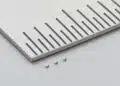
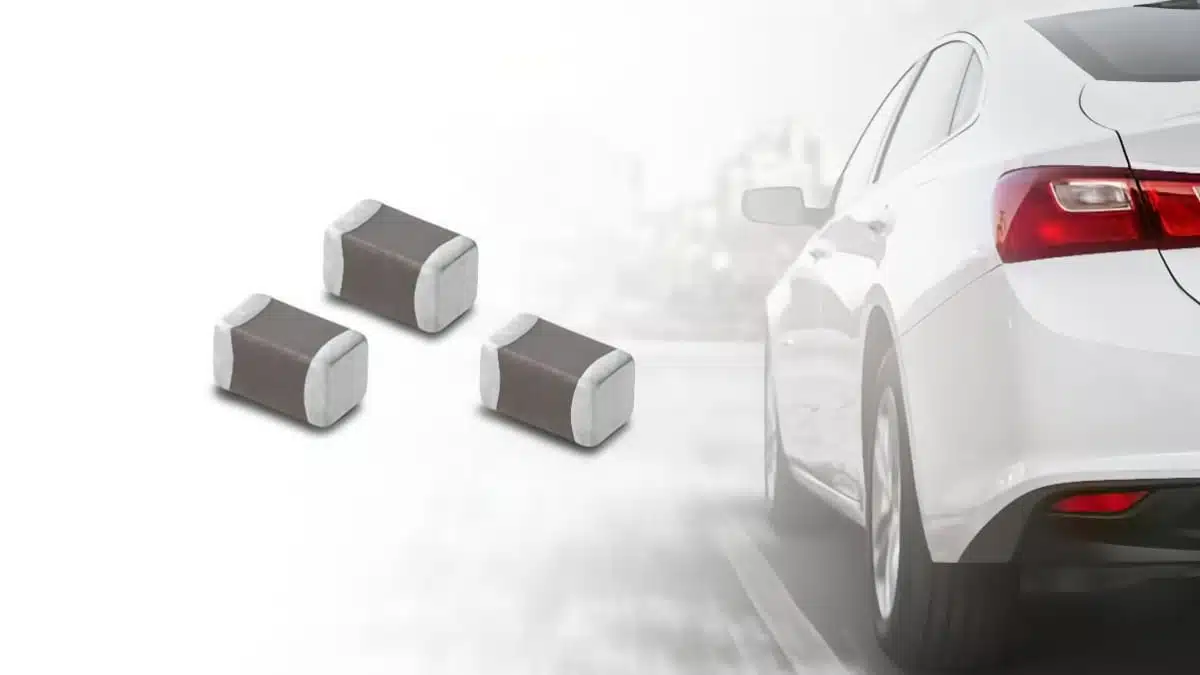
Murata has introduced GCJ21BD72A225KE02, an automotive‑grade soft‑termination multilayer ceramic capacitor (MLCC) that delivers World First 2.2µF at 100 V DC in a compact 0805‑inch (2.0 × 1.25 mm) package.

This Murata MLCC ceramic capacitor targets crowded powertrain and safety ECUs where designers need high capacitance, high voltage, and robust mechanical reliability in the smallest possible footprint.

RelatedPosts

Murata Expands Ansys Simulation Models for RF inductors, MLCCs, and Power Inductors

Murata and Xona Partner on LEO Satellite Navigation for Industrial Applications

Murata Expands Thermistor Production Capacity at Yokaichi Plant

Key features and benefits

  • High capacitance in 0805 package – 2.2µF at 100 V DC in 0805 size, a rating that previously required 1206, enables aggressive downsizing of decoupling and smoothing networks in automotive power rails.
  • Board space reduction – According to Murata, replacing a 1206 solution with this 0805 device can reduce board mounting area by approximately 51%, helping engineers free up PCB area for sensors, MCUs, and connectors.
  • Higher capacitance in same footprint – Compared with Murata’s previous 100 V 0805 MLCC, this device provides about 2.2× higher capacitance, allowing fewer capacitors in parallel to reach a given total value.
  • Soft‑termination structure – A compliant termination stack absorbs board flexure and vibration, reducing the risk of ceramic cracking after reflow and during vehicle lifetime. This is particularly beneficial on large or mechanically constrained boards in engine bay or chassis systems.
  • Automotive‑grade reliability – The part is aimed at powertrain and safety applications, where temperature cycling, vibration and long operating life demand robust MLCC construction and process control.
  • X7T temperature characteristic – The capacitor meets X7T characteristics per EIA, with an operating temperature range from −55 °C to +125 °C, making it suitable for typical automotive ECU environments.
  • Advanced ceramic material design – Fine particle size and tight uniformity support both miniaturization and high capacitance at 100 V without sacrificing reliability, which is critical for 48 V and other elevated bus voltages in vehicles.

Typical applications

As vehicles move toward higher electrification, 48 V subsystems, and more complex AD/ADAS architectures, the demand for compact, high‑voltage MLCCs in control and power stages continues to grow. This 2.2µF / 100 V 0805 MLCC is positioned mainly for:

  • Powertrain ECUs (engine, transmission, hybrid control units) requiring high‑voltage decoupling close to power devices.
  • Safety‑critical ECUs such as braking, steering, and airbag controllers, where robust components help maintain long‑term stability under thermal and mechanical stress.
  • AD/ADAS ECUs and domain controllers with dense power distribution networks operating from 48 V or other higher‑voltage rails.
  • Local DC link and bulk decoupling in smaller DC‑DC converters or gate driver boards where 100 V rating provides sufficient margin.
  • Noise suppression and stabilization on intermediate bus rails that must tolerate load steps and switching noise from power stages.

In many of these circuits the capacitor can serve as an input or output decoupling element in buck/boost stages, as a local energy reservoir near power MOSFETs or GaN devices, or as a smoothing capacitor across sensitive analog rails running off high‑voltage buses.

Technical highlights

The table below summarizes the key published parameters of the GCJ21BD72A225KE02, as stated in the Murata product release and related product page information.

ParameterValue / information
Series / familyGCJ automotive soft‑termination MLCC
Part numberGCJ21BD72A225KE02
Capacitance2.2µF
Rated voltage100 V DC
Package size0805 inch (2.0 × 1.25 mm)
Temperature range−55 °C to +125 °C
Temperature characteristicX7T (per EIA standard)
TerminationSoft‑termination structure
Automotive focusPowertrain and safety‑related ECUs

X7T temperature characteristic means the capacitance is specified over the −55 °C to +125 °C range with a particular tolerance behavior that is suitable for many automotive power and control rails. For exact capacitance tolerance, derating, and class behavior over temperature and DC bias, designers should consult the detailed manufacturer datasheet and simulation tools.

Design‑in notes for engineers

When selecting and designing in this 2.2µF / 100 V 0805 MLCC, a few practical considerations can help ensure reliable performance in the target ECU:

  • Check DC bias behavior – High‑value MLCCs at 100 V can exhibit significant capacitance reduction under DC bias, especially on high‑voltage rails. Always evaluate effective capacitance at the actual operating voltage using manufacturer curves or simulation tools.
  • Consider temperature and ripple current – While the device is specified for −55 °C to +125 °C, real application stress combines temperature, ripple current, and mechanical load. Verify loss and self‑heating in worst‑case conditions.
  • Leverage soft termination correctly – Soft‑termination improves tolerance to board flexure and vibration, but does not eliminate the need for sound PCB design. Avoid placing the capacitor too close to board edges, scoring lines, or heavy connectors where bending is concentrated.
  • Use appropriate land patterns – Follow Murata’s recommended land pattern and soldering profile to maintain the designed stress relief in the soft‑termination structure and to minimize solder joint cracking.
  • Plan for derating – Even with a 100 V rating, in automotive environments it is common to include a safety margin against transient overshoot and long‑term degradation. Selecting the part with appropriate voltage derating improves reliability.
  • Evaluate parallel combinations – Thanks to the higher capacitance in 0805, fewer devices may be needed in parallel compared with previous 0805 or 1206 implementations. This can simplify layout and reduce BOM line items, but it is still important to review impedance and ESL requirements at the switching frequencies of interest.
  • Check qualification and standards – For safety‑related ECUs, confirm that the specific part number meets the required automotive standards and internal OEM specifications according to the manufacturer datasheet and qualification reports.

For purchasing and component engineering teams, the migration from former 1206 2.2µF / 100 V solutions to this 0805 option can simplify footprint standardization and reduce board area, but it is important to track any changes in lead time, pricing, and second‑source strategy when introducing such a high‑performance MLCC.

Source

This article is based on information provided in Murata’s official product and event news release and the corresponding Murata product information pages for the GCJ21BD72A225KE02 automotive soft‑termination MLCC.
References

  1. Murata press release – World’s first 2.2µF/100Vdc soft‑termination chip MLCC in 0805‑inch size for automotive applications
  2. Murata product page – GCJ21BD72A225KE02
  3. Murata automotive MLCC lineup expansion overview

Related

Recent Posts

YAGEO Introduces 310VAC SMD Y2 Safety MP Capacitors for Compact EMI Filtering

16.6.2026
9

DMASS: European Components Distribution Returns To Growth In Q1 2026

16.6.2026
10

German Component Distribution Market Rebounds in Q1 2026 According to FBDi

16.6.2026
9

Nippon Chemi-Con Announces New Capacitor series for AI, Automotive and Immersion Cooling

16.6.2026
13

Ultrahigh Energy Storage in Lead‑Free BiFeO₃‑Based Ceramic Capacitors via Local Polar Structure Design

16.6.2026
14

Murata Expands Ansys Simulation Models for RF inductors, MLCCs, and Power Inductors

16.6.2026
10

Sumida Introduces SMD Metal Inductors for High‑Current Automotive DC/DC Converters

15.6.2026
19

Knowles Releases 3825 X1/Y2 Safety MLCCs for High‑Voltage Applications

11.6.2026
35

TAIYO YUDEN Releases 220uF 1210 Automotive MLCC

11.6.2026
49

Upcoming Events

Jul 14
16:00 - 17:00 CEST

EMC Design Essentials: Mastering Varistors and Common Mode Chokes

Jul 21
16:00 - 17:00 CEST

Safety by design: X and Y Interference suppression capacitors for power line filters

View Calendar

Popular Posts

  • Buck Converter Design and Calculation

    0 shares
    Share 0 Tweet 0
  • Boost Converter Design and Calculation

    0 shares
    Share 0 Tweet 0
  • LLC Resonant Converter Design and Calculation

    0 shares
    Share 0 Tweet 0
  • Flyback Converter Design and Calculation

    0 shares
    Share 0 Tweet 0
  • MLCC and Ceramic Capacitors

    0 shares
    Share 0 Tweet 0
  • Earthing Systems and IEC Classification Explained

    0 shares
    Share 0 Tweet 0
  • SEPIC Converter Design and Calculation

    0 shares
    Share 0 Tweet 0
  • Dual Active Bridge (DAB) Topology

    0 shares
    Share 0 Tweet 0
  • What Electronics Engineer Needs to Know About Passive Low Pass Filters

    0 shares
    Share 0 Tweet 0
  • MLCC Case Sizes Standards Explained

    0 shares
    Share 0 Tweet 0

Newsletter Subscription


Passive Components Blog

© EPCI - Leading Passive Components Educational and Information Site

  • Home
  • Privacy Policy
  • EPCI Membership & Advertisement
  • About

No Result
View All Result
  • Home
  • Knowledge Blog
  • Dossiers
  • PCNS

© EPCI - Leading Passive Components Educational and Information Site

This website uses cookies. By continuing to use this website you are giving consent to cookies being used. Visit our Privacy and Cookie Policy.
Go to mobile version