















Passive Components Blog
No Result
View All Result
  • Home
  • NewsFilter
    • All
    • Aerospace & Defence
    • Antenna
    • Applications
    • Automotive
    • Capacitors
    • Circuit Protection Devices
    • electro-mechanical news
    • Filters
    • Fuses
    • Inductors
    • Industrial
    • Integrated Passives
    • inter-connect news
    • Market & Supply Chain
    • Market Insights
    • Medical
    • Modelling and Simulation
    • New Materials & Supply
    • New Technologies
    • Non-linear Passives
    • Oscillators
    • Passive Sensors News
    • Resistors
    • RF & Microwave
    • Telecommunication
    • Weekly Digest

    Vishay Extends Aluminum Capacitors Rating Up to 600 V for DC Links

    Würth Elektronik Introduces Product Navigator for Passive Components

    Panasonic Passive Components for Reliable Robotic Arms

    Littelfuse Unveils Ultra-Low-Power TMR Magnetic Switches

    DC/DC Push‑Pull Converter vs PSFB Design Guide

    Wk 2 Electronics Supply Chain Digest

    Rubycon PMLCAP DC‑Link Film Capacitors in Mass Production

    Bourns SSD‑1000A AEC‑Q Digital Current Sensors

    YAGEO High‑Capacitance X7R Automotive MLCC Extensions

    Trending Tags

    • Ripple Current
    • RF
    • Leakage Current
    • Tantalum vs Ceramic
    • Snubber
    • Low ESR
    • Feedthrough
    • Derating
    • Dielectric Constant
    • New Products
    • Market Reports
  • VideoFilter
    • All
    • Antenna videos
    • Capacitor videos
    • Circuit Protection Video
    • Filter videos
    • Fuse videos
    • Inductor videos
    • Inter-Connect Video
    • Non-linear passives videos
    • Oscillator videos
    • Passive sensors videos
    • Resistor videos

    One‑Pulse Characterization of Nonlinear Power Inductors

    Thermistor Linearization Challenges

    Coaxial Connectors and How to Connect with PCB

    PCB Manufacturing, Test Methods, Quality and Reliability

    Transformer Behavior – Current Transfer and Hidden Feedback

    Choosing the Right Capacitor: The Importance of Accurate Measurements

    RF Inductors: Selection and Design Challenges for High-Frequency Circuits

    Transformer Safety IEC 61558 Standard

    3-Phase EMI Filter Design, Simulation, Calculation and Test

    Trending Tags

    • Capacitors explained
    • Inductors explained
    • Resistors explained
    • Filters explained
    • Application Video Guidelines
    • EMC
    • New Products
    • Ripple Current
    • Simulation
    • Tantalum vs Ceramic
  • Knowledge Blog
  • Suppliers
    • Who is Who
  • PCNS
    • PCNS 2025
    • PCNS 2023
    • PCNS 2021
    • PCNS 2019
    • PCNS 2017
  • Events
  • Home
  • NewsFilter
    • All
    • Aerospace & Defence
    • Antenna
    • Applications
    • Automotive
    • Capacitors
    • Circuit Protection Devices
    • electro-mechanical news
    • Filters
    • Fuses
    • Inductors
    • Industrial
    • Integrated Passives
    • inter-connect news
    • Market & Supply Chain
    • Market Insights
    • Medical
    • Modelling and Simulation
    • New Materials & Supply
    • New Technologies
    • Non-linear Passives
    • Oscillators
    • Passive Sensors News
    • Resistors
    • RF & Microwave
    • Telecommunication
    • Weekly Digest

    Vishay Extends Aluminum Capacitors Rating Up to 600 V for DC Links

    Würth Elektronik Introduces Product Navigator for Passive Components

    Panasonic Passive Components for Reliable Robotic Arms

    Littelfuse Unveils Ultra-Low-Power TMR Magnetic Switches

    DC/DC Push‑Pull Converter vs PSFB Design Guide

    Wk 2 Electronics Supply Chain Digest

    Rubycon PMLCAP DC‑Link Film Capacitors in Mass Production

    Bourns SSD‑1000A AEC‑Q Digital Current Sensors

    YAGEO High‑Capacitance X7R Automotive MLCC Extensions

    Trending Tags

    • Ripple Current
    • RF
    • Leakage Current
    • Tantalum vs Ceramic
    • Snubber
    • Low ESR
    • Feedthrough
    • Derating
    • Dielectric Constant
    • New Products
    • Market Reports
  • VideoFilter
    • All
    • Antenna videos
    • Capacitor videos
    • Circuit Protection Video
    • Filter videos
    • Fuse videos
    • Inductor videos
    • Inter-Connect Video
    • Non-linear passives videos
    • Oscillator videos
    • Passive sensors videos
    • Resistor videos

    One‑Pulse Characterization of Nonlinear Power Inductors

    Thermistor Linearization Challenges

    Coaxial Connectors and How to Connect with PCB

    PCB Manufacturing, Test Methods, Quality and Reliability

    Transformer Behavior – Current Transfer and Hidden Feedback

    Choosing the Right Capacitor: The Importance of Accurate Measurements

    RF Inductors: Selection and Design Challenges for High-Frequency Circuits

    Transformer Safety IEC 61558 Standard

    3-Phase EMI Filter Design, Simulation, Calculation and Test

    Trending Tags

    • Capacitors explained
    • Inductors explained
    • Resistors explained
    • Filters explained
    • Application Video Guidelines
    • EMC
    • New Products
    • Ripple Current
    • Simulation
    • Tantalum vs Ceramic
  • Knowledge Blog
  • Suppliers
    • Who is Who
  • PCNS
    • PCNS 2025
    • PCNS 2023
    • PCNS 2021
    • PCNS 2019
    • PCNS 2017
  • Events
No Result
View All Result
Passive Components Blog
No Result
View All Result

Giant enhancement of electromagnetic waves revealed within small dielectric particles

11.7.2017
Reading Time: 3 mins read
A A

source: Phys.org news

Scientists from the Lomonosov Moscow State University, together with their Russian and foreign colleagues, have achieved the first direct measurements of giant electromagnetic fields emerging in dielectric particles with high refractive index at the scattering of electromagnetic waves. The researchers have presented their project results in Scientific Reports.

RelatedPosts

Vishay Extends Aluminum Capacitors Rating Up to 600 V for DC Links

Würth Elektronik Introduces Product Navigator for Passive Components

Panasonic Passive Components for Reliable Robotic Arms

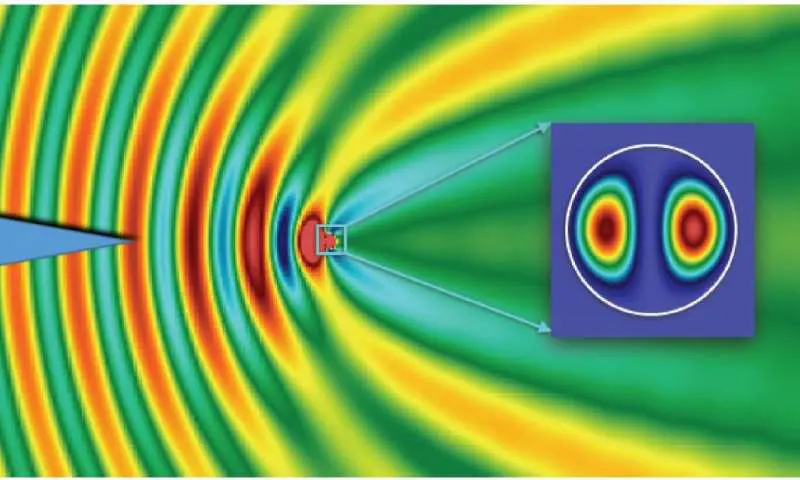
Miniaturization of basic elements in electronics requires new approaches. It has thus become very important to create intensive electromagnetic fields concentrated in the smallest possible volume. Scientists from the Lomonosov Moscow State University in collaboration with an international team conducted the first direct measurements of a giant resonant field excited inside a subwavelength dielectric particle at the scattering of a plane electromagnetic wave and provided the complete quantitatively theoretical explanation of the observed effect.

Physicist Michael Tribelsky, the leading author, says, “In theory, this effect has been known. In this case, the scattering particle acts as a funnel, gathering incident radiation from a large area and concentrating it in a small volume within the particle. However, there are many difficulties on the way to practical realization. Metallic nanoparticles were the first candidates for such ‘field concentrators.’ Unfortunately, they have deceived the expectations. The point is that metals have high dissipative losses in the most interesting applications area of visible light frequencies of the incident waves. The dissipation leads to significant energy losses, wasted for fruitless (and often harmful) heating of the nanoparticle, and diminishes the resonant enhancement of the electromagnetic field. In such a case, it would be natural to turn to dielectric particles. Unfortunately, it is not so simple to deal with them.”

If a particle does not have a high refractive index, the resonant effects are weak. Regarding the high-index particles, whose size is smaller than the wavelength of the incident radiation, the common belief was that the electromagnetic field hardly penetrated in such a particle. However, it turns out that at some frequencies of the incident radiation, the case is just the opposite. Namely, the field not only penetrates into the particle, but its high concentration may be observed. In a sense, the effect is analogous to the arc of a swing due to weak but well-timed pushes.

“Our main result is that, to the best of our knowledge, we are the first to achieve the direct experimental evidence of the effect and measure the profiles of the excited fields,” Michael Tribelsky says.

The difficulties of the corresponding measurements at optical frequencies are related to the necessity of measuring fields within a nanoparticle, and the spatial resolution of the measurements must be on the order of nanometers. The researchers modeled the scattering of light by a nanoparticle by means of the identical scattering of radio waves by a centimeter-size particle. To be able to move a probe inside the particle, liquid dielectric (usual distilled water held at a certain fixed temperature) poured into a transparent for the incident radio wave container has been employed.

The achievement lies on the very frontier of modern studies on subwavelength optics (namely optics dealing with objects whose scales are smaller than the wavelength of the incident radiation). These phenomena have applications including medicine (diagnosis and treatment of diseases, including cancer; targeted drug delivery and others), biology (various sensors and markers), telecommunications (nanoantennas) and systems for information recording and storage and other spheres. It could also be used for the creation of revolutionary new optical computers in which information is transferred not by electric pulses but by light packages.

The scientist says, “In a broad perspective, our project may initiate the creation of a new landscape for design and fabrication of super-miniature nanodevices and metamaterials—namely materials that are artificially formed and structured in a special way to possess unusual electromagnetic properties.”

featured image: Intensity of the magnetic field at the scattering of an electromagnetic wave. The incident wave propagates from left to right as it is indicated by the blue arrow. The color bar has different scales for the field outside the particle and within it (shown on a larger scale on the insert). Credit: Michael Tribelsky

 

Related

Recent Posts

Vishay Extends Aluminum Capacitors Rating Up to 600 V for DC Links

15.1.2026
19

Panasonic Passive Components for Reliable Robotic Arms

14.1.2026
49

Littelfuse Unveils Ultra-Low-Power TMR Magnetic Switches

13.1.2026
22

Rubycon PMLCAP DC‑Link Film Capacitors in Mass Production

9.1.2026
67

Bourns SSD‑1000A AEC‑Q Digital Current Sensors

8.1.2026
47

YAGEO High‑Capacitance X7R Automotive MLCC Extensions

8.1.2026
63

Jianghai Vibration‑Resistant Aluminum Capacitors Guidelines for Industrial Electronics

6.1.2026
36

2025 Top Passive Components Blog Articles

5.1.2026
113

Bourns BTJ Thermal Jumper Chips for PCB Heat Management

22.12.2025
96

Upcoming Events

Jan 21
18:00 - 18:45 CET

To Rogowski or not to Rogowski

Jan 27
16:00 - 17:00 CET

Simplifying Vehicle Development with Automotive Ethernet and Zonal Smart Switch Technologies

Feb 24
16:00 - 17:00 CET

Designing Qi2 Wireless Power Systems: Practical Development and EMC Optimization

View Calendar

Popular Posts

  • Buck Converter Design and Calculation

    0 shares
    Share 0 Tweet 0
  • Boost Converter Design and Calculation

    0 shares
    Share 0 Tweet 0
  • LLC Resonant Converter Design and Calculation

    0 shares
    Share 0 Tweet 0
  • Flyback Converter Design and Calculation

    0 shares
    Share 0 Tweet 0
  • Ripple Current and its Effects on the Performance of Capacitors

    3 shares
    Share 3 Tweet 0
  • MLCC and Ceramic Capacitors

    0 shares
    Share 0 Tweet 0
  • How Metal Prices Are Driving Passive Component Price Hikes

    0 shares
    Share 0 Tweet 0
  • Dual Active Bridge (DAB) Topology

    0 shares
    Share 0 Tweet 0
  • What is a Dielectric Constant and DF of Plastic Materials?

    4 shares
    Share 4 Tweet 0
  • Degradation of Capacitors and its Failure Mechanisms

    0 shares
    Share 0 Tweet 0

Newsletter Subscription


Passive Components Blog

© EPCI - Leading Passive Components Educational and Information Site

  • Home
  • Privacy Policy
  • EPCI Membership & Advertisement
  • About

No Result
View All Result
  • Home
  • Knowledge Blog
  • PCNS

© EPCI - Leading Passive Components Educational and Information Site

This website uses cookies. By continuing to use this website you are giving consent to cookies being used. Visit our Privacy and Cookie Policy.
Go to mobile version