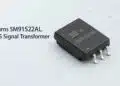






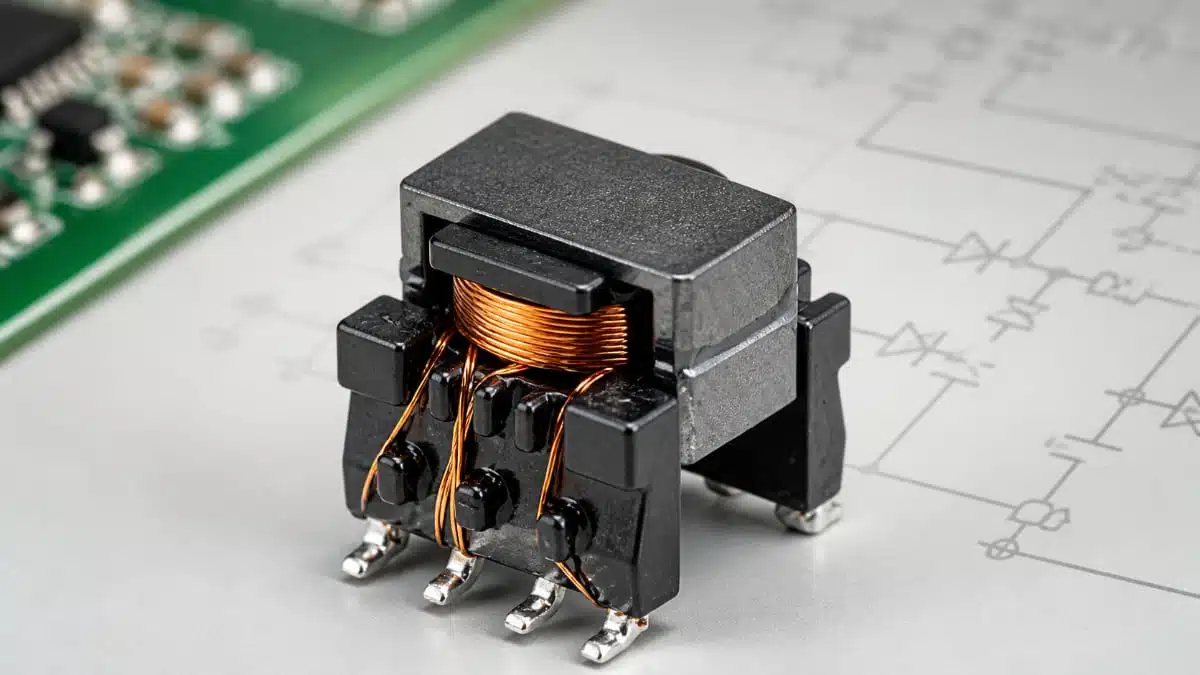
Bourns has introduced the HVMA03F45A‑ST8S, a 3‑watt surface‑mount gate driver transformer designed for automotive and industrial applications requiring robust isolation and compact form factor.
The Bourns 3‑watt SMT gate driver transformer targets isolated gate drive and auxiliary power functions where high working voltage, automotive qualification, and AEC‑Q200 compliance are important design constraints.
Key features and benefits
- Automotive‑grade, AEC‑Q200 compliant
- Qualified to AEC‑Q200, making it suitable for automotive ECUs and powertrain electronics without requiring custom qualification on the magnetics side.
- Supports long‑term reliability expectations in harsh environments with extended thermal and mechanical stress.
- 3 W isolated gate drive transformer
- Output power up to 3 W, suitable for powering isolated gate driver circuits or low‑power auxiliary rails in wide bandgap and traditional power stages.
- Enables compact isolated bias supplies for half‑bridge, full‑bridge, and multi‑phase power stages.
- High working voltage and creepage
- Rated working voltage of 850 V with 8 mm creepage distance.
- Supports reinforced spacing for systems with elevated DC bus voltages, helping designers meet safety and insulation requirements in traction inverters and high‑voltage battery systems according to IEC 61558‑2 and IEC 60664‑1.
- Wide switching frequency range
- Specified switching frequency range from 50 kHz to 380 kHz.
- Compatible with a broad range of fixed‑frequency and variable‑frequency gate driver controller ICs, giving flexibility when migrating between different controller families.
- Extended temperature range
- Operating temperature range from −40 °C to +125 °C (Class F insulation system).
- Supports under‑hood and powertrain locations where ambient and self‑heating push the magnetics near the upper end of typical component limits.
- Compact SMT construction
- Surface‑mount transformer built on a standard ER9.5 core.
- Facilitates automated assembly, simplifies PCB layout compared to through‑hole transformers, and can help reduce z‑height in compact power modules.
- Regulatory and environmental compliance
- Basic insulation per IEC 61558‑2 and IEC 60664‑1 according to manufacturer information.
- RoHS compliant according to the RoHS Directive 2015/863.
Typical applications
The HVMA03F45A‑ST8S is aimed at isolated gate drive and auxiliary power functions in automotive and industrial power electronics. Typical application areas include:
- Automotive and e‑mobility
- Transistor gate drive power for high‑voltage inverters in hybrid and electric vehicles.
- Battery management systems that require galvanic isolation between high‑voltage packs and low‑voltage control electronics.
- Power delivery subsystems in on‑board chargers and DC‑DC converters where isolated bias rails are needed.
- Industrial drives and motor control
- Motor drives and inverter circuits requiring isolated driver supplies for IGBTs, SiC, or GaN devices.
- Industrial power delivery modules where high working voltages and robust isolation distances are mandatory.
- General isolated auxiliary supplies
- Low‑power isolated supplies within power supplies and DC‑DC converters for housekeeping or control rails.
- Applications using variable‑frequency gate driver controllers that benefit from the transformer’s wide frequency compatibility.
In many of these use cases, a 3 W transformer with 8 mm creepage and 850 V working voltage provides sufficient headroom for typical DC bus voltages in the 400–800 V range, while still fitting within compact SMT form factors.
Technical highlights
This section summarizes the key electrical and mechanical parameters. Exact and detailed values should always be taken from the current manufacturer datasheet.
Core electrical parameters
- Output power: up to 3 W according to manufacturer data.
- Primary inductance: 45 µH measured at 400 kHz / 1 V.
- Switching frequency range: 50 kHz to 380 kHz, supporting both lower‑frequency and high‑frequency gate drive controllers.
- Rated working voltage: 850 V, indicating the maximum continuous operating voltage for which the insulation system is designed.
From a practical perspective, the specified primary inductance and frequency range define the transformer’s behavior in typical push‑pull or flyback‑style isolated gate driver topologies. Designers should align the selected operating frequency with the controller IC and ensure that duty cycle and turns ratio meet the needed output voltage and regulation characteristics according to the datasheet.
Isolation and insulation
- Creepage distance: 8 mm.
- Insulation level: basic insulation per IEC 61558‑2 and IEC 60664‑1 according to the manufacturer.
- Automotive qualification: AEC‑Q200 compliant.
An 8 mm creepage distance is particularly relevant in automotive and industrial systems with high DC bus voltages and pollution degree considerations. It helps designers comply with minimum clearance and creepage distances mandated by safety standards without adding complex PCB slotting or multi‑layer spacing measures.
Thermal and environmental ratings
- Operating temperature range: −40 °C to +125 °C, Class F insulation.
- Automotive grade: designed for environments with wide temperature swings and potential thermal cycling.
Class F insulation supports winding and insulation materials rated up to a maximum operating temperature typically associated with Class F systems, which helps maintain transformer reliability under higher ambient temperatures plus self‑heating from copper and core losses.
Package and construction
- Package type: SMT transformer.
- Core: standard ER9.5 core.
- Series: HVMA03F45A‑ST8S model in the Bourns custom magnetics product line.
Using a standard ER9.5 core geometry simplifies mechanical design and can reduce risk for long‑term availability, as this core format is widely used in small transformers. The SMT construction aligns with automated assembly lines, reflow soldering, and compact PCB layouts.
Summary table of main parameters
| Parameter | Value (according to manufacturer) |
|---|---|
| Model | HVMA03F45A‑ST8S |
| Output power | 3 W |
| Primary inductance | 45 µH @ 400 kHz / 1 V |
| Switching frequency range | 50 kHz to 380 kHz |
| Creepage distance | 8 mm |
| Rated working voltage | 850 V |
| Operating temperature range | −40 °C to +125 °C (Class F) |
| Qualification | AEC‑Q200 compliant |
| Insulation class | Basic insulation (IEC 61558‑2, IEC 60664‑1) |
| Package / core | SMT, standard ER9.5 core |
| RoHS status | RoHS compliant |
For any additional parameters such as turns ratio, leakage inductance, or detailed isolation test voltages, designers should consult the latest manufacturer datasheet and product selector tools.
Design‑in notes for engineers
When integrating the HVMA03F45A‑ST8S into a new or existing design, several practical considerations can help ensure robust performance and efficient development.
Electrical design considerations
- Match controller frequency to transformer window
- Ensure the chosen gate driver or auxiliary supply controller operates within the 50–380 kHz range.
- Verify efficiency and thermal behavior at the intended switching frequency using manufacturer datasheet limits.
- Check power budget and derating
- The 3 W power rating should be interpreted in the context of ambient temperature, cooling, and duty cycle.
- Apply appropriate derating for high ambient temperatures near +125 °C and for continuous full‑load operation.
- Verify working voltage and insulation
- Align the 850 V working voltage and 8 mm creepage distance with system‑level safety requirements and standards.
- Confirm that the intended DC bus voltage, pollution degree, and overvoltage category are compatible with the transformer’s insulation class.
- Consider core and copper losses
- At higher switching frequencies, core losses can increase significantly.
- Validate temperature rise under worst‑case operating conditions according to data from the manufacturer datasheet or application notes.
PCB layout and mechanical notes
- Use clearance and creepage‑friendly layout
- Maintain sufficient clearance around primary and secondary pins to preserve the 8 mm creepage on the board.
- Avoid solder mask openings or copper pours encroaching on creepage paths.
- Plan for SMT reflow profile
- Confirm that the selected soldering profile aligns with the transformer’s recommended reflow conditions.
- Position the transformer to minimize mechanical stress during thermal cycling, especially in automotive applications.
- Standard ER9.5 core footprint
- Use the ER9.5‑based package outline from the manufacturer drawings to position the transformer and any isolation slots.
- Consider mechanical retention or underfill only if specifically recommended by the manufacturer and compatible with automotive qualification.
System‑level and interoperability aspects
- Gate driver IC compatibility
- The transformer is stated to be compatible with fixed‑frequency and variable‑frequency gate driver controller ICs; designers should verify specific IC recommendations or reference designs from Bourns.
- Check that the transformer’s turns ratio and magnetizing inductance meet the energy and duty‑cycle requirements of the selected controller.
- Custom variants
- If the standard HVMA03F45A‑ST8S does not match required output voltages or isolation constraints, Bourns offers customization options according to the press release.
- Engaging with the manufacturer early in the design can help align custom magnetics with automotive qualification timelines and documentation needs.
- Thermal and reliability validation
- For automotive projects, plan for validation under combined thermal, vibration, and humidity stress conditions.
- Use the AEC‑Q200 status as a baseline but complement it with project‑specific reliability testing as needed.
Source
This article is based on information provided in the official Bourns new product release for the HVMA03F45A‑ST8S gate driver transformer and associated manufacturer documentation. Exact numerical values and detailed specifications should always be confirmed against the latest manufacturer datasheet and technical resources.