











Passive Components Blog
No Result
View All Result
  • Home
  • NewsFilter
    • All
    • Aerospace & Defence
    • Antenna
    • Applications
    • Automotive
    • Capacitors
    • Circuit Protection Devices
    • electro-mechanical news
    • Filters
    • Fuses
    • Inductors
    • Industrial
    • Integrated Passives
    • inter-connect news
    • Market & Supply Chain
    • Market Insights
    • Medical
    • Modelling and Simulation
    • New Materials & Supply
    • New Technologies
    • Non-linear Passives
    • Oscillators
    • Passive Sensors News
    • Resistors
    • RF & Microwave
    • Telecommunication
    • Weekly Digest

    Circuit Protection Technology Annual Dossier

    ESA SPCD 26 Registration Open

    Capacitances of Nonlinear MLCCs: What Datasheets Don’t Tell You

    Stackpole Releases Automotive Wide‑Termination Resistors

    How a Digital Structural Twin Can Predict Tantalum Capacitor Reliability

    SCHURTER Buys Biaodi to Boost High-Voltage Protection Portfolio

    Binder Hybrid Connector Simplifies One Cable Automation

    Tapped Inductor Buck Converter Fundamentals

    TAIYO YUDEN Releases Mini Metal Power Inductors

    Trending Tags

    • Ripple Current
    • RF
    • Leakage Current
    • Tantalum vs Ceramic
    • Snubber
    • Low ESR
    • Feedthrough
    • Derating
    • Dielectric Constant
    • New Products
    • Market Reports
  • VideoFilter
    • All
    • Antenna videos
    • Capacitor videos
    • Circuit Protection Video
    • Filter videos
    • Fuse videos
    • Inductor videos
    • Inter-Connect Video
    • Non-linear passives videos
    • Oscillator videos
    • Passive sensors videos
    • Resistor videos

    Capacitances of Nonlinear MLCCs: What Datasheets Don’t Tell You

    Tapped Inductor Buck Converter Fundamentals

    Planar vs Conventional Transformer: When it Make Sense

    Modeling Fringing Field Losses in Inductors & Transformers

    Why Power Inductors Use a Ferrite Core With an Air Gap

    Transformer-Based Power-Line Harvester Magnetic Design

    Thermal Modeling of Magnetics

    Standard vs Planar LLC transformers Comparison for Battery Chargers

    How Modern Tools Model Magnetic Components for Power Electronics

    Trending Tags

    • Capacitors explained
    • Inductors explained
    • Resistors explained
    • Filters explained
    • Application Video Guidelines
    • EMC
    • New Products
    • Ripple Current
    • Simulation
    • Tantalum vs Ceramic
  • Knowledge Blog
  • DossiersNew
  • Suppliers
    • Who is Who
  • PCNS
    • PCNS 2025
    • PCNS 2023
    • PCNS 2021
    • PCNS 2019
    • PCNS 2017
  • Events
  • Home
  • NewsFilter
    • All
    • Aerospace & Defence
    • Antenna
    • Applications
    • Automotive
    • Capacitors
    • Circuit Protection Devices
    • electro-mechanical news
    • Filters
    • Fuses
    • Inductors
    • Industrial
    • Integrated Passives
    • inter-connect news
    • Market & Supply Chain
    • Market Insights
    • Medical
    • Modelling and Simulation
    • New Materials & Supply
    • New Technologies
    • Non-linear Passives
    • Oscillators
    • Passive Sensors News
    • Resistors
    • RF & Microwave
    • Telecommunication
    • Weekly Digest

    Circuit Protection Technology Annual Dossier

    ESA SPCD 26 Registration Open

    Capacitances of Nonlinear MLCCs: What Datasheets Don’t Tell You

    Stackpole Releases Automotive Wide‑Termination Resistors

    How a Digital Structural Twin Can Predict Tantalum Capacitor Reliability

    SCHURTER Buys Biaodi to Boost High-Voltage Protection Portfolio

    Binder Hybrid Connector Simplifies One Cable Automation

    Tapped Inductor Buck Converter Fundamentals

    TAIYO YUDEN Releases Mini Metal Power Inductors

    Trending Tags

    • Ripple Current
    • RF
    • Leakage Current
    • Tantalum vs Ceramic
    • Snubber
    • Low ESR
    • Feedthrough
    • Derating
    • Dielectric Constant
    • New Products
    • Market Reports
  • VideoFilter
    • All
    • Antenna videos
    • Capacitor videos
    • Circuit Protection Video
    • Filter videos
    • Fuse videos
    • Inductor videos
    • Inter-Connect Video
    • Non-linear passives videos
    • Oscillator videos
    • Passive sensors videos
    • Resistor videos

    Capacitances of Nonlinear MLCCs: What Datasheets Don’t Tell You

    Tapped Inductor Buck Converter Fundamentals

    Planar vs Conventional Transformer: When it Make Sense

    Modeling Fringing Field Losses in Inductors & Transformers

    Why Power Inductors Use a Ferrite Core With an Air Gap

    Transformer-Based Power-Line Harvester Magnetic Design

    Thermal Modeling of Magnetics

    Standard vs Planar LLC transformers Comparison for Battery Chargers

    How Modern Tools Model Magnetic Components for Power Electronics

    Trending Tags

    • Capacitors explained
    • Inductors explained
    • Resistors explained
    • Filters explained
    • Application Video Guidelines
    • EMC
    • New Products
    • Ripple Current
    • Simulation
    • Tantalum vs Ceramic
  • Knowledge Blog
  • DossiersNew
  • Suppliers
    • Who is Who
  • PCNS
    • PCNS 2025
    • PCNS 2023
    • PCNS 2021
    • PCNS 2019
    • PCNS 2017
  • Events
No Result
View All Result
Passive Components Blog
No Result
View All Result

I Sing the Capacitor Electric

4.4.2017
Reading Time: 3 mins read
A A

source: EDN article

Michael Dunn -April 03, 2017. Most of us with a decent knowledge of components know that ceramic capacitors can sing, or, act as mechanical-to-voltage converters. But metalized film?

RelatedPosts

Circuit Protection Technology Annual Dossier

ESA SPCD 26 Registration Open

Capacitances of Nonlinear MLCCs: What Datasheets Don’t Tell You

In Why is everything junk? (Heat-pump edition), I reviewed and analyzed the electrical and functional behaviour of my heat-pump system and the problems it caused the induction cooktop. I postulated that throwing some capacitance across the 240V AC line might solve my problem by absorbing the interfering audio-band line noise generated by the heat pump. Well, I finally tried it, and the results are a definite maybe.


Figure 1  The 15µF X2 (AC-line rated) capacitor assembly

For my first try, I connected the cap assembly to a spare pair of circuit-breaker outputs. Upon flipping the breaker, I immediately noticed a surprisingly high acoustic noise level emitted from the capacitor! This was…worrisome, to say the least. Still, it didn’t burst into flames, explode, or even get warm.

But did it have the desired effect of quieting the induction cooktop? Just barely.

So…it was doing something, but, not much of it. I next paralleled the cap across the cooktop breaker’s output (though having both wires connected to one breaker would not be acceptable for a permanent installation). This time, the quieting effect on the cooktop was more noticeable, but still nothing to write home about.

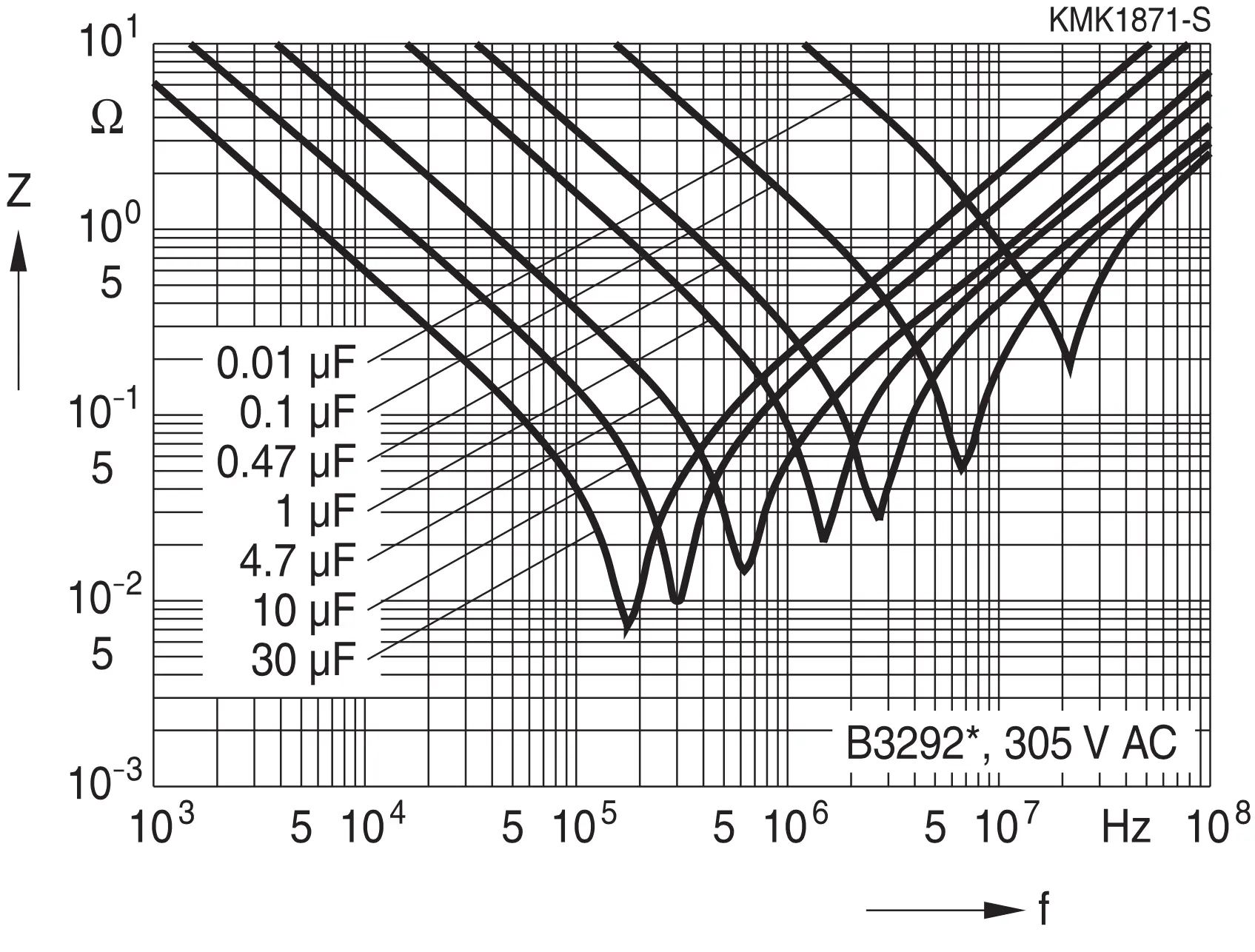
For reference, here are some capacitor graphs:


Figure 2  Capacitor impedance vs. frequency: Interpolating between the 10µF & 30µF lines, the impedance varies from 0.5Ω to 10Ω over the 1kHz to 20kHz band – we’re far enough from the 250kHz self-resonance that the cap’s impedance is close to ideal (p/n: B32926D3156K; source: TDK/Epcos).


Figure 3  Permissible AC current through the cap: Extrapolating down to 60Hz returns about 1.5A. XC @60Hz is 177Ω. At 240 VAC, that’s 1.4A, which doesn’t leave much “headroom” for all the higher-frequency noise current. Presumably the graph only applies to a single frequency component, and one must somehow “integrate” current across the band (source: TDK/Epcos).

A call to Epcos might be in order to help interpret Figure 3. And I’ll need to measure voltage across or current through the cap (with a scope/FFT) to get a clear understanding of what’s going on.

But getting back to the scary capacitor singing, I did some research, and sure enough, the manufacturer’s application note mentions:

6.4  Buzz noise

Under AC regime, buzzing noise is produced in film capacitors by the mechanical vibration of the films, due to the Coulomb force existing between electrodes of opposite polarity. Buzz noise becomes louder if the applied voltage waveform presents distortion and/or high frequency harmonics. Buzz noise does not affect the capacitor structure, nor its electrical characteristics or reliability.

Given the cap slightly but noticeably quieted the cooktop, I imagine that using several in parallel might make a significant improvement. Additionally, I could house the caps in an electrical box in the basement, inserted near the load-end of the line, which would provide about 5m of wiring impedance to my filtering advantage.

I must confirm the caps won’t incur a “running cost”. A purely capacitive load should theoretically not make the electric meter spin, but as we all know, theory and practice have been known to diverge.

Related

Recent Posts

ESA SPCD 26 Registration Open

15.5.2026
14

Capacitances of Nonlinear MLCCs: What Datasheets Don’t Tell You

14.5.2026
58

How a Digital Structural Twin Can Predict Tantalum Capacitor Reliability

14.5.2026
43

Researchers Propose Next‑Gen Compact Memory Using Ultra-thin Ferroelectric Capacitors

11.5.2026
50

Nichicon ADN Automotive Hybrid Aluminum Capacitors Now Available in EMEA

11.5.2026
38

Electrocaloric Multilayer Capacitors: Towards Quiet, Solid‑State Cooling Around Room Temperature

7.5.2026
212

KYOCERA 10 µF 0201 MLCC Brings High‑Capacitance into Mobile Designs

6.5.2026
62

Energy Localization in Tantalum Anode Formation: A Structural Perspective

4.5.2026
51

YAGEO Introduces C0G Flexible Termination Automotive MLCCs

30.4.2026
45

Upcoming Events

May 19
16:00 - 17:00 CEST

Designing Qi2 Wireless Power Systems: Practical Development and EMC Optimization

Jun 2
16:00 - 17:00 CEST

Calculation, Simulation and Measurement of 800V EMC Filters

Jun 16
16:00 - 17:00 CEST

EMC with EMC – EMC‑compliant design with electromechanical connectors

View Calendar

Popular Posts

  • Buck Converter Design and Calculation

    0 shares
    Share 0 Tweet 0
  • Boost Converter Design and Calculation

    0 shares
    Share 0 Tweet 0
  • Flyback Converter Design and Calculation

    0 shares
    Share 0 Tweet 0
  • LLC Resonant Converter Design and Calculation

    0 shares
    Share 0 Tweet 0
  • MLCC and Ceramic Capacitors

    0 shares
    Share 0 Tweet 0
  • Capacitor Charging and Discharging

    0 shares
    Share 0 Tweet 0
  • What Electronics Engineer Needs to Know About Passive Low Pass Filters

    0 shares
    Share 0 Tweet 0
  • Dual Active Bridge (DAB) Topology

    0 shares
    Share 0 Tweet 0
  • Ripple Current and its Effects on the Performance of Capacitors

    3 shares
    Share 3 Tweet 0
  • Samsung Electro-Mechanics Releases High-Capacitance MLCCs for AI Server Applications

    0 shares
    Share 0 Tweet 0

Newsletter Subscription


Passive Components Blog

© EPCI - Leading Passive Components Educational and Information Site

  • Home
  • Privacy Policy
  • EPCI Membership & Advertisement
  • About

No Result
View All Result
  • Home
  • Knowledge Blog
  • PCNS

© EPCI - Leading Passive Components Educational and Information Site

This website uses cookies. By continuing to use this website you are giving consent to cookies being used. Visit our Privacy and Cookie Policy.
Go to mobile version