



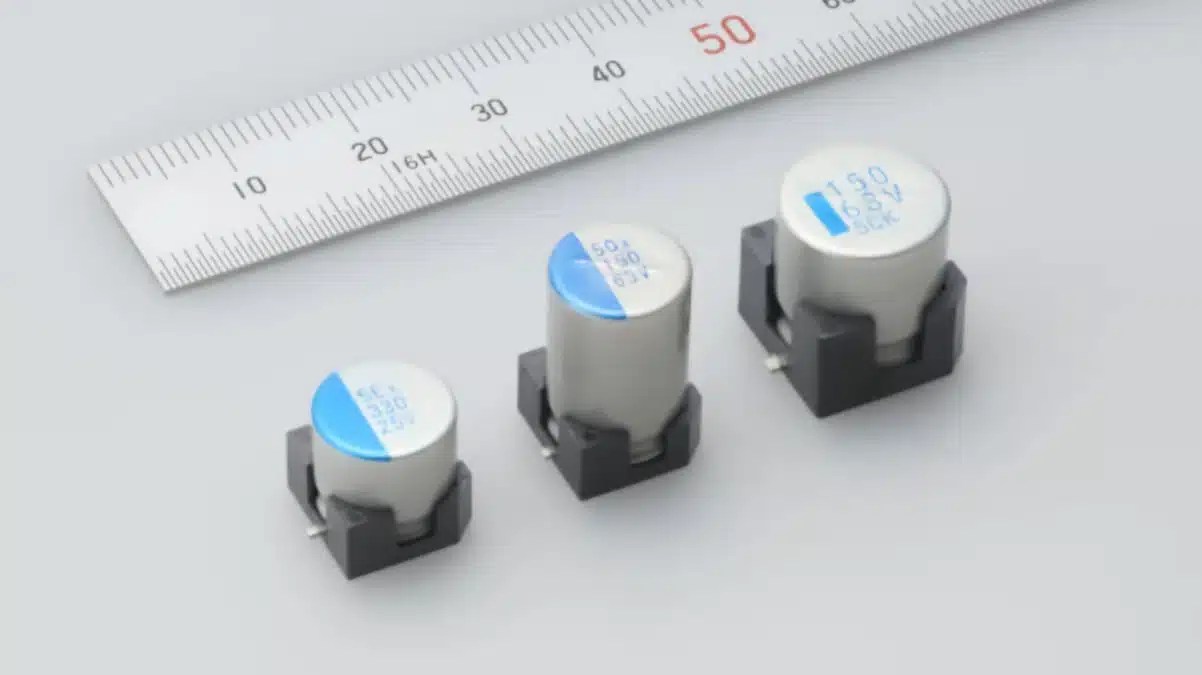
TAIYO YUDEN has introduced the HVX (-K) and HTX (-K) series of conductive polymer hybrid aluminum electrolytic capacitors qualified to AEC‑Q200 for demanding automotive power electronics.
These hybrid aluminum electrolytic capacitors target high‑voltage, large‑current rails used in 48 V power steering, ADAS and other control/safety functions where compact footprint, ripple capability and reliability at elevated temperatures are critical.
Key features and benefits
- Hybrid electrolyte system combining conductive polymer with liquid electrolyte to achieve low ESR while maintaining the self‑repairing behavior of aluminum electrolytic capacitors, improving both efficiency and robustness in noisy power rails.
- AEC‑Q200 qualification for passive components, making the HVX (-K) and HTX (-K) series suitable for automotive ECUs and power modules without requiring custom qualification by every OEM project.
- High voltage capability up to 80 V to support modern 48 V automotive power architectures with sufficient margin for transients and derating practices commonly used in power design.
- High ripple current ratings at elevated temperature, with top parts such as RAHTX181M1RGP5005K specified at 3,900 mArms at 135°C, allowing fewer parallel capacitors or smaller case sizes in high‑current buck/boost and motor drive stages.
- Wide size lineup from compact φ6.3 × 7.7 mm can‑types to larger φ12.5 × 16.5 mm devices, enabling both space‑constrained control boards and higher energy storage nodes to use the same technology family.
- Improved capacitance characteristics versus previous HVX/HTX generations, supporting better low‑frequency smoothing and reduced voltage droop on dynamic load steps in ADAS and power steering applications.
- Automotive‑focused manufacturing footprint, with mass production at ELNA’s Shirakawa and Aomori plants, supporting volume supply and alignment with automotive quality systems.
Typical applications
The HVX (-K) and HTX (-K) hybrid capacitors are intended as noise suppression and power‑smoothing elements in automotive power supply circuits. This maps naturally onto several common design blocks:
- 48 V electric power steering inverters and control units, where high ripple currents and tight space require compact capacitors with low ESR and high endurance at under‑hood temperatures.
- ADAS ECUs (camera, radar, lidar and sensor fusion units) using multi‑phase DC‑DC converters to generate low‑voltage digital rails from 12 V or 48 V, where output capacitors must balance transient response and lifetime.
- Safety‑critical control modules such as braking, stability control or steer‑by‑wire electronics, where AEC‑Q200 qualification and predictable failure modes are important.
- On‑board chargers and auxiliary DC‑DC converters in electrified powertrains (HEV/EV) that require high‑voltage intermediate buses and robust decoupling of switching noise.
- General automotive body and comfort ECUs using 12 V to 48 V rails where hybrid capacitors can replace or complement traditional electrolytics for better ripple and lifetime at elevated temperatures.
Technical highlights
TAIYO YUDEN’s press release highlights several key technical parameters and lineup aspects that are relevant for design‑in.
Hybrid construction and performance
Hybrid aluminum electrolytic capacitors use a conductive polymer plus liquid electrolyte to form the cathode system. The low resistivity of the polymer reduces equivalent series resistance, which directly lowers ripple voltage for a given ripple current, allowing designers to operate converters at higher switching frequencies or with more aggressive transient requirements. At the same time, the traditional aluminum oxide dielectric with liquid electrolyte preserves self‑healing capability, which can help maintain reliability under surge and minor defect conditions.
The HVX (-K) and HTX (-K) series are designed to operate up to 135°C, with the flagship 80 V rated part RAHTX181M1RGP5005K specified at 3,900 mArms ripple current at this upper temperature limit. In practice, this allows use in engine compartment or near‑inverter locations where ambient and self‑heating are significant, without derating ripple capability down to impractical levels.
Voltage range and sizes
The new lineup achieves rated voltages up to 80 V, supporting 48 V systems with realistic engineering margins for load dump and other transients. Within this voltage class, the portfolio spans:
- Seven can sizes from approximately φ6.3 × 7.7 mm to φ12.5 × 16.5 mm.
- 46 individual part numbers, across HVX (-K) and HTX (-K) designations, enabling fine granularity in capacitance and ripple ratings.
Mechanical form factor is the familiar radial can style, making it straightforward to integrate into existing PCB footprints used for aluminum electrolytics in automotive designs.
HVX (-K) versus HTX (-K) positioning
The part numbering schemes RAHVX… and RAHTX… identify HVX (-K) and HTX (-K) variants respectively. While the press release focuses on the improved capacitance characteristics common to both, designers should consult the detailed datasheets and series comparison pages to understand differences in ESR, lifetime and case size mapping between HVX and HTX for given voltage and capacitance combinations. In many automotive platforms, engineers standardize on a single hybrid family for a whole ECU; having both HVX and HTX options allows optimization between ripple performance and volume or cost.
Availability and part numbers
TAIYO YUDEN has commercialized 46 types within the HVX (-K) and HTX (-K) hybrid capacitor families. The press release lists the specific part numbers for the initial mass‑production lineup, covering multiple voltage and capacitance combinations in seven case sizes.
Key points on availability:
- Mass production started in June 2026 at ELNA’s Shirakawa and Aomori plants in Japan, indicating that devices are in regular series production rather than engineering samples.
- Samples are available at a unit price of 150 yen, useful for early evaluation and benchmark testing versus legacy electrolytics or competing hybrid technologies.
- The full lineup can be browsed through TAIYO YUDEN’s online specification search interface using filters for hybrid capacitors and HVX/HTX series identifiers.
When planning sourcing, purchasers should coordinate with TAIYO YUDEN authorized distributors or direct sales, taking into account AEC‑Q200 qualification and customer‑specific PPAP or documentation needs for automotive programs.
Design‑in notes for engineers
From a practical design standpoint, hybrid aluminum electrolytics in the HVX (-K) and HTX (-K) series can be considered as candidates for output, input and intermediate bus capacitors in switched‑mode converters, particularly in automotive contexts. Some concrete design‑in notes:
- Voltage derating strategy: For 48 V systems, using 80 V rated parts provides comfortable headroom for transients and long‑term reliability. Designers should still follow standard derating guidelines (for example designing for nominal operating voltage well below the rated voltage) as defined in TAIYO YUDEN’s datasheets and application notes.
- Ripple current and thermal design: With ripple ratings specified up to 135°C, these hybrids can sustain high AC currents, but PCB layout and airflow must still be designed to avoid excessive local temperature rise. Placing multiple devices in parallel, using wide copper pours and considering distance from hot components (MOSFETs, inductors) helps maximize lifetime.
- ESR versus ceramic capacitors: Hybrid electrolytics offer lower ESR than traditional wet aluminum parts but higher ESR than parallel MLCC banks. A common approach is to combine one or more hybrids for bulk energy storage and damping with MLCCs for high‑frequency decoupling, especially on ADAS digital rails.
- Lifetime and AEC‑Q200 considerations: Products are tested to AEC‑Q200 stress methods, but the manufacturer recommends reviewing and approving the official product specifications and test results before release to automotive production. This includes checking endurance at temperature, vibration, surge and humidity for the specific project profile.
- Layout and mechanical constraints: The cylindrical can format simplifies replacement of existing electrolytics. However, designers should pay attention to height limits in compact ECUs and ensure that the selected φ and height combination fits within enclosure and connector clearances.
- EMI and noise suppression: Low‑ESR hybrids help reduce conducted ripple on supply lines, which can ease compliance with CISPR and automotive OEM EMC requirements. When used at converter outputs and across intermediate buses, they can help flatten impedance versus frequency and reduce resonances with wiring harness inductances.
- Qualification for safety‑related functions: In ADAS and steering applications, component selection must align with the system’s safety goals. Designers should integrate these hybrid capacitors within a broader safety analysis (for example ISO 26262‑based FMEDA) using failure rate and mode data provided by the manufacturer.
Engineers are advised to pull the detailed datasheets for each candidate part number, especially to verify capacitance, ESR, ripple ratings and endurance at the actual operating temperature profile for their ECU.
Source
This article is based on information provided in TAIYO YUDEN’s official press release and related online product documentation for the HVX (-K) and HTX (-K) hybrid aluminum electrolytic capacitor series. Detailed numerical values and qualification data should always be confirmed against the latest manufacturer datasheets and application notes.