












This post based on article by Dennis Zogbi, Paumanok Inc. published by TTI Market Eye provides an overview and mapping of growth in industrial grade passive components, underpinned by the energy transition, AI data centers, EV charging and Industry 4.0 automation.
Industrial Segment: Profitable “Middle Ground” of the Supply Chain
The industrial end-use segment accounts for roughly 12% of global passive component consumption value, covering capacitors, resistors and inductors. Its combination of moderate unit volumes, robust pricing and demanding specifications makes it one of the most profitable and strategically attractive parts of the supply chain.
From a supply chain perspective, industrial applications sit between high-reliability defense/medical segments and ultra-high-volume consumer markets. This positioning shields suppliers from extreme price pressure while still enabling scale and long-term customer partnerships.
Four Structural Growth Drivers in 2026
Four key structural forces are reshaping industrial demand for passive components:
- Global energy transition and buildout of renewable energy and EV charging infrastructure.
- Expansion of AI data center infrastructure, driving high-performance power management requirements.
- Industry 4.0 and industrial automation, increasing use of inductors, precision resistors and protection devices in smart factories.
- Wide-bandgap semiconductor adoption (SiC and GaN), redefining requirements for capacitors, inductors and circuit protection.
These forces span multiple industrial sub-segments, from high-voltage transmission and distribution to motors and drives, power supplies, automation and lighting.
Capacitor Technologies: Film Core, Ceramics Rising, EDLC and Tantalum in Niches
Plastic Film Capacitors Anchor Industrial Power Electronics
Plastic film capacitors represent around half of industrial capacitor market value and remain the primary dielectric for power factor correction, smoothing and burst power. Key applications include AC power systems using polypropylene film and DC electronic systems using PET film, particularly in DC link bus capacitors for renewable inverters and traction drives above 800 V.
The self-healing capability of film under voltage stress is emphasized as a unique enabler for high-reliability industrial electronics with lifetimes of 100,000+ hours.
Ceramic Capacitors Move Further into Line-Voltage Space
High-voltage ceramic capacitors are gaining ground at line voltage, from disc and doorknob styles up to SMD MLCCs rated to 5 kV and beyond. A highlight is Samsung Electro-Mechanics’ 1000 V automotive and industrial MLCC, introduced in 2025 with a stable dielectric from -40 °C to 125 °C, allowing ceramics to compete in inverter and converter positions traditionally dominated by film.
Aluminum Electrolytics Remain Essential for Bulk Energy Storage
Large can and snap-in aluminum electrolytic capacitors remain indispensable for motor drives, power supplies and renewable energy DC buses up to about 500 V. Long-life designs with 10,000–15,000 hour ratings are now standard in many industrial power supplies where maintenance access is costly.
Carbon Supercapacitors (EDLC) and Tantalum Capacitors in Demanding Roles
EDLC supercapacitors are described as one of the fastest-growing industrial capacitor segments, used in actuated power systems, motor starting, battery load leveling, UPS, wind turbines and regenerative braking.
Knowles Precision Devices’ three-cell EDLC modules launched in March 2024 target higher-voltage storage in EVs, IoT and renewable energy systems, with a 10-year design life.
Large case molded chip and hermetic tantalum capacitors serve harsh industrial environments such as downhole oil and gas, mining electronics and motor controllers.
Vishay’s STH wet tantalum series, introduced in 2023 with robust shock and vibration performance, exemplifies ongoing investment in ruggedized tantalum solutions.
Industrial Resistors: High-Voltage, Flameproof and Precision Shunts
Industrial resistors remain heavily focused on high-voltage and safety-critical performance:
- Thick film chip resistors and networks based on precious metal pastes for line-voltage industrial electronics.
- Nickel-chromium (nichrome) film and wirewound resistors for high-voltage and precision applications in motor controllers and thermostats.
- Flameproof tin-oxide types for applications above 1 kV where non-flammable failure modes are required by safety regulations.
A fast-growing sub-market is current-sense shunt resistors for battery management systems, solar inverters, EV drives and industrial power regulation.
Bourns’ expanded Riedon industrial shunt resistor portfolio, released in 2024, is cited as an example of targeted investment in this segment.
Vishay’s 2025 opening of a large resistor plant in Monterrey, Mexico, with an annual capacity of about 50 billion units underscores ongoing capacity expansion in industrial-grade resistors.
Inductors and Magnetics: From Ferrites to Nanocrystalline
Power Inductors and Wide-Bandgap Converters
Discrete inductors are identified as one of the most strategically important and fast-evolving passive categories between 2022 and 2026.
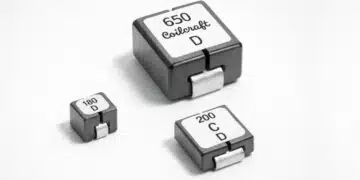
Industrial power inductors serve SMPS chokes, DC/DC converters, VFD line reactors, active front-end boost stages and UPS energy storage chokes.
A key technology shift is the transition from ferrite cores to nanocrystalline and amorphous alloys for high-frequency GaN and SiC power stages, approaching 1 MHz.
Nanocrystalline cores can reduce core losses at 1 MHz by more than 60% compared to ferrites, and Hitachi Metals reports a 20% volume reduction and two-thirds loss reduction in a 10 kW solar inverter by using nanocrystalline ribbon cores.
In 2025, TDK and Infineon co-packaged inductors and capacitors within SiC inverter modules to support switching frequencies above 100 kHz in EV traction systems, signaling an emerging trend toward integrated magnetics.
EMI Filters, Common Mode Chokes and Planar Solutions
Common mode chokes and EMI filter inductors are highlighted as large-volume products in power supplies, drives, inverters and automation.
Increased EMI from wide-bandgap power devices is paradoxically boosting demand for such magnetics.
Vanguard Electronics expanded its common mode choke lineup in 2024 with the SCMN and CMN series, optimized for 100 kHz to 600 kHz+ operation in GaN, SiC and GaAs power supplies.
Planar magnetics and coupled inductors are gaining share in high-density industrial power supplies, AI servers and telecom rectifiers, with Vishay’s 2025 acquisition of a Czech specialty inductor producer strengthening its capabilities in this field.
Ferrite beads and bead arrays remain the highest-volume inductor family by unit count, serving noise suppression in PLCs, distributed control systems and industrial communication interfaces.
Key Industrial Applications in 2026
Power Transmission, Distribution and HVDC
Industrial grade passive components are critical in power transmission and distribution systems from 3 kV up to and beyond 745 kV.
Distribution and transmission capacitor banks rely on series/parallel configurations of large film capacitors, while associated MOV arresters and inductors support surge and harmonic control.
A highlighted trend is accelerated deployment of HVDC links for offshore wind and long-distance renewables, which requires specialized high-voltage DC capacitors, surge protection and harmonic filtering inductors.
Motors, Drives and Industrial Automation
Motor run capacitors historically tracked residential construction, but growth has shifted toward industrial VFD-driven efficiency upgrades under IE3, IE4 and emerging IE5 regulations.
VFDs consume large aluminum electrolytics, AC film capacitors, line reactors, output chokes, MOVs, inrush thermistors and current-sense resistors.
Industrial automation and robotics drive demand for compact servo drives with advanced film capacitors, SMD inductors, precision resistors and fast-acting ESD/TVS protection.
Renewable Energy and Energy Storage
Solar and wind systems are among the most important growth markets for industrial passive components.
Modern grid-connected inverters require large numbers of DC link film and aluminum capacitors, power inductors, supercapacitors for ride-through, MOVs for surge protection and fuses for overcurrent protection.
The move to 1500 V DC bus voltages in large solar installations is raising voltage and reliability requirements for both capacitors and inductors.
Battery energy storage systems co-located with renewable plants add further demand for high-voltage capacitors, inductors and protection devices.
EV Charging and AI Data Centers
EV charging infrastructure has emerged as a distinct, high-growth industrial market consuming film and aluminum capacitors, PFC inductors, EMI chokes, MOVs, PTCs and high-voltage fuses for Level 2 and DC fast chargers.
Ultra-fast chargers of 350 kW and above push component voltage and ripple current specifications close to physical and material limits.
AI data centers, with racks in the 30–100 kW+ range, require high-current, high-frequency power inductors, large aluminum bulk capacitors, film DC bus capacitors and robust ESD/TVS protection.
The growing deployment of GaN-based power supplies in data centers further drives adoption of low-loss nanocrystalline and amorphous inductors.
Outlook to 2031: Technology and Supply Chain Trends
TTI Europe and Paumanok Research identify several macro drivers set to support industrial passive component demand through at least 2031:
- Multi-decade energy transition and grid investment, with clean energy spending needing to reach an estimated 4 trillion USD per year by 2030.
- Continued adoption of SiC and GaN, raising performance demands on inductors, capacitors and protection components in high-frequency, high-efficiency power stages.
- Expansion of AI data center infrastructure and industrial robotics, both driving high-value demand for power magnetics, bulk capacitors and precision components.
- Ongoing EV adoption and associated charging infrastructure, especially for high-voltage film, aluminum, inductors and protection devices.
On the technology side, mainstream adoption of nanocrystalline and amorphous core inductors, integrated magnetics in wide-bandgap modules, AEC-Q200 Grade 0 qualified inductors and high-current low-profile molded inductors are all expected.
Supply chain resilience, including reshoring of some inductor and MLCC capacity to North America and Europe, is also highlighted as a strategic priority for industrial and high-reliability customers.
Industrial grade passive components are experiencing robust, multi‑year growth driven by the energy transition, EV charging, AI data centers and Industry 4.0 automation, with film capacitors and advanced magnetics playing central roles in new power architectures.
Summary
The industrial segment currently accounts for a relatively small but highly profitable portion of global passive component consumption, sitting between low‑margin consumer electronics and niche high‑reliability sectors such as defense and medical. Demand is concentrated in capacitors, resistors and inductors specified for higher voltages, temperatures and lifetimes, making this segment attractive for value‑added, differentiated products.
Four structural drivers stand out for 2026 and beyond: global energy and grid investment, the buildout of EV charging, the rapid expansion of AI data centers and the penetration of Industry 4.0/automation across factories and process industries. Plastic film capacitors remain the backbone of industrial power electronics, while high‑voltage MLCCs, long‑life aluminum electrolytics, EDLC supercapacitors and rugged tantalum designs grow into specific niches. On the resistor side, high‑voltage, flameproof and current‑sense shunt products support motor drives, inverters, battery systems and power management, while inductors and magnetics are shifting from traditional ferrites toward nanocrystalline and amorphous alloys to match SiC and GaN switching speeds.
Across applications—power transmission and HVDC, motors and drives, renewable energy, energy storage, EV charging and high‑power computing—these components are being pushed to higher voltages, frequencies and power densities. At the same time, supply chain strategies emphasize regional diversification and closer collaboration between passive component makers, semiconductor vendors and system OEMs to meet increasingly demanding performance and reliability requirements.
Conclusion
Industrial grade passive components are set to enjoy sustained, technology‑rich growth through at least the early 2030s, underpinned by long‑cycle infrastructure investments rather than short consumer‑driven upswings. The most attractive opportunities will favor suppliers capable of delivering high‑voltage, high‑temperature and long‑life products—particularly in film capacitors, advanced magnetics and precision current‑sense solutions—aligned with wide‑bandgap power semiconductors.
For distributors and manufacturers, this landscape rewards deep technical engagement with customers, investment in materials and core technologies such as nanocrystalline alloys and advanced dielectrics, and a proactive stance on regional supply resilience. Designers and purchasing teams who understand these trends can de‑risk projects, secure capacity and leverage the latest passive technologies to improve efficiency, power density and reliability in next‑generation industrial systems.
Source
This article is based on information and data provided in a TTI Europe MarketEYE article authored by Dennis M. Zogbi and associated research from Paumanok IMR on industrial grade passive components and their markets and technologies through 2031.tti+1