












Passive Components Blog
No Result
View All Result
  • Home
  • NewsFilter
    • All
    • Aerospace & Defence
    • Antenna
    • Applications
    • Automotive
    • Capacitors
    • Circuit Protection Devices
    • electro-mechanical news
    • Filters
    • Fuses
    • Inductors
    • Industrial
    • Integrated Passives
    • inter-connect news
    • Market & Supply Chain
    • Market Insights
    • Medical
    • Modelling and Simulation
    • New Materials & Supply
    • New Technologies
    • Non-linear Passives
    • Oscillators
    • Passive Sensors News
    • Resistors
    • RF & Microwave
    • Telecommunication
    • Weekly Digest

    Vishay Introduces SMD Polymer PTC Thermistors for Fast Resettable Overcurrent Protection

    MLCCs in the Age of AI: Q2 2026 Market Tightness

    AI Hardware Demand for Passive Components Dossier

    June 2026 Interconnect, Passives and Electromechanical Components Market Insights

    KYOCERA AVX Presents Antenna Integrator Studio Tutorial for Antenna Placement and RF Design

    Power Design Simulation Tools for Faster Inductor Selection and Loss Optimization

    Wk 25 Electronics Supply Chain Digest

    Skeleton Supercapacitor Achieves UL‑certified 3,500 A Peak Current for AI Data Centers

    Bourns Planar Transformers for SiC and GaN Gate Driver Isolation

    Trending Tags

    • Ripple Current
    • RF
    • Leakage Current
    • Tantalum vs Ceramic
    • Snubber
    • Low ESR
    • Feedthrough
    • Derating
    • Dielectric Constant
    • New Products
    • Market Reports
  • VideoFilter
    • All
    • Antenna videos
    • Capacitor videos
    • Circuit Protection Video
    • Filter videos
    • Fuse videos
    • Inductor videos
    • Inter-Connect Video
    • Non-linear passives videos
    • Oscillator videos
    • Passive sensors videos
    • Resistor videos

    KYOCERA AVX Presents Antenna Integrator Studio Tutorial for Antenna Placement and RF Design

    Power Design Simulation Tools for Faster Inductor Selection and Loss Optimization

    EMC‑Compliant PCB and Connector Design Guidelines

    Why Isolated DC/DC Power Supplies Fail Late, Würth Elektronik Podcast

    Designing 800 V DC EMC Filters: Calculation, Simulation and Measurement

    Current Sense Transformer Datasheet and Design‑in Guide

    Designing a USB Type‑C Flyback Planar Transformer with Frenetic’s Planar Tool

    Magnetics Design in High‑Frequency GaN Converters

    Qi2 Wireless Charging: Inductors, Capacitors and EMC Filters

    Trending Tags

    • Capacitors explained
    • Inductors explained
    • Resistors explained
    • Filters explained
    • Application Video Guidelines
    • EMC
    • New Products
    • Ripple Current
    • Simulation
    • Tantalum vs Ceramic
  • Knowledge Blog
  • DossiersNew
  • Suppliers
    • Who is Who
  • PCNS
    • PCNS 2025
    • PCNS 2023
    • PCNS 2021
    • PCNS 2019
    • PCNS 2017
  • Events
  • Home
  • NewsFilter
    • All
    • Aerospace & Defence
    • Antenna
    • Applications
    • Automotive
    • Capacitors
    • Circuit Protection Devices
    • electro-mechanical news
    • Filters
    • Fuses
    • Inductors
    • Industrial
    • Integrated Passives
    • inter-connect news
    • Market & Supply Chain
    • Market Insights
    • Medical
    • Modelling and Simulation
    • New Materials & Supply
    • New Technologies
    • Non-linear Passives
    • Oscillators
    • Passive Sensors News
    • Resistors
    • RF & Microwave
    • Telecommunication
    • Weekly Digest

    Vishay Introduces SMD Polymer PTC Thermistors for Fast Resettable Overcurrent Protection

    MLCCs in the Age of AI: Q2 2026 Market Tightness

    AI Hardware Demand for Passive Components Dossier

    June 2026 Interconnect, Passives and Electromechanical Components Market Insights

    KYOCERA AVX Presents Antenna Integrator Studio Tutorial for Antenna Placement and RF Design

    Power Design Simulation Tools for Faster Inductor Selection and Loss Optimization

    Wk 25 Electronics Supply Chain Digest

    Skeleton Supercapacitor Achieves UL‑certified 3,500 A Peak Current for AI Data Centers

    Bourns Planar Transformers for SiC and GaN Gate Driver Isolation

    Trending Tags

    • Ripple Current
    • RF
    • Leakage Current
    • Tantalum vs Ceramic
    • Snubber
    • Low ESR
    • Feedthrough
    • Derating
    • Dielectric Constant
    • New Products
    • Market Reports
  • VideoFilter
    • All
    • Antenna videos
    • Capacitor videos
    • Circuit Protection Video
    • Filter videos
    • Fuse videos
    • Inductor videos
    • Inter-Connect Video
    • Non-linear passives videos
    • Oscillator videos
    • Passive sensors videos
    • Resistor videos

    KYOCERA AVX Presents Antenna Integrator Studio Tutorial for Antenna Placement and RF Design

    Power Design Simulation Tools for Faster Inductor Selection and Loss Optimization

    EMC‑Compliant PCB and Connector Design Guidelines

    Why Isolated DC/DC Power Supplies Fail Late, Würth Elektronik Podcast

    Designing 800 V DC EMC Filters: Calculation, Simulation and Measurement

    Current Sense Transformer Datasheet and Design‑in Guide

    Designing a USB Type‑C Flyback Planar Transformer with Frenetic’s Planar Tool

    Magnetics Design in High‑Frequency GaN Converters

    Qi2 Wireless Charging: Inductors, Capacitors and EMC Filters

    Trending Tags

    • Capacitors explained
    • Inductors explained
    • Resistors explained
    • Filters explained
    • Application Video Guidelines
    • EMC
    • New Products
    • Ripple Current
    • Simulation
    • Tantalum vs Ceramic
  • Knowledge Blog
  • DossiersNew
  • Suppliers
    • Who is Who
  • PCNS
    • PCNS 2025
    • PCNS 2023
    • PCNS 2021
    • PCNS 2019
    • PCNS 2017
  • Events
No Result
View All Result
Passive Components Blog
No Result
View All Result

MIT Researchers Reported Organic Material with High Energy and Power Density Storage Potential

25.4.2023
Reading Time: 3 mins read
A A
source: Joule, https://doi.org/10.1016/j.joule.2023.03.011

source: Joule, https://doi.org/10.1016/j.joule.2023.03.011

Researchers at MIT say they have created a new organic based material suitable for high energy storage with fast charge transport.

MIT researchers in the journal Joule, report new material suitable for energy storage that combines high charge capacity of batteries with “long cycling life of capacitors.”

RelatedPosts

Vishay Introduces SMD Polymer PTC Thermistors for Fast Resettable Overcurrent Protection

MLCCs in the Age of AI: Q2 2026 Market Tightness

AI Hardware Demand for Passive Components Dossier

Lithium-ion cells (LIC), they explain, are the leading electrochemical energy storage devices in use today. They boast high charge capacity but fall short when it comes to recharging times.

As an alternative, designs that incorporated plentiful, inexpensive organic materials were proposed. But they were found to suffer from diminished electrical conductivity. Other approaches that utilized modular designs that combined LICs and supercapacitors within specific devices proved overly complex and costly.

Those problems, according to MIT graduate student Tianyang Chen, author of the Joule report, “create a strong incentive to develop electrode materials that combine the high charge capacity of LICs with the fast charging and long cycling life of capacitors.”

Chen and his team came up with a combination of organic materials that can be used in battery cathodes, where lithium is stored in discharged batteries.

Attempts by others to use organic materials failed because they dissolved in battery electrolytes.

“Although strategies such as polymerization and compositing organic molecules with insoluble admixers can limit electrode dissolution,” Chen said, “designing organic materials that are themselves insoluble but still allow swift charge transport and storage is difficult.”

But the materials created in MIT laboratories remain stable, Chen said.

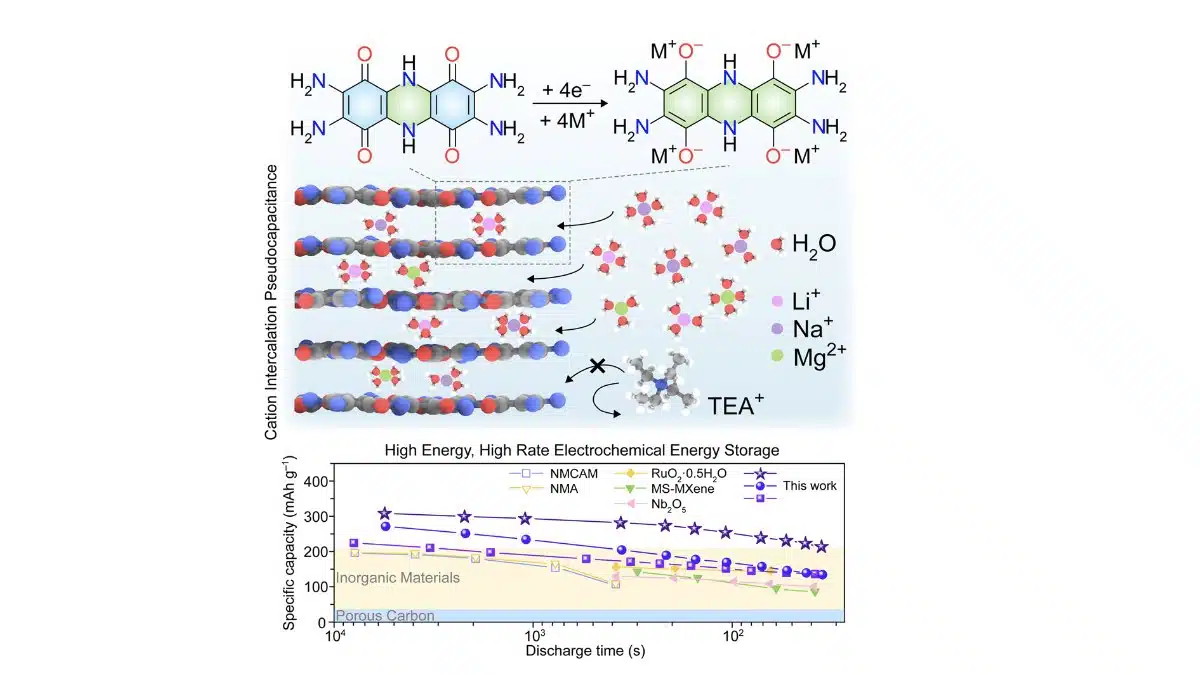
“We report bis-tetraaminobenzoquinone and its polymeric analog poly(bis-tetraaminobenzoquinone) as pseudocapacitive organic materials” for electrical energy storage devices, he said. They “exhibit high charge storage capacities at high charge-discharge rates.”

Abstract

Designing materials for electrochemical energy storage with short charging times and high charge capacities is a longstanding challenge. The fundamental difficulty lies in incorporating a high density of redox couples into a stable material that can efficiently conduct both ions and electrons. We report all-organic, fused aromatic materials that store up to 310 mAh g−1 and charge in as little as 33 s. This performance stems from abundant quinone/imine functionalities that decorate an extended aromatic backbone, act as redox-active sites, engage in hydrogen bonding, and enable a delocalized high-rate energy storage with stability upon cycling. The extended conjugation and hydrogen-bonding-assisted bulk charge storage contrast with the surface-confined or hydration-dependent behavior of traditional inorganic electrodes.

Highlights

  • Fused aromatic molecules with abundant heteroatoms are developed for energy storage
  • Extended conjugation and hydrogen bonding enable rapid conduction of charges
  • pH-dependent pseudocapacitive intercalation charge storage is realized
  • A rare combination of high-capacity, high-rate charge storage is achieved

Reference: Tianyang Chen et al, High-rate, high-capacity electrochemical energy storage in hydrogen-bonded fused aromatics, Joule (2023). DOI: 10.1016/j.joule.2023.03.011

Related

Recent Posts

MLCCs in the Age of AI: Q2 2026 Market Tightness

30.6.2026
19

AI Hardware Demand for Passive Components Dossier

30.6.2026
16

Skeleton Supercapacitor Achieves UL‑certified 3,500 A Peak Current for AI Data Centers

26.6.2026
46

100 V Hybrid Polymer Capacitor from VINA Enesol Targets 48–72 V Power Platforms

26.6.2026
100

Using a Virtual Anode Thermal Model to Evaluate Miniaturization Risk in Tantalum Capacitors

24.6.2026
40

High‑Speed Supercapacitor Balancing for AI Data Center Power Systems

23.6.2026
91

Practical Value of Structural Diagnostics for Tantalum Capacitor Anodes

22.6.2026
34

Knowles Expands High‑Q Ceramic Core Inductors for RF designs

19.6.2026
34

TrendForce: CSP in‑house AI ASIC Boom Reshapes Capacitor Demand

18.6.2026
166

Upcoming Events

Jul 2
17:30 - 18:30 CEST

Can Claude design a production-ready Custom Magnetic Component?

Jul 14
16:00 - 17:00 CEST

EMC Design Essentials: Mastering Varistors and Common Mode Chokes

Jul 21
16:00 - 17:00 CEST

Safety by design: X and Y Interference suppression capacitors for power line filters

View Calendar

Popular Posts

  • Boost Converter Design and Calculation

    0 shares
    Share 0 Tweet 0
  • Buck Converter Design and Calculation

    0 shares
    Share 0 Tweet 0
  • LLC Resonant Converter Design and Calculation

    0 shares
    Share 0 Tweet 0
  • Flyback Converter Design and Calculation

    0 shares
    Share 0 Tweet 0
  • MLCC and Ceramic Capacitors

    0 shares
    Share 0 Tweet 0
  • Nvidia Vera Rubin: Why One AI Rack Needs So Many More MLCC Capacitors

    0 shares
    Share 0 Tweet 0
  • Earthing Systems and IEC Classification Explained

    0 shares
    Share 0 Tweet 0
  • Dual Active Bridge (DAB) Topology

    0 shares
    Share 0 Tweet 0
  • SEPIC Converter Design and Calculation

    0 shares
    Share 0 Tweet 0
  • MLCC Case Sizes Standards Explained

    0 shares
    Share 0 Tweet 0

Newsletter Subscription


Passive Components Blog

© EPCI - Leading Passive Components Educational and Information Site

  • Home
  • Privacy Policy
  • EPCI Membership & Advertisement
  • About

No Result
View All Result
  • Home
  • Knowledge Blog
  • Dossiers
  • PCNS

© EPCI - Leading Passive Components Educational and Information Site

This website uses cookies. By continuing to use this website you are giving consent to cookies being used. Visit our Privacy and Cookie Policy.
Go to mobile version