












Passive Components Blog
No Result
View All Result
  • Home
  • NewsFilter
    • All
    • Aerospace & Defence
    • Antenna
    • Applications
    • Automotive
    • Capacitors
    • Circuit Protection Devices
    • electro-mechanical news
    • Filters
    • Fuses
    • Inductors
    • Industrial
    • Integrated Passives
    • inter-connect news
    • Market & Supply Chain
    • Market Insights
    • Medical
    • Modelling and Simulation
    • New Materials & Supply
    • New Technologies
    • Non-linear Passives
    • Oscillators
    • Passive Sensors News
    • Resistors
    • RF & Microwave
    • Telecommunication
    • Weekly Digest

    Binder Extends NCC Circular Connectors for Harsh Environments

    Standard vs Planar LLC transformers Comparison for Battery Chargers

    Würth Elektronik and Grinn Launch Edge AI Cooperation

    Bourns Expanded Semi-Shielded Low Profile Automotive Power Inductor

    Peak Nano to Develop Fusion Grade High Energy Film Capacitors

    Murata New Vibration Sensor Targets High‑Frequency Predictive Maintenance

    Kyocera Releases 30fs Jitter Differential Clock Oscillator

    Panasonic Expands Automotive PP Film Capacitors Voltage Range

    Panasonic Extends Automotive Power Inductor Line

    Trending Tags

    • Ripple Current
    • RF
    • Leakage Current
    • Tantalum vs Ceramic
    • Snubber
    • Low ESR
    • Feedthrough
    • Derating
    • Dielectric Constant
    • New Products
    • Market Reports
  • VideoFilter
    • All
    • Antenna videos
    • Capacitor videos
    • Circuit Protection Video
    • Filter videos
    • Fuse videos
    • Inductor videos
    • Inter-Connect Video
    • Non-linear passives videos
    • Oscillator videos
    • Passive sensors videos
    • Resistor videos

    Standard vs Planar LLC transformers Comparison for Battery Chargers

    How Modern Tools Model Magnetic Components for Power Electronics

    Advanced Loss Modeling for Planar Magnetics in the Frenetic Planar Tool

    2026 Power Magnetics Design Trends: Flyback, DAB and Planar

    Enabling Software‑Defined Vehicle Architectures: Automotive Ethernet and Zonal Smart Power

    Calculating Resistance Value of a Flyback RC Snubber 

    One‑Pulse Characterization of Nonlinear Power Inductors

    Thermistor Linearization Challenges

    Coaxial Connectors and How to Connect with PCB

    Trending Tags

    • Capacitors explained
    • Inductors explained
    • Resistors explained
    • Filters explained
    • Application Video Guidelines
    • EMC
    • New Products
    • Ripple Current
    • Simulation
    • Tantalum vs Ceramic
  • Knowledge Blog
  • DossiersNew
  • Suppliers
    • Who is Who
  • PCNS
    • PCNS 2025
    • PCNS 2023
    • PCNS 2021
    • PCNS 2019
    • PCNS 2017
  • Events
  • Home
  • NewsFilter
    • All
    • Aerospace & Defence
    • Antenna
    • Applications
    • Automotive
    • Capacitors
    • Circuit Protection Devices
    • electro-mechanical news
    • Filters
    • Fuses
    • Inductors
    • Industrial
    • Integrated Passives
    • inter-connect news
    • Market & Supply Chain
    • Market Insights
    • Medical
    • Modelling and Simulation
    • New Materials & Supply
    • New Technologies
    • Non-linear Passives
    • Oscillators
    • Passive Sensors News
    • Resistors
    • RF & Microwave
    • Telecommunication
    • Weekly Digest

    Binder Extends NCC Circular Connectors for Harsh Environments

    Standard vs Planar LLC transformers Comparison for Battery Chargers

    Würth Elektronik and Grinn Launch Edge AI Cooperation

    Bourns Expanded Semi-Shielded Low Profile Automotive Power Inductor

    Peak Nano to Develop Fusion Grade High Energy Film Capacitors

    Murata New Vibration Sensor Targets High‑Frequency Predictive Maintenance

    Kyocera Releases 30fs Jitter Differential Clock Oscillator

    Panasonic Expands Automotive PP Film Capacitors Voltage Range

    Panasonic Extends Automotive Power Inductor Line

    Trending Tags

    • Ripple Current
    • RF
    • Leakage Current
    • Tantalum vs Ceramic
    • Snubber
    • Low ESR
    • Feedthrough
    • Derating
    • Dielectric Constant
    • New Products
    • Market Reports
  • VideoFilter
    • All
    • Antenna videos
    • Capacitor videos
    • Circuit Protection Video
    • Filter videos
    • Fuse videos
    • Inductor videos
    • Inter-Connect Video
    • Non-linear passives videos
    • Oscillator videos
    • Passive sensors videos
    • Resistor videos

    Standard vs Planar LLC transformers Comparison for Battery Chargers

    How Modern Tools Model Magnetic Components for Power Electronics

    Advanced Loss Modeling for Planar Magnetics in the Frenetic Planar Tool

    2026 Power Magnetics Design Trends: Flyback, DAB and Planar

    Enabling Software‑Defined Vehicle Architectures: Automotive Ethernet and Zonal Smart Power

    Calculating Resistance Value of a Flyback RC Snubber 

    One‑Pulse Characterization of Nonlinear Power Inductors

    Thermistor Linearization Challenges

    Coaxial Connectors and How to Connect with PCB

    Trending Tags

    • Capacitors explained
    • Inductors explained
    • Resistors explained
    • Filters explained
    • Application Video Guidelines
    • EMC
    • New Products
    • Ripple Current
    • Simulation
    • Tantalum vs Ceramic
  • Knowledge Blog
  • DossiersNew
  • Suppliers
    • Who is Who
  • PCNS
    • PCNS 2025
    • PCNS 2023
    • PCNS 2021
    • PCNS 2019
    • PCNS 2017
  • Events
No Result
View All Result
Passive Components Blog
No Result
View All Result

Molex Introduces Modular Wire-to-Wire Automotive Connectors

11.12.2025
Reading Time: 3 mins read
A A

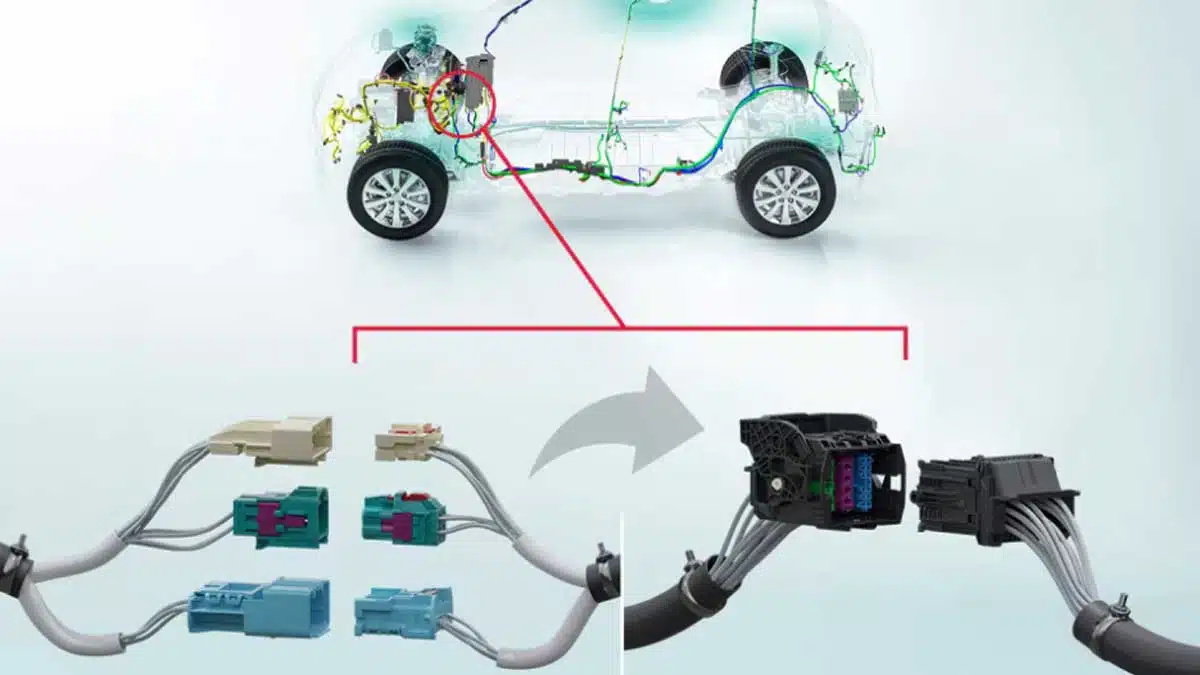
Molex introduces MX-DaSH Modular Wire-to-Wire Connectors, combining power and signal terminals in a single, modular system to reduce wiring harness weight and complexity for automotive zonal architectures. This solution enhances design flexibility and supports global OEMs. 

Molex, a global leader in electronics and connectivity innovation, proudly announces the launch of the MX-DaSH Modular Wire-to-Wire Connectors, the latest addition to its acclaimed MX-DaSH family.

RelatedPosts

Molex Extends Cardinal Multi‑Port Coax Assemblies to 145 GHz for AI and 6G Test

Molex Releases Industry-First Quad-Row Board-to-Board Connectors with EMI Shields

Molex Acquires Smiths Interconnect

These state-of-the-art connectors integrate power, signal, and high-speed data connectivity into a single system, offering unparalleled flexibility and efficiency for automotive design.

The MX-DaSH Modular connectors feature a versatile cartridge-based design housed in a single system, simplifying wiring and harness architecture. This innovation enhances automotive design flexibility, adaptability, and scalability across various vehicle models and applications.

“MX-DaSH Modular Wire-to-Wire Connectors address critical challenges in today’s automotive design processes, driven by rapid changes in electrical and electronic requirements,” stated Scott Whicker, Senior Vice President and President of Transportation Innovative Solutions at Molex. “Our cartridge-based design facilitates easy function mixing and reconfiguration, enabling faster development cycles and cost reductions.”

Designed for Zonal Architectures

Each MX-DaSH Modular connector is built on an unsealed, cartridge-based hybrid connectivity platform, consolidating multiple connectors and connection types into one. This approach reduces the number of unique parts, offering unmatched freedom to tackle specific automotive design challenges, accelerate upgrades, and significantly cut design and tooling time.

The “building block” approach optimizes vehicle harnesses, leading to substantial weight, size, and cost savings. Tailored for zonal architectures, MX-DaSH Modular connectors are perfect for high-content connection points, such as instrument panel-to-body harness connections, seat power and signal connections, and electrical/electronic architecture components. Engineers can easily change cartridges within the housing, allowing for seamless feature additions or pin and cartridge swaps to meet evolving architecture needs.

Global Adoption and Chinese Market Impact

Localized manufacturing and compatibility with industry-standard terminals are driving global adoption of MX-DaSH Modular connectors, while mitigating global supply chain challenges. The connectors adhere to USCAR2 performance specifications for automotive electrical connector systems and USCAR49 specifications for miniature automotive coaxial connectors.

China, the largest automotive market and a hub for innovation in electric vehicles (EVs) and Advanced Driver-Assistance Systems (ADAS), is a key testing ground for next-generation automotive technologies, including Molex solutions. A regional version of the MX-DaSH Modular connector will be featured in MY26 cars in China, addressing the unique cost, packaging, and expedited time-to-market requirements of Chinese automotive OEMs.

Additionally, other automotive manufacturers in North America and Europe are deploying these new modular connectors, with MY28 vehicle designs expected to incorporate MX-DaSH Modular Wire-to-Wire and Wire-to-Board Connectors.

Automation-Friendly and Reliability-Focused

The MX-DaSH Modular connector’s automation-friendly design supports precise automated assembly operations, enhancing manufacturing efficiency and quality while reducing labor costs. Positive-locking features, blade stabilization, and vibration resistance further enhance reliability by preventing inadvertent disconnection in demanding automotive environments. Molex’s robust engineering support, extensive quality control, and range of versatile, customizable solutions solidify its role as a unique resource for improving vehicle wiring performance and reliability.

Product Availability

Molex MX-DaSH Modular Wire-to-Wire Connectors are now available, offering unprecedented design freedom and flexibility to meet the rapidly increasing data, power, and high-speed signal requirements in today’s vehicles. The connectors support a maximum pin count of 70 circuits, with the following maximum circuit counts per cartridge: 26 circuits for 0.50mm (CTX50) cartridges, 14 circuits for 1.20mm cartridges, 4 circuits for 2.80mm cartridges, and 3 circuits for 4.80 and 6.30mm cartridges.

Related

Source: Molex

Recent Posts

Binder Extends NCC Circular Connectors for Harsh Environments

13.3.2026
1

Samtec ANSI/VITA 90 Connectors: Rugged Small Form Factor Standard

5.3.2026
10

Molex Extends Cardinal Multi‑Port Coax Assemblies to 145 GHz for AI and 6G Test

25.2.2026
13

Earthing Systems and IEC Classification Explained

26.2.2026
142

Smiths Interconnect invests £2m in Costa Rica electronics plant

23.2.2026
14

Würth Elektronik Introduces Lead-Free SMT Spacers

11.2.2026
47

Top 10 Connector Vendors by Product Type

29.1.2026
131

Binder Unveils M8 Flange Solder Connectors for Flexible Cabling

28.1.2026
23

Coaxial Connectors and How to Connect with PCB

17.12.2025
351

Upcoming Events

Mar 19
13:00 - 14:00 CDT

Smart Consideration of Inductor Thermal Performance

Mar 21
All day

PSMA Capacitor Workshop 2026

Apr 21
16:00 - 17:00 CEST

Heatsink Solutions: Thermal Management in electronic devices

View Calendar

Popular Posts

  • Buck Converter Design and Calculation

    0 shares
    Share 0 Tweet 0
  • Boost Converter Design and Calculation

    0 shares
    Share 0 Tweet 0
  • Flyback Converter Design and Calculation

    0 shares
    Share 0 Tweet 0
  • LLC Resonant Converter Design and Calculation

    0 shares
    Share 0 Tweet 0
  • MLCC Manufacturers Consider Price Increase as AI Demand Outpaces Supply

    0 shares
    Share 0 Tweet 0
  • Dual Active Bridge (DAB) Topology

    0 shares
    Share 0 Tweet 0
  • Ripple Current and its Effects on the Performance of Capacitors

    3 shares
    Share 3 Tweet 0
  • MLCC and Ceramic Capacitors

    0 shares
    Share 0 Tweet 0
  • MLCC Case Sizes Standards Explained

    0 shares
    Share 0 Tweet 0
  • 3-Phase EMI Filter Design, Simulation, Calculation and Test

    0 shares
    Share 0 Tweet 0

Newsletter Subscription


Passive Components Blog

© EPCI - Leading Passive Components Educational and Information Site

  • Home
  • Privacy Policy
  • EPCI Membership & Advertisement
  • About

No Result
View All Result
  • Home
  • Knowledge Blog
  • PCNS

© EPCI - Leading Passive Components Educational and Information Site

This website uses cookies. By continuing to use this website you are giving consent to cookies being used. Visit our Privacy and Cookie Policy.
Go to mobile version