



Passive Components Blog
No Result
View All Result
  • Home
  • NewsFilter
    • All
    • Aerospace & Defence
    • Antenna
    • Applications
    • Automotive
    • Capacitors
    • Circuit Protection Devices
    • electro-mechanical news
    • Filters
    • Fuses
    • Inductors
    • Industrial
    • Integrated Passives
    • inter-connect news
    • Market & Supply Chain
    • Market Insights
    • Medical
    • Modelling and Simulation
    • New Materials & Supply
    • New Technologies
    • Non-linear Passives
    • Oscillators
    • Passive Sensors News
    • Resistors
    • RF & Microwave
    • Telecommunication
    • Weekly Digest

    Rubycon PMLCAP DC‑Link Film Capacitors in Mass Production

    Bourns SSD‑1000A AEC‑Q Digital Current Sensors

    YAGEO High‑Capacitance X7R Automotive MLCC Extensions

    How Metal Prices Are Driving Passive Component Price Hikes

    Modelithics COMPLETE Library v25.8 for Keysight ADS

    Taiyo Yuden Releases 165C Automotive Multilayer Metal Power Inductor in 1608 Size

    Energy-Controlled Structural Evolution of Amorphous Ta₂O₅ in Tantalum Anodes

    Jianghai Vibration‑Resistant Aluminum Capacitors Guidelines for Industrial Electronics

    2025 Top Passive Components Blog Articles

    Trending Tags

    • Ripple Current
    • RF
    • Leakage Current
    • Tantalum vs Ceramic
    • Snubber
    • Low ESR
    • Feedthrough
    • Derating
    • Dielectric Constant
    • New Products
    • Market Reports
  • VideoFilter
    • All
    • Antenna videos
    • Capacitor videos
    • Circuit Protection Video
    • Filter videos
    • Fuse videos
    • Inductor videos
    • Inter-Connect Video
    • Non-linear passives videos
    • Oscillator videos
    • Passive sensors videos
    • Resistor videos

    One‑Pulse Characterization of Nonlinear Power Inductors

    Thermistor Linearization Challenges

    Coaxial Connectors and How to Connect with PCB

    PCB Manufacturing, Test Methods, Quality and Reliability

    Transformer Behavior – Current Transfer and Hidden Feedback

    Choosing the Right Capacitor: The Importance of Accurate Measurements

    RF Inductors: Selection and Design Challenges for High-Frequency Circuits

    Transformer Safety IEC 61558 Standard

    3-Phase EMI Filter Design, Simulation, Calculation and Test

    Trending Tags

    • Capacitors explained
    • Inductors explained
    • Resistors explained
    • Filters explained
    • Application Video Guidelines
    • EMC
    • New Products
    • Ripple Current
    • Simulation
    • Tantalum vs Ceramic
  • Knowledge Blog
  • Suppliers
    • Who is Who
  • PCNS
    • PCNS 2025
    • PCNS 2023
    • PCNS 2021
    • PCNS 2019
    • PCNS 2017
  • Events
  • Home
  • NewsFilter
    • All
    • Aerospace & Defence
    • Antenna
    • Applications
    • Automotive
    • Capacitors
    • Circuit Protection Devices
    • electro-mechanical news
    • Filters
    • Fuses
    • Inductors
    • Industrial
    • Integrated Passives
    • inter-connect news
    • Market & Supply Chain
    • Market Insights
    • Medical
    • Modelling and Simulation
    • New Materials & Supply
    • New Technologies
    • Non-linear Passives
    • Oscillators
    • Passive Sensors News
    • Resistors
    • RF & Microwave
    • Telecommunication
    • Weekly Digest

    Rubycon PMLCAP DC‑Link Film Capacitors in Mass Production

    Bourns SSD‑1000A AEC‑Q Digital Current Sensors

    YAGEO High‑Capacitance X7R Automotive MLCC Extensions

    How Metal Prices Are Driving Passive Component Price Hikes

    Modelithics COMPLETE Library v25.8 for Keysight ADS

    Taiyo Yuden Releases 165C Automotive Multilayer Metal Power Inductor in 1608 Size

    Energy-Controlled Structural Evolution of Amorphous Ta₂O₅ in Tantalum Anodes

    Jianghai Vibration‑Resistant Aluminum Capacitors Guidelines for Industrial Electronics

    2025 Top Passive Components Blog Articles

    Trending Tags

    • Ripple Current
    • RF
    • Leakage Current
    • Tantalum vs Ceramic
    • Snubber
    • Low ESR
    • Feedthrough
    • Derating
    • Dielectric Constant
    • New Products
    • Market Reports
  • VideoFilter
    • All
    • Antenna videos
    • Capacitor videos
    • Circuit Protection Video
    • Filter videos
    • Fuse videos
    • Inductor videos
    • Inter-Connect Video
    • Non-linear passives videos
    • Oscillator videos
    • Passive sensors videos
    • Resistor videos

    One‑Pulse Characterization of Nonlinear Power Inductors

    Thermistor Linearization Challenges

    Coaxial Connectors and How to Connect with PCB

    PCB Manufacturing, Test Methods, Quality and Reliability

    Transformer Behavior – Current Transfer and Hidden Feedback

    Choosing the Right Capacitor: The Importance of Accurate Measurements

    RF Inductors: Selection and Design Challenges for High-Frequency Circuits

    Transformer Safety IEC 61558 Standard

    3-Phase EMI Filter Design, Simulation, Calculation and Test

    Trending Tags

    • Capacitors explained
    • Inductors explained
    • Resistors explained
    • Filters explained
    • Application Video Guidelines
    • EMC
    • New Products
    • Ripple Current
    • Simulation
    • Tantalum vs Ceramic
  • Knowledge Blog
  • Suppliers
    • Who is Who
  • PCNS
    • PCNS 2025
    • PCNS 2023
    • PCNS 2021
    • PCNS 2019
    • PCNS 2017
  • Events
No Result
View All Result
Passive Components Blog
No Result
View All Result

Murata Announces Mass Manufacturing of World’s First 0402 47µF MLCC

10.7.2025
Reading Time: 2 mins read
A A

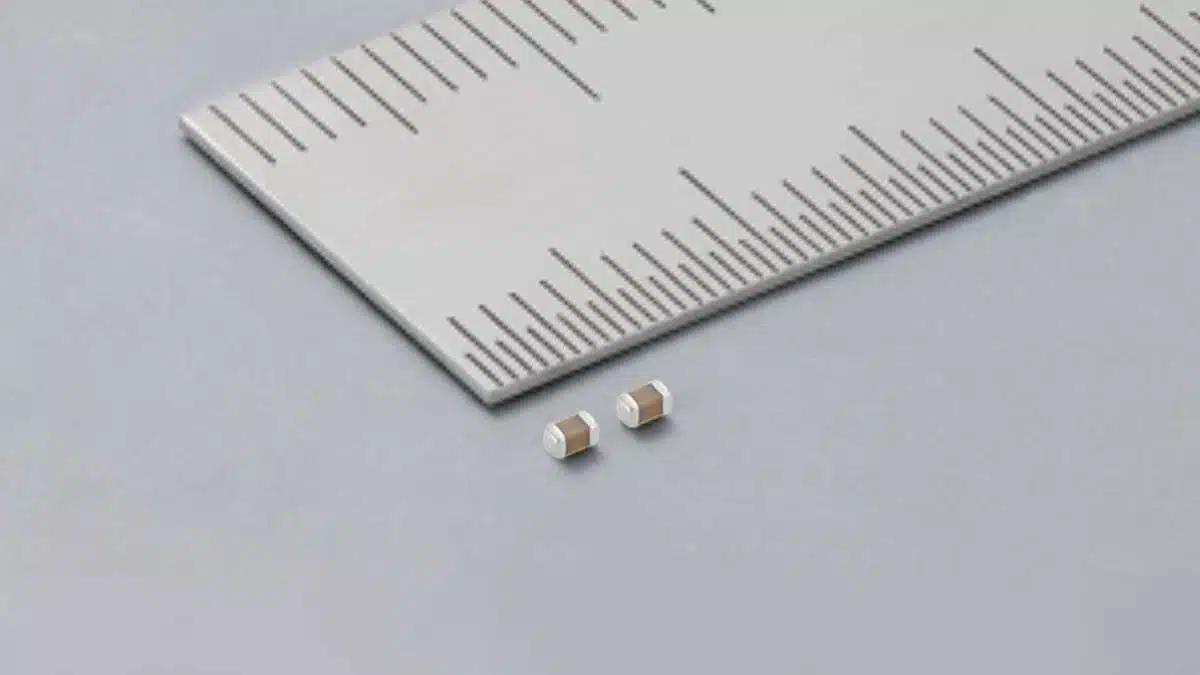
Murata Manufacturing Co., Ltd. has begun the world’s first mass production of the 0402-inch size (1.0 × 0.5 mm) multilayer ceramic capacitors (MLCC) with a capacitance of 47µF.

The new product line, available in two variants with different temperature characteristics, is designed to advance MLCC miniaturization and enhance customer system performance.

RelatedPosts

Murata Releases World’s First Inner Cavity-Structure Ultra-Low-Loss LCP Flexible Substrate

Murata Releases World First 15nF 1.25kV C0G MLCC in 1210 Size

Murata Expands High Rel NTC Thermistors in Compact 0603M Size

In recent years, high-performance IT solutions, such as those used in AI servers and data centers, have seen rapid growth. Due to the often high component density demanded by these devices, optimized component placement within limited PCB areas is paramount.

As a result, there is increasing demand for capacitors that offer both miniaturization and higher capacitance, along with high reliability under high-temperature conditions caused by heat generated from PCBs and integrated circuits (ICs).

In response to these requirements, Murata has utilized its proprietary technologies in ceramic dielectric layers and internal electrode miniaturization to facilitate the world’s first mass production of this innovative 47µF product in the compact 0402-inch size.

Compared to Murata’s conventional 0603-inch size product with the same capacitance, this new capacitor reduces mounting area by approximately 60%. Additionally, it delivers about 2.1 times the capacitance of Murata’s previous 22µF product in the same 0402-inch size. 

The MLCC is available in two variants – the X5R (EIA) GRM158R60E476ME01 with an operating temperature range of -55 to +85°C, and the X6S (EIA) GRM158C80E476ME01 with an operating temperature range of -55 to +105°C.

The ability to operate in environments up to 105°C, makes the X6S variant well-suited for placement near ICs, thereby contributing to improved device performance and integration. Both devices feature a ±20% tolerance and rated voltage of 2.5Vdc.

Murata is committed to advancing miniaturized capacitors with higher capacitance and improved high-temperature reliability to meet evolving market demands. These innovations not only support the ongoing miniaturization and functional enhancement of electronic devices but also contribute to lower material usage and increased production efficiency per unit, ultimately helping reduce power consumption at Murata’s factories and lessen environmental impact.

Related

Source: Murata

Recent Posts

Rubycon PMLCAP DC‑Link Film Capacitors in Mass Production

9.1.2026
16

YAGEO High‑Capacitance X7R Automotive MLCC Extensions

8.1.2026
35

How Metal Prices Are Driving Passive Component Price Hikes

8.1.2026
124

Modelithics COMPLETE Library v25.8 for Keysight ADS

7.1.2026
23

Energy-Controlled Structural Evolution of Amorphous Ta₂O₅ in Tantalum Anodes

6.1.2026
40

Jianghai Vibration‑Resistant Aluminum Capacitors Guidelines for Industrial Electronics

6.1.2026
25

2025 Top Passive Components Blog Articles

5.1.2026
84

Exxelia Releases Custom Smart Integrated Magnetics for Space Applications

5.1.2026
39
Credit: Institute of Science Tokyo

Researchers Demonstrated 30nm Ferroelectric Capacitor for Compact Memory

2.1.2026
31

Upcoming Events

Jan 27
16:00 - 17:00 CET

Simplifying Vehicle Development with Automotive Ethernet and Zonal Smart Switch Technologies

Feb 24
16:00 - 17:00 CET

Designing Qi2 Wireless Power Systems: Practical Development and EMC Optimization

View Calendar

Popular Posts

  • Buck Converter Design and Calculation

    0 shares
    Share 0 Tweet 0
  • Boost Converter Design and Calculation

    0 shares
    Share 0 Tweet 0
  • LLC Resonant Converter Design and Calculation

    0 shares
    Share 0 Tweet 0
  • Flyback Converter Design and Calculation

    0 shares
    Share 0 Tweet 0
  • Ripple Current and its Effects on the Performance of Capacitors

    3 shares
    Share 3 Tweet 0
  • What Electronics Engineer Needs to Know About Passive Low Pass Filters

    0 shares
    Share 0 Tweet 0
  • MLCC and Ceramic Capacitors

    0 shares
    Share 0 Tweet 0
  • Dual Active Bridge (DAB) Topology

    0 shares
    Share 0 Tweet 0
  • SEPIC Converter Design and Calculation

    0 shares
    Share 0 Tweet 0
  • Core Materials, Permeability and Their Losses

    0 shares
    Share 0 Tweet 0

Newsletter Subscription


Passive Components Blog

© EPCI - Leading Passive Components Educational and Information Site

  • Home
  • Privacy Policy
  • EPCI Membership & Advertisement
  • About

No Result
View All Result
  • Home
  • Knowledge Blog
  • PCNS

© EPCI - Leading Passive Components Educational and Information Site

This website uses cookies. By continuing to use this website you are giving consent to cookies being used. Visit our Privacy and Cookie Policy.
Go to mobile version