












Passive Components Blog
No Result
View All Result
  • Home
  • NewsFilter
    • All
    • Aerospace & Defence
    • Antenna
    • Applications
    • Automotive
    • Capacitors
    • Circuit Protection Devices
    • electro-mechanical news
    • Filters
    • Fuses
    • Inductors
    • Industrial
    • Integrated Passives
    • inter-connect news
    • Market & Supply Chain
    • Market Insights
    • Medical
    • Modelling and Simulation
    • New Materials & Supply
    • New Technologies
    • Non-linear Passives
    • Oscillators
    • Passive Sensors News
    • Resistors
    • RF & Microwave
    • Telecommunication
    • Weekly Digest

    Smoltek CNF-MIM Capacitors Hit 1,000x Lower Leakage

    DigiKey Expands Line Card with 108K Stock Parts and 364 Suppliers

    Würth Elektronik Announces Partner Program

    Vishay Releases Compact 0806 Low‑DCR Power Inductor

    Murata Opens New Ceramic Capacitor Manufacturing and R&D Center in Japan

    Murata Publishes Power Delivery Guide for AI Servers

    Selecting Current Sense Transformers with Würth Elektronik REDEXPERT

    Mechanical Drift Indicator of Tantalum Capacitor Anodes Degradation under Reverse Bias

    Enabling Software‑Defined Vehicle Architectures: Automotive Ethernet and Zonal Smart Power

    Trending Tags

    • Ripple Current
    • RF
    • Leakage Current
    • Tantalum vs Ceramic
    • Snubber
    • Low ESR
    • Feedthrough
    • Derating
    • Dielectric Constant
    • New Products
    • Market Reports
  • VideoFilter
    • All
    • Antenna videos
    • Capacitor videos
    • Circuit Protection Video
    • Filter videos
    • Fuse videos
    • Inductor videos
    • Inter-Connect Video
    • Non-linear passives videos
    • Oscillator videos
    • Passive sensors videos
    • Resistor videos

    Enabling Software‑Defined Vehicle Architectures: Automotive Ethernet and Zonal Smart Power

    Calculating Resistance Value of a Flyback RC Snubber 

    One‑Pulse Characterization of Nonlinear Power Inductors

    Thermistor Linearization Challenges

    Coaxial Connectors and How to Connect with PCB

    PCB Manufacturing, Test Methods, Quality and Reliability

    Transformer Behavior – Current Transfer and Hidden Feedback

    Choosing the Right Capacitor: The Importance of Accurate Measurements

    RF Inductors: Selection and Design Challenges for High-Frequency Circuits

    Trending Tags

    • Capacitors explained
    • Inductors explained
    • Resistors explained
    • Filters explained
    • Application Video Guidelines
    • EMC
    • New Products
    • Ripple Current
    • Simulation
    • Tantalum vs Ceramic
  • Knowledge Blog
  • DossiersNew
  • Suppliers
    • Who is Who
  • PCNS
    • PCNS 2025
    • PCNS 2023
    • PCNS 2021
    • PCNS 2019
    • PCNS 2017
  • Events
  • Home
  • NewsFilter
    • All
    • Aerospace & Defence
    • Antenna
    • Applications
    • Automotive
    • Capacitors
    • Circuit Protection Devices
    • electro-mechanical news
    • Filters
    • Fuses
    • Inductors
    • Industrial
    • Integrated Passives
    • inter-connect news
    • Market & Supply Chain
    • Market Insights
    • Medical
    • Modelling and Simulation
    • New Materials & Supply
    • New Technologies
    • Non-linear Passives
    • Oscillators
    • Passive Sensors News
    • Resistors
    • RF & Microwave
    • Telecommunication
    • Weekly Digest

    Smoltek CNF-MIM Capacitors Hit 1,000x Lower Leakage

    DigiKey Expands Line Card with 108K Stock Parts and 364 Suppliers

    Würth Elektronik Announces Partner Program

    Vishay Releases Compact 0806 Low‑DCR Power Inductor

    Murata Opens New Ceramic Capacitor Manufacturing and R&D Center in Japan

    Murata Publishes Power Delivery Guide for AI Servers

    Selecting Current Sense Transformers with Würth Elektronik REDEXPERT

    Mechanical Drift Indicator of Tantalum Capacitor Anodes Degradation under Reverse Bias

    Enabling Software‑Defined Vehicle Architectures: Automotive Ethernet and Zonal Smart Power

    Trending Tags

    • Ripple Current
    • RF
    • Leakage Current
    • Tantalum vs Ceramic
    • Snubber
    • Low ESR
    • Feedthrough
    • Derating
    • Dielectric Constant
    • New Products
    • Market Reports
  • VideoFilter
    • All
    • Antenna videos
    • Capacitor videos
    • Circuit Protection Video
    • Filter videos
    • Fuse videos
    • Inductor videos
    • Inter-Connect Video
    • Non-linear passives videos
    • Oscillator videos
    • Passive sensors videos
    • Resistor videos

    Enabling Software‑Defined Vehicle Architectures: Automotive Ethernet and Zonal Smart Power

    Calculating Resistance Value of a Flyback RC Snubber 

    One‑Pulse Characterization of Nonlinear Power Inductors

    Thermistor Linearization Challenges

    Coaxial Connectors and How to Connect with PCB

    PCB Manufacturing, Test Methods, Quality and Reliability

    Transformer Behavior – Current Transfer and Hidden Feedback

    Choosing the Right Capacitor: The Importance of Accurate Measurements

    RF Inductors: Selection and Design Challenges for High-Frequency Circuits

    Trending Tags

    • Capacitors explained
    • Inductors explained
    • Resistors explained
    • Filters explained
    • Application Video Guidelines
    • EMC
    • New Products
    • Ripple Current
    • Simulation
    • Tantalum vs Ceramic
  • Knowledge Blog
  • DossiersNew
  • Suppliers
    • Who is Who
  • PCNS
    • PCNS 2025
    • PCNS 2023
    • PCNS 2021
    • PCNS 2019
    • PCNS 2017
  • Events
No Result
View All Result
Passive Components Blog
No Result
View All Result

Powerbox’s S-CAP supercapacitor BOOST technology delivers power and safety to industrial and medical applications

14.6.2018
Reading Time: 2 mins read
A A

Source: Powerbox news

Powerbox, one of Europe’s largest power supply companies, and for more than four decades a leading force in optimizing power solutions for demanding applications, announces the introduction of its supercapacitor boost technology, S-CAP BOOST, offering backup and peak power solutions to industrial and medical applications.

RelatedPosts

Smoltek CNF-MIM Capacitors Hit 1,000x Lower Leakage

DigiKey Expands Line Card with 108K Stock Parts and 364 Suppliers

Würth Elektronik Announces Partner Program

Based on the latest supercapacitor technology combined with intelligent control and monitoring, S-CAP BOOST offers a solution to equipment manufacturers requiring high energy peaks for short periods or emergency backup purposes in applications where due to safety regulations, Lithium Ion or acid batteries are not allowed. Depending on the application, S-CAP BOOST can be configured to charge and monitor supercapacitor banks to work as UPS, delivering backup power to allow safety operations to take place before shutdown or delivering high peak power for a short period without disturbing the main source or discharging/damaging the system battery in applications such as laser, electric motor booster or X-ray emission element.

Critical applications operating in hostile or confined environments are strictly regulated in terms of chemical and other hazardous risks, reducing or forbidding certain type of batteries such as Lithium Ion. For safety reasons, those applications must have a power backup long enough to run alarms and safety shutdown processes. In such arduous conditions conventional batteries are replaced by supercapacitor banks whose values could be from few Farads to 200 Farads for general applications, but up to container size in the case of large systems. S-CAP BOOST technology tightly controls vital parameters, from a single 2.8V cell supercapacitor to a wide range of assemblies delivering a specific voltage and energy required for a given application.

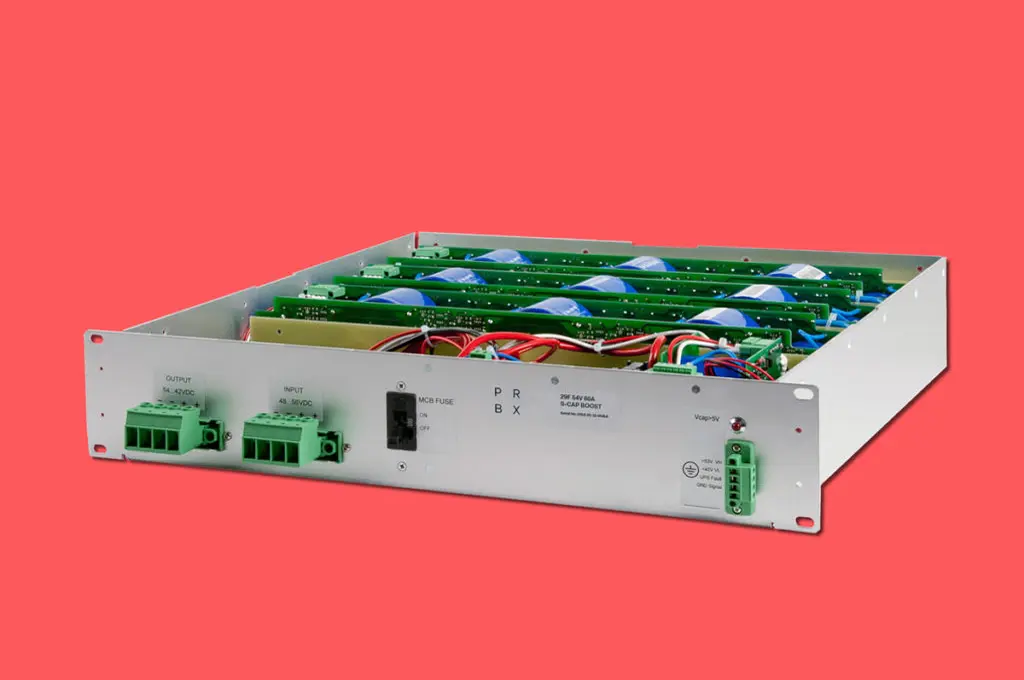
One example of a product built using Powerbox’s S-CAP BOOST technology is a 2500W backup unit developed for an industrial process-control computer installed in a very restricted area. Housed in a 19 inch 2U chassis, the 29F-54V-60A integrates 22 supercapacitors totaling 29 Farads and has a capacity of 2500W during 5 seconds at full load and 30 seconds at half-load. To optimize the cells charge, the 29F-54V-60A integrates a DC/DC converter with current control, guaranteeing the supercapacitors are properly charged to deliver full power when required. The unit includes active charging cells control with load balancing, cell health monitoring and alarms. Alarms signals including Vcell-high, Vcell-low, Vcell-zero and temperature are available via a physical interface, with digital control and monitoring being an alternative option.

“The number of applications requiring emergency backup or high peak current are growing, and integrating supercapacitors within power supplies is becoming an extremely reliable and well suited option to be considered by system architects.” said Patrick Le Fèvre, Powerbox’s Chief Marketing and Communication Officer. “Powerbox’s S-CAP BOOST is a great platform for the future and we foresee an impressive number of applications for supercapacitor energy storage technology, and not only for electrical vehicles.”

Compared to Lithium Ion which has a cyclability (number of recharges) of 500 to 1,000, supercapacitors can sustain from 500,000 to 20,000,000 cycles, making that technology extremely relevant for applications requiring large amounts of charge /discharge cycles with high energy such as industrial or medical lasers. This is what S-CAP BOOST technology has been developed for, very tight control of the supercapacitors’ charge in order to optimize the energy stored between each cycle, with very high levels of safety and reliability.

featured image: Housed within a 19” 2U chassis, the 29F-54V-60A integrates 22 supercapacitors, totalizing 29 Farad and a capacity of 2500W. image credit: Powerbox


 

Related

Recent Posts

Smoltek CNF-MIM Capacitors Hit 1,000x Lower Leakage

6.2.2026
4

Vishay Releases Compact 0806 Low‑DCR Power Inductor

5.2.2026
20

Murata Opens New Ceramic Capacitor Manufacturing and R&D Center in Japan

5.2.2026
53

Murata Publishes Power Delivery Guide for AI Servers

4.2.2026
74

Mechanical Drift Indicator of Tantalum Capacitor Anodes Degradation under Reverse Bias

3.2.2026
33

Enabling Software‑Defined Vehicle Architectures: Automotive Ethernet and Zonal Smart Power

2.2.2026
26

CMSE 2026 Announces Call for Presentations on High-Reliability Military and Space Electronics

28.1.2026
50

ESA Call for Papers 6th Space Passive Component Days – SPCD 2026

28.1.2026
43

Binder Unveils M8 Flange Solder Connectors for Flexible Cabling

28.1.2026
18

Upcoming Events

Feb 11
16:00 - 17:00 CET

What’s Next in Power Electronics Design

Feb 24
16:00 - 17:00 CET

Designing Qi2 Wireless Power Systems: Practical Development and EMC Optimization

Mar 3
16:00 - 17:00 CET

Cybersecurity at the Eleventh Hour – from RED to CRA – Information and Discussion

View Calendar

Popular Posts

  • Buck Converter Design and Calculation

    0 shares
    Share 0 Tweet 0
  • Boost Converter Design and Calculation

    0 shares
    Share 0 Tweet 0
  • LLC Resonant Converter Design and Calculation

    0 shares
    Share 0 Tweet 0
  • Flyback Converter Design and Calculation

    0 shares
    Share 0 Tweet 0
  • Ripple Current and its Effects on the Performance of Capacitors

    3 shares
    Share 3 Tweet 0
  • MLCC and Ceramic Capacitors

    0 shares
    Share 0 Tweet 0
  • Dual Active Bridge (DAB) Topology

    0 shares
    Share 0 Tweet 0
  • How Metal Prices Are Driving Passive Component Price Hikes

    0 shares
    Share 0 Tweet 0
  • What is a Dielectric Constant and DF of Plastic Materials?

    4 shares
    Share 4 Tweet 0
  • MLCC Case Sizes Standards Explained

    0 shares
    Share 0 Tweet 0

Newsletter Subscription


Passive Components Blog

© EPCI - Leading Passive Components Educational and Information Site

  • Home
  • Privacy Policy
  • EPCI Membership & Advertisement
  • About

No Result
View All Result
  • Home
  • Knowledge Blog
  • PCNS

© EPCI - Leading Passive Components Educational and Information Site

This website uses cookies. By continuing to use this website you are giving consent to cookies being used. Visit our Privacy and Cookie Policy.
Go to mobile version