




Passive Components Blog
No Result
View All Result
  • Home
  • NewsFilter
    • All
    • Aerospace & Defence
    • Antenna
    • Applications
    • Automotive
    • Capacitors
    • Circuit Protection Devices
    • electro-mechanical news
    • Filters
    • Fuses
    • Inductors
    • Industrial
    • Integrated Passives
    • inter-connect news
    • Market & Supply Chain
    • Market Insights
    • Medical
    • Modelling and Simulation
    • New Materials & Supply
    • New Technologies
    • Non-linear Passives
    • Oscillators
    • Passive Sensors News
    • Resistors
    • RF & Microwave
    • Telecommunication
    • Weekly Digest

    Bourns Introduces Automotive BMS Signal Transformer with Integrated Common Mode Chokes

    Itelcond Introduces High‑Voltage Aluminium Capacitors for Modern IGBT DC‑links

    Bourns Introduces Automotive Shielded Power Inductors for Compact DC‑DC Converters

    EMC Design Fundamentals: Safe Use of Varistors and Common Mode Chokes in Mains and Data-Line Filters

    Murata Unveils Lead Disc Ceramic Capacitors for Automotive Safety and EMI Suppression

    SCHURTER Releases Intelligent Three‑Terminal Fuses for Safer Li‑ion Battery Systems

    Can Copper Conductive Inks Displace Silver in Hybrid Electronics?

    Square-Wave Harmonics and RMS Currents in Power Converters

    LeanBOM: Practical Cross‑Technology Capacitor Search by Real Working Conditions

    Trending Tags

    • Ripple Current
    • RF
    • Leakage Current
    • Tantalum vs Ceramic
    • Snubber
    • Low ESR
    • Feedthrough
    • Derating
    • Dielectric Constant
    • New Products
    • Market Reports
  • VideoFilter
    • All
    • Antenna videos
    • Capacitor videos
    • Circuit Protection Video
    • Filter videos
    • Fuse videos
    • Inductor videos
    • Inter-Connect Video
    • Non-linear passives videos
    • Oscillator videos
    • Passive sensors videos
    • Resistor videos

    EMC Design Fundamentals: Safe Use of Varistors and Common Mode Chokes in Mains and Data-Line Filters

    Ferrite versus Nanocrystalline Power Inductor Cores: Turns, Gap and Size

    KYOCERA AVX Presents Antenna Integrator Studio Tutorial for Antenna Placement and RF Design

    Power Design Simulation Tools for Faster Inductor Selection and Loss Optimization

    EMC‑Compliant PCB and Connector Design Guidelines

    Why Isolated DC/DC Power Supplies Fail Late, Würth Elektronik Podcast

    Designing 800 V DC EMC Filters: Calculation, Simulation and Measurement

    Current Sense Transformer Datasheet and Design‑in Guide

    Designing a USB Type‑C Flyback Planar Transformer with Frenetic’s Planar Tool

    Trending Tags

    • Capacitors explained
    • Inductors explained
    • Resistors explained
    • Filters explained
    • Application Video Guidelines
    • EMC
    • New Products
    • Ripple Current
    • Simulation
    • Tantalum vs Ceramic
  • Knowledge Blog
  • Dossiers
    • AI Hardware Dossier
    • Power Converter Dossier
    • Automotive Dossier
    • Capacitor Dossier
    • Resistor Dossier
    • Inductor Dossier
    • Circuit Protection Dossier
  • Suppliers
    • Who is Who
  • PCNS
    • PCNS 2025
    • PCNS 2023
    • PCNS 2021
    • PCNS 2019
    • PCNS 2017
  • Events
  • Home
  • NewsFilter
    • All
    • Aerospace & Defence
    • Antenna
    • Applications
    • Automotive
    • Capacitors
    • Circuit Protection Devices
    • electro-mechanical news
    • Filters
    • Fuses
    • Inductors
    • Industrial
    • Integrated Passives
    • inter-connect news
    • Market & Supply Chain
    • Market Insights
    • Medical
    • Modelling and Simulation
    • New Materials & Supply
    • New Technologies
    • Non-linear Passives
    • Oscillators
    • Passive Sensors News
    • Resistors
    • RF & Microwave
    • Telecommunication
    • Weekly Digest

    Bourns Introduces Automotive BMS Signal Transformer with Integrated Common Mode Chokes

    Itelcond Introduces High‑Voltage Aluminium Capacitors for Modern IGBT DC‑links

    Bourns Introduces Automotive Shielded Power Inductors for Compact DC‑DC Converters

    EMC Design Fundamentals: Safe Use of Varistors and Common Mode Chokes in Mains and Data-Line Filters

    Murata Unveils Lead Disc Ceramic Capacitors for Automotive Safety and EMI Suppression

    SCHURTER Releases Intelligent Three‑Terminal Fuses for Safer Li‑ion Battery Systems

    Can Copper Conductive Inks Displace Silver in Hybrid Electronics?

    Square-Wave Harmonics and RMS Currents in Power Converters

    LeanBOM: Practical Cross‑Technology Capacitor Search by Real Working Conditions

    Trending Tags

    • Ripple Current
    • RF
    • Leakage Current
    • Tantalum vs Ceramic
    • Snubber
    • Low ESR
    • Feedthrough
    • Derating
    • Dielectric Constant
    • New Products
    • Market Reports
  • VideoFilter
    • All
    • Antenna videos
    • Capacitor videos
    • Circuit Protection Video
    • Filter videos
    • Fuse videos
    • Inductor videos
    • Inter-Connect Video
    • Non-linear passives videos
    • Oscillator videos
    • Passive sensors videos
    • Resistor videos

    EMC Design Fundamentals: Safe Use of Varistors and Common Mode Chokes in Mains and Data-Line Filters

    Ferrite versus Nanocrystalline Power Inductor Cores: Turns, Gap and Size

    KYOCERA AVX Presents Antenna Integrator Studio Tutorial for Antenna Placement and RF Design

    Power Design Simulation Tools for Faster Inductor Selection and Loss Optimization

    EMC‑Compliant PCB and Connector Design Guidelines

    Why Isolated DC/DC Power Supplies Fail Late, Würth Elektronik Podcast

    Designing 800 V DC EMC Filters: Calculation, Simulation and Measurement

    Current Sense Transformer Datasheet and Design‑in Guide

    Designing a USB Type‑C Flyback Planar Transformer with Frenetic’s Planar Tool

    Trending Tags

    • Capacitors explained
    • Inductors explained
    • Resistors explained
    • Filters explained
    • Application Video Guidelines
    • EMC
    • New Products
    • Ripple Current
    • Simulation
    • Tantalum vs Ceramic
  • Knowledge Blog
  • Dossiers
    • AI Hardware Dossier
    • Power Converter Dossier
    • Automotive Dossier
    • Capacitor Dossier
    • Resistor Dossier
    • Inductor Dossier
    • Circuit Protection Dossier
  • Suppliers
    • Who is Who
  • PCNS
    • PCNS 2025
    • PCNS 2023
    • PCNS 2021
    • PCNS 2019
    • PCNS 2017
  • Events
No Result
View All Result
Passive Components Blog
No Result
View All Result

Modelithics Releases COMPLETE Library v26.2 for Keysight Genesys

8.6.2026
Reading Time: 9 mins read
A A

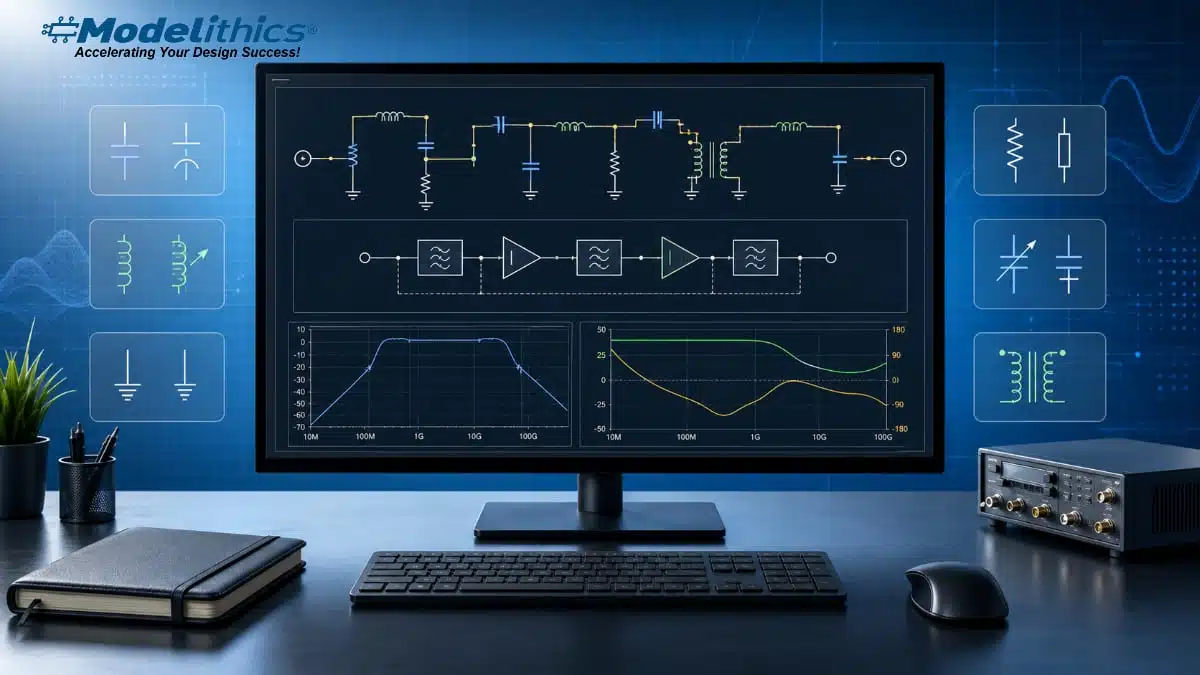
Modelithics has released version 26.2 of its COMPLETE Library for Keysight RF Synthesis (Genesys), adding dozens of new measurement‑based models for passive components and system‑level blocks.

The Modelithics update targets RF, microwave, and millimeter‑wave designers who need accurate, scalable models for capacitors, inductors, resistors, and active devices to close the gap between simulation and hardware.

RelatedPosts

Spectrum Controls Joins Modelithics Program to Offer High‑Fidelity RF Models for Resistors, Attenuators and Terminations

Modelithics Releases COMPLETE v26.1 for Keysight ADS

Modelithics Expands COMPLETE+3D Library for Ansys HFSS

Version 26.2 significantly enhances available passive component models, including new additions from: Amotech, Kyocera-AVX, Coilcraft, Dalicap, International Manufacturing Services, Knowles, Murata, NIC Components, Passive Plus, Susumu, TDK, TTM Technologies and Vishay.

Key features and benefits

Expanded passive component coverage

  • New measurement‑based models for capacitors, inductors and resistors from multiple vendors, covering thousands of individual part numbers.
  • Broader frequency coverage, including RF, microwave and millimeter‑wave bands, suitable for modern communication, radar and high‑speed digital systems.
  • Models validated on different substrates and pad configurations, making them more representative of real PCB layouts.

Global Microwave Models with multi‑dimensional scaling

  • Use of Global Microwave Models that support part‑value scaling, enabling one model to represent a full value range within a given component family.
  • Substrate scaling lets designers adapt a single model to different board materials and thicknesses according to manufacturing choices.
  • Pad scaling helps capture the impact of different pad geometries and land patterns on RF performance without re‑deriving new models.

High‑fidelity behavior in critical regions

  • Modeling of high‑order resonances and effective series resistance, essential for accurate prediction of loss and parasitics at higher frequencies.
  • Support for both linear passive components and non‑linear devices such as diodes and transistors within the same library framework.
  • Consistency across models, as they are derived using common measurement and extraction methodologies.

System‑level component models

  • Inclusion of functional blocks such as filters, attenuators and amplifiers as complete system‑level components.
  • Ability to simulate both discrete passives and higher‑level RF building blocks in one environment, reducing the need for ad‑hoc or idealized models.
  • Better correlation between schematic‑level simulations and measured performance of the assembled RF chain.

Licensing and access options

  • Vendor‑sponsored access through the Modelithics Vendor Partner (MVP) program, including time‑limited free use of selected models.
  • Support for multiple EDA platforms in the broader Modelithics ecosystem, with Genesys as one of the supported tools.

Typical applications

The COMPLETE Library for Keysight Genesys is targeted at engineers working on RF and microwave designs where model accuracy directly impacts design cycles and first‑pass success. Typical application areas include:

  • Front‑end RF modules for wireless infrastructure, small cells and repeaters.
  • Radar and sensing systems operating into the microwave and millimeter‑wave range.
  • High‑frequency power amplifiers and driver stages where device models and matching networks must be tightly correlated to measurements.
  • Filter, attenuator and coupler designs that rely on realistic parasitic behavior of passives and interconnects.
  • High‑speed digital and SerDes designs where package parasitics of passives and discontinuities can affect signal integrity.
  • Evaluation and optimization of wide‑bandgap power devices such as GaN, via dedicated libraries like the Qorvo GaN Library within the Modelithics portfolio.

For purchasing and sourcing teams, the broader vendor coverage means that internal “preferred supplier” lists can be more easily reflected in simulation, reducing the risk that a simulated design depends on a part that is not readily available.

Technical highlights

The table below summarizes key technical aspects of the Modelithics COMPLETE Library v26.2 for Keysight Genesys based on the information provided by the manufacturer.

AspectDescription
Library typeMeasurement‑based component and system‑level model library
ReleaseModelithics COMPLETE Library v26.2 for Keysight RF Synthesis (Genesys)
Component classesCapacitors, inductors, resistors, diodes, transistors, system components
Modeling approachGlobal Microwave Models with multi‑dimensional scaling
Behavioral detailsHigh‑order resonances, effective series resistance, non‑linear behavior
Frequency rangeRF, microwave and millimeter‑wave applications
Model validationBased on precision RF and microwave measurements on multiple substrates
Vendor coverage (examples)Multiple passive and active component manufacturers
Access optionsStandard licensing and MVP vendor‑sponsored free trials

Global Microwave Models and scaling

Global Microwave Models are equivalent‑circuit models that have been parameterized against precision RF and microwave measurements. In practical design terms, this means:

  • One model can be tuned for different part values within a given series, rather than maintaining separate single‑value models.
  • A substrate change (for example, moving from one FR‑4 variant to a low‑loss RF laminate) can be reflected by adjusting substrate parameters instead of switching to an unrelated model.
  • Pad and land pattern variants can be evaluated without remeshing or re‑measuring, which is especially useful when optimizing layout for manufacturability or EMC.

System‑component‑level modeling

The inclusion of system components library content allows engineers to:

  • Insert realistic amplifier, filter or attenuator models as blocks in Genesys system‑level simulations.
  • Evaluate cascaded gain, noise figure and linearity with models that reflect measurement‑based performance rather than idealized textbook behavior.
  • Study the interaction between component‑level parasitics and higher‑level system blocks, which is increasingly important in compact RF modules.

Availability and access

The v26.2 release of the Modelithics COMPLETE Library for Keysight Genesys is available directly from Modelithics. According to the manufacturer:

  • A detailed set of release notes for version 26.2 is available and provides the complete list of new models introduced in this release, including coverage by vendor and component family.
  • A free trial of the library for Genesys can be requested via the Modelithics website.
  • Through the Modelithics Vendor Partner (MVP) program, selected vendor‑sponsored libraries and models can be used for a limited period at no cost, enabling evaluation without upfront licensing.

For design teams standardizing on Modelithics libraries, Modelithics also offers additional libraries such as mmWave‑focused content and specialized GaN transistor libraries, as well as a line of RF test fixtures and accessories.

Design‑in notes for engineers

When to consider Modelithics COMPLETE for Genesys

  • When your RF or microwave design has shown poor correlation between ideal or generic models and measured prototypes, and you need tighter simulation‑to‑measurement alignment.
  • When you rely on advanced passives (for example, high‑Q RF capacitors or precision thin‑film resistors) and need models that accurately capture loss tangents, ESR and resonant behavior.
  • When layout‑dependent effects, such as pad size or substrate transitions, significantly influence performance at your target frequency.

Workflow and productivity considerations

  • Use the Global Microwave Models during early architecture definition to quickly sweep part values and substrates, then lock in specific commercial part numbers as the design converges.
  • Leverage substrate and pad scaling to maintain a single schematic across multiple board stack‑ups (for example, a prototype stack‑up and a cost‑optimized production stack‑up).
  • Incorporate system‑level component models early in the design flow to ensure that gain, noise and linearity budgets reflect realistic device behavior.

Collaboration between design and procurement

  • Share the list of supported vendors and component families from the v26.2 release notes with purchasing to align simulation models with preferred supplier lists.
  • When considering alternative components due to supply or cost changes, use model‑based simulations to assess the impact of switching between supported vendors or value ranges.
  • Work with the MVP program and vendor‑sponsored libraries where available to evaluate parts under consideration without immediate licensing commitments.

Source

This article is based on information provided in the official Modelithics press release announcing the Modelithics COMPLETE Library v26.2 for Keysight Genesys, complemented by general information from the manufacturer’s website and library documentation.


References

  1. Modelithics press release – Modelithics COMPLETE Library v26.2 for Keysight Genesys
  2. Modelithics COMPLETE Library product overview
  3. Modelithics MVP program information
  4. Modelithics Genesys library and trial request page

Related

Recent Posts

Bourns Introduces Automotive BMS Signal Transformer with Integrated Common Mode Chokes

17.7.2026
9

Itelcond Introduces High‑Voltage Aluminium Capacitors for Modern IGBT DC‑links

17.7.2026
13

Bourns Introduces Automotive Shielded Power Inductors for Compact DC‑DC Converters

16.7.2026
31

EMC Design Fundamentals: Safe Use of Varistors and Common Mode Chokes in Mains and Data-Line Filters

16.7.2026
49

Murata Unveils Lead Disc Ceramic Capacitors for Automotive Safety and EMI Suppression

15.7.2026
38

Square-Wave Harmonics and RMS Currents in Power Converters

14.7.2026
40

LeanBOM: Practical Cross‑Technology Capacitor Search by Real Working Conditions

14.7.2026
49

In the Age of AI, Every Watt Counts: Implications for Components

13.7.2026
60

Stackpole Extends Resistance Range of 2512 High‑Power Current Sense Resistors

13.7.2026
26

Upcoming Events

Jul 21
16:00 - 17:00 CEST

Safety by design: X and Y Interference suppression capacitors for power line filters

Jul 28
8:00 - 11:00 CEST

Post Procurement Testing of EEE Components for LEO Space Applications

Jul 29
17:30 - 18:30 CEST

To Ferrite or to Nanocrystalline in Transformer Design

View Calendar

Popular Posts

  • Boost Converter Design and Calculation

    0 shares
    Share 0 Tweet 0
  • Buck Converter Design and Calculation

    0 shares
    Share 0 Tweet 0
  • YAGEO Announces July 2026 Capacitor Price Increase

    0 shares
    Share 0 Tweet 0
  • Flyback Converter Design and Calculation

    0 shares
    Share 0 Tweet 0
  • LLC Resonant Converter Design and Calculation

    0 shares
    Share 0 Tweet 0
  • MLCC and Ceramic Capacitors

    0 shares
    Share 0 Tweet 0
  • Earthing Systems and IEC Classification Explained

    0 shares
    Share 0 Tweet 0
  • MLCCs in the Age of AI: Q2 2026 Market Tightness

    0 shares
    Share 0 Tweet 0
  • Nvidia Vera Rubin: Why One AI Rack Needs So Many More MLCC Capacitors

    0 shares
    Share 0 Tweet 0
  • Dual Active Bridge (DAB) Topology

    0 shares
    Share 0 Tweet 0

Newsletter Subscription


Passive Components Blog

© EPCI - Leading Passive Components Educational and Information Site

  • Home
  • Privacy Policy
  • EPCI Membership & Advertisement
  • About

No Result
View All Result
  • Home
  • Knowledge Blog
  • Dossiers
  • PCNS

© EPCI - Leading Passive Components Educational and Information Site

This website uses cookies. By continuing to use this website you are giving consent to cookies being used. Visit our Privacy and Cookie Policy.
Go to mobile version