



Passive Components Blog
No Result
View All Result
  • Home
  • NewsFilter
    • All
    • Aerospace & Defence
    • Antenna
    • Applications
    • Automotive
    • Capacitors
    • Circuit Protection Devices
    • electro-mechanical news
    • Filters
    • Fuses
    • Inductors
    • Industrial
    • Integrated Passives
    • inter-connect news
    • Market & Supply Chain
    • Market Insights
    • Medical
    • Modelling and Simulation
    • New Materials & Supply
    • New Technologies
    • Non-linear Passives
    • Oscillators
    • Passive Sensors News
    • Resistors
    • RF & Microwave
    • Telecommunication
    • Weekly Digest

    When More Capacitance Hurts Reliability: The Role of the Metallic Skeleton in Tantalum Anodes

    Why Power Inductors Use a Ferrite Core With an Air Gap

    Wk 16 Electronics Supply Chain Digest

    YAGEO Introduces High‑Current Y2/X1 Film Capacitors for Wide-bandgap Power Systems

    Amphenol Explanded Liquid Cooling Connectors for AI, ESS and EV Systems

    Hirose Introduced BGA connector for PCIe Gen6 for AI and Edge Computing

    YAGEO Introduces High Rel MLCCs Beyond MIL-Spec Limits

    Würth Elektronik Expanded Capacity for Validation and Services in Asia

    Samsung Introduces Ultra-High-Voltage 1500 V MLCCs for xEV Powertrains

    Trending Tags

    • Ripple Current
    • RF
    • Leakage Current
    • Tantalum vs Ceramic
    • Snubber
    • Low ESR
    • Feedthrough
    • Derating
    • Dielectric Constant
    • New Products
    • Market Reports
  • VideoFilter
    • All
    • Antenna videos
    • Capacitor videos
    • Circuit Protection Video
    • Filter videos
    • Fuse videos
    • Inductor videos
    • Inter-Connect Video
    • Non-linear passives videos
    • Oscillator videos
    • Passive sensors videos
    • Resistor videos

    Why Power Inductors Use a Ferrite Core With an Air Gap

    Transformer-Based Power-Line Harvester Magnetic Design

    Thermal Modeling of Magnetics

    Standard vs Planar LLC transformers Comparison for Battery Chargers

    How Modern Tools Model Magnetic Components for Power Electronics

    Advanced Loss Modeling for Planar Magnetics in the Frenetic Planar Tool

    2026 Power Magnetics Design Trends: Flyback, DAB and Planar

    Enabling Software‑Defined Vehicle Architectures: Automotive Ethernet and Zonal Smart Power

    Calculating Resistance Value of a Flyback RC Snubber 

    Trending Tags

    • Capacitors explained
    • Inductors explained
    • Resistors explained
    • Filters explained
    • Application Video Guidelines
    • EMC
    • New Products
    • Ripple Current
    • Simulation
    • Tantalum vs Ceramic
  • Knowledge Blog
  • DossiersNew
  • Suppliers
    • Who is Who
  • PCNS
    • PCNS 2025
    • PCNS 2023
    • PCNS 2021
    • PCNS 2019
    • PCNS 2017
  • Events
  • Home
  • NewsFilter
    • All
    • Aerospace & Defence
    • Antenna
    • Applications
    • Automotive
    • Capacitors
    • Circuit Protection Devices
    • electro-mechanical news
    • Filters
    • Fuses
    • Inductors
    • Industrial
    • Integrated Passives
    • inter-connect news
    • Market & Supply Chain
    • Market Insights
    • Medical
    • Modelling and Simulation
    • New Materials & Supply
    • New Technologies
    • Non-linear Passives
    • Oscillators
    • Passive Sensors News
    • Resistors
    • RF & Microwave
    • Telecommunication
    • Weekly Digest

    When More Capacitance Hurts Reliability: The Role of the Metallic Skeleton in Tantalum Anodes

    Why Power Inductors Use a Ferrite Core With an Air Gap

    Wk 16 Electronics Supply Chain Digest

    YAGEO Introduces High‑Current Y2/X1 Film Capacitors for Wide-bandgap Power Systems

    Amphenol Explanded Liquid Cooling Connectors for AI, ESS and EV Systems

    Hirose Introduced BGA connector for PCIe Gen6 for AI and Edge Computing

    YAGEO Introduces High Rel MLCCs Beyond MIL-Spec Limits

    Würth Elektronik Expanded Capacity for Validation and Services in Asia

    Samsung Introduces Ultra-High-Voltage 1500 V MLCCs for xEV Powertrains

    Trending Tags

    • Ripple Current
    • RF
    • Leakage Current
    • Tantalum vs Ceramic
    • Snubber
    • Low ESR
    • Feedthrough
    • Derating
    • Dielectric Constant
    • New Products
    • Market Reports
  • VideoFilter
    • All
    • Antenna videos
    • Capacitor videos
    • Circuit Protection Video
    • Filter videos
    • Fuse videos
    • Inductor videos
    • Inter-Connect Video
    • Non-linear passives videos
    • Oscillator videos
    • Passive sensors videos
    • Resistor videos

    Why Power Inductors Use a Ferrite Core With an Air Gap

    Transformer-Based Power-Line Harvester Magnetic Design

    Thermal Modeling of Magnetics

    Standard vs Planar LLC transformers Comparison for Battery Chargers

    How Modern Tools Model Magnetic Components for Power Electronics

    Advanced Loss Modeling for Planar Magnetics in the Frenetic Planar Tool

    2026 Power Magnetics Design Trends: Flyback, DAB and Planar

    Enabling Software‑Defined Vehicle Architectures: Automotive Ethernet and Zonal Smart Power

    Calculating Resistance Value of a Flyback RC Snubber 

    Trending Tags

    • Capacitors explained
    • Inductors explained
    • Resistors explained
    • Filters explained
    • Application Video Guidelines
    • EMC
    • New Products
    • Ripple Current
    • Simulation
    • Tantalum vs Ceramic
  • Knowledge Blog
  • DossiersNew
  • Suppliers
    • Who is Who
  • PCNS
    • PCNS 2025
    • PCNS 2023
    • PCNS 2021
    • PCNS 2019
    • PCNS 2017
  • Events
No Result
View All Result
Passive Components Blog
No Result
View All Result

Researchers Presents High-Performance Carbon-Based Supercapacitors

1.8.2025
Reading Time: 4 mins read
A A

Ivan Dědek et al from CATRIN, Palacky University Olomouc, Czech Republic published an article on “High-Performance Carbon-Based Supercapacitors” Published by IOP Publishing Ltd.

Introduction

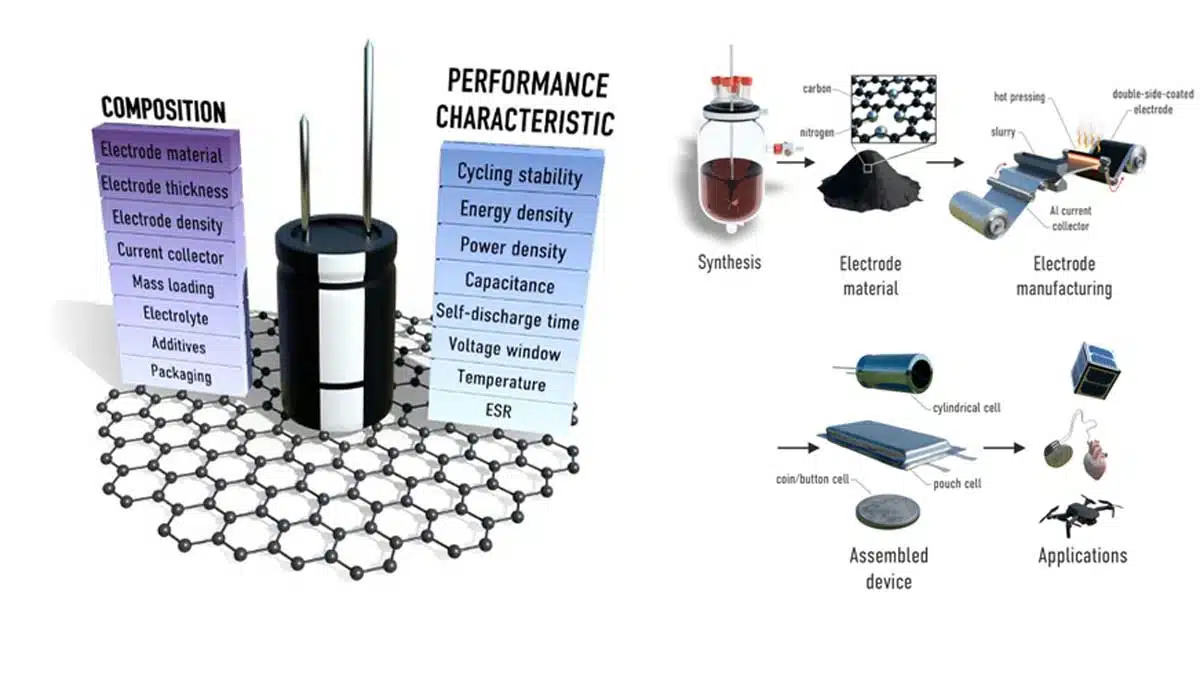
This article explores the rapidly evolving landscape of carbon-based supercapacitors (SCs), focusing on electric double-layer capacitors (EDLCs).

RelatedPosts

When More Capacitance Hurts Reliability: The Role of the Metallic Skeleton in Tantalum Anodes

Why Power Inductors Use a Ferrite Core With an Air Gap

Wk 16 Electronics Supply Chain Digest

These devices offer fast charging, long cycle life, and high power density, making them suitable for a wide range of applications—from consumer electronics to aerospace. The discussion centers on advances in activated carbon (AC), graphene, and their derivatives, while emphasizing the challenges of transitioning high-performance materials from laboratory research to scalable commercial devices. Sustainability and systems-level optimization are recurring themes throughout the article.

Key Points

  • Carbon-based SCs are poised to bridge the gap between traditional capacitors and lithium-ion batteries.
  • Activated carbon and graphene are key electrode materials, but real-world performance lags behind lab results.
  • Device architecture, electrode thickness, and testing methods impact performance outcomes.
  • Emerging materials like N-doped graphene and graphdiyne offer potential but face scalability issues.
  • Electrolyte selection and thermal operating range are critical for optimizing energy and power density.
  • Environmental and safety standards must be met for industrial adoption.

Extended Summary

The article begins by highlighting the role of supercapacitors in meeting the UN’s energy goals through improved electrochemical energy storage. EDLCs offer advantages such as fast charge/discharge cycles, long life, and reduced safety risks. Carbon-based materials, particularly AC and graphene, dominate current SC technology due to their conductivity and abundance.

Real-world SC performance, however, often falls short of lab benchmarks. The discrepancy stems from differences in electrode thickness, device design, and performance reporting standards. Thin lab-scale electrodes perform better due to full ion accessibility, while practical devices with thicker electrodes exhibit lower capacitance. Furthermore, volumetric energy densities tend to be diluted due to excessive porosity and low packing density of nanomaterials like graphene.

The paper explores various carbon materials used for electrodes. Activated carbon, derived from biomass or plastic waste, is porous and cost-effective but hydrophobic. Surface functionalization or N-doping improves ion accessibility and adds pseudocapacitive effects. Graphene, although promising, suffers from restacking issues, which reduce surface area. Curved or defective graphene mitigates these limitations and has already shown scalability in commercial devices. Graphdiyne, a newer carbon allotrope, has great potential but faces production and consistency challenges.

Device form factor influences SC performance. Wound-cell configurations offer manufacturing scalability, while pouch-type cells are ideal for space-constrained designs. Each architecture comes with trade-offs in energy density, mechanical stability, and cost. The market demands SCs with higher energy densities, thermal stability, and compatibility with surface-mount technology, especially for high-temperature reflow soldering.

Electrolytes are crucial for determining performance. Aqueous electrolytes are voltage-limited; organic electrolytes and ionic liquids offer wider windows and better energy density. However, ionic liquids are expensive and often viscous, limiting ion transport. Strategies such as blending ILs with low-viscosity solvents or developing eutectic mixtures are being explored to extend operational temperature ranges.

Manufacturing processes also play a pivotal role. NMP is commonly used as a solvent but poses environmental risks, driving research into safer alternatives like water-based or green organic solvents. Nonetheless, performance trade-offs remain a challenge.

The paper concludes with a call for holistic optimization. Improvements should target not only active materials but also electrolytes, device architecture, and regulatory alignment. Micro-supercapacitors and hybrid devices combining SCs and batteries represent emerging directions. Continued interdisciplinary research is needed to close the performance gap and make carbon-based SCs viable for widespread adoption.

Conclusion

Carbon-based supercapacitors hold significant promise for energy storage solutions that require rapid charge-discharge cycles, safety, and sustainability. While advanced materials such as curved graphene and graphdiyne offer excellent electrochemical properties, industrial implementation is hindered by scalability, cost, and integration challenges. Addressing these requires a systems-level approach, from material innovation to manufacturing processes and regulatory compliance. The future of SCs lies in their adaptability across diverse applications, and with ongoing research, they are well-positioned to become indispensable components of next-generation energy systems.

Read the complete article here:

High-Performance Carbon-Based Supercapacitors, Ivan Dědek, Veronika Šedajová, Vojtěch Kupka, Tomáš Zedníček, Luca Primavesi, Doron Aurbach, Malachi Noked and Michal Otyepka, Accepted Manuscript. Published by IOP Publishing Ltd, DOI 10.1088/2053-1583/adf653, https://iopscience.iop.org/article/10.1088/2053-1583/adf653
Related

Source: IOP Publishing

Recent Posts

When More Capacitance Hurts Reliability: The Role of the Metallic Skeleton in Tantalum Anodes

20.4.2026
14

YAGEO Introduces High‑Current Y2/X1 Film Capacitors for Wide-bandgap Power Systems

17.4.2026
14

YAGEO Introduces High Rel MLCCs Beyond MIL-Spec Limits

16.4.2026
40

Samsung Introduces Ultra-High-Voltage 1500 V MLCCs for xEV Powertrains

16.4.2026
20

YAGEO Q1 2026 Results: AI Servers and Pricing Power Behind a Moderate Q2 Outlook

16.4.2026
58

Samsung Presents MLCC Selection Guide for Humanoids and Robotic Applications

15.4.2026
24

AI-Assisted Structural Diagnostics and Physics-Based Reliability Interpretation of Tantalum Capacitor Anodes

14.4.2026
31

KYOCERA AVX MIL-PRF-32535 BME NP0 MLCCs Approved to the DLA QPD

16.4.2026
28

ECIA March 2026 Industry Pulse Points to Best Sales Climate in Five Years

13.4.2026
46

Upcoming Events

Apr 21
16:00 - 17:00 CEST

Heatsink Solutions: Thermal Management in electronic devices

Apr 22
17:00 - 17:30 CEST

Magnetics in a high frequency GaN era

Apr 22
17:00 - 18:00 CEST

Derating Tantalum, Film, and Ceramic Capacitors

View Calendar

Popular Posts

  • Buck Converter Design and Calculation

    0 shares
    Share 0 Tweet 0
  • Boost Converter Design and Calculation

    0 shares
    Share 0 Tweet 0
  • Flyback Converter Design and Calculation

    0 shares
    Share 0 Tweet 0
  • LLC Resonant Converter Design and Calculation

    0 shares
    Share 0 Tweet 0
  • Dual Active Bridge (DAB) Topology

    0 shares
    Share 0 Tweet 0
  • MLCC and Ceramic Capacitors

    0 shares
    Share 0 Tweet 0
  • Capacitor Charging and Discharging

    0 shares
    Share 0 Tweet 0
  • Plastic Materials Dielectric Constant and DF

    4 shares
    Share 4 Tweet 0
  • Ripple Current and its Effects on the Performance of Capacitors

    3 shares
    Share 3 Tweet 0
  • MLCC Case Sizes Standards Explained

    0 shares
    Share 0 Tweet 0

Newsletter Subscription


Passive Components Blog

© EPCI - Leading Passive Components Educational and Information Site

  • Home
  • Privacy Policy
  • EPCI Membership & Advertisement
  • About

No Result
View All Result
  • Home
  • Knowledge Blog
  • PCNS

© EPCI - Leading Passive Components Educational and Information Site

This website uses cookies. By continuing to use this website you are giving consent to cookies being used. Visit our Privacy and Cookie Policy.
Go to mobile version