



Passive Components Blog
No Result
View All Result
  • Home
  • NewsFilter
    • All
    • Aerospace & Defence
    • Antenna
    • Applications
    • Automotive
    • Capacitors
    • Circuit Protection Devices
    • electro-mechanical news
    • Filters
    • Fuses
    • Inductors
    • Industrial
    • Integrated Passives
    • inter-connect news
    • Market & Supply Chain
    • Market Insights
    • Medical
    • Modelling and Simulation
    • New Materials & Supply
    • New Technologies
    • Non-linear Passives
    • Oscillators
    • Passive Sensors News
    • Resistors
    • RF & Microwave
    • Telecommunication
    • Weekly Digest

    ECIA Industry Pulse April 2026: Sentiment Cools but Stays Strong

    Industrial Passive Components Markets and Technologies 2026

    Automotive Passive Components Technology Dossier

    Samsung Electro-Mechanics Signs 1.5T KRW Silicon Capacitor AI Contract

    Murata Expands Thermistor Production Capacity at Yokaichi Plant

    Hirose Expands Compact High‑Voltage EV connectors

    Qi2 Wireless Charging: Inductors, Capacitors and EMC Filters

    Samsung Introduced Low ESL 3-Terminal Reverse-Geometry MLCCs for High-Performance ADAS

    Würth Elektronik Presents New Bidirectional Digital Isolators

    Trending Tags

    • Ripple Current
    • RF
    • Leakage Current
    • Tantalum vs Ceramic
    • Snubber
    • Low ESR
    • Feedthrough
    • Derating
    • Dielectric Constant
    • New Products
    • Market Reports
  • VideoFilter
    • All
    • Antenna videos
    • Capacitor videos
    • Circuit Protection Video
    • Filter videos
    • Fuse videos
    • Inductor videos
    • Inter-Connect Video
    • Non-linear passives videos
    • Oscillator videos
    • Passive sensors videos
    • Resistor videos

    Qi2 Wireless Charging: Inductors, Capacitors and EMC Filters

    Two‑capacitor paradox explained for engineers

    Capacitances of Nonlinear MLCCs: What Datasheets Don’t Tell You

    Tapped Inductor Buck Converter Fundamentals

    Planar vs Conventional Transformer: When it Make Sense

    Modeling Fringing Field Losses in Inductors & Transformers

    Why Power Inductors Use a Ferrite Core With an Air Gap

    Transformer-Based Power-Line Harvester Magnetic Design

    Thermal Modeling of Magnetics

    Trending Tags

    • Capacitors explained
    • Inductors explained
    • Resistors explained
    • Filters explained
    • Application Video Guidelines
    • EMC
    • New Products
    • Ripple Current
    • Simulation
    • Tantalum vs Ceramic
  • Knowledge Blog
  • DossiersNew
  • Suppliers
    • Who is Who
  • PCNS
    • PCNS 2025
    • PCNS 2023
    • PCNS 2021
    • PCNS 2019
    • PCNS 2017
  • Events
  • Home
  • NewsFilter
    • All
    • Aerospace & Defence
    • Antenna
    • Applications
    • Automotive
    • Capacitors
    • Circuit Protection Devices
    • electro-mechanical news
    • Filters
    • Fuses
    • Inductors
    • Industrial
    • Integrated Passives
    • inter-connect news
    • Market & Supply Chain
    • Market Insights
    • Medical
    • Modelling and Simulation
    • New Materials & Supply
    • New Technologies
    • Non-linear Passives
    • Oscillators
    • Passive Sensors News
    • Resistors
    • RF & Microwave
    • Telecommunication
    • Weekly Digest

    ECIA Industry Pulse April 2026: Sentiment Cools but Stays Strong

    Industrial Passive Components Markets and Technologies 2026

    Automotive Passive Components Technology Dossier

    Samsung Electro-Mechanics Signs 1.5T KRW Silicon Capacitor AI Contract

    Murata Expands Thermistor Production Capacity at Yokaichi Plant

    Hirose Expands Compact High‑Voltage EV connectors

    Qi2 Wireless Charging: Inductors, Capacitors and EMC Filters

    Samsung Introduced Low ESL 3-Terminal Reverse-Geometry MLCCs for High-Performance ADAS

    Würth Elektronik Presents New Bidirectional Digital Isolators

    Trending Tags

    • Ripple Current
    • RF
    • Leakage Current
    • Tantalum vs Ceramic
    • Snubber
    • Low ESR
    • Feedthrough
    • Derating
    • Dielectric Constant
    • New Products
    • Market Reports
  • VideoFilter
    • All
    • Antenna videos
    • Capacitor videos
    • Circuit Protection Video
    • Filter videos
    • Fuse videos
    • Inductor videos
    • Inter-Connect Video
    • Non-linear passives videos
    • Oscillator videos
    • Passive sensors videos
    • Resistor videos

    Qi2 Wireless Charging: Inductors, Capacitors and EMC Filters

    Two‑capacitor paradox explained for engineers

    Capacitances of Nonlinear MLCCs: What Datasheets Don’t Tell You

    Tapped Inductor Buck Converter Fundamentals

    Planar vs Conventional Transformer: When it Make Sense

    Modeling Fringing Field Losses in Inductors & Transformers

    Why Power Inductors Use a Ferrite Core With an Air Gap

    Transformer-Based Power-Line Harvester Magnetic Design

    Thermal Modeling of Magnetics

    Trending Tags

    • Capacitors explained
    • Inductors explained
    • Resistors explained
    • Filters explained
    • Application Video Guidelines
    • EMC
    • New Products
    • Ripple Current
    • Simulation
    • Tantalum vs Ceramic
  • Knowledge Blog
  • DossiersNew
  • Suppliers
    • Who is Who
  • PCNS
    • PCNS 2025
    • PCNS 2023
    • PCNS 2021
    • PCNS 2019
    • PCNS 2017
  • Events
No Result
View All Result
Passive Components Blog
No Result
View All Result

SABIC Releases 40% Thinner Film Foil for High Temperature Automotive EVs Film Capacitor Applications

16.3.2022
Reading Time: 3 mins read
A A

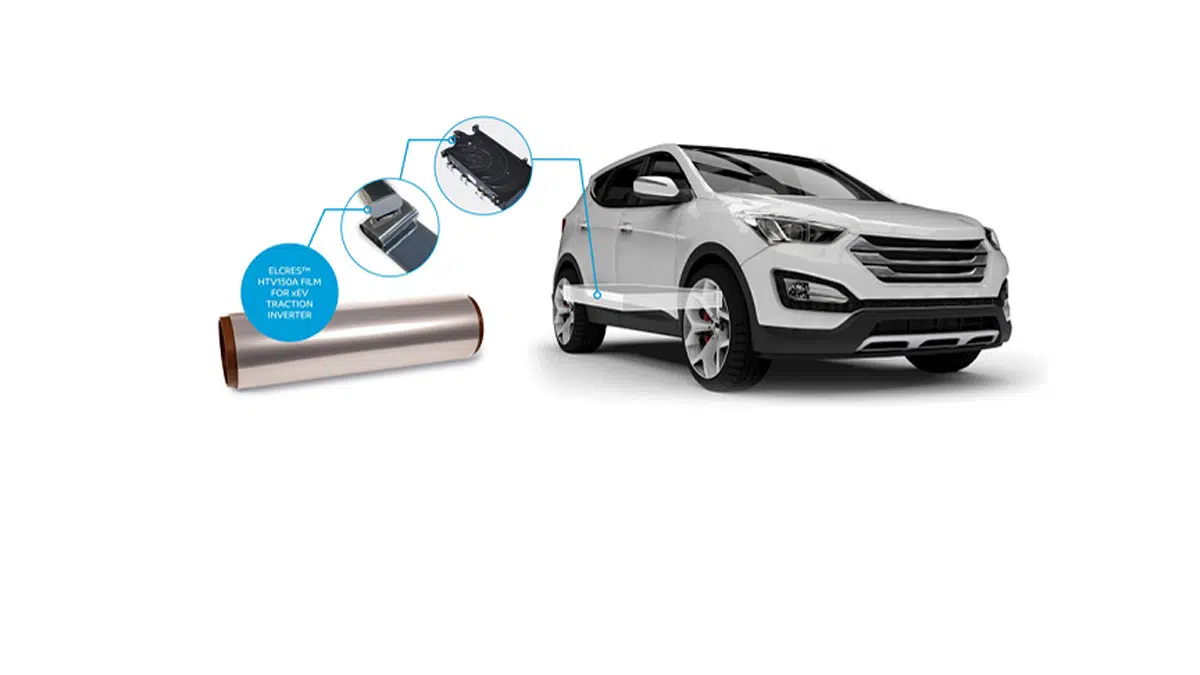
SABIC to launch at APEC 2022 40% thinner Elcres™ Htv150a film foil for further adoption of high temperature film capacitors in SiC inverter technology used in Automotive EV applications.

SABIC, a global leader in the chemical industry, will introduce at the 2022 Applied Power Electronics Conference (APEC), a new, thinner gauge of its ELCRES™ HTV150A dielectric film which may be used for film capacitors in the traction inverters, onboard chargers and electrical compressors of hybrid, plug-in hybrid and battery electric vehicles (xEV). The 3-micron (µm) film is 40 percent thinner than SABIC’s recently announced 5 µm film, enabling further volume and weight reductions and greater design flexibility through enhanced energy density for the capacitor. Like the 5 µm ELCRES HTV150A film, this exceptionally thin film maintains stable performance at high operating temperatures up to 150°C and addresses the critical performance gap experienced by traditional polypropylene (PP) films above 135°C. This new level of thermal performance helps customers to increase the adoption of SiC power modules with smaller package size due to the higher energy density, reducing weight while providing the increased efficiency and performance desired for increased xEV adoption by consumers.

RelatedPosts

Nichicon Develops High Voltage 150C Film Capacitors using Sabic High-Heat Foil

SABIC to Lower DF Losses of its Dielectric Films for Hi-Temp Capacitors

SABIC Validates its 150°C Film Foil to Enable Adoption of Film Capacitors in SIC Power Modules

SABIC’s participation at APEC will include a technical presentation by Dr. Adel Bastawros, chief scientist, Technology & Innovation, on March 22. His presentation, titled “ELCRES™ HTV150A Film – New Generation Capacitor Films for High Heat Inverter Applications,” will begin at 2:30pm Central Daylight Time (CDT). At its booth, the company will exhibit ELCRES HTV150A film and typical capacitor applications.

“When we launched the five-micron ELCRES HTV150A film last year, we committed to develop thinner gauges to meet requirements for different capacitor voltages – and we’ve delivered on that pledge,” said Greg Stoddard, technical director, Resins and New Chemistries, SABIC. “Our new three-micron film can help customers design smaller package sizes that potentially avoid the use of active cooling systems associated with films that perform at lower temperatures. As OEMs design electric and hybrid vehicles to operate at specific voltages, the new three-micron film can help with differentiation by providing tailored properties. Segmentation of voltage performance aids automakers to match capacitor performance to the needs of different vehicles in their product lines.”  

Higher Temperatures, Thinner Gauges

ELCRES HTV150A dielectric film is the first capacitor film in the industry to be engineered for stable performance at operating temperatures of -40°C to 150°C and frequencies up to 100 kHz, while offering stable capacitance, high insulation resistance and good dielectric performance (dielectric constant (Dk) of 2.9, dissipation factor (Df) of 0.002). Other key properties include high breakdown strength over the full temperature range, good self-healing and excellent adhesion to aluminum and zinc. The film has been validated by customers for use with both film-foil and metalized electrodes. Capacitors built with 3 µm and 5 µm metalized films pass standard electrical and life tests at 150°C for 2,000 hours with low capacitance change and stable insulation resistance. Additional key features and benefits, typical properties and potential applications for SABIC’s ELCRES HTV150A film portfolio can be found in SABIC’s new brochure.

SABIC will continue to develop new products to meet higher heat requirements as inverter technology continues to advance, demonstrating its continued commitment to deliver innovative material and film technologies to power electronics.

Related

Source: SABIC

Recent Posts

ECIA Industry Pulse April 2026: Sentiment Cools but Stays Strong

21.5.2026
7

Industrial Passive Components Markets and Technologies 2026

21.5.2026
13

Automotive Passive Components Technology Dossier

21.5.2026
18

Samsung Electro-Mechanics Signs 1.5T KRW Silicon Capacitor AI Contract

21.5.2026
12

Murata Expands Thermistor Production Capacity at Yokaichi Plant

21.5.2026
7

Qi2 Wireless Charging: Inductors, Capacitors and EMC Filters

21.5.2026
17

Samsung Introduced Low ESL 3-Terminal Reverse-Geometry MLCCs for High-Performance ADAS

20.5.2026
28

Using Stress–Strain Curves to Diagnose Tantalum Powders for Capacitors

20.5.2026
24

Samsung Launches Ultra-Compact 008004 High Q MLCC for Next-Generation RF Applications

20.5.2026
21

Upcoming Events

Jun 2
16:00 - 17:00 CEST

Calculation, Simulation and Measurement of 800V EMC Filters

Jun 16
16:00 - 17:00 CEST

EMC with EMC – EMC‑compliant design with electromechanical connectors

View Calendar

Popular Posts

  • Buck Converter Design and Calculation

    0 shares
    Share 0 Tweet 0
  • Boost Converter Design and Calculation

    0 shares
    Share 0 Tweet 0
  • Flyback Converter Design and Calculation

    0 shares
    Share 0 Tweet 0
  • LLC Resonant Converter Design and Calculation

    0 shares
    Share 0 Tweet 0
  • MLCC and Ceramic Capacitors

    0 shares
    Share 0 Tweet 0
  • Capacitor Charging and Discharging

    0 shares
    Share 0 Tweet 0
  • What Electronics Engineer Needs to Know About Passive Low Pass Filters

    0 shares
    Share 0 Tweet 0
  • Dual Active Bridge (DAB) Topology

    0 shares
    Share 0 Tweet 0
  • Ripple Current and its Effects on the Performance of Capacitors

    3 shares
    Share 3 Tweet 0
  • Samsung Electro-Mechanics Releases High-Capacitance MLCCs for AI Server Applications

    0 shares
    Share 0 Tweet 0

Newsletter Subscription


Passive Components Blog

© EPCI - Leading Passive Components Educational and Information Site

  • Home
  • Privacy Policy
  • EPCI Membership & Advertisement
  • About

No Result
View All Result
  • Home
  • Knowledge Blog
  • Dossiers
  • PCNS

© EPCI - Leading Passive Components Educational and Information Site

This website uses cookies. By continuing to use this website you are giving consent to cookies being used. Visit our Privacy and Cookie Policy.
Go to mobile version