




Passive Components Blog
No Result
View All Result
  • Home
  • NewsFilter
    • All
    • Aerospace & Defence
    • Antenna
    • Applications
    • Automotive
    • Capacitors
    • Circuit Protection Devices
    • electro-mechanical news
    • Filters
    • Fuses
    • Inductors
    • Industrial
    • Integrated Passives
    • inter-connect news
    • Market & Supply Chain
    • Market Insights
    • Medical
    • Modelling and Simulation
    • New Materials & Supply
    • New Technologies
    • Non-linear Passives
    • Oscillators
    • Passive Sensors News
    • Resistors
    • RF & Microwave
    • Telecommunication
    • Weekly Digest

    Samsung MLCC Replacing Aluminum Polymer Capacitors in AI Systems

    Reliability Improvement in BaTiO3 MLCCs Using Ni–Sn and Ni–In Alloy Electrodes

    Littelfuse Introduces Automotive Current Sensors for EV Battery, Motor, and Safety Systems

    Vishay Releases Fast Acting Thin Film Chip Fuses

    Mechanical Testing of Tantalum Anodes to Predict Tantalum Capacitor Quality

    Thermistor Linearization Challenges

    Coaxial Connectors and How to Connect with PCB

    SCHURTER APO Pyrofuse Brings Active Safety for High-Voltage Systems

    Coilcraft Releases Worlds Smallest 0402 Ferrite-Core Wirewound Chip Inductor

    Trending Tags

    • Ripple Current
    • RF
    • Leakage Current
    • Tantalum vs Ceramic
    • Snubber
    • Low ESR
    • Feedthrough
    • Derating
    • Dielectric Constant
    • New Products
    • Market Reports
  • VideoFilter
    • All
    • Antenna videos
    • Capacitor videos
    • Circuit Protection Video
    • Filter videos
    • Fuse videos
    • Inductor videos
    • Inter-Connect Video
    • Non-linear passives videos
    • Oscillator videos
    • Passive sensors videos
    • Resistor videos

    Thermistor Linearization Challenges

    Coaxial Connectors and How to Connect with PCB

    PCB Manufacturing, Test Methods, Quality and Reliability

    Transformer Behavior – Current Transfer and Hidden Feedback

    Choosing the Right Capacitor: The Importance of Accurate Measurements

    RF Inductors: Selection and Design Challenges for High-Frequency Circuits

    Transformer Safety IEC 61558 Standard

    3-Phase EMI Filter Design, Simulation, Calculation and Test

    Transformer Design Optimization for Power Electronics Applications

    Trending Tags

    • Capacitors explained
    • Inductors explained
    • Resistors explained
    • Filters explained
    • Application Video Guidelines
    • EMC
    • New Products
    • Ripple Current
    • Simulation
    • Tantalum vs Ceramic
  • Knowledge Blog
  • Suppliers
    • Who is Who
  • PCNS
    • PCNS 2025
    • PCNS 2023
    • PCNS 2021
    • PCNS 2019
    • PCNS 2017
  • Events
  • Home
  • NewsFilter
    • All
    • Aerospace & Defence
    • Antenna
    • Applications
    • Automotive
    • Capacitors
    • Circuit Protection Devices
    • electro-mechanical news
    • Filters
    • Fuses
    • Inductors
    • Industrial
    • Integrated Passives
    • inter-connect news
    • Market & Supply Chain
    • Market Insights
    • Medical
    • Modelling and Simulation
    • New Materials & Supply
    • New Technologies
    • Non-linear Passives
    • Oscillators
    • Passive Sensors News
    • Resistors
    • RF & Microwave
    • Telecommunication
    • Weekly Digest

    Samsung MLCC Replacing Aluminum Polymer Capacitors in AI Systems

    Reliability Improvement in BaTiO3 MLCCs Using Ni–Sn and Ni–In Alloy Electrodes

    Littelfuse Introduces Automotive Current Sensors for EV Battery, Motor, and Safety Systems

    Vishay Releases Fast Acting Thin Film Chip Fuses

    Mechanical Testing of Tantalum Anodes to Predict Tantalum Capacitor Quality

    Thermistor Linearization Challenges

    Coaxial Connectors and How to Connect with PCB

    SCHURTER APO Pyrofuse Brings Active Safety for High-Voltage Systems

    Coilcraft Releases Worlds Smallest 0402 Ferrite-Core Wirewound Chip Inductor

    Trending Tags

    • Ripple Current
    • RF
    • Leakage Current
    • Tantalum vs Ceramic
    • Snubber
    • Low ESR
    • Feedthrough
    • Derating
    • Dielectric Constant
    • New Products
    • Market Reports
  • VideoFilter
    • All
    • Antenna videos
    • Capacitor videos
    • Circuit Protection Video
    • Filter videos
    • Fuse videos
    • Inductor videos
    • Inter-Connect Video
    • Non-linear passives videos
    • Oscillator videos
    • Passive sensors videos
    • Resistor videos

    Thermistor Linearization Challenges

    Coaxial Connectors and How to Connect with PCB

    PCB Manufacturing, Test Methods, Quality and Reliability

    Transformer Behavior – Current Transfer and Hidden Feedback

    Choosing the Right Capacitor: The Importance of Accurate Measurements

    RF Inductors: Selection and Design Challenges for High-Frequency Circuits

    Transformer Safety IEC 61558 Standard

    3-Phase EMI Filter Design, Simulation, Calculation and Test

    Transformer Design Optimization for Power Electronics Applications

    Trending Tags

    • Capacitors explained
    • Inductors explained
    • Resistors explained
    • Filters explained
    • Application Video Guidelines
    • EMC
    • New Products
    • Ripple Current
    • Simulation
    • Tantalum vs Ceramic
  • Knowledge Blog
  • Suppliers
    • Who is Who
  • PCNS
    • PCNS 2025
    • PCNS 2023
    • PCNS 2021
    • PCNS 2019
    • PCNS 2017
  • Events
No Result
View All Result
Passive Components Blog
No Result
View All Result

Samsung MLCC Replacing Aluminum Polymer Capacitors in AI Systems

19.12.2025
Reading Time: 5 mins read
A A

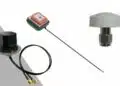
As AI servers and GPU accelerators push to higher performance and power density, their power delivery networks are undergoing a major architectural shift. Designers are increasingly replacing aluminum polymer capacitors with advanced multilayer ceramic capacitors (MLCCs) to meet stringent requirements for transient response, footprint, and reliability according to Samsung Electro-Mechanics post.

Rising Power Demand in AI Servers

Modern AI servers integrate multiple high‑power GPUs and custom accelerators, which generate large, fast load transients on the power rails. Traditional aluminum polymer capacitors struggle to keep pace with these dynamic profiles, especially as switching frequencies rise and board space becomes constrained. This environment favors capacitors that offer low impedance at high frequencies, compact size, and high capacitance density.

RelatedPosts

Samsungs Low ESL MLCCs to Power Next-Generation ADAS SoCs

Samsung Releases 1uF 25V 0402 MLCC for AI Power Modules 

Samsung Presents Worlds First 100V 22nF Automotive MLCC in 0402 Size

Why MLCCs Are Replacing Aluminum Polymer Capacitors

  • Smaller size and lower height: MLCCs provide high capacitance in a compact form factor, making them ideal for dense GPU modules and low‑profile server cards.
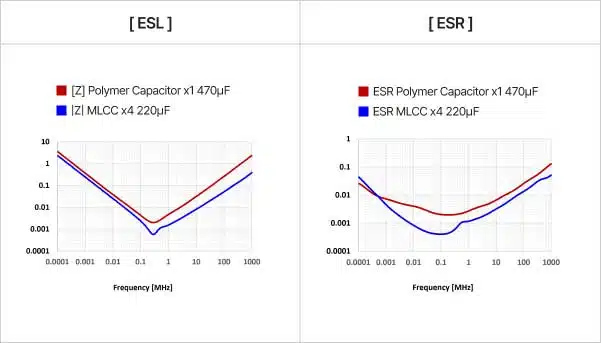
  • Excellent high‑frequency characteristics: Very low ESR and ESL enable MLCCs to handle fast current transients and reduce voltage droop during GPU load steps.
  • Improved board utilization: By configuring multiple MLCCs in parallel, designers can implement the required bulk capacitance while freeing PCB area for signal routing and thermal solutions.
  • Robust supply chain: A broader supplier base and mature manufacturing ecosystem contribute to more stable sourcing compared to aluminum polymer capacitors.
Fig. 1. Example layout of MLCC to Aluminum Polymer Capacitor replacement.
Fig-2. ESR and ESL comparison of MLCC and Aluminum Polymer Capacitors solution

Impact on Power Delivery Network Design

In AI server VRMs and GPU power stages, the combination of higher switching frequencies and large transient currents demands capacitors that remain effective in the 1–2 MHz range. MLCCs excel here due to their low impedance characteristics, which improve output voltage stability and reduce the magnitude and duration of undershoot and overshoot during load steps.

At the same time, strict mechanical and thermal constraints in GPU boards and server motherboards favor lower component profiles. MLCC‑based solutions help designers maintain or even reduce module height while meeting target capacitance and ripple current specifications.

High-CV Mid-to-Large MLCCs for AI Applications

Recent advances in Samsung Electro-Mechanics high‑CV mid‑to‑large MLCCs have opened up application areas that were previously dominated by aluminum polymer capacitors. These high‑capacitance devices, available in popular case sizes such as 0603, 1206 and 1210, support low‑voltage rails commonly used in AI GPU cores and memory systems.

Part NumberSize (inch/mm)CapacitanceRated VoltageTCCData SheetSamples
CL10X107MS8NZW#0603 / 1608100 µF2.5 VdcX6SDownloadAvailable
CL31X227MRKNNW#1206 / 3216220 µF4.0 VdcX6SDownloadAvailable
CL31A227MQKNNW#1206 / 3216220 µF6.3 VdcX5RDownloadAvailable
CL31Z107MRKN4N#1206 / 3216100 µF4.0 VdcX7TDownloadAvailable
CL32X337MSVN4S#1210 / 3225330 µF2.5 VdcX6SDownloadAvailable
CL32Z227MSVN4S#1210 / 3225220 µF2.5 VdcX7TDownloadAvailable

Design Takeaways for Power Engineers

  • Use parallel MLCC banks near the GPU or AI accelerator to minimize loop inductance and improve transient response.
  • Select MLCCs with appropriate voltage derating and temperature characteristics (e.g., X6S, X5R, X7T) for the target rail and environment.
  • Validate impedance and ripple performance at the actual switching frequency range of the VRM, not only at low frequencies.
  • Consider mechanical constraints and PCB warpage when deploying high‑capacitance MLCC arrays in tight layouts.

By leveraging high‑CV MLCCs in mid‑to‑large case sizes, AI server and GPU designers can build more compact, efficient, and robust power delivery networks that keep pace with the rapid evolution of AI workloads.

Related

Source: Samsung Electro-Mechanics

Recent Posts

Reliability Improvement in BaTiO3 MLCCs Using Ni–Sn and Ni–In Alloy Electrodes

19.12.2025
6

Littelfuse Introduces Automotive Current Sensors for EV Battery, Motor, and Safety Systems

18.12.2025
3

Mechanical Testing of Tantalum Anodes to Predict Tantalum Capacitor Quality

17.12.2025
21

Jianghai Offers Custom Bottom Cooled Screw Aluminum Capacitors

17.12.2025
35

TDK Unveils Vibration-Resistant Hybrid Polymer Aluminum Capacitors

15.12.2025
22

Vishay Releases Automotive Glass Protected 0402 NTC Thermistor

11.12.2025
15

Samsungs Low ESL MLCCs to Power Next-Generation ADAS SoCs

10.12.2025
26

YAGEO Launches Hybrid Polymer Radial Capacitor for High-Reliability Automotive and Power Applications

10.12.2025
29

Industry Smallest Dual-Pole Reed Relay Wins Elektra Awards 2025

10.12.2025
17

Upcoming Events

Dec 19
12:00 - 14:00 EST

External Visual Inspection per MIL-STD-883 TM 2009

Jan 27
16:00 - 17:00 CET

Simplifying Vehicle Development with Automotive Ethernet and Zonal Smart Switch Technologies

Feb 24
16:00 - 17:00 CET

Designing Qi2 Wireless Power Systems: Practical Development and EMC Optimization

View Calendar

Popular Posts

  • Buck Converter Design and Calculation

    0 shares
    Share 0 Tweet 0
  • Boost Converter Design and Calculation

    0 shares
    Share 0 Tweet 0
  • LLC Resonant Converter Design and Calculation

    0 shares
    Share 0 Tweet 0
  • Flyback Converter Design and Calculation

    0 shares
    Share 0 Tweet 0
  • What Electronics Engineer Needs to Know About Passive Low Pass Filters

    0 shares
    Share 0 Tweet 0
  • Dual Active Bridge (DAB) Topology

    0 shares
    Share 0 Tweet 0
  • Ripple Current and its Effects on the Performance of Capacitors

    3 shares
    Share 3 Tweet 0
  • What is a Dielectric Constant and DF of Plastic Materials?

    4 shares
    Share 4 Tweet 0
  • MLCC and Ceramic Capacitors

    0 shares
    Share 0 Tweet 0
  • SEPIC Converter Design and Calculation

    0 shares
    Share 0 Tweet 0

Newsletter Subscription


Passive Components Blog

© EPCI - Leading Passive Components Educational and Information Site

  • Home
  • Privacy Policy
  • EPCI Membership & Advertisement
  • About

No Result
View All Result
  • Home
  • Knowledge Blog
  • PCNS

© EPCI - Leading Passive Components Educational and Information Site

This website uses cookies. By continuing to use this website you are giving consent to cookies being used. Visit our Privacy and Cookie Policy.
Go to mobile version