









Passive Components Blog
No Result
View All Result
  • Home
  • NewsFilter
    • All
    • Aerospace & Defence
    • Antenna
    • Applications
    • Automotive
    • Capacitors
    • Circuit Protection Devices
    • electro-mechanical news
    • Filters
    • Fuses
    • Inductors
    • Industrial
    • Integrated Passives
    • inter-connect news
    • Market & Supply Chain
    • Market Insights
    • Medical
    • Modelling and Simulation
    • New Materials & Supply
    • New Technologies
    • Non-linear Passives
    • Oscillators
    • Passive Sensors News
    • Resistors
    • RF & Microwave
    • Telecommunication
    • Weekly Digest

    Bourns Offers Custom Magnetics for 3‑Phase Flying Capacitor Inverters

    YAGEO Releases Cost Efficient Pt‑RTD Sensors with Ni wires

    Nvidia Vera Rubin: Why One AI Rack Needs So Many More MLCC Capacitors

    Stackpole Introduces 1400A Busbar Shunt Resistors

    Tecate Unveils High‑temp 105C Supercapacitors for Harsh‑Environment Designs

    Bourns Expands 1000V High‑Power Fuses for Semiconductor and Battery Protection

    Passive Components in 2026: From Invisible Commodity to Design Parameter

    Bourns Introduces High Current Chip Ferrite Beads for Dense Power Rails

    Wk 22 Electronics Supply Chain Digest

    Trending Tags

    • Ripple Current
    • RF
    • Leakage Current
    • Tantalum vs Ceramic
    • Snubber
    • Low ESR
    • Feedthrough
    • Derating
    • Dielectric Constant
    • New Products
    • Market Reports
  • VideoFilter
    • All
    • Antenna videos
    • Capacitor videos
    • Circuit Protection Video
    • Filter videos
    • Fuse videos
    • Inductor videos
    • Inter-Connect Video
    • Non-linear passives videos
    • Oscillator videos
    • Passive sensors videos
    • Resistor videos

    Current Sense Transformer Datasheet and Design‑in Guide

    Designing a USB Type‑C Flyback Planar Transformer with Frenetic’s Planar Tool

    Magnetics Design in High‑Frequency GaN Converters

    Qi2 Wireless Charging: Inductors, Capacitors and EMC Filters

    Two‑capacitor paradox explained for engineers

    Capacitances of Nonlinear MLCCs: What Datasheets Don’t Tell You

    Tapped Inductor Buck Converter Fundamentals

    Planar vs Conventional Transformer: When it Make Sense

    Modeling Fringing Field Losses in Inductors & Transformers

    Trending Tags

    • Capacitors explained
    • Inductors explained
    • Resistors explained
    • Filters explained
    • Application Video Guidelines
    • EMC
    • New Products
    • Ripple Current
    • Simulation
    • Tantalum vs Ceramic
  • Knowledge Blog
  • DossiersNew
  • Suppliers
    • Who is Who
  • PCNS
    • PCNS 2025
    • PCNS 2023
    • PCNS 2021
    • PCNS 2019
    • PCNS 2017
  • Events
  • Home
  • NewsFilter
    • All
    • Aerospace & Defence
    • Antenna
    • Applications
    • Automotive
    • Capacitors
    • Circuit Protection Devices
    • electro-mechanical news
    • Filters
    • Fuses
    • Inductors
    • Industrial
    • Integrated Passives
    • inter-connect news
    • Market & Supply Chain
    • Market Insights
    • Medical
    • Modelling and Simulation
    • New Materials & Supply
    • New Technologies
    • Non-linear Passives
    • Oscillators
    • Passive Sensors News
    • Resistors
    • RF & Microwave
    • Telecommunication
    • Weekly Digest

    Bourns Offers Custom Magnetics for 3‑Phase Flying Capacitor Inverters

    YAGEO Releases Cost Efficient Pt‑RTD Sensors with Ni wires

    Nvidia Vera Rubin: Why One AI Rack Needs So Many More MLCC Capacitors

    Stackpole Introduces 1400A Busbar Shunt Resistors

    Tecate Unveils High‑temp 105C Supercapacitors for Harsh‑Environment Designs

    Bourns Expands 1000V High‑Power Fuses for Semiconductor and Battery Protection

    Passive Components in 2026: From Invisible Commodity to Design Parameter

    Bourns Introduces High Current Chip Ferrite Beads for Dense Power Rails

    Wk 22 Electronics Supply Chain Digest

    Trending Tags

    • Ripple Current
    • RF
    • Leakage Current
    • Tantalum vs Ceramic
    • Snubber
    • Low ESR
    • Feedthrough
    • Derating
    • Dielectric Constant
    • New Products
    • Market Reports
  • VideoFilter
    • All
    • Antenna videos
    • Capacitor videos
    • Circuit Protection Video
    • Filter videos
    • Fuse videos
    • Inductor videos
    • Inter-Connect Video
    • Non-linear passives videos
    • Oscillator videos
    • Passive sensors videos
    • Resistor videos

    Current Sense Transformer Datasheet and Design‑in Guide

    Designing a USB Type‑C Flyback Planar Transformer with Frenetic’s Planar Tool

    Magnetics Design in High‑Frequency GaN Converters

    Qi2 Wireless Charging: Inductors, Capacitors and EMC Filters

    Two‑capacitor paradox explained for engineers

    Capacitances of Nonlinear MLCCs: What Datasheets Don’t Tell You

    Tapped Inductor Buck Converter Fundamentals

    Planar vs Conventional Transformer: When it Make Sense

    Modeling Fringing Field Losses in Inductors & Transformers

    Trending Tags

    • Capacitors explained
    • Inductors explained
    • Resistors explained
    • Filters explained
    • Application Video Guidelines
    • EMC
    • New Products
    • Ripple Current
    • Simulation
    • Tantalum vs Ceramic
  • Knowledge Blog
  • DossiersNew
  • Suppliers
    • Who is Who
  • PCNS
    • PCNS 2025
    • PCNS 2023
    • PCNS 2021
    • PCNS 2019
    • PCNS 2017
  • Events
No Result
View All Result
Passive Components Blog
No Result
View All Result

Smoltek Releases New Generation of its CNF-MIM Capacitors Boosting Capacitance Density

22.4.2024
Reading Time: 2 mins read
A A

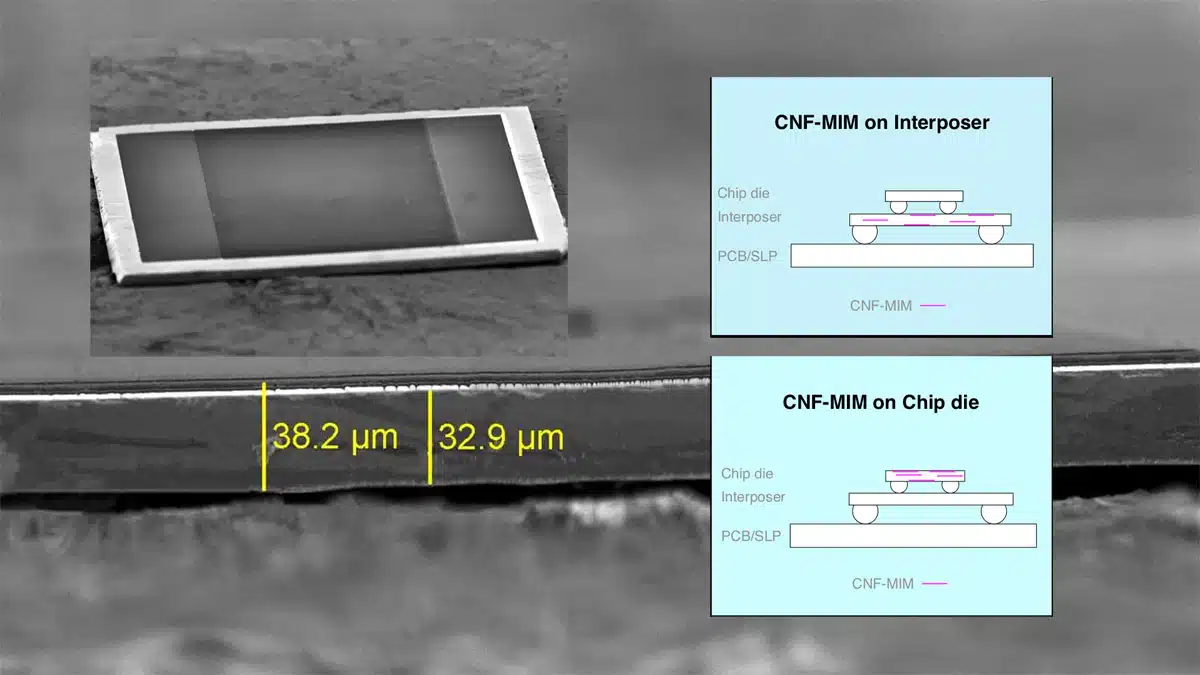
Smoltek Nanotech Holding AB (“Smoltek”) announces that the group company Smotek Semi has developed a new technology generation of the company’s carbon nanofiber wafer-based capacitor technology, CNF-MIM.

The new generation, called Gen-Zero, is the foundation for achieving the goal of manufacturing different types of capacitors with very high capacitance density. High capacitance density combined with an extremely small form factor is a requirement for next-generation capacitors for advanced electronic products, such as mobile phones.

RelatedPosts

Smoltek CNF-MIM Capacitors Hit 1,000x Lower Leakage

Smoltek CNF-MIM Capacitors Pass 1,000h Reliability Test

Smolteks CNF-MIM Capacitors Meet Thermal and Voltage Stability Industry Requirements

During 2023 group company Smoltek Semi has worked on developing a new technology generation of the company’s CNF-MIM capacitors with high volumetric capacitance density. Gen-Zero, as it is called, has recently been completed as part of the collaboration with YAGEO, with Smoltek Semi owning all rights to the result.

“Although we have currently concluded discussions regarding a license and service agreement for the capacitors, YAGEO still has a great interest in our technology and will help us evaluate the results of upcoming Gen-One capacitors”, says Farzan Ghavanini, CTO at Smoltek.

High capacitance in a small area – and the importance of volumetric capacitance density 

Smoltek’s carbon nanofiber-based capacitor technology, CNF-MIM, creates high capacitance values by growing extremely thin and tall carbon nanofibers on top of a silicon substrate. With this technology, a very high capacitance is created in a very small area. This is fundamental and demanded from the capacitor manufacturers and their customers worldwide.

“Smoltek’s technology differs from competitors’, which etch deep trenches, or holes, in the silicon substrate. To fairly evaluate the two technologies, one must look at the volumetric capacitance density. This means that you must compare how much capacitance you can get in a given volume in a CNF-MIM capacitor compared to that of the competitors”, Farzan Ghavanini explains.

With the new Gen-Zero capacitors, Smoltek can create a volumetric capacitance density of up to 120 nanofarads per square millimeter and per 1 micrometer of carbon nanofiber. This is comparable to the best capacitors on the market.

The capacitance values in the Gen-Zero capacitors are, however, lower than the competitors. This is due to the fact that Smoltek Semi has not yet optimized the length of the fibers. The carbon nanofibers in Gen-Zero are only a few of micrometers tall. In the next generation, Gen-One, the ambition is to grow longer carbon nanofibers, up to 10 micrometers tall, which is expected to bring the capacitance values on par with the competitors.

“Although we can provide a very high volumetric capacitance density, there is still work to be done to reach our full potential. The ongoing Gen-One project will already during this year prove the strength and potential of our technology to create a world-leading capacitor product”, Farzan Ghavanini concludes.

Related

Source: Smoltek

Recent Posts

Nvidia Vera Rubin: Why One AI Rack Needs So Many More MLCC Capacitors

2.6.2026
40

Tecate Unveils High‑temp 105C Supercapacitors for Harsh‑Environment Designs

2.6.2026
10

Passive Components in 2026: From Invisible Commodity to Design Parameter

2.6.2026
20

May 2026 Interconnect, Passives and Electromechanical Components Market Insights

29.5.2026
93

Passive Components Enable Safe and Reliable ADAS Architectures

28.5.2026
68

YMIN Releases Square Supercapacitors for AI Server Power System

27.5.2026
51

Exxelia Extends Temperature Range of its PP Film Capacitors to 140C

1.6.2026
47

Nichicon Presents Self-Charging LTO Board for Maintenance-Free IoT Nodes

26.5.2026
28

Mechanical SSC Testing as a Structural Diagnostic Tool for Tantalum Capacitor Anodes

25.5.2026
52

Upcoming Events

Jun 16
16:00 - 17:00 CEST

EMC with EMC – EMC‑compliant design with electromechanical connectors

View Calendar

Popular Posts

  • Buck Converter Design and Calculation

    0 shares
    Share 0 Tweet 0
  • Boost Converter Design and Calculation

    0 shares
    Share 0 Tweet 0
  • Flyback Converter Design and Calculation

    0 shares
    Share 0 Tweet 0
  • MLCC and Ceramic Capacitors

    0 shares
    Share 0 Tweet 0
  • LLC Resonant Converter Design and Calculation

    0 shares
    Share 0 Tweet 0
  • Capacitor Charging and Discharging

    0 shares
    Share 0 Tweet 0
  • What Electronics Engineer Needs to Know About Passive Low Pass Filters

    0 shares
    Share 0 Tweet 0
  • Dual Active Bridge (DAB) Topology

    0 shares
    Share 0 Tweet 0
  • Ripple Current and its Effects on the Performance of Capacitors

    3 shares
    Share 3 Tweet 0
  • SEPIC Converter Design and Calculation

    0 shares
    Share 0 Tweet 0

Newsletter Subscription


Passive Components Blog

© EPCI - Leading Passive Components Educational and Information Site

  • Home
  • Privacy Policy
  • EPCI Membership & Advertisement
  • About

No Result
View All Result
  • Home
  • Knowledge Blog
  • Dossiers
  • PCNS

© EPCI - Leading Passive Components Educational and Information Site

This website uses cookies. By continuing to use this website you are giving consent to cookies being used. Visit our Privacy and Cookie Policy.
Go to mobile version