













Passive Components Blog
No Result
View All Result
  • Home
  • NewsFilter
    • All
    • Aerospace & Defence
    • Antenna
    • Applications
    • Automotive
    • Capacitors
    • Circuit Protection Devices
    • electro-mechanical news
    • Filters
    • Fuses
    • Inductors
    • Industrial
    • Integrated Passives
    • inter-connect news
    • Market & Supply Chain
    • Market Insights
    • Medical
    • Modelling and Simulation
    • New Materials & Supply
    • New Technologies
    • Non-linear Passives
    • Oscillators
    • Passive Sensors News
    • Resistors
    • RF & Microwave
    • Telecommunication
    • Weekly Digest

    Equivalent Circuit Constants of Crystal Units Explained

    Vishay Releases Compact High‑Accuracy Hall Effect Linear Position Sensor

    Nanocrystalline Cores for Low‑Loss MHz Chip Inductors

    Exxelia Miniaturized 400 MHz Inverted‑F Antenna

    Würth Elektronik Unveils High-Current Automotive Power Inductor

    Transformer-Based Power-Line Harvester Magnetic Design

    Tantalum Capacitor Anode Manufacturing Quality Management

    Middle East Conflict: The Potential Impact to Passive Components

    Wk 12 Electronics Supply Chain Digest

    Trending Tags

    • Ripple Current
    • RF
    • Leakage Current
    • Tantalum vs Ceramic
    • Snubber
    • Low ESR
    • Feedthrough
    • Derating
    • Dielectric Constant
    • New Products
    • Market Reports
  • VideoFilter
    • All
    • Antenna videos
    • Capacitor videos
    • Circuit Protection Video
    • Filter videos
    • Fuse videos
    • Inductor videos
    • Inter-Connect Video
    • Non-linear passives videos
    • Oscillator videos
    • Passive sensors videos
    • Resistor videos

    Transformer-Based Power-Line Harvester Magnetic Design

    Thermal Modeling of Magnetics

    Standard vs Planar LLC transformers Comparison for Battery Chargers

    How Modern Tools Model Magnetic Components for Power Electronics

    Advanced Loss Modeling for Planar Magnetics in the Frenetic Planar Tool

    2026 Power Magnetics Design Trends: Flyback, DAB and Planar

    Enabling Software‑Defined Vehicle Architectures: Automotive Ethernet and Zonal Smart Power

    Calculating Resistance Value of a Flyback RC Snubber 

    One‑Pulse Characterization of Nonlinear Power Inductors

    Trending Tags

    • Capacitors explained
    • Inductors explained
    • Resistors explained
    • Filters explained
    • Application Video Guidelines
    • EMC
    • New Products
    • Ripple Current
    • Simulation
    • Tantalum vs Ceramic
  • Knowledge Blog
  • DossiersNew
  • Suppliers
    • Who is Who
  • PCNS
    • PCNS 2025
    • PCNS 2023
    • PCNS 2021
    • PCNS 2019
    • PCNS 2017
  • Events
  • Home
  • NewsFilter
    • All
    • Aerospace & Defence
    • Antenna
    • Applications
    • Automotive
    • Capacitors
    • Circuit Protection Devices
    • electro-mechanical news
    • Filters
    • Fuses
    • Inductors
    • Industrial
    • Integrated Passives
    • inter-connect news
    • Market & Supply Chain
    • Market Insights
    • Medical
    • Modelling and Simulation
    • New Materials & Supply
    • New Technologies
    • Non-linear Passives
    • Oscillators
    • Passive Sensors News
    • Resistors
    • RF & Microwave
    • Telecommunication
    • Weekly Digest

    Equivalent Circuit Constants of Crystal Units Explained

    Vishay Releases Compact High‑Accuracy Hall Effect Linear Position Sensor

    Nanocrystalline Cores for Low‑Loss MHz Chip Inductors

    Exxelia Miniaturized 400 MHz Inverted‑F Antenna

    Würth Elektronik Unveils High-Current Automotive Power Inductor

    Transformer-Based Power-Line Harvester Magnetic Design

    Tantalum Capacitor Anode Manufacturing Quality Management

    Middle East Conflict: The Potential Impact to Passive Components

    Wk 12 Electronics Supply Chain Digest

    Trending Tags

    • Ripple Current
    • RF
    • Leakage Current
    • Tantalum vs Ceramic
    • Snubber
    • Low ESR
    • Feedthrough
    • Derating
    • Dielectric Constant
    • New Products
    • Market Reports
  • VideoFilter
    • All
    • Antenna videos
    • Capacitor videos
    • Circuit Protection Video
    • Filter videos
    • Fuse videos
    • Inductor videos
    • Inter-Connect Video
    • Non-linear passives videos
    • Oscillator videos
    • Passive sensors videos
    • Resistor videos

    Transformer-Based Power-Line Harvester Magnetic Design

    Thermal Modeling of Magnetics

    Standard vs Planar LLC transformers Comparison for Battery Chargers

    How Modern Tools Model Magnetic Components for Power Electronics

    Advanced Loss Modeling for Planar Magnetics in the Frenetic Planar Tool

    2026 Power Magnetics Design Trends: Flyback, DAB and Planar

    Enabling Software‑Defined Vehicle Architectures: Automotive Ethernet and Zonal Smart Power

    Calculating Resistance Value of a Flyback RC Snubber 

    One‑Pulse Characterization of Nonlinear Power Inductors

    Trending Tags

    • Capacitors explained
    • Inductors explained
    • Resistors explained
    • Filters explained
    • Application Video Guidelines
    • EMC
    • New Products
    • Ripple Current
    • Simulation
    • Tantalum vs Ceramic
  • Knowledge Blog
  • DossiersNew
  • Suppliers
    • Who is Who
  • PCNS
    • PCNS 2025
    • PCNS 2023
    • PCNS 2021
    • PCNS 2019
    • PCNS 2017
  • Events
No Result
View All Result
Passive Components Blog
No Result
View All Result

Tantalum Capacitors: Best Practices for Increasing Profitability in 2019

27.8.2019
Reading Time: 2 mins read
A A

Source: Paumanok blog

The global capacitor industry, which for the purposes of this article includes ceramic, aluminum, tantalum , plastic film and carbon capacitors of all types and configurations, accounted for approximately $30 billion US dollars in global revenues for FY 2019 (Fiscal Year ending March) with almost 4 trillion pieces shipped, and 2 trillion consumed.

RelatedPosts

Equivalent Circuit Constants of Crystal Units Explained

Vishay Releases Compact High‑Accuracy Hall Effect Linear Position Sensor

Nanocrystalline Cores for Low‑Loss MHz Chip Inductors

Fixed and Variable Costs To Produce Capacitors:

In the worldwide capacitor industry, fixed costs represent about 20% of the costs of goods sold, while variable costs- those that fluctuate, represent a full 80% of CGS; with vendors focusing primarily on variable costs as the area to improve profitability. Variable costs include raw material costs, labor costs, variable overhead costs and variable manufacturing costs.

Raw Materials: The Largest Single Variable Associated With Cost of Goods Sold:

Raw material costs represent the largest single cost factor in the production of capacitors regardless of dielectric, so the reader will notice that many historical methods for cost savings and increased profitability are related to management and manipulation of the costs associated with buying and processing raw materials, which include feedstocks, engineered dielectrics, cathode materials, additives, electrodes, terminations and leads.

Tantalum Capacitors: Documented Methods for Increasing Profitability-

Vertical Integration of Powder and Wire Production:

It is difficult to find cost savings for the production of tantalum capacitors, because unlike the other capacitor dielectrics, it is extremely difficult to produce capacitor grade tantalum metal powder, requiring a level of expertise that is considered advanced among metallurgists.

The chemistry and processing capabilities to create tantalum pentoxide, the active ingredient in tantalum capacitor anodes- are significantly advanced and require a level of expertise that is beyond the capabilities of many governments, much less trade vendors. Therefore the number of active production facilities that can produce capacitor grade powder and wire is limited worldwide to Japan, Germany, China and the USA.

However, the vertical integration of a smaller tantalum powder producer into the largest tantalum capacitor manufacturer has shown, through presentations and reports to the financial community, that such actions can produce significant cost savings over time by eliminating the premiums associated with the merchant market.

Tantalum wire production has become more prevalent in the supply chain with more and more capacitor manufacturers bringing wire drawing capabilities in-house. This is prevalent in the tantalum supply chain because of the dwindling number of merchant vendors of tantalum wire.

Cathode Application- Gas Versus Dipping:

A gas infusion process for the application of conductive polymers into the porous structure of tantalum anodes generates a higher margin than the alternative monomer and polymer “dipping” process due to the excessive waste stream associated with impregnating anodes by chemical bath. Manufacturing facilities that employ dipping processes to impregnate anode porous structure with conductive polymers have also taken steps to limit the number of dip cycles as a method of cost savings as well.

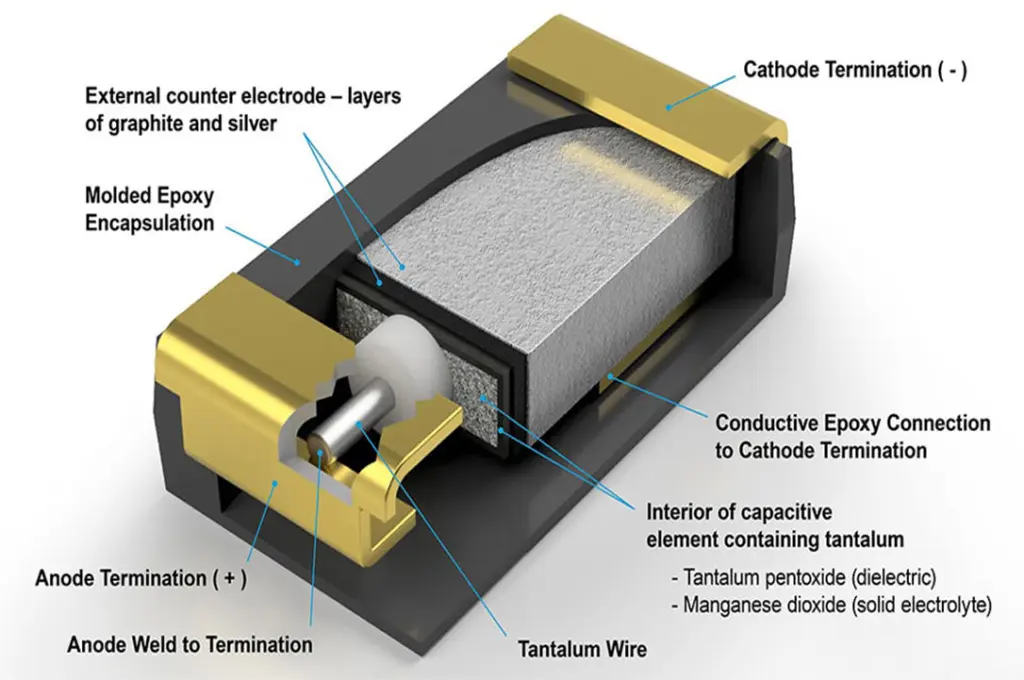
featured image source: AVX Corporation

Related

Recent Posts

Tantalum Capacitor Anode Manufacturing Quality Management

23.3.2026
21

Middle East Conflict: The Potential Impact to Passive Components

23.3.2026
94

Inductor Technology Dossier

19.3.2026
48

Rutheniums Critical Role in Passive Component Supply Chains

19.3.2026
36

Murata to Decouple China Rare Earth Supply in 3 Years

19.3.2026
165

Hirose Electric to Establish Automotive Connector Plant in India

19.3.2026
17
Schematic illustration of the electric double layer of porous carbon electrodes at elevated potentials in a a conventional electrolyte and b a weakly solvating electrolyte; source: authors

Researchers Presented Lignin-based Electrolyte for 4V Supercapacitors with Low Self‑Discharge

19.3.2026
25

Samsung Outlines Growth Roadmap at its 52nd General Shareholders Meeting

19.3.2026
24

Samsung Electro-Mechanics Enters LEO Satellite Market With High‑Reliability MLCCs

19.3.2026
37

Upcoming Events

Apr 21
16:00 - 17:00 CEST

Heatsink Solutions: Thermal Management in electronic devices

May 5
16:00 - 17:00 CEST

Understanding and Selecting Capacitors – Fundamentals, Technologies and Latest Trends

May 19
16:00 - 17:00 CEST

Designing Qi2 Wireless Power Systems: Practical Development and EMC Optimization

View Calendar

Popular Posts

  • Buck Converter Design and Calculation

    0 shares
    Share 0 Tweet 0
  • Boost Converter Design and Calculation

    0 shares
    Share 0 Tweet 0
  • Flyback Converter Design and Calculation

    0 shares
    Share 0 Tweet 0
  • LLC Resonant Converter Design and Calculation

    0 shares
    Share 0 Tweet 0
  • Dual Active Bridge (DAB) Topology

    0 shares
    Share 0 Tweet 0
  • MLCC and Ceramic Capacitors

    0 shares
    Share 0 Tweet 0
  • Ripple Current and its Effects on the Performance of Capacitors

    3 shares
    Share 3 Tweet 0
  • MLCC Case Sizes Standards Explained

    0 shares
    Share 0 Tweet 0
  • What is a Dielectric Constant and DF of Plastic Materials?

    4 shares
    Share 4 Tweet 0
  • MLCC Manufacturers Consider Price Increase as AI Demand Outpaces Supply

    0 shares
    Share 0 Tweet 0

Newsletter Subscription


Passive Components Blog

© EPCI - Leading Passive Components Educational and Information Site

  • Home
  • Privacy Policy
  • EPCI Membership & Advertisement
  • About

No Result
View All Result
  • Home
  • Knowledge Blog
  • PCNS

© EPCI - Leading Passive Components Educational and Information Site

This website uses cookies. By continuing to use this website you are giving consent to cookies being used. Visit our Privacy and Cookie Policy.
Go to mobile version