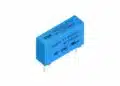

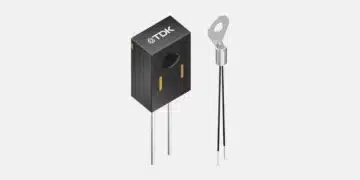






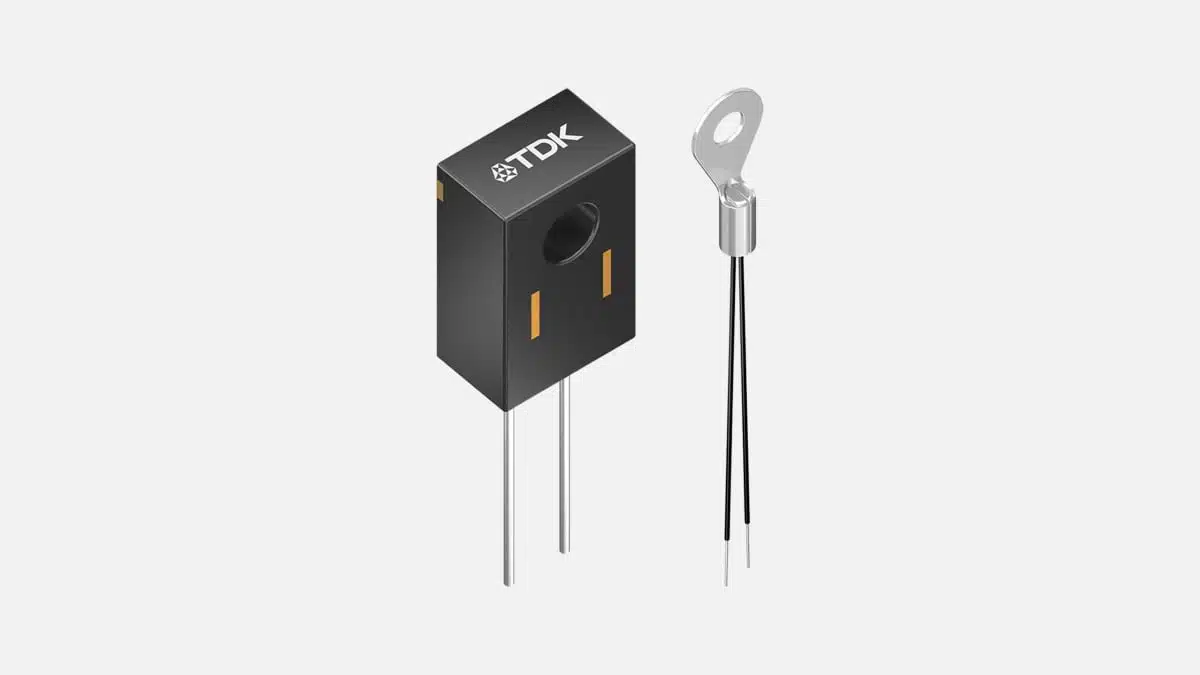
TDK has introduced the M704 and M705 NTC temperature-sensor series for surface-temperature measurement in high-voltage power electronics.
Both use a 10 kΩ sensing characteristic, but offer different mounting arrangements, temperature limits and thermal response times. The M704 combines PCB-compatible leads with screw mounting, while the M705 uses a metal-tag ring lug for attachment to the measured surface.
Key features and benefits
- Shared sensing characteristic: both series have a resistance of 10 kΩ at 25 °C, resistance tolerance of ±2% and a B25/100 value of 3988 K ±1%.
- M704 insulation test capability: 4000 V AC for 1 s, with an operating temperature range of −40 °C to +125 °C.
- M705 temperature capability: an operating temperature range of −40 °C to +180 °C, with an insulation test voltage of 2500 V AC for 1 s.
- Different mechanical interfaces: the M704 has 3.5 mm lead spacing and supports screw mounting with M3 screws; the M705 provides a screw-on metal-tag ring lug.
- Different thermal responses: thermal time constants on a metal plate are approximately 34 s for the M704 and 6.2 s for the M705.
Technical highlights
The two NTC thermistor assemblies share the same nominal resistance and B value. Their principal selection differences lie in insulation testing, operating temperature, thermal behaviour and mechanical integration.
| Parameter | M704 | M705/10k/A1 |
|---|---|---|
| Ordering code | B57704M0103A001 | B57705M0103A001 |
| Resistance at 25 °C | 10 kΩ | 10 kΩ |
| Resistance tolerance | ±2% | ±2% |
| B25/100 | 3988 K ±1% | 3988 K ±1% |
| Operating temperature | −40 °C to +125 °C | −40 °C to +180 °C |
| AC test voltage, 1 s | 4000 V | 2500 V |
| Maximum power at 25 °C | 60 mW | 150 mW |
| Dissipation factor in air | Approx. 8 mW/K | Approx. 3.5 mW/K |
| Time constant on metal plate | Approx. 34 s | Approx. 6.2 s |
| R/T characteristic | 8016 | 8016 |
Electrical characteristic and measurement accuracy
The 10 kΩ rating establishes resistance at 25 °C. The B25/100 value characterises the resistance–temperature relationship between 25 °C and 100 °C, while characteristic 8016 provides the resistance ratios needed for temperature conversion across the operating range.
Resistance tolerance and B-value tolerance are separate selection parameters. The ±2% resistance tolerance is not a ±2% temperature-accuracy rating. Temperature conversion should use the characteristic 8016 resistance–temperature table over the required measurement interval.
Insulation test voltage and system voltage
The test voltage is 4000 V AC for the M704 and 2500 V AC for the M705, applied for 1 s. These are short-duration insulation-test values, not continuous working-voltage ratings.
Selection therefore needs to distinguish the sensor’s insulation test from the system’s operating voltage, transients and fault conditions. The sensor, attachment and measurement circuit must be assessed together as part of the equipment’s insulation design.
Mechanical integration and thermal response
The M704 uses a plastic case with a brass plate. Its tin-plated solid-copper leads have a diameter of 0.5 mm, a length of 15 ±1 mm and 3.5 mm spacing. The combination accommodates PCB integration and screw attachment to a measurement surface.
The M705 uses a metal-tag ring lug and 50 ±3 mm leads. Its leads have PEEK insulation and a silver-plated nickel core with a diameter of 0.25 mm.
On a metal plate, the M705 has an approximately 6.2 s thermal time constant, compared with approximately 34 s for the M704. These values describe the tested mounting condition; the finished assembly’s contact interface and heat paths also affect its response.
Typical applications
Target applications include:
- UPS and PSU systems in data centres.
- Charging stations.
- Photovoltaic inverters.
- Industrial power electronics.
Application fit
For data-centre PSU heat-sink monitoring, the M704 combines surface measurement with a +125 °C upper operating limit and a 4000 V AC insulation test for 1 s. Its lead spacing supports a mechanical arrangement that connects the sensor to a PCB while fastening it to the measured surface.
For surface-temperature monitoring requiring operation above +125 °C, the M705 extends the upper limit to +180 °C. Its ring-lug mounting and approximately 6.2 s time constant on a metal plate make attachment and thermal response central selection considerations.
The choice is not simply between two interchangeable 10 kΩ sensors. The M704 offers the higher insulation-test voltage; the M705 offers the higher operating-temperature ceiling and shorter metal-plate thermal time constant.
Design-in notes for engineers
- Match the conversion curve. Use characteristic 8016 and include both resistance and B-value tolerances in the measurement error budget.
- Set measurement excitation separately from maximum power. The 60 mW and 150 mW limits at 25 °C are component power limits, not recommended sensing-power levels. Assess excitation together with the dissipation factor and installed thermal coupling.
- Define the thermal attachment. Keep the mounting surface and contacts clean, and avoid thermomechanical stress from fastening, potting or adjacent materials.
- Protect the leads. Avoid tensile loading and bending directly at the sensor body. Provide mechanical relief during lead forming and assembly.
- Control environmental exposure. Prevent liquid ingress and avoid condensation. Surrounding materials must withstand the sensor’s operating temperature.
- Include a fail-safe response. A sensor malfunction should not allow secondary equipment damage.
- Validate final selection under the actual electrical, thermal, mechanical and environmental operating conditions before production release.
Further reading
- Thermistor-Based Temperature Sensing System Explained
- TDK technical guide: How to Use Temperature Protection Devices : Chip NTC Thermistors
Source
This article is based on the TDK product announcement and official product documentation. Engineers should refer to the current manufacturer datasheet for final design and qualification.
References
- NTC thermistors for temperature measurement — Probe assemblies — M704, TDK Electronics, June 4, 2025.
- NTC thermistors for temperature measurement — Probe assemblies — M705/10k/A1, TDK Electronics, May 16, 2025.
- NTC Temperature Sensors — AI data center cooling solutions, TDK Electronics, July 2025.
- TDK presents robust and easy-to-mount NTC systems for demanding industrial applications with voltages up to 4000 V, TDK Electronics, October 22, 2026.