














Passive Components Blog
No Result
View All Result
  • Home
  • NewsFilter
    • All
    • Aerospace & Defence
    • Antenna
    • Applications
    • Automotive
    • Capacitors
    • Circuit Protection Devices
    • electro-mechanical news
    • Filters
    • Fuses
    • Inductors
    • Industrial
    • Integrated Passives
    • inter-connect news
    • Market & Supply Chain
    • Market Insights
    • Medical
    • Modelling and Simulation
    • New Materials & Supply
    • New Technologies
    • Non-linear Passives
    • Oscillators
    • Passive Sensors News
    • Resistors
    • RF & Microwave
    • Telecommunication
    • Weekly Digest

    High-Q RF & Microwave MLCCs: A Cross-Vendor Benchmark

    Molex Unveils Automotive Ethernet Connectors for Next‑Gen SDV Architectures

    TAIYO YUDEN Introduced Hybrid Aluminum Capacitors for 48V Automotive Power Supplies

    ECIA Industry Pulse June 2026 Reaches Five‑Year High

    YAGEO Announces July 2026 Capacitor Price Increase

    YAGEO Presents Single-Phase Common Mode Chokes for Industrial EMI Suppression

    Enabling the 800 V AI Server Era: How C0G High-Voltage MLCC Supports Next-Generation Power Architectures

    binder Prints Electronics on 3D Components Connector Surface

    Vishay Introduces SMD Polymer PTC Thermistors for Fast Resettable Overcurrent Protection

    Trending Tags

    • Ripple Current
    • RF
    • Leakage Current
    • Tantalum vs Ceramic
    • Snubber
    • Low ESR
    • Feedthrough
    • Derating
    • Dielectric Constant
    • New Products
    • Market Reports
  • VideoFilter
    • All
    • Antenna videos
    • Capacitor videos
    • Circuit Protection Video
    • Filter videos
    • Fuse videos
    • Inductor videos
    • Inter-Connect Video
    • Non-linear passives videos
    • Oscillator videos
    • Passive sensors videos
    • Resistor videos

    KYOCERA AVX Presents Antenna Integrator Studio Tutorial for Antenna Placement and RF Design

    Power Design Simulation Tools for Faster Inductor Selection and Loss Optimization

    EMC‑Compliant PCB and Connector Design Guidelines

    Why Isolated DC/DC Power Supplies Fail Late, Würth Elektronik Podcast

    Designing 800 V DC EMC Filters: Calculation, Simulation and Measurement

    Current Sense Transformer Datasheet and Design‑in Guide

    Designing a USB Type‑C Flyback Planar Transformer with Frenetic’s Planar Tool

    Magnetics Design in High‑Frequency GaN Converters

    Qi2 Wireless Charging: Inductors, Capacitors and EMC Filters

    Trending Tags

    • Capacitors explained
    • Inductors explained
    • Resistors explained
    • Filters explained
    • Application Video Guidelines
    • EMC
    • New Products
    • Ripple Current
    • Simulation
    • Tantalum vs Ceramic
  • Knowledge Blog
  • DossiersNew
  • Suppliers
    • Who is Who
  • PCNS
    • PCNS 2025
    • PCNS 2023
    • PCNS 2021
    • PCNS 2019
    • PCNS 2017
  • Events
  • Home
  • NewsFilter
    • All
    • Aerospace & Defence
    • Antenna
    • Applications
    • Automotive
    • Capacitors
    • Circuit Protection Devices
    • electro-mechanical news
    • Filters
    • Fuses
    • Inductors
    • Industrial
    • Integrated Passives
    • inter-connect news
    • Market & Supply Chain
    • Market Insights
    • Medical
    • Modelling and Simulation
    • New Materials & Supply
    • New Technologies
    • Non-linear Passives
    • Oscillators
    • Passive Sensors News
    • Resistors
    • RF & Microwave
    • Telecommunication
    • Weekly Digest

    High-Q RF & Microwave MLCCs: A Cross-Vendor Benchmark

    Molex Unveils Automotive Ethernet Connectors for Next‑Gen SDV Architectures

    TAIYO YUDEN Introduced Hybrid Aluminum Capacitors for 48V Automotive Power Supplies

    ECIA Industry Pulse June 2026 Reaches Five‑Year High

    YAGEO Announces July 2026 Capacitor Price Increase

    YAGEO Presents Single-Phase Common Mode Chokes for Industrial EMI Suppression

    Enabling the 800 V AI Server Era: How C0G High-Voltage MLCC Supports Next-Generation Power Architectures

    binder Prints Electronics on 3D Components Connector Surface

    Vishay Introduces SMD Polymer PTC Thermistors for Fast Resettable Overcurrent Protection

    Trending Tags

    • Ripple Current
    • RF
    • Leakage Current
    • Tantalum vs Ceramic
    • Snubber
    • Low ESR
    • Feedthrough
    • Derating
    • Dielectric Constant
    • New Products
    • Market Reports
  • VideoFilter
    • All
    • Antenna videos
    • Capacitor videos
    • Circuit Protection Video
    • Filter videos
    • Fuse videos
    • Inductor videos
    • Inter-Connect Video
    • Non-linear passives videos
    • Oscillator videos
    • Passive sensors videos
    • Resistor videos

    KYOCERA AVX Presents Antenna Integrator Studio Tutorial for Antenna Placement and RF Design

    Power Design Simulation Tools for Faster Inductor Selection and Loss Optimization

    EMC‑Compliant PCB and Connector Design Guidelines

    Why Isolated DC/DC Power Supplies Fail Late, Würth Elektronik Podcast

    Designing 800 V DC EMC Filters: Calculation, Simulation and Measurement

    Current Sense Transformer Datasheet and Design‑in Guide

    Designing a USB Type‑C Flyback Planar Transformer with Frenetic’s Planar Tool

    Magnetics Design in High‑Frequency GaN Converters

    Qi2 Wireless Charging: Inductors, Capacitors and EMC Filters

    Trending Tags

    • Capacitors explained
    • Inductors explained
    • Resistors explained
    • Filters explained
    • Application Video Guidelines
    • EMC
    • New Products
    • Ripple Current
    • Simulation
    • Tantalum vs Ceramic
  • Knowledge Blog
  • DossiersNew
  • Suppliers
    • Who is Who
  • PCNS
    • PCNS 2025
    • PCNS 2023
    • PCNS 2021
    • PCNS 2019
    • PCNS 2017
  • Events
No Result
View All Result
Passive Components Blog
No Result
View All Result

To Be Planar or Not To Be

24.10.2023
Reading Time: 3 mins read
A A

This article based on Chema Molina, CEO of Frenetic newsletter discusses planar magnetics considerations as it may not be the best optimum solution designers are asking for.

The trend of planar magnetics as the holy grail of magnetics has lasted 30 years. The trend consists of people, usually not magnetic experts, asking for a planar solution to improve their power density. Or teams of engineers, only trying to solve their designs with Planar technologies without considering any other option.

RelatedPosts

Designing a USB Type‑C Flyback Planar Transformer with Frenetic’s Planar Tool

Designing a Custom Core Transformer for 10 kW LLC Data Center Power Stages

Magnetics Design in High‑Frequency GaN Converters

That’s a mistake.

In most cases, the planar solution is not the best, I would say in only 10% of the cases, the planar is the best technical solution for DC/DC magnetics. Inductors are usually the main discussion, so I will focus on transformers and flybacks directly. In the Flyback topology, we have done both cases and to be honest, there was only one case I considered interesting.

When the magnetic is integrated into the PCB from the starting moment. When doing the simulation, you already consider a sizeable parasitic capacitance and use the PCB space considering the winding wires. But in terms of volume, 90% of the cases, you can get a smaller solution and easy to integrate with a concentric magnetic.

For transformers, it depends on the current levels and your mechanical goals. If you consider integrating the magnetic in the PCB, your current levels should be limited to your PCB manufacturer’s copper thickness capability.

For very high current designs, this is entirely different. We don´t use PCB; we use cooper layers and the connection to the power module needs some mechanical solution. Additionally, we use a case to improve the heat dissipation, increasing the weight. In this case, a planar solution is likely more compact.

However, once you are not integrated into the PCB, the height can be achieved using Litz or a combination of Litz and Cooper layers. We saw a good example here in this design completed by Antonio Escudero, in my opinion, one of the best engineers of Infineon.
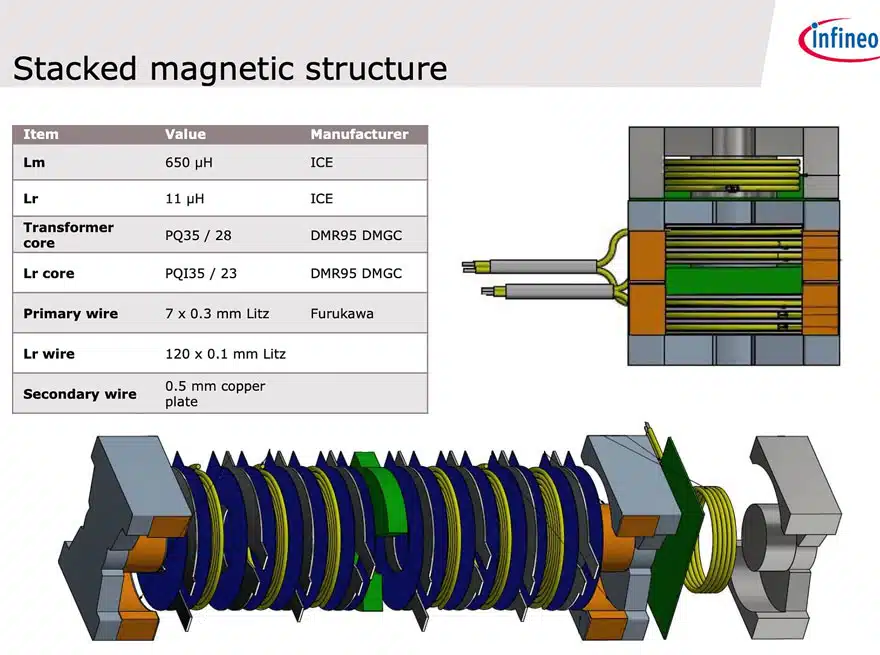
Integrating Transformer + Inductor

One of the limitations of using a planar transformer is the complexity added in integrating the Leakage inductance as part of the operation. The main reasons are:

  • The leakage inductance is low and difficult to predict with more than a 70% accuracy
  • You can include some ferrite layers to increase the leakage like in the Total Component article.

There is a significant benefit of the planar designs in this regard: the repeatability, which is extremely good.


Related

Source: Frenetic

Recent Posts

YAGEO Presents Single-Phase Common Mode Chokes for Industrial EMI Suppression

1.7.2026
14

Enabling the 800 V AI Server Era: How C0G High-Voltage MLCC Supports Next-Generation Power Architectures

1.7.2026
77

AI Hardware Demand for Passive Components Dossier

30.6.2026
81

Power Design Simulation Tools for Faster Inductor Selection and Loss Optimization

29.6.2026
25

Bourns Planar Transformers for SiC and GaN Gate Driver Isolation

26.6.2026
55

Coilcraft Releases 0402 Ferrite-Core Wirewound Chip Inductors for RF and EMI Control

25.6.2026
37

Using a Virtual Anode Thermal Model to Evaluate Miniaturization Risk in Tantalum Capacitors

24.6.2026
45

Bourns Introduced High-Current Coupled Inductor for 48 V Hybrid and IBC Converters

24.6.2026
51

Würth Elektronik Expands Nanocrystalline Cable Cores for Broadband EMI Suppression

23.6.2026
42

Upcoming Events

Jul 14
16:00 - 17:00 CEST

EMC Design Essentials: Mastering Varistors and Common Mode Chokes

Jul 21
16:00 - 17:00 CEST

Safety by design: X and Y Interference suppression capacitors for power line filters

Jul 28
8:00 - 11:00 CEST

Post Procurement Testing of EEE Components for LEO Space Applications

View Calendar

Popular Posts

  • Boost Converter Design and Calculation

    0 shares
    Share 0 Tweet 0
  • Buck Converter Design and Calculation

    0 shares
    Share 0 Tweet 0
  • Flyback Converter Design and Calculation

    0 shares
    Share 0 Tweet 0
  • LLC Resonant Converter Design and Calculation

    0 shares
    Share 0 Tweet 0
  • MLCC and Ceramic Capacitors

    0 shares
    Share 0 Tweet 0
  • Nvidia Vera Rubin: Why One AI Rack Needs So Many More MLCC Capacitors

    0 shares
    Share 0 Tweet 0
  • Earthing Systems and IEC Classification Explained

    0 shares
    Share 0 Tweet 0
  • Dual Active Bridge (DAB) Topology

    0 shares
    Share 0 Tweet 0
  • MLCC Case Sizes Standards Explained

    0 shares
    Share 0 Tweet 0
  • SEPIC Converter Design and Calculation

    0 shares
    Share 0 Tweet 0

Newsletter Subscription


Passive Components Blog

© EPCI - Leading Passive Components Educational and Information Site

  • Home
  • Privacy Policy
  • EPCI Membership & Advertisement
  • About

No Result
View All Result
  • Home
  • Knowledge Blog
  • Dossiers
  • PCNS

© EPCI - Leading Passive Components Educational and Information Site

This website uses cookies. By continuing to use this website you are giving consent to cookies being used. Visit our Privacy and Cookie Policy.
Go to mobile version