










Passive Components Blog
No Result
View All Result
  • Home
  • NewsFilter
    • All
    • Aerospace & Defence
    • Antenna
    • Applications
    • Automotive
    • Capacitors
    • Circuit Protection Devices
    • electro-mechanical news
    • Filters
    • Fuses
    • Inductors
    • Industrial
    • Integrated Passives
    • inter-connect news
    • Market & Supply Chain
    • Market Insights
    • Medical
    • Modelling and Simulation
    • New Materials & Supply
    • New Technologies
    • Non-linear Passives
    • Oscillators
    • Passive Sensors News
    • Resistors
    • RF & Microwave
    • Telecommunication
    • Weekly Digest

    YAGEO Introduces C0G Flexible Termination Automotive MLCCs

    SCHURTER Releases SMT Micro Switch for Compact HMIs

    binder Releases Tool‑Tightenable M12 Connectors for Improved Reliability

    Vishay Introduced Thin Film Submount Platform for Optical and RF Modules

    Murata Introduces Crystal and NTC Set for Automotive UWB Timing

    Kyocera Developed Multilayer Ceramic Core Substrate for AI Packages

    Modeling Fringing Field Losses in Inductors & Transformers

    YMIN Introduces Polymer Tantalum Capacitors for AI Server SSDs

    Littelfuse Expands High-Voltage TVS Diodes

    Trending Tags

    • Ripple Current
    • RF
    • Leakage Current
    • Tantalum vs Ceramic
    • Snubber
    • Low ESR
    • Feedthrough
    • Derating
    • Dielectric Constant
    • New Products
    • Market Reports
  • VideoFilter
    • All
    • Antenna videos
    • Capacitor videos
    • Circuit Protection Video
    • Filter videos
    • Fuse videos
    • Inductor videos
    • Inter-Connect Video
    • Non-linear passives videos
    • Oscillator videos
    • Passive sensors videos
    • Resistor videos

    Modeling Fringing Field Losses in Inductors & Transformers

    Why Power Inductors Use a Ferrite Core With an Air Gap

    Transformer-Based Power-Line Harvester Magnetic Design

    Thermal Modeling of Magnetics

    Standard vs Planar LLC transformers Comparison for Battery Chargers

    How Modern Tools Model Magnetic Components for Power Electronics

    Advanced Loss Modeling for Planar Magnetics in the Frenetic Planar Tool

    2026 Power Magnetics Design Trends: Flyback, DAB and Planar

    Enabling Software‑Defined Vehicle Architectures: Automotive Ethernet and Zonal Smart Power

    Trending Tags

    • Capacitors explained
    • Inductors explained
    • Resistors explained
    • Filters explained
    • Application Video Guidelines
    • EMC
    • New Products
    • Ripple Current
    • Simulation
    • Tantalum vs Ceramic
  • Knowledge Blog
  • DossiersNew
  • Suppliers
    • Who is Who
  • PCNS
    • PCNS 2025
    • PCNS 2023
    • PCNS 2021
    • PCNS 2019
    • PCNS 2017
  • Events
  • Home
  • NewsFilter
    • All
    • Aerospace & Defence
    • Antenna
    • Applications
    • Automotive
    • Capacitors
    • Circuit Protection Devices
    • electro-mechanical news
    • Filters
    • Fuses
    • Inductors
    • Industrial
    • Integrated Passives
    • inter-connect news
    • Market & Supply Chain
    • Market Insights
    • Medical
    • Modelling and Simulation
    • New Materials & Supply
    • New Technologies
    • Non-linear Passives
    • Oscillators
    • Passive Sensors News
    • Resistors
    • RF & Microwave
    • Telecommunication
    • Weekly Digest

    YAGEO Introduces C0G Flexible Termination Automotive MLCCs

    SCHURTER Releases SMT Micro Switch for Compact HMIs

    binder Releases Tool‑Tightenable M12 Connectors for Improved Reliability

    Vishay Introduced Thin Film Submount Platform for Optical and RF Modules

    Murata Introduces Crystal and NTC Set for Automotive UWB Timing

    Kyocera Developed Multilayer Ceramic Core Substrate for AI Packages

    Modeling Fringing Field Losses in Inductors & Transformers

    YMIN Introduces Polymer Tantalum Capacitors for AI Server SSDs

    Littelfuse Expands High-Voltage TVS Diodes

    Trending Tags

    • Ripple Current
    • RF
    • Leakage Current
    • Tantalum vs Ceramic
    • Snubber
    • Low ESR
    • Feedthrough
    • Derating
    • Dielectric Constant
    • New Products
    • Market Reports
  • VideoFilter
    • All
    • Antenna videos
    • Capacitor videos
    • Circuit Protection Video
    • Filter videos
    • Fuse videos
    • Inductor videos
    • Inter-Connect Video
    • Non-linear passives videos
    • Oscillator videos
    • Passive sensors videos
    • Resistor videos

    Modeling Fringing Field Losses in Inductors & Transformers

    Why Power Inductors Use a Ferrite Core With an Air Gap

    Transformer-Based Power-Line Harvester Magnetic Design

    Thermal Modeling of Magnetics

    Standard vs Planar LLC transformers Comparison for Battery Chargers

    How Modern Tools Model Magnetic Components for Power Electronics

    Advanced Loss Modeling for Planar Magnetics in the Frenetic Planar Tool

    2026 Power Magnetics Design Trends: Flyback, DAB and Planar

    Enabling Software‑Defined Vehicle Architectures: Automotive Ethernet and Zonal Smart Power

    Trending Tags

    • Capacitors explained
    • Inductors explained
    • Resistors explained
    • Filters explained
    • Application Video Guidelines
    • EMC
    • New Products
    • Ripple Current
    • Simulation
    • Tantalum vs Ceramic
  • Knowledge Blog
  • DossiersNew
  • Suppliers
    • Who is Who
  • PCNS
    • PCNS 2025
    • PCNS 2023
    • PCNS 2021
    • PCNS 2019
    • PCNS 2017
  • Events
No Result
View All Result
Passive Components Blog
No Result
View All Result

Trimmer Capacitor Considerations in Practice

20.1.2022
Reading Time: 3 mins read
A A

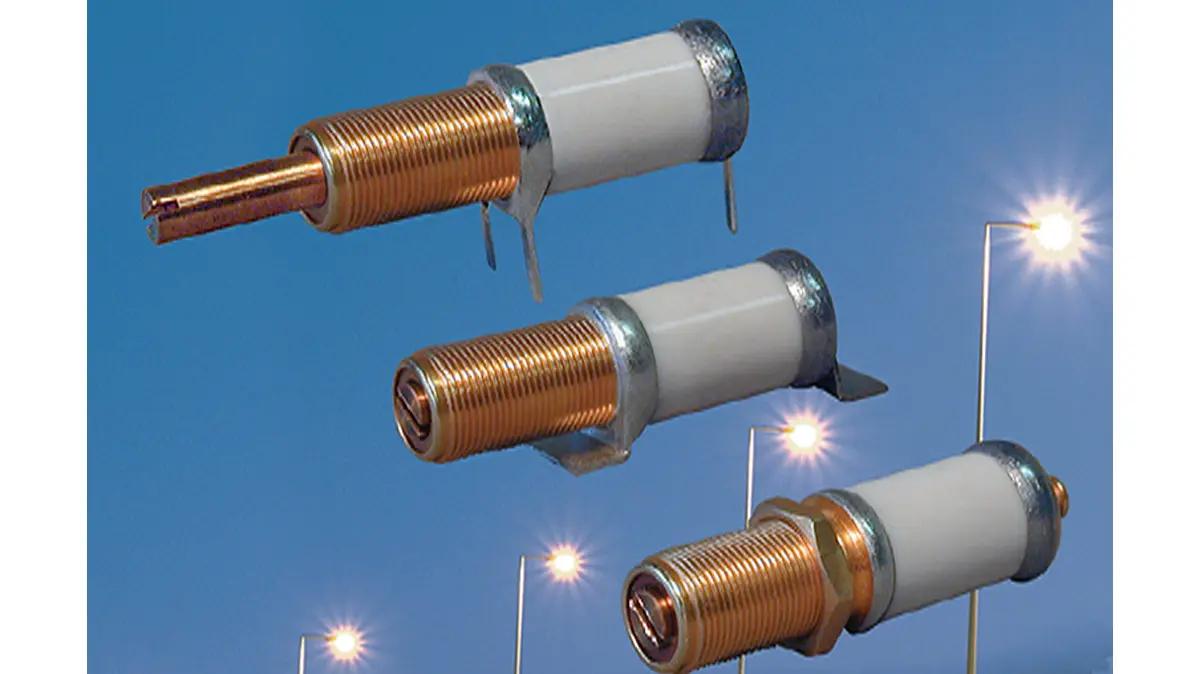
Trimmer capacitors are variable components used to calibrate RF circuits during manufacturing or servicing. These components allow for variable tuning–think oscillator frequency values or rise and fall times. Should values drift over the life of the device, trimmer capacitors can be recalibrated as needed.

For sensitive applications like magnetic resonance imaging (MRI), these components help to optimize performance where any instability in time or temperature could impact the image output.

RelatedPosts

YAGEO Introduces C0G Flexible Termination Automotive MLCCs

SCHURTER Releases SMT Micro Switch for Compact HMIs

binder Releases Tool‑Tightenable M12 Connectors for Improved Reliability

In essence, when a patient is positioned inside an MRI scanner tube and a magnetic field is applied, the proton spins inside their body’s molecules line up, facing the same direction. When a short, computer-generated RF signal is applied to a proton in the uniform field, it’s “nudged” to break formation. After the interruption, protons return to their original state of alignment. In the process of realigning, energy is emitted; the emitted energy can be measured and used to identify different types of molecules and their locations in the body. Trimmer capacitors are used to tune the TX and RX coils to Lamor Frequency, the frequency at which this energy is emitted. By extension, trimmer capacitor tuning is pivotal in MRI imaging accuracy.

In order to meet the high demand of MRI, important considerations for trimmer capacitor selection include:

Q FactorInfluences power handling; higher Q lessens self-heating under RF conditions Important in filter circuits; impacts insertion loss
K Value (dielectric constant)Determines the capacitance density in conjunction with dielectric withstand voltage; higher the K Value, smaller the component can be
Dielectric Withstand VoltageThe maximum DC voltage the part can withstand without failure
Non-magnetic PropertiesEssential for MRI components, especially body coil and surface coils Close control of raw materials and processes required to ensure MRI accuracy and performance
Half-turn vs. Multi-turn TrimmersHalf turn trimmers have a lower Q, DWV, and precision; typically used in lower voltage and power environments where some tuning is required Multi turn trimmers boast higher Q, DWV, and performance; provides precision where exact tuning is imperative 


MRI components face severe non-magnetism requirements across components. In addition to careful material choices, Voltronics, a brand of Knowles Precision Devices (KPD), has developed a unique test setup to allow for Q and RF Voltage breakdown measurement at MRI operational frequencies. This has allowed for the development of parts designed specifically to meet the strict MRI requirements.

KPD is a leader in the design and manufacture of precision trimmer capacitors through our brands Voltronics and Johanson Manufacturing. The KPD trimmers portfolio includes air, glass, sapphire, and PTFE dielectrics that can be used from 1 MHz to over 2 GHz and at voltages up to 20,000 VDC. These trimmers are available in precision multi-turn and half-turn formats to accommodate any level of application demand.

featured image: multi-turn trimmer capacitor; source: Knowles Precision Devices

Related

Source: Knowles Precision Devices

Recent Posts

YAGEO Introduces C0G Flexible Termination Automotive MLCCs

30.4.2026
3

SCHURTER Releases SMT Micro Switch for Compact HMIs

30.4.2026
3

Vishay Introduced Thin Film Submount Platform for Optical and RF Modules

30.4.2026
4

Modeling Fringing Field Losses in Inductors & Transformers

30.4.2026
7

YMIN Introduces Polymer Tantalum Capacitors for AI Server SSDs

29.4.2026
27

Miniaturization of Tantalum Capacitors: Structural Limit Under Constant Rating

27.4.2026
25

Heatsink Design and Thermal Interface Materials for Reliable Electronics

27.4.2026
9

Murata New MLCC Bulk Case Packaging Cuts Packaging Material by 99%

27.4.2026
45

Exxelia Introduces SMD High‑Voltage Mica Capacitors

28.4.2026
19

Upcoming Events

May 5
16:00 - 17:00 CEST

Understanding and Selecting Capacitors – Fundamentals, Technologies and Latest Trends

May 7
17:00 - 18:00 CEST

From Grid to Motion: How Industrial Electrification is Redefining Power System Design

May 12
8:00 - 15:00 CEST

ESCC Space Splice connectors

View Calendar

Popular Posts

  • Buck Converter Design and Calculation

    0 shares
    Share 0 Tweet 0
  • Boost Converter Design and Calculation

    0 shares
    Share 0 Tweet 0
  • Flyback Converter Design and Calculation

    0 shares
    Share 0 Tweet 0
  • LLC Resonant Converter Design and Calculation

    0 shares
    Share 0 Tweet 0
  • MLCC and Ceramic Capacitors

    0 shares
    Share 0 Tweet 0
  • Dual Active Bridge (DAB) Topology

    0 shares
    Share 0 Tweet 0
  • What Electronics Engineer Needs to Know About Passive Low Pass Filters

    0 shares
    Share 0 Tweet 0
  • Capacitor Charging and Discharging

    0 shares
    Share 0 Tweet 0
  • Ripple Current and its Effects on the Performance of Capacitors

    3 shares
    Share 3 Tweet 0
  • MLCC Case Sizes Standards Explained

    0 shares
    Share 0 Tweet 0

Newsletter Subscription


Passive Components Blog

© EPCI - Leading Passive Components Educational and Information Site

  • Home
  • Privacy Policy
  • EPCI Membership & Advertisement
  • About

No Result
View All Result
  • Home
  • Knowledge Blog
  • PCNS

© EPCI - Leading Passive Components Educational and Information Site

This website uses cookies. By continuing to use this website you are giving consent to cookies being used. Visit our Privacy and Cookie Policy.
Go to mobile version