








Passive Components Blog
No Result
View All Result
  • Home
  • NewsFilter
    • All
    • Aerospace & Defence
    • Antenna
    • Applications
    • Automotive
    • Capacitors
    • Circuit Protection Devices
    • electro-mechanical news
    • Filters
    • Fuses
    • Inductors
    • Industrial
    • Integrated Passives
    • inter-connect news
    • Market & Supply Chain
    • Market Insights
    • Medical
    • Modelling and Simulation
    • New Materials & Supply
    • New Technologies
    • Non-linear Passives
    • Oscillators
    • Passive Sensors News
    • Resistors
    • RF & Microwave
    • Telecommunication
    • Weekly Digest

    CMSE 2026 Announces Call for Presentations on High-Reliability Military and Space Electronics

    ESA Call for Papers 6th Space Passive Component Days – SPCD 2026

    Würth Elektronik Offers Halogen‑Free EMC Gaskets for Displays and Housings

    Component Distribution Supply Chain January 2026

    Binder Unveils M8 Flange Solder Connectors for Flexible Cabling

    Power Electronics Tools for Passives and Magnetic Designs

    Modelithics Releases Component Model Library for SIMULIA CST Studio Suite

    Exxelia Publishes Micropen White Papers for Printed Electronics

    Stackpole Releases AlN High‑Power Thick Film Chip Resistors

    Trending Tags

    • Ripple Current
    • RF
    • Leakage Current
    • Tantalum vs Ceramic
    • Snubber
    • Low ESR
    • Feedthrough
    • Derating
    • Dielectric Constant
    • New Products
    • Market Reports
  • VideoFilter
    • All
    • Antenna videos
    • Capacitor videos
    • Circuit Protection Video
    • Filter videos
    • Fuse videos
    • Inductor videos
    • Inter-Connect Video
    • Non-linear passives videos
    • Oscillator videos
    • Passive sensors videos
    • Resistor videos

    One‑Pulse Characterization of Nonlinear Power Inductors

    Thermistor Linearization Challenges

    Coaxial Connectors and How to Connect with PCB

    PCB Manufacturing, Test Methods, Quality and Reliability

    Transformer Behavior – Current Transfer and Hidden Feedback

    Choosing the Right Capacitor: The Importance of Accurate Measurements

    RF Inductors: Selection and Design Challenges for High-Frequency Circuits

    Transformer Safety IEC 61558 Standard

    3-Phase EMI Filter Design, Simulation, Calculation and Test

    Trending Tags

    • Capacitors explained
    • Inductors explained
    • Resistors explained
    • Filters explained
    • Application Video Guidelines
    • EMC
    • New Products
    • Ripple Current
    • Simulation
    • Tantalum vs Ceramic
  • Knowledge Blog
  • DossiersNew
  • Suppliers
    • Who is Who
  • PCNS
    • PCNS 2025
    • PCNS 2023
    • PCNS 2021
    • PCNS 2019
    • PCNS 2017
  • Events
  • Home
  • NewsFilter
    • All
    • Aerospace & Defence
    • Antenna
    • Applications
    • Automotive
    • Capacitors
    • Circuit Protection Devices
    • electro-mechanical news
    • Filters
    • Fuses
    • Inductors
    • Industrial
    • Integrated Passives
    • inter-connect news
    • Market & Supply Chain
    • Market Insights
    • Medical
    • Modelling and Simulation
    • New Materials & Supply
    • New Technologies
    • Non-linear Passives
    • Oscillators
    • Passive Sensors News
    • Resistors
    • RF & Microwave
    • Telecommunication
    • Weekly Digest

    CMSE 2026 Announces Call for Presentations on High-Reliability Military and Space Electronics

    ESA Call for Papers 6th Space Passive Component Days – SPCD 2026

    Würth Elektronik Offers Halogen‑Free EMC Gaskets for Displays and Housings

    Component Distribution Supply Chain January 2026

    Binder Unveils M8 Flange Solder Connectors for Flexible Cabling

    Power Electronics Tools for Passives and Magnetic Designs

    Modelithics Releases Component Model Library for SIMULIA CST Studio Suite

    Exxelia Publishes Micropen White Papers for Printed Electronics

    Stackpole Releases AlN High‑Power Thick Film Chip Resistors

    Trending Tags

    • Ripple Current
    • RF
    • Leakage Current
    • Tantalum vs Ceramic
    • Snubber
    • Low ESR
    • Feedthrough
    • Derating
    • Dielectric Constant
    • New Products
    • Market Reports
  • VideoFilter
    • All
    • Antenna videos
    • Capacitor videos
    • Circuit Protection Video
    • Filter videos
    • Fuse videos
    • Inductor videos
    • Inter-Connect Video
    • Non-linear passives videos
    • Oscillator videos
    • Passive sensors videos
    • Resistor videos

    One‑Pulse Characterization of Nonlinear Power Inductors

    Thermistor Linearization Challenges

    Coaxial Connectors and How to Connect with PCB

    PCB Manufacturing, Test Methods, Quality and Reliability

    Transformer Behavior – Current Transfer and Hidden Feedback

    Choosing the Right Capacitor: The Importance of Accurate Measurements

    RF Inductors: Selection and Design Challenges for High-Frequency Circuits

    Transformer Safety IEC 61558 Standard

    3-Phase EMI Filter Design, Simulation, Calculation and Test

    Trending Tags

    • Capacitors explained
    • Inductors explained
    • Resistors explained
    • Filters explained
    • Application Video Guidelines
    • EMC
    • New Products
    • Ripple Current
    • Simulation
    • Tantalum vs Ceramic
  • Knowledge Blog
  • DossiersNew
  • Suppliers
    • Who is Who
  • PCNS
    • PCNS 2025
    • PCNS 2023
    • PCNS 2021
    • PCNS 2019
    • PCNS 2017
  • Events
No Result
View All Result
Passive Components Blog
No Result
View All Result

Vishay Releases X1, X2, and Y2 EMI Suppression Film Capacitors Certified to IEC 60384-14

27.8.2019
Reading Time: 2 mins read
A A

Source: Vishay news

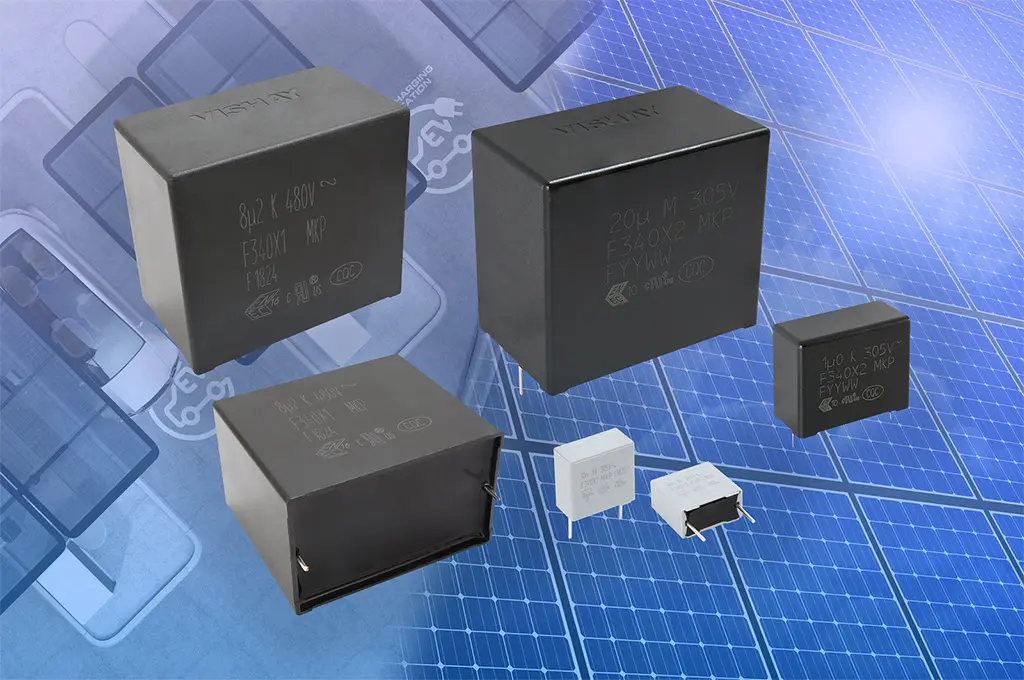
MALVERN, Pa. Vishay Intertechnology, Inc. today introduced three new series of X1, X2, and Y2 electromagnetic interference (EMI) suppression film capacitors for standard across the line and line bypass applications.

RelatedPosts

CMSE 2026 Announces Call for Presentations on High-Reliability Military and Space Electronics

ESA Call for Papers 6th Space Passive Component Days – SPCD 2026

Würth Elektronik Offers Halogen‑Free EMC Gaskets for Displays and Housings

Designed to meet the most stringent requirements for robustness against humidity, the new F340 EMI suppression family is certified to IEC 60384-14: 2013 ed. 4 / AMD1: 2016 grade IIIB: “High Robustness Under High Humidity.”

To comply with the humidity grading system defined under IEC 60384-14: 2013 ed. 4 / AMD1: 2016 grade IIIB, the Vishay BCcomponents devices released today withstand temperature humidity bias (THB) testing of 85 °C, 85 % relative humidity for 1000 hours while biased at the rated AC voltage with high stability on capacitance, dissipation factor, and insulation resistance. This translates into longer service life under harsh application conditions for industrial and automotive power electronics, such as battery chargers, renewable energy inverters, motor drives, and UPS.

The F340X1 is designed for a rated voltage of 480 VAC. It offers a broad capacitance range from 0.22 µF to 8.2 µF, while withstanding operation voltages up to 530 VAC to ensure compliance with permissible voltage variations on three-phase mains. The F340X2 has a rated voltage of 305 VAC and provides a capacitance range from 1 µF to 20 µF, with  high ripple current capabilities up to 18 A at 10 kHz. Also featuring a rated voltage of 305 VAC, the F340Y2 is qualified in accordance with AEC-Q200, Automotive Grade and provides a capacitance range from 0.01 µF to 1 µF.

The entire F340 family is certified in accordance with EN, UL and CQC for Safety and Humidity Robustness. The capacitors offer lead pitches of 15 mm, 22.5 mm, 27.5 mm, 37.5 mm and 52.5 mm. Their encapsulation consists of a flame-retardant UL-class 94 V-0 plastic case and epoxy resin sealing. All three series are lead (Pb)-free and RoHS-compliant; F340X1 480VAC and F340X2 305VAC devices are also halogen-free and Vishay Green.

Device Specification Table:

Series F340X1 480VAC F340X2 305VAC F340Y2 305VAC
Capacitance 0.22 μF to 8.2 μF 1 μF to 20 μF 0.01 μF to 1 μF
Tolerance ± 10 %; ± 20 % ± 10 %; ± 20 % ± 5 %; ± 10 %; ± 20 %
Permissible DC voltage 800 VDC at 105 °C 630 VDC at 105 °C 1000 VDC at 105 °C
THB 85 °C, 85 % RH for 1000 hours at URAC

Samples of the new X1, X2, and Y2 capacitors are available now, with lead times of 16 weeks.

Related

Recent Posts

CMSE 2026 Announces Call for Presentations on High-Reliability Military and Space Electronics

28.1.2026
10

ESA Call for Papers 6th Space Passive Component Days – SPCD 2026

28.1.2026
11

Binder Unveils M8 Flange Solder Connectors for Flexible Cabling

28.1.2026
9

Stackpole Releases AlN High‑Power Thick Film Chip Resistors

26.1.2026
17

Samsung Q4 2025 Results: MLCC focus for AI, Server and Automotive

26.1.2026
45

Capacitor Technology Dossier

26.1.2026
68

ROHM Extends 2012 Shunt Resistors Power Rating up to 1.25 W

23.1.2026
23

Passive Components in Quantum Computing

22.1.2026
117

0603 Automotive Chip Varistors as TVS Diode Replacements, TDK Tech Note

21.1.2026
29

Upcoming Events

Feb 24
16:00 - 17:00 CET

Designing Qi2 Wireless Power Systems: Practical Development and EMC Optimization

Mar 3
16:00 - 17:00 CET

Cybersecurity at the Eleventh Hour – from RED to CRA – Information and Discussion

Mar 21
All day

PSMA Capacitor Workshop 2026

View Calendar

Popular Posts

  • Buck Converter Design and Calculation

    0 shares
    Share 0 Tweet 0
  • Boost Converter Design and Calculation

    0 shares
    Share 0 Tweet 0
  • LLC Resonant Converter Design and Calculation

    0 shares
    Share 0 Tweet 0
  • Flyback Converter Design and Calculation

    0 shares
    Share 0 Tweet 0
  • Ripple Current and its Effects on the Performance of Capacitors

    3 shares
    Share 3 Tweet 0
  • How Metal Prices Are Driving Passive Component Price Hikes

    0 shares
    Share 0 Tweet 0
  • MLCC and Ceramic Capacitors

    0 shares
    Share 0 Tweet 0
  • Dual Active Bridge (DAB) Topology

    0 shares
    Share 0 Tweet 0
  • Degradation of Capacitors and its Failure Mechanisms

    0 shares
    Share 0 Tweet 0
  • What is a Dielectric Constant and DF of Plastic Materials?

    4 shares
    Share 4 Tweet 0

Newsletter Subscription


Passive Components Blog

© EPCI - Leading Passive Components Educational and Information Site

  • Home
  • Privacy Policy
  • EPCI Membership & Advertisement
  • About

No Result
View All Result
  • Home
  • Knowledge Blog
  • PCNS

© EPCI - Leading Passive Components Educational and Information Site

This website uses cookies. By continuing to use this website you are giving consent to cookies being used. Visit our Privacy and Cookie Policy.
Go to mobile version