

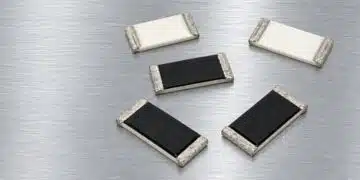



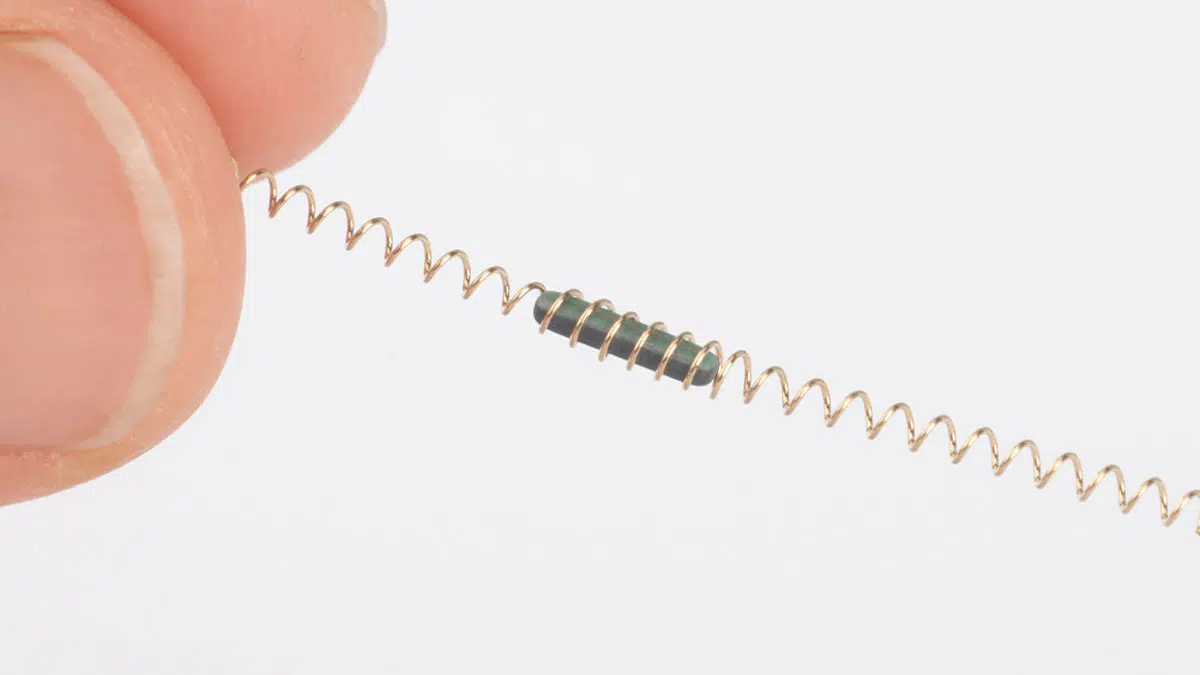
This article based on Murata blog briefly explains What is RFID and how RFID works, and RFID frequency bands.
RFID, short for radio-frequency identification, is a family of wireless automatic-identification technologies used to identify, authenticate, track, or manage tagged items without an optical line of sight. An RFID system combines a tag, reader, antennas, software, and a suitable RF environment; the resulting read range, reliability, speed, and security depend on the frequency band, protocol, tag design, and tagged material.
Unlike a barcode, an RFID tag can often be read through packaging and in a group of items. However, RFID is not a single universal technology: LF, HF, UHF, and microwave systems use different coupling mechanisms, standards, regulatory frequency allocations, and antenna designs.
Key Takeaways
- RFID stands for radio-frequency identification and enables wireless identification, tracking, and management of tagged items without line of sight.
- RFID systems include tags, readers, antennas, and software, functioning across various frequency bands—LF, HF, UHF, and microwave.
- Key advantages of RFID include no need for line of sight, rapid inventory capabilities, and passive operation with low-maintenance tags.
- RFID applications range from contactless access and consumer interactions to inventory management and traceability in manufacturing.
- Understanding RFID requires knowledge of system architecture, environmental effects, and security considerations to ensure effective implementation.
Key features and benefits
- No optical line of sight required: A correctly positioned RFID tag can be read through many non-metallic materials and packaging without presenting a printed code directly to a scanner.
- Rapid inventory: Reader anti-collision protocols enable many tags to be identified during one inventory operation. Actual throughput depends on the protocol, reader settings, tag population, orientation, and RF environment.
- Passive operation: Passive tags contain no battery. They collect energy from the reader field, which can enable a thin, low-maintenance identification label or inlay.
- Rewritable memory: Depending on the tag IC and protocol, tag memory can store a unique identifier and, in some cases, application data. In most UHF supply-chain systems, the tag primarily carries a compact identifier while detailed item data remains in the backend database.
- Different operating ranges: RFID can be optimised for close, intentional interactions, such as NFC access credentials, or for metre-scale inventory applications using UHF RAIN RFID.
- Robust identification: RFID may remain readable when a conventional label is obscured, although metal, liquids, tag damage, antenna detuning, and poor orientation can reduce performance substantially.
- System-level traceability: RFID can link physical goods to manufacturing, warehouse, maintenance, quality, and supply-chain records.
RFID system architecture
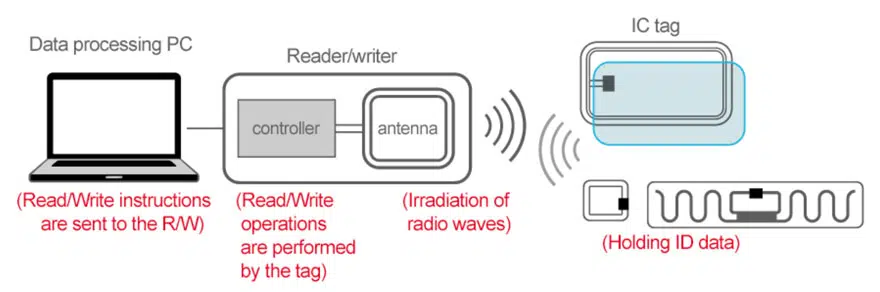
An RFID system is more than a tag and a handheld scanner. The following functional blocks must work together:
- RFID tag or inlay: Includes an IC, antenna or coil, substrate, and usually an adhesive or protective enclosure. Some tags also include a battery, sensor, or environmental logger.
- Reader or interrogator: Generates the RF field, receives tag responses, runs the air-interface protocol, and transfers processed data to a host system.
- Reader antenna and RF path: Includes one or more antennas, feed cables, connectors, optional multiplexers, matching networks, filters, and protection devices.
- Middleware and application software: Filters repeated reads, associates tag identifiers with assets or transactions, and connects to systems such as WMS, MES, ERP, maintenance, or traceability platforms.
- Tagged item and environment: The product material, packaging, tag location, reader geometry, movement, metal structures, liquids, electromagnetic noise, and nearby antennas all influence read performance.
RFID tag types
Passive RFID tags
Passive tags have no battery. The reader field powers the IC sufficiently for it to decode a command and return a response. They are widely used for item identification because they can be thin, economical, and maintenance-free.
Their practical read range is not fixed. It depends on reader power and antenna gain, regulatory limits, tag sensitivity, frequency band, antenna orientation, coupling, packaging, and nearby materials.
Battery-assisted passive tags
Battery-assisted passive, or semi-passive, tags contain a battery to power the IC, a sensor, or memory functions but generally still use the reader field for communications. This approach can support sensor logging or improve operating margin, while retaining a backscatter-based reader interaction.
The trade-off is higher cost, larger size, storage-life limits, and battery qualification requirements.
Active RFID tags
Active tags use an onboard battery and transmitter. They may periodically beacon their identifier or sensor data and can support longer-range tracking, depending on the selected radio technology and system architecture.
They are normally used where tag cost, size, and battery maintenance are acceptable, such as high-value asset tracking, reusable logistics equipment, real-time location systems, and environmental monitoring.
How RFID communication works
Passive RFID communication differs according to frequency band and coupling method. LF and HF systems are primarily based on magnetic near-field coupling, while UHF and microwave systems predominantly use far-field electromagnetic propagation.
Inductive coupling and load modulation
LF and HF RFID readers generate an alternating magnetic field. A tag coil captures energy from this field and provides power to the IC. The tag communicates back by changing its electrical load, which produces a detectable variation at the reader antenna; this process is called load modulation.
This principle makes coil inductance, resistance, quality factor, resonant frequency, IC input capacitance, and nearby materials important design variables. An HF/NFC inlay is essentially a resonant LC system that must be tuned for its intended operating environment.
Far-field coupling and backscatter
UHF RFID systems normally use a radiated electromagnetic field. A passive UHF tag changes the impedance presented by its antenna, modulating the amount and character of RF energy reflected toward the reader. This mechanism is called backscatter modulation.
UHF performance depends strongly on antenna radiation behaviour, conjugate impedance matching between the antenna and tag IC, polarisation, tag orientation, cable loss, reflections, and the material carrying the tag.
RFID communication sequence
- The reader transmits a carrier and protocol command through its antenna.
- A passive tag receives sufficient energy to power its IC.
- The tag decodes the command and retrieves the requested identifier or memory content.
- The tag modulates the reader field through load modulation or backscatter.
- The reader receives, demodulates, and validates the tag response.
- Reader software filters events and passes useful data to the application or database.
RFID frequency bands
| RFID band | Typical operating frequency | Primary coupling mechanism | Typical use | Main design considerations |
|---|---|---|---|---|
| LF | 125 kHz to 134.2 kHz | Inductive near field | Animal identification, legacy access systems, automotive immobilisers | Large antenna coils, lower data rates, short read range |
| HF | 13.56 MHz | Inductive near field | NFC, access credentials, ticketing, library and item-management systems | Coil tuning, Q factor, metal detuning, reader-to-tag alignment |
| UHF | Broadly 860 MHz to 960 MHz, region dependent | Far-field backscatter | RAIN RFID, retail, logistics, manufacturing WIP, asset inventory | Metal and liquid effects, polarisation, orientation, regional regulation |
| Microwave | Often 2.45 GHz for specialised systems | Far-field propagation | Specialised RFID, sensing, location, and industrial systems | Propagation loss, reflections, coexistence, enclosure and antenna design |
Read range should be treated as a system performance result rather than a guaranteed property of a frequency band. LF and HF systems are generally suitable for close-range, controlled transactions, while passive UHF systems are commonly selected when a deployment requires rapid multi-tag inventory at metre-scale distances.
In Europe, commonly used UHF RAIN RFID systems operate in the 865 MHz to 868 MHz region under applicable ETSI requirements. North American UHF implementations commonly use a different allocation, so tags and reader configuration must be selected for the intended deployment region.
HF RFID, NFC, and UHF RAIN RFID
HF RFID and NFC both operate at 13.56 MHz and use inductive coupling, but NFC should not be treated as a synonym for all RFID. NFC is designed for close-range interaction and supports reader/writer, card-emulation, and peer-to-peer operating modes in compatible devices.
HF systems commonly use standards including ISO/IEC 14443 and ISO/IEC 15693. Their operating distance, data rate, security options, and reader ecosystem vary, so engineers should select an air interface based on the required use case rather than frequency alone.
UHF RAIN RFID is widely used for item-level identification, logistics, retail inventory, production tracking, and reusable transport assets. Its principal air-interface family is GS1 EPC UHF Gen2, internationally standardised as ISO/IEC 18000-63.
RFID standards and interoperability
RFID interoperability requires more than using the same nominal frequency. A deployed tag and reader must support compatible air-interface standards, protocol options, regional frequency settings, antenna configurations, data encoding, and software integration.
- ISO/IEC 14443: HF proximity-card technology widely used for contactless credentials and NFC-compatible applications.
- ISO/IEC 15693: HF vicinity-card technology often used for item identification at longer HF read distances than proximity-card systems.
- ISO/IEC 18000-3: An ISO/IEC air-interface family for HF RFID.
- ISO/IEC 18000-63: Passive UHF RFID air interface aligned with GS1 EPC UHF Gen2 and commonly used for RAIN RFID.
- GS1 Electronic Product Code (EPC): A structured item identifier used in many supply-chain RFID systems. It should be distinguished from enterprise data stored in databases and event systems.
- EPC Gen2v2: An evolution of the UHF Gen2 protocol that provides optional security and privacy functions, depending on the selected tag IC, reader firmware, and system implementation.
Passive-component design considerations
RFID creates a direct connection between passive-component behaviour and system performance. The antenna or coil is not an interchangeable mechanical feature; it is an RF component that must be designed, tuned, and validated with the selected IC and final product environment.
- HF antenna coil: Inductance and parasitic capacitance determine resonance with the tag IC input capacitance. Coil resistance influences Q factor and available operating margin.
- LC tuning: An HF tag must resonate near the operating frequency, typically 13.56 MHz. Packaging, adhesives, a battery, a metal backplate, the human body, or the tagged object can shift the resonance.
- UHF antenna match: A UHF antenna must be matched to the complex input impedance of the tag IC. This normally requires co-design of antenna geometry, conductor properties, substrate, packaging, and the tagged item.
- Metal and liquid effects: Metal can detune or shield a tag antenna, while water-containing materials can absorb RF energy and alter antenna loading. Specialised on-metal tags, spacers, ferrite sheets, or revised tag positions may be necessary.
- Reader RF front end: Impedance-matching networks, RF inductors, capacitors, filters, baluns, RF chokes, ESD protection, and well-controlled PCB layout influence reader sensitivity and regulatory compliance.
- Production validation: Test tags on the final product, at the intended orientation and distance, with representative packaging, temperature, humidity, motion, and neighbouring tagged objects.
For the RF front end, RF inductors for high-frequency circuits are selected not only by nominal inductance, but also by self-resonant frequency, Q factor, DC resistance, current capability, tolerance, package parasitics, and repeatability.
For HF systems, impedance matching with RF LC circuits provides useful background on the resonance and matching principles that govern energy transfer between a reader and tag.
Environmental effects and tag placement
The correct tag is only part of a successful RFID design. Tag placement and test conditions must represent the final deployment.
- Place UHF tags away from conductive surfaces when possible, and validate both linear and circular reader-antenna polarisation where item orientation is uncontrolled.
- Use purpose-designed on-metal tags or suitable spacers when an item has a metallic enclosure, chassis, foil packaging, or conductive coating.
- Assess UHF performance on liquids, food, biological products, and moisture-rich materials, which may absorb RF energy and alter antenna impedance.
- Verify HF/NFC antenna tuning in the final mechanical assembly, especially in products containing batteries, displays, shields, metal bezels, ferrite elements, or large ground planes.
- Avoid assuming that a read range measured in free air will be reproduced on a production line, conveyor, warehouse rack, pallet, or vehicle.
Magnetic material can be used to manage the field environment in close-coupled systems. Magnetic shielding and magnetic shielding sheets explains how magnetic materials can guide flux and help isolate magnetic-field-sensitive assemblies.
Security, privacy, and lifecycle management
RFID does not automatically provide encrypted communications, authentication, or protection against cloning. The required security level depends on whether the tag is used only for inventory visibility or forms part of an access-control, payment, product-authentication, safety, or regulated traceability process.
- Store only the minimum necessary data on the tag, particularly where a tag can be read outside the intended operational area.
- Select tag and reader ICs that support suitable password, lock, kill, authentication, or cryptographic functions where required.
- Protect credentials, cryptographic keys, reader configuration, middleware interfaces, and backend APIs throughout the product lifecycle.
- Define processes for tag commissioning, replacement, revocation, disposal, and database record retention.
- Perform a threat assessment for cloning, unauthorised reading, relay attacks, reader spoofing, and unauthorised backend access.
Security-capable RFID ICs and protocols should be selected only after confirming the actual security functions, implementation limits, key-management model, and reader support in current manufacturer documentation.
Typical applications
| Application | Suitable RFID approach | Why it fits |
|---|---|---|
| Contactless access credentials | HF RFID or NFC | Close-range, deliberate one-to-one interaction with established secure-card ecosystems |
| Consumer product interaction | NFC | Smartphone compatibility for product information, commissioning, authentication, or service records |
| Retail and warehouse inventory | Passive UHF RAIN RFID | Rapid identification of many tagged items without direct optical scanning |
| Manufacturing work-in-progress | Passive UHF, HF, or rugged industrial tags | Traceability through process stations, depending on metal, heat, chemical, and distance constraints |
| Reusable transport items and returnable assets | UHF, battery-assisted, or active tags | Asset tracking, reusable-container identification, and optional sensor or location functions |
| Automotive and industrial access | LF or HF RFID | Established short-range identification architectures and controlled interaction zones |
| Medical or regulated asset management | HF, UHF, or active tags selected by environment | Identification and traceability where material compatibility, cleaning, privacy, and validation are critical |
Application fit
RFID is generally a strong fit when an application needs non-line-of-sight identification, multi-item inventory, durable identification, automated process capture, or a digital link between an item and a backend record.
A barcode, QR code, or alternative wireless technology may be more appropriate when cost must be minimised, line-of-sight scanning is acceptable, item volumes are low, a smartphone is the only reader, or the physical environment prevents reliable RFID operation without costly tag engineering.
Design-in notes for engineers
- Define the primary requirement before selecting a tag: identification, authentication, inventory speed, sensing, location, or smartphone interaction.
- Choose the air-interface standard and regional RF configuration before committing to tag mechanics or reader hardware.
- Treat free-air read-range claims as preliminary data only; validate read probability and inventory time on representative products and packaging.
- Characterise tag orientation, polarisation, distance, motion speed, tag density, nearby metal, liquids, reader antenna placement, and multipath reflections.
- Design the reader RF chain for controlled impedance, low insertion loss, adequate filtering, ESD robustness, and regulatory compliance.
- For HF and NFC, verify resonant frequency, coil inductance, Q factor, and matching after final enclosure integration.
- For UHF tags, validate antenna-to-IC matching after adding the final substrate, adhesive, spacer, and product attachment method.
- Confirm whether a tag is passive, battery-assisted passive, or active, and incorporate battery storage, replacement, transport, and end-of-life requirements where applicable.
- Select security functions according to the threat model rather than assuming RFID inherently prevents unauthorised reading or cloning.
- Freeze component selection only after testing current tag and reader documentation, applicable standards, regional regulations, and the final mechanical assembly.
FAQ
NFC is a subset of HF RFID technologies operating at 13.56 MHz and intended for close-range interaction with compatible devices such as phones, cards, and readers. RFID is the broader family and also includes LF, UHF, and microwave systems with different coupling methods and use cases.
No. Passive tags are battery-free, but battery-assisted passive and active RFID tags also exist for sensing, beaconing, or longer-range operation.
Metal can detune or shield antennas, while water-rich materials can absorb RF energy and change the effective antenna environment. This can reduce coupling, degrade impedance matching, and lower read reliability.
No. RFID offers strong advantages for non-line-of-sight and multi-item reading, but barcodes and QR codes often remain simpler and cheaper where manual scanning is acceptable and the environment is RF-unfriendly.
How to select an RFID approach
- Define whether the application needs close-range interaction, smartphone compatibility, metre-scale inventory, or rugged industrial traceability.
- Choose LF, HF/NFC, or UHF according to range, environment, standards, and reader ecosystem.
- Evaluate the tagged material, especially metal, water-rich content, shielding, and mounting constraints.
- Match the tag and reader to the correct air-interface standard and regulatory region.
- Validate performance in the final mechanical and operational setup before release.
Conclusion
RFID is best understood as a system technology rather than a single tag type. For a reliable design, engineers need to evaluate the frequency band, coupling method, standard, antenna implementation, tagged material, environmental detuning, security model, and backend integration together rather than treating read range as a standalone specification.
For Passive Components Blog readers, the most valuable design lesson is that RFID performance is tightly linked to passive-component behaviour, especially coil inductance, Q factor, impedance matching, shielding, and antenna integration. That makes RFID a strong knowledge-topic fit for the site when the article goes beyond a basic definition and explains real RF design trade-offs.
Further reading
- How to Select RF Inductors for High-Frequency Circuits
- Impedance Matching with RF LC Circuits
- Magnetic Shielding and Magnetic Shielding Sheets
- RF Inductors and Filters: Guide to Selection, Design and LTCC
Source
This article is based on the original Murata RFID technology material and has been expanded with editorial engineering context on RFID architecture, frequency selection, standards, RF design, environmental constraints, and security. Engineers should consult the current manufacturer datasheet, protocol documentation, reader documentation, and applicable regulatory requirements before final qualification or design release.
- Murata: What is RFID?
- GS1 EPC UHF Gen2 Air Interface Protocol
- GS1 EPC Gen2v2 Fact Sheet
- RAIN RFID System Design Guidelines