








Passive Components Blog
No Result
View All Result
  • Home
  • NewsFilter
    • All
    • Aerospace & Defence
    • Antenna
    • Applications
    • Automotive
    • Capacitors
    • Circuit Protection Devices
    • electro-mechanical news
    • Filters
    • Fuses
    • Inductors
    • Industrial
    • Integrated Passives
    • inter-connect news
    • Market & Supply Chain
    • Market Insights
    • Medical
    • Modelling and Simulation
    • New Materials & Supply
    • New Technologies
    • Non-linear Passives
    • Oscillators
    • Passive Sensors News
    • Resistors
    • RF & Microwave
    • Telecommunication
    • Weekly Digest

    Smoltek CNF-MIM Capacitors Hit 1,000x Lower Leakage

    DigiKey Expands Line Card with 108K Stock Parts and 364 Suppliers

    Würth Elektronik Announces Partner Program

    Vishay Releases Compact 0806 Low‑DCR Power Inductor

    Murata Opens New Ceramic Capacitor Manufacturing and R&D Center in Japan

    Murata Publishes Power Delivery Guide for AI Servers

    Selecting Current Sense Transformers with Würth Elektronik REDEXPERT

    Mechanical Drift Indicator of Tantalum Capacitor Anodes Degradation under Reverse Bias

    Enabling Software‑Defined Vehicle Architectures: Automotive Ethernet and Zonal Smart Power

    Trending Tags

    • Ripple Current
    • RF
    • Leakage Current
    • Tantalum vs Ceramic
    • Snubber
    • Low ESR
    • Feedthrough
    • Derating
    • Dielectric Constant
    • New Products
    • Market Reports
  • VideoFilter
    • All
    • Antenna videos
    • Capacitor videos
    • Circuit Protection Video
    • Filter videos
    • Fuse videos
    • Inductor videos
    • Inter-Connect Video
    • Non-linear passives videos
    • Oscillator videos
    • Passive sensors videos
    • Resistor videos

    Enabling Software‑Defined Vehicle Architectures: Automotive Ethernet and Zonal Smart Power

    Calculating Resistance Value of a Flyback RC Snubber 

    One‑Pulse Characterization of Nonlinear Power Inductors

    Thermistor Linearization Challenges

    Coaxial Connectors and How to Connect with PCB

    PCB Manufacturing, Test Methods, Quality and Reliability

    Transformer Behavior – Current Transfer and Hidden Feedback

    Choosing the Right Capacitor: The Importance of Accurate Measurements

    RF Inductors: Selection and Design Challenges for High-Frequency Circuits

    Trending Tags

    • Capacitors explained
    • Inductors explained
    • Resistors explained
    • Filters explained
    • Application Video Guidelines
    • EMC
    • New Products
    • Ripple Current
    • Simulation
    • Tantalum vs Ceramic
  • Knowledge Blog
  • DossiersNew
  • Suppliers
    • Who is Who
  • PCNS
    • PCNS 2025
    • PCNS 2023
    • PCNS 2021
    • PCNS 2019
    • PCNS 2017
  • Events
  • Home
  • NewsFilter
    • All
    • Aerospace & Defence
    • Antenna
    • Applications
    • Automotive
    • Capacitors
    • Circuit Protection Devices
    • electro-mechanical news
    • Filters
    • Fuses
    • Inductors
    • Industrial
    • Integrated Passives
    • inter-connect news
    • Market & Supply Chain
    • Market Insights
    • Medical
    • Modelling and Simulation
    • New Materials & Supply
    • New Technologies
    • Non-linear Passives
    • Oscillators
    • Passive Sensors News
    • Resistors
    • RF & Microwave
    • Telecommunication
    • Weekly Digest

    Smoltek CNF-MIM Capacitors Hit 1,000x Lower Leakage

    DigiKey Expands Line Card with 108K Stock Parts and 364 Suppliers

    Würth Elektronik Announces Partner Program

    Vishay Releases Compact 0806 Low‑DCR Power Inductor

    Murata Opens New Ceramic Capacitor Manufacturing and R&D Center in Japan

    Murata Publishes Power Delivery Guide for AI Servers

    Selecting Current Sense Transformers with Würth Elektronik REDEXPERT

    Mechanical Drift Indicator of Tantalum Capacitor Anodes Degradation under Reverse Bias

    Enabling Software‑Defined Vehicle Architectures: Automotive Ethernet and Zonal Smart Power

    Trending Tags

    • Ripple Current
    • RF
    • Leakage Current
    • Tantalum vs Ceramic
    • Snubber
    • Low ESR
    • Feedthrough
    • Derating
    • Dielectric Constant
    • New Products
    • Market Reports
  • VideoFilter
    • All
    • Antenna videos
    • Capacitor videos
    • Circuit Protection Video
    • Filter videos
    • Fuse videos
    • Inductor videos
    • Inter-Connect Video
    • Non-linear passives videos
    • Oscillator videos
    • Passive sensors videos
    • Resistor videos

    Enabling Software‑Defined Vehicle Architectures: Automotive Ethernet and Zonal Smart Power

    Calculating Resistance Value of a Flyback RC Snubber 

    One‑Pulse Characterization of Nonlinear Power Inductors

    Thermistor Linearization Challenges

    Coaxial Connectors and How to Connect with PCB

    PCB Manufacturing, Test Methods, Quality and Reliability

    Transformer Behavior – Current Transfer and Hidden Feedback

    Choosing the Right Capacitor: The Importance of Accurate Measurements

    RF Inductors: Selection and Design Challenges for High-Frequency Circuits

    Trending Tags

    • Capacitors explained
    • Inductors explained
    • Resistors explained
    • Filters explained
    • Application Video Guidelines
    • EMC
    • New Products
    • Ripple Current
    • Simulation
    • Tantalum vs Ceramic
  • Knowledge Blog
  • DossiersNew
  • Suppliers
    • Who is Who
  • PCNS
    • PCNS 2025
    • PCNS 2023
    • PCNS 2021
    • PCNS 2019
    • PCNS 2017
  • Events
No Result
View All Result
Passive Components Blog
No Result
View All Result

When you can not recognize your resistor band code

27.11.2018
Reading Time: 3 mins read
A A

Source: Digikey Tech forum, Reiner Kuehl LinkedIn note, IEC 60062:2016 standard

Resistor band code recognition may not be sometimes straightforward as it one could expect. IEC 60062 specifies designation and marking codes for capacitors and resistors. It is latest review 2016 (IEC 60062:2016) includes some significant technical changes with respect to the previous edition such as introduction of the new code colour pink for the coding of the multiplier 10-3. This has not been updated in some reference resource manuals on web. Also sometimes manufacturers have they specific marking style in addition. 

RelatedPosts

Smoltek CNF-MIM Capacitors Hit 1,000x Lower Leakage

DigiKey Expands Line Card with 108K Stock Parts and 364 Suppliers

Würth Elektronik Announces Partner Program

World market of resistors has grown continuously by approx. 5 to 8 % in pieces annually. The total consumption will be probably ahead of 1300 billion pieces in 2018, according to Reiner Kuehl’s estimations.

Further growth can be foreseen. Main reasons are the strong trends to electro-mobility and photovoltaic. These application need special stable resistors in <1 Ohm- and >1 MOhm-ranges, with tight tolerance and low thermal coefficient (TCR). To meet those requirements in the low ohmic range, a new multiplier for the 3rd or 4th color code band ( /1000) has been introduced and added to the standard IEC 60062:2016 its color is PINK.

IEC 60062:2016 specifies designation and marking codes for capacitors and resistors. It provides coding methods for the resistance or capacitance value and its tolerance, including colour coding for resistors. It also provides date code systems suitable for the marking of small components. The latest edition includes the following significant technical changes with respect to the previous edition:

  • introduction of the new code colour pink for the coding of the multiplier 10-3;
  • introduction of new subclauses, 3.2 Prescription of code colours, 3.3 Methods for marking resistance value and tolerance, 3.4 Methods for TCR marking, for improved clarity, the subjects of colour assignment, coding of R value and tolerance, and coding of TCR is dealt with in separate clauses;
  • inclusion of illustrations for TCR marking by interrupted colour band;
  • inclusion of a new subclause on a fixed length code marking, fixed length code marking of resistance values with up to 3 significant digits, hence a fixed code length of 4 digits, and fixed length code marking of capacitance values with up to 2 significant digits, hence a fixed code length of 3 digits;
  • introduction of two new clauses, Clause 6, Coding of properties specific to capacitors and Clause 7, Coding of properties specific to resistors;
  • introduction of Annex A, Special three character coding of resistance value with three significant numerals.

Some troubleshooting in resistor band coding is identified in Digikey Tech forum by Robert Fay:

How do I tell if my resistor is a 4 band or a 5 band? If my 5 band is a 4 band then what is the 5th band?

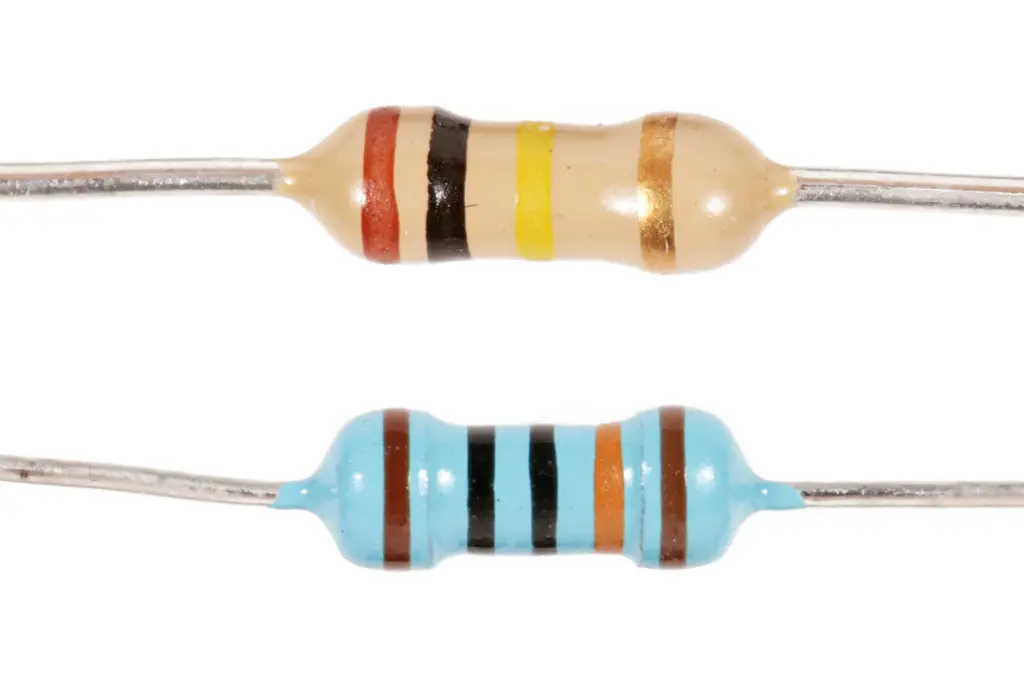
One key indicator is to look for a gap in the bands. Most resistor companies will put a slightly larger gap between the multiplier and the tolerance gap then between the other bands. Here is an example from Yageo showing a 4 band resistor with a special band.

image


Here is a similar resistor showing a 5 band from Bourns. Though not as pronounced you can see there is a slightly larger gap between the Multiplier and the Tolerance band.

image


Now that you have identified that you have a 4 band resistor with a 5th band you want to know what it is calling out. This can also be a bit tricky.
Per IEC 60062:2016 the standard color code would call out Temp Coefficient.
image

This is not always the case. Yageo for instance uses a Black 5th band in certain series to call out non-inductance.
image

Trying to identify which you have can range from hard to impossible. If it is a color it is most likely a temp coefficient IEC 60062:2016. If your 5th band is black you are best to try to identify the resistor manufacturer and look at their data sheet.


Related

Recent Posts

Mechanical Drift Indicator of Tantalum Capacitor Anodes Degradation under Reverse Bias

3.2.2026
33

Enabling Software‑Defined Vehicle Architectures: Automotive Ethernet and Zonal Smart Power

2.2.2026
25

Calculating Resistance Value of a Flyback RC Snubber 

2.2.2026
29

CMSE 2026 Announces Call for Presentations on High-Reliability Military and Space Electronics

28.1.2026
50

ESA Call for Papers 6th Space Passive Component Days – SPCD 2026

28.1.2026
43

Power Electronics Tools for Passives and Magnetic Designs

3.2.2026
85

Stackpole Releases AlN High‑Power Thick Film Chip Resistors

26.1.2026
36

ROHM Extends 2012 Shunt Resistors Power Rating up to 1.25 W

23.1.2026
31

Passive Components in Quantum Computing

22.1.2026
162

Upcoming Events

Feb 11
16:00 - 17:00 CET

What’s Next in Power Electronics Design

Feb 24
16:00 - 17:00 CET

Designing Qi2 Wireless Power Systems: Practical Development and EMC Optimization

Mar 3
16:00 - 17:00 CET

Cybersecurity at the Eleventh Hour – from RED to CRA – Information and Discussion

View Calendar

Popular Posts

  • Buck Converter Design and Calculation

    0 shares
    Share 0 Tweet 0
  • Boost Converter Design and Calculation

    0 shares
    Share 0 Tweet 0
  • LLC Resonant Converter Design and Calculation

    0 shares
    Share 0 Tweet 0
  • Flyback Converter Design and Calculation

    0 shares
    Share 0 Tweet 0
  • Ripple Current and its Effects on the Performance of Capacitors

    3 shares
    Share 3 Tweet 0
  • MLCC and Ceramic Capacitors

    0 shares
    Share 0 Tweet 0
  • Dual Active Bridge (DAB) Topology

    0 shares
    Share 0 Tweet 0
  • How Metal Prices Are Driving Passive Component Price Hikes

    0 shares
    Share 0 Tweet 0
  • What is a Dielectric Constant and DF of Plastic Materials?

    4 shares
    Share 4 Tweet 0
  • MLCC Case Sizes Standards Explained

    0 shares
    Share 0 Tweet 0

Newsletter Subscription


Passive Components Blog

© EPCI - Leading Passive Components Educational and Information Site

  • Home
  • Privacy Policy
  • EPCI Membership & Advertisement
  • About

No Result
View All Result
  • Home
  • Knowledge Blog
  • PCNS

© EPCI - Leading Passive Components Educational and Information Site

This website uses cookies. By continuing to use this website you are giving consent to cookies being used. Visit our Privacy and Cookie Policy.
Go to mobile version