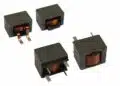











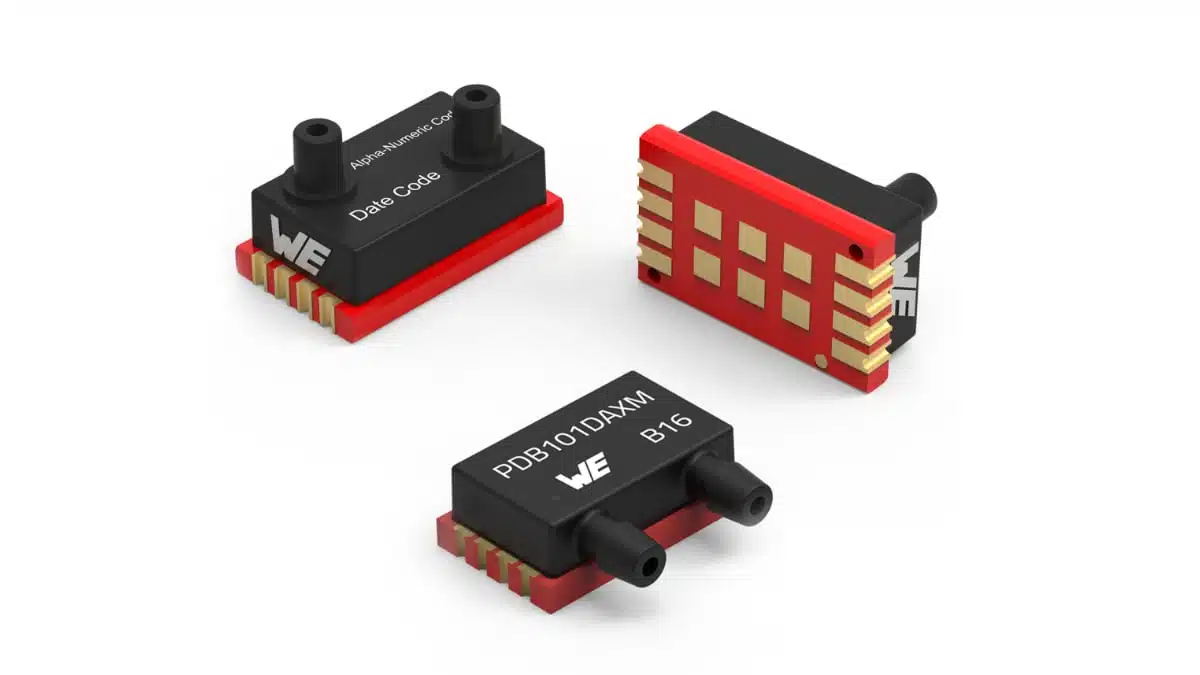
Würth Elektronik has introduced the WSEN-PDMS, a compact differential pressure sensor that combines high accuracy, flexible interfaces and multiple port configurations for easy integration into a wide range of embedded systems.
The device addresses typical design tasks in HVAC, filter monitoring, gas-leak detection, industrial automation and medical equipment where reliable low-pressure measurement and straightforward system interfacing are critical.
Key features and benefits
The Würth Elektronik WSEN-PDMS is designed as a highly accurate differential pressure sensor for versatile use in embedded applications.
- Accuracy of ±1 mbar with 16-bit resolution, supporting precise low-pressure measurement in control loops and monitoring functions.
- Supply voltage range from 3.0 V to 5.5 V, allowing direct connection to common 3.3 V and 5 V microcontroller platforms without additional regulation in many designs.
- Digital I²C and SPI interfaces plus an analog output option, giving designers freedom to match the sensor to existing system architectures and legacy analog signal chains.
- Two package variants with different pressure ports: vertical straight nozzles for manifold or pressure adapter mounting, and horizontal barbed nozzles for direct tube connection.
- Fully calibrated differential pressure output with optional temperature measurement, simplifying system software and reducing the need for external compensation.
- Reliable operation over a temperature range from -25 °C to +85 °C, supporting typical indoor, industrial and many light outdoor environments.
- Optional CRC-protected communication frames to increase robustness in noisy industrial or long-cable installations.
Compared to using discrete pressure transducers with external signal conditioning, the integrated WSEN-PDMS helps reduce design effort, improve repeatability between units and shorten validation time.
Typical applications
The WSEN-PDMS targets a broad application space where air or gas differential pressure needs to be measured accurately and reliably.
- Heating, ventilation and air-conditioning (HVAC) systems, for example to monitor air flow, duct pressure or damper positions in building automation.
- Filter-status monitoring in industrial or commercial systems, where differential pressure across a filter element is used to detect clogging and schedule maintenance.
- Gas-leak detection setups that infer small leakage or flow changes from low differential pressure variations.
- Industrial automation, including pneumatic systems, process monitoring and general-purpose pressure-based sensing in machinery.
- Medical devices such as inhalation or respiratory equipment, where stable low-pressure measurement supports flow control, patient monitoring or safety interlocks.
In many of these use cases, combining calibrated pressure data with temperature information from the same sensor can simplify compensation and improve control algorithms.
Technical highlights
From an implementation perspective, the WSEN-PDMS offers several characteristics that are particularly relevant to embedded designers.
- Calibrated digital output: The sensor delivers factory-calibrated differential pressure values, so host firmware typically only needs to apply scaling to engineering units according to the manufacturer datasheet.
- Integrated temperature measurement: Optional temperature readout can be used for system monitoring or to enhance pressure compensation and diagnostics.
- Communication flexibility:
- I²C interface for multi-drop sensor buses and straightforward integration into modern microcontroller designs.
- SPI interface for higher-speed, point-to-point communication and better noise immunity on longer traces.
- Analog interface option for systems that rely on traditional ADC-based measurement without digital sensor buses.
- Electrical operating range: wide 3.0 V to 5.5 V supply range simplifies reuse across platforms and can reduce BOM by avoiding additional level-shifting between sensor and host.
- Mechanical interfacing:
- Vertical straight nozzles are suitable for direct connection to manifolds or custom fixtures, often preferred in compact modules or multi-sensor blocks.
- Horizontal barbed nozzles are designed for easy attachment of flexible tubing, a typical requirement in HVAC and medical front ends.
Exact pressure ranges, full-scale values and output characteristics should be taken from the official WSEN-PDMS datasheet to ensure correct selection and scaling for a given design.
Design-in notes for engineers
When designing in the WSEN-PDMS, a few practical points can improve performance and ease of integration.
- Selection of interface:
- Use I²C when multiple sensors share a bus and layout distances are moderate.
- Prefer SPI when you need higher data rates or when the sensor sits further away on the PCB in a noisy environment.
- Choose the analog interface if the system is built around conventional analog front ends or when software changes must be minimized.
- Port configuration and mechanics:
- Vertical straight nozzles are advantageous when integrating into rigid manifolds or when building compact multi-channel blocks.
- Horizontal barbed nozzles are better suited to flexible hose and tube routing, especially in HVAC ducts and medical front ends where serviceability matters.
- EMC and signal integrity: Combine the optional CRC on the digital interface with good PCB layout practices (short signal lines, proper grounding, shielding where necessary) to increase system robustness.
- Temperature range and environment: Ensure that ambient and media temperatures stay within the specified -25 °C to +85 °C range and observe any media compatibility guidance in the datasheet, especially in medical or harsh industrial environments.
- System software: Take advantage of the calibrated digital pressure and temperature outputs to reduce custom calibration overhead; align scaling, units and sampling rates directly with values given in the manufacturer documentation.
For safety-critical systems such as medical equipment or gas monitoring, engineers should follow relevant standards and carry out their own qualification and redundancy concepts, using the WSEN-PDMS as one building block in the overall architecture.
Source
The information in this article is based on the official WSEN-PDMS product announcement and related materials from Würth Elektronik, complemented with general engineering guidance for differential pressure sensor design-in. For exact ratings, limits and ordering details, please refer to the manufacturer datasheet and product documentation.